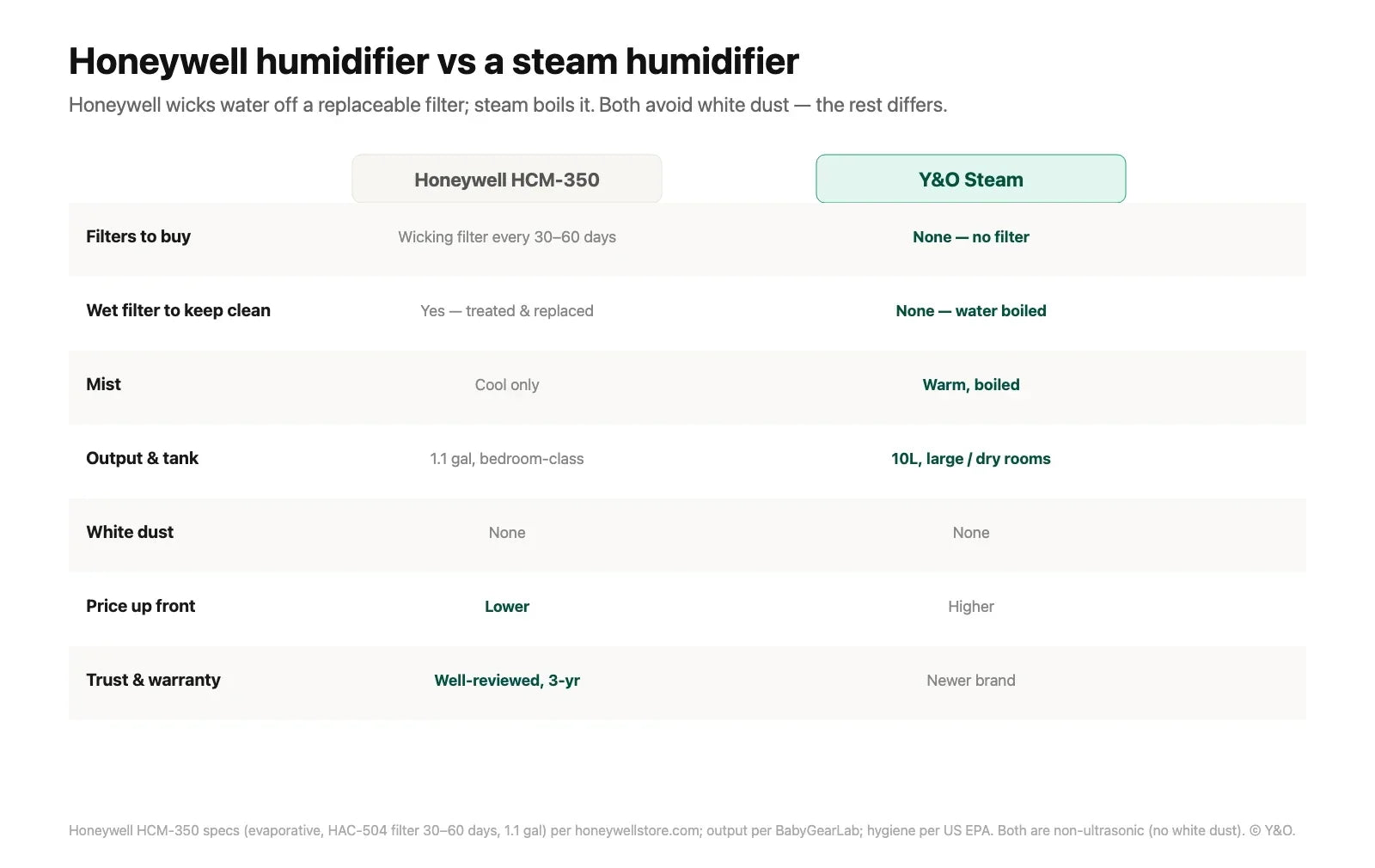

Honeywell is one of the most trusted names in cool-mist humidifiers, and its evaporative models — the well-known HCM-350 among them — are quiet, well-reviewed, and genuinely good at what they do. They’re also built around a wet wicking filter you replace every month or two, and that single design choice is behind the things owners actually weigh: the filters you keep buying, the cool-only mist, and keeping that damp filter clean. Judged on humidification, a Honeywell evaporative humidifier is a solid, filter-based cool-mist machine — while a steam humidifier makes moisture a different way that needs no filter at all, sterilizes the water by boiling, and puts out warm rather than cold mist. Here’s the honest, principle-first comparison, using Honeywell’s own specs and EPA guidance.
The short answer
Choose a Honeywell evaporative humidifier if you want a trusted, inexpensive cool-mist unit for a bedroom and you don’t mind buying filters. Choose a steam humidifier if you want no filters to buy or grow mold on, warm mist for a dry winter room, and more output for a larger space. Both avoid white dust, so that isn’t the deciding factor here — the real trade is Honeywell’s replaceable wet filter and cool-only mist against steam’s filter-free, boiled, warmer output.
| If you want… | Better pick | Why |
|---|---|---|
| A trusted, cheap cool-mist unit for one room | Honeywell | Well-reviewed evaporative design, low price, quiet white noise |
| Never to buy or change a filter again | Steam | Boiling needs no wicking filter; nothing to replace or reorder |
| No wet filter to keep clean and mold-free | Steam | The water is sterilized by boiling; there’s no damp filter to foul |
| Warm mist and more output for a big, dry room | Steam | Warm boiled vapor and high output; Honeywell is cool-only and lower-output |
1. How each one makes moisture
Everything below follows from one mechanical choice, so it’s worth being clear on it first.
A Honeywell cool-mist humidifier is evaporative. A wicking filter sits in the water and draws it up, and a fan blows air through the wet filter, carrying invisible moisture into the room (BabyGearLab). It’s a proven, gentle way to add humidity, and because the minerals stay trapped in the filter, it doesn’t throw white dust. The catch is the part doing the work: that filter is wet, disposable, and central to how the machine behaves.
A steam humidifier, like the Y&O Steam Plus, boils the water instead. A heating element brings it to a boil, which turns it to pure vapor and kills bacteria in the water on the way; the vapor is cooled before it leaves so it isn’t scalding. There’s no filter and no wick — the water is purified by boiling before it ever becomes mist. Hold that difference in mind: Honeywell wicks water off a replaceable wet filter, steam boils it clean with no filter at all — the rest of this page is the consequences.
2. The filter you keep buying
This is the Honeywell design’s defining ongoing cost. Honeywell’s evaporative units run on a wicking filter — the HAC-504 “Filter A” on the HCM-350 — that the maker says to replace every 30 to 60 days, plus an optional Protec antimicrobial cartridge replaced about every 30 days (Honeywell). In other words, keeping it running means reordering filters every month or two for as long as you own it — a recurring cost the sticker price never shows, and one that’s easy to forget until the unit stops humidifying well because the filter is clogged.
A steam humidifier has no filter to buy, ever. Boiling doesn’t need a wick, so there’s nothing to replace, reorder, or forget; upkeep is descaling the tank now and then instead of swapping a part. It’s the clearest practical difference between the two machines, and it’s the same filter-free logic laid out in the filter-free steam guide. If you’ve ever bought a humidifier and then quietly stopped replacing the filter, this is the difference you’d feel.
3. The wet filter & hygiene
A wicking filter isn’t just a cost — it’s a wet surface that sits damp between uses, and wet surfaces are where things grow. Honeywell addresses this head-on with an antimicrobial-treated filter and an optional Protec cartridge, and says the design inhibits “up to 99.99%” of mold growth (Honeywell) — which is a real, credited feature, but also a quiet admission that a damp filter is somewhere mold wants to be, which is exactly why it needs treating and replacing on schedule.
A steam humidifier sidesteps the whole question: boiling sterilizes the water before it becomes vapor, so there’s no living thing to launch and no wet filter to foul in the first place. The EPA draws the same line, noting that evaporative and steam humidifiers “generally disperse less, if any” of the microorganisms and minerals that a poorly maintained unit can spread (EPA) — but where the evaporative unit relies on a treated filter you must keep changing, the steam unit relies on heat and has no filter at all. Whichever you run, hygiene comes down to upkeep, covered in how to clean and descale a humidifier.
4. Cool-only mist vs warm steam
The two machines also feel different in the room, and this is a genuine point in steam’s favor for winter. A Honeywell evaporative unit produces cool, invisible mist only — there is no warm setting — which is fine year-round but does nothing to take the chill off a cold, dry room in the depths of the heating season. Its fan also makes a steady white noise as it pushes air through the filter, which some people find soothing and others don’t.
A steam humidifier boils the water and cools the vapor just enough that what reaches the room is warm rather than cold, and invisible rather than a plume. In a heated winter home — the exact season a humidifier earns its keep — warm mist feels more comfortable than cold, which is the trade-off detailed in warm vs cool mist. The honest cost on steam’s side is electricity: boiling uses more power than a 60-watt fan, so a steam unit costs a little more to run.
5. Output & tank size
Here the gap is about the size of the job each machine is built for. Honeywell’s cool-mist units are bedroom-class: the HCM-350 holds about 1.1 gallons and runs up to 24 hours on low (Honeywell), and independent testing has found this Honeywell humidifier puts out only about two-thirds the moisture of comparable units (BabyGearLab). For a single bedroom, that’s plenty; for a large, open, or very dry space, it’s working uphill.
A steam humidifier such as the Y&O Steam Plus is built for the bigger, drier room: a 10-litre tank, about 1,200 ml per hour of output, and up to 24 hours between refills. If your problem is one bedroom overnight, Honeywell’s output is enough; if it’s a whole floor in January, the higher-output steam unit holds a level the bedroom-class Honeywell humidifier can’t, the case laid out in humidifying large rooms.
6. White dust: an honest tie
One point where the internet often gets this comparison wrong deserves a straight answer. Neither of these machines throws white dust. Honeywell’s wicking filter traps the minerals in the filter, so an evaporative unit doesn’t spray them into the room; a steam unit leaves the minerals behind in the tank because boiling doesn’t carry them into the vapor. So “no white dust” is not a reason to pick one over the other here — it’s the reason both beat an ultrasonic humidifier, which is a different comparison covered in steam vs ultrasonic vs evaporative. Between Honeywell and steam, the deciding factors are the filter, the hygiene, the warmth of the mist, and the output — not dust.
Who should buy which
Buy a Honeywell evaporative humidifier if you want a trusted, inexpensive cool-mist unit for a bedroom, you like its quiet white noise, and you don’t mind reordering a wicking filter every month or two. It’s a well-made, well-reviewed machine with a genuine antimicrobial design and a three-year warranty, and for a single room it does its job.
Buy a steam humidifier such as the Y&O Steam Plus if you want no filter to buy or keep clean, warm boiled mist for a cold dry room, and the output for a large or very dry space — and you don’t need the low price or the cool-only mist. And whichever you run, set your target with a hygrometer you’ve actually checked, because either machine is only as accurate as the gauge you aim it at.
Done buying filters every month?
The Y&O Steam Plus is a dedicated 10L steam humidifier — no filter to buy or grow mold on, warm sterilized mist on ordinary tap water, and high output for a large, dry room.
See the Y&O Steam Plus 10L
FAQ
Is a Honeywell humidifier worth it?
It is worth it if you want a trusted, inexpensive cool-mist humidifier for a bedroom and you are willing to replace the wicking filter every 30 to 60 days. Honeywell's evaporative units are quiet and well-reviewed. If you want no filters to buy, warm mist, or more output for a large room, a steam humidifier does more over time.
Does a Honeywell humidifier have a filter?
Yes. Honeywell's evaporative cool-mist humidifiers use a wicking filter, such as the HAC-504 Filter A on the HCM-350, that the maker says to replace every 30 to 60 days, plus an optional Protec antimicrobial cartridge about every 30 days. A steam humidifier has no filter at all, because boiling does not need one.
Does a Honeywell humidifier leave white dust?
No. Honeywell's wicking filter traps the minerals, so an evaporative unit does not spray white dust into the room. A steam humidifier also avoids white dust, because boiling leaves the minerals in the tank. White dust is a problem of ultrasonic humidifiers, not of Honeywell or steam units.
Honeywell humidifier vs steam, which is better?
They are built for different priorities. Honeywell is better if you want a cheap, trusted cool-mist unit for one room and do not mind buying filters. A steam humidifier is better if you want no filter to buy or clean, warm mist for a cold dry room, and more output for a large space, without the low price or cool-only mist.
Does a Honeywell wicking filter grow mold?
It can, which is why Honeywell treats the filter with an antimicrobial and says the design inhibits up to 99.99% of mold growth, and why the filter must be replaced on schedule. A steam humidifier has no wet filter to grow mold, because it sterilizes the water by boiling instead.
Keep reading
- Why a filter-free steam humidifier
- Warm mist vs cool mist
- Canopy vs steam (another filter-based unit)
- Steam vs ultrasonic vs evaporative
- The best humidifier for large rooms
Sources — Honeywell specifications, independent testing and EPA guidance. Verified live.