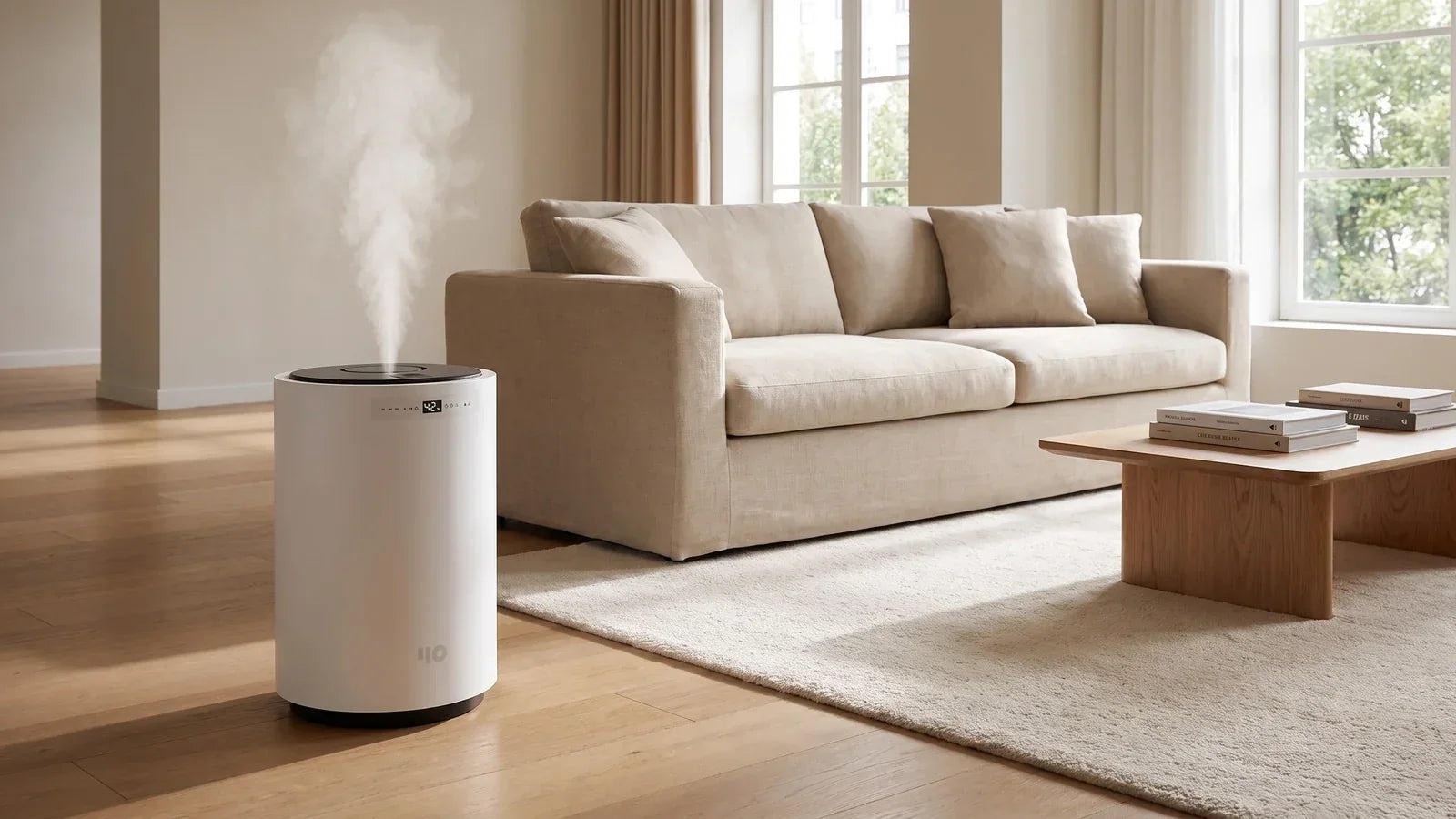

When a whole-house humidifier stops working, it’s rarely the whole thing that’s dead — it’s almost always one small, waterlogged part. Nearly every common failure — no humidity, leaks, a humming valve, constant running — comes down to the plumbing and electrical bits bolted onto your furnace: a clogged water panel, a scaled-up solenoid valve, a blocked drain, or a humidistat that’s reading wrong. Most are fixable, but several need an HVAC technician and a replacement part. Below is a plain-English guide to what breaks, what causes it, and which fixes you can do yourself — plus why a portable steam humidifier sidesteps this whole category of problems by not having any of those parts.
First, rule out the easy stuff
Before you diagnose a broken part, check the four things that fake a breakdown. A surprising share of “my humidifier died” calls are one of these:
- Is the furnace actually heating? Most whole-house humidifiers only run when the furnace blower is on. No heat call, no humidity — by design, not a fault.
- Is the humidistat set high enough to call for moisture? Set it to a sensible winter target (around 30–40%) and see if the unit kicks in. A setting below the room’s current humidity means it will never turn on.
- Is the water supply valve open? The small saddle valve on the water line gets bumped closed more often than you’d think.
- Is the water panel filthy? A panel crusted with scale can’t wick water. If it’s discolored and stiff, that alone can explain “no humidity.”
If all four check out and it’s still not working, you’re into an actual failed part — and the table below tells you which one.
The common problems, decoded
These are the failures HVAC makers like Bryant and Carrier list in their own repair guides. Match your symptom to the likely cause and the fix.
| Symptom | Likely cause | Fix | DIY or pro? |
|---|---|---|---|
| No or low humidity | Clogged water panel; closed supply valve; humidistat set low or faulty; solenoid orifice blocked by scale; stuck float | Replace the panel; open the valve; check/reset the humidistat; descale the orifice; free the float | Mostly DIY |
| Leaking / overflowing | Clogged water panel or drain line backs water up in the tray; solenoid valve won’t fully close; tray cracked by scale | Clear the drain line; replace the panel; replace a failed valve or tray | Drain & panel DIY; valve/tray = pro |
| Humming, but no water | Stuck solenoid valve (scale or an electrical short) | Descale or replace the solenoid valve | Pro (electrical) |
| Runs constantly | Humidistat stuck or miscalibrated; valve stuck open | Recalibrate or replace the humidistat; check the valve | Setting DIY; valve = pro |
| Won’t turn on at all | No power or heat call; loose wiring | Check power, confirm the furnace is heating, inspect humidistat wiring | Basic DIY; wiring = pro |
| White scale everywhere | Hard water scaling the panel, orifice and tray | Change the panel more often; descale the parts | DIY |
Read down the last column and a pattern jumps out: the quick fixes are cleaning and swapping consumables, but the real failures — the solenoid valve, the wiring, a cracked tray — send you to an HVAC technician. That split is the whole story of owning one of these, and it’s worth understanding why.
Why so many fixes need a pro
A whole-house humidifier isn’t a standalone appliance you unplug and shake out. It’s wired into your furnace’s control board, tapped into a water line, and drained into your plumbing. So the moment the problem is electrical (a dead solenoid coil, a wiring fault) or structural (a cracked distribution tray, a seized valve), you’re looking at a service call — because the fix involves your furnace’s wiring and your home’s water lines, not a part you can pop out in the kitchen.
That’s not a knock on any one brand; it’s true of the category. The solenoid valve, the water panel, the drain line and the distribution tray are the same handful of parts across makes, and they’re the same handful that fail. The convenience of “set it and forget it” comes with the catch that when it does break, forgetting isn’t an option — and the repair often isn’t a DIY job.
The root cause: too many parts to fail
Step back and the reason these units are troublesome is simply that there’s a lot of plumbing to go wrong. Count the failure points on a typical whole-house humidifier: a saddle valve, a solenoid valve, a water supply line, a distribution tray, a water panel, a drain line, and a humidistat — each one a thing that can clog, scale, leak, stick or lose its calibration. Every part you add to keep water flowing through your ductwork is another part that can fail, and hard water speeds the wear on most of them.
This is the same underlying issue we cover from the mold angle in do whole-house humidifiers cause mold in your ducts: putting water into a ducted system means adding components, and components fail. The failures aren’t bad luck — they’re the predictable cost of humidifying a house through its plumbing and ductwork.
The maintenance that prevents most of it
If you own one and want to keep it running, most problems are preventable with a routine. This is the honest, do-this list — it genuinely cuts down the service calls:
- Replace the water panel on schedule. Check it every one to two months during heating season and replace it at least once a year — more often on hard water, where scale clogs it faster.
- Keep the drain line clear. A blocked drain is the leading cause of “leaks,” because the tray backs up and overflows. Flush it at the start of each season.
- Descale the tray and orifice. Mineral scale is what seizes valves and cracks trays; a seasonal vinegar soak of the removable parts slows that down.
- Check the humidistat setting against the weather. Lower it in cold snaps so the system isn’t forcing moisture the air can’t hold — which also protects your windows and ducts from condensation.
Done every season, that upkeep prevents the majority of the failures in the table above. The honest catch, again, is the word “every season” — the system only stays trouble-free as long as someone keeps servicing it, year after year.
The simpler fix
Here’s the case for stepping off the treadmill entirely. A portable steam humidifier does the same job — adding clean moisture to the air — without any of the parts that break above. There’s no solenoid valve, no water supply line, no drain line, and no distribution tray, because it isn’t plumbed into anything: you fill it, it boils water into steam, and that’s the whole mechanism. The failure modes shrink from a table of seven to two chores you do yourself: refill the tank, and descale it now and then.
We build steam humidifiers, so read that as disclosure — but the logic is structural, not a pitch: you can’t have a solenoid-valve failure on a machine with no solenoid valve. That said, a portable unit isn’t free of trade-offs, and we’d rather be straight about them. It needs refilling by hand, it covers the rooms you put it in rather than the whole house through vents, and boiling water uses more electricity than a furnace-fed pad. For most people that’s the better deal — you probably only need to humidify the rooms you actually live in, which is the case we make in how many humidifiers you really need. If you’re weighing the two approaches head to head, whole-house vs portable steam lays out the full comparison, and steam vs ultrasonic vs evaporative covers the technology choice.

FAQ
Why is my whole-house humidifier not producing humidity?
The usual causes are a clogged water panel, a closed water supply valve, a humidistat set too low or reading wrong, or a solenoid orifice blocked by mineral scale. Remember that most units only run while the furnace is heating, so a system with no heat call will not produce humidity either. Replace the panel, open the valve, check the setting, and descale the orifice.
Why is my whole-house humidifier leaking water?
Leaks are usually not the humidifier splitting open. Most often a clogged water panel or a blocked drain line makes the distribution tray back up and overflow, which looks like a leak. A solenoid valve that will not fully close can also let water run continuously. Clear the drain line, replace a clogged panel, and check the valve.
Can I fix a whole-house humidifier myself?
Some of it, yes. Replacing the water panel, clearing the drain line, adjusting the humidistat, and descaling the removable parts are do-it-yourself jobs. But a failed solenoid valve, wiring faults, and a cracked distribution tray usually need an HVAC technician, because those repairs involve your furnace wiring and water lines.
How often should I replace the water panel?
Check it every one to two months during the heating season and replace it at least once a year. Homes with hard water need it more often, because mineral scale clogs the panel faster and can seize valves and crack trays.
Does a portable steam humidifier have these problems?
No, because it does not have the parts that cause them. A portable steam unit has no solenoid valve, no water supply line, no drain line, and no distribution tray, so those failure modes do not exist. Its upkeep is refilling the tank and descaling it periodically, and it covers the rooms you place it in rather than the whole house through ducts.
Keep reading
- Do whole-house humidifiers cause mold?
- Whole-house vs portable steam
- How many humidifiers do you really need?
- Steam vs ultrasonic vs evaporative
- Can you use tap water in a humidifier?
- Do humidifiers cause mold?
Sources — troubleshooting and maintenance guidance from the HVAC makers and the EPA. Verified live.