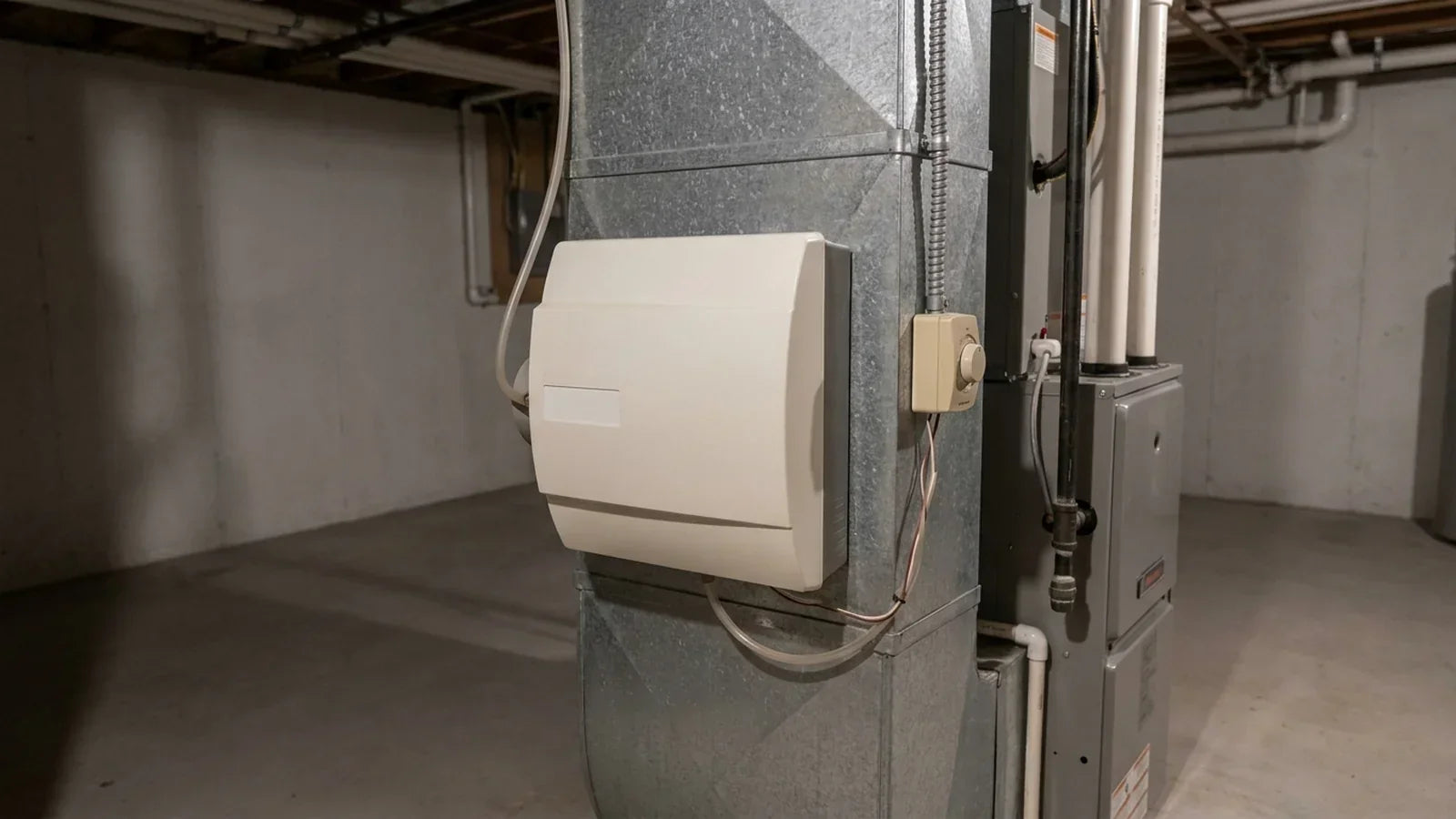

A furnace humidifier goes by a lot of names — whole-house, central, HVAC, in-duct — but they’re all the same idea: a small unit bolted onto your ductwork that humidifies the entire house through the air your furnace already moves. It works by tapping into your water line and letting the furnace’s air pick up moisture from a wet pad or a steam canister, and it comes in three types — bypass, fan-powered, and steam — that differ mostly in how hard they push and how much they cost to run. Here’s exactly how each one works, how they compare, the one drawback nobody mentions (water down the drain), and how to tell whether you need one at all.
What a furnace humidifier is
A furnace humidifier is a small appliance — usually a box about the size of a large book — mounted on the ductwork right next to your furnace or air handler, and plumbed into your home’s cold water line. Instead of humidifying one room, it adds moisture to the air moving through your ducts, so the whole house comes up to humidity at once. That’s the appeal, and it’s why it’s often called a whole-house humidifier.
Because it’s wired into your heating system and tapped into your plumbing, it’s a permanent installation — not something you unbox and plug in. That single fact shapes everything about how it behaves, what it costs, and what can go wrong.
How it works, step by step
Every furnace humidifier, whatever the type, follows the same basic sequence:
- The humidistat calls for moisture. A control mounted on your ductwork or wall senses that indoor humidity has dropped below its setting.
- A valve opens. When the humidistat calls and the furnace is running, it signals a small 24-volt solenoid valve to release water from your supply line.
- Water wets a panel — or boils. In most units the water trickles over an evaporator pad (the “water panel”); in a steam unit it’s boiled into vapor.
- Air picks up the moisture. Air passing over the wet pad or through the steam absorbs water vapor.
- The ducts carry it through the house. Your furnace’s blower distributes that humidified air to every room on the system.
The whole thing hinges on two connections most appliances don’t have: a live water line and your furnace’s airflow. Take away either — a closed valve, a furnace that isn’t running — and the humidifier does nothing, which is the source of a lot of “it stopped working” confusion we cover in whole-house humidifier problems.
The three types, explained
“Furnace humidifier” covers three designs, and the difference between them is real — it decides the output, the running cost, and whether the unit works when the heat is off. This is the comparison the makers’ own guides lay out.
| Type | How it works | Output | Runs without the furnace? | Trade-off |
|---|---|---|---|---|
| Bypass (flow-through) | No fan of its own; a bypass duct routes the furnace’s warm air through a wet evaporator pad and back to the return | Lowest of the three | No — needs the furnace blower | Cheapest and simplest, but lower output and only humidifies while the heat runs |
| Fan-powered (flow-through) | A built-in fan blows air across the water panel | More than bypass | Yes | Compact (no bypass duct), more output; a little more electricity |
| Steam (in-duct) | Electrically boils water and injects steam into the ductwork | Highest | Yes | Best output and control, but the highest to buy and to run |
There’s also an older drum type, which turns a foam sleeve through a tray of standing water. It still exists, but that reservoir of sitting water is the classic breeding ground for the mold we cover in do whole-house humidifiers cause mold in your ducts, so most installs today use a flow-through or steam design instead. In short: bypass is the budget default, fan-powered adds output and independence from the furnace, and steam is the premium performer that costs the most to own.
The drawback nobody mentions: water down the drain
Here’s the part the brochures skip. The flow-through types — bypass and fan-powered — deliberately run extra water over the pad and send it to a drain, to rinse away the mineral scale that would otherwise clog the panel. Depending on the unit and your water, that rinse can send anywhere from 3 to 14 gallons down the drain for every single gallon that actually reaches your air. Over a heating season that adds up to real water, and it’s invisible because it happens quietly at the drain line.
Newer models with recirculation cut the waste, and steam units don’t rinse this way — but it’s worth knowing that the most common, cheapest type is also the thirstiest. It’s the clearest example of a cost that doesn’t show up on the price tag. A portable steam unit, by contrast, turns essentially all the water you pour in into humidity, with nothing going to a drain — a point we come back to below.
What every furnace humidifier has in common
Strip away the type differences and all three share the same DNA, for better and worse. Each one is plumbed into a water line, tied into your ductwork, controlled by a humidistat, and dependent on seasonal maintenance — chiefly replacing the water panel — to keep working. Each adds moisture to a duct network you can’t see into, which is why humidity that’s set too high can condense and grow mold in cold ducts.
Those shared traits are exactly what make a whole-house unit powerful and high-maintenance at the same time: it treats your entire home, but it does so through your plumbing and HVAC, so its upkeep and its failure modes live there too. We break those down in the mold guide and the problems guide. The convenience and the catch are the same fact: it’s built into the house.
Do you actually need one?
A furnace humidifier genuinely earns its place in some homes. If you want to bring an entire large house up to humidity, you’ll stay put long enough to get value from the installation, and you don’t mind the seasonal upkeep, a whole-house unit does something no portable can — treat every room at once through the ducts.
But that’s a narrower group than the marketing suggests. Most people don’t need every room humidified — they need the rooms they actually live in to stop being dry, which is the case we make in how many humidifiers you really need. We build portable steam humidifiers, so treat this as disclosure, but the structural points are simple: a portable unit has no ducts to grow mold in, no drain quietly wasting water, and no dependence on the furnace running — you fill it and it works. The honest trade is the flip side: a portable covers the rooms you put it in rather than the whole house, you refill it by hand, and boiling water uses electricity. If you’re weighing the two head to head, whole-house vs portable steam lays it out, and steam vs ultrasonic vs evaporative covers the technology choice.

FAQ
How does a furnace humidifier work?
It is plumbed into your water line and mounted on your ductwork. When a humidistat senses low humidity and the furnace is running, it opens a small valve that wets an evaporator pad, or boils water in a steam unit; air passing through picks up the moisture, and the furnace blower carries it through the ducts to the whole house.
What are the types of furnace humidifiers?
There are three main types. A bypass unit has no fan and uses the furnace blower to push warm air through a wet pad. A fan-powered unit has its own fan, so it makes more moisture and does not need the furnace running. A steam unit boils water into vapor for the highest output. An older drum type, which uses a tray of standing water, also exists but is more prone to mold.
Which is better, a bypass or a steam humidifier?
It depends on your priorities. A bypass humidifier is the cheapest and simplest, but it has lower output and only runs while the furnace is heating. A steam humidifier has the highest output and works anytime, but it costs the most to buy and to run. A fan-powered unit sits between the two.
Do furnace humidifiers waste water?
The flow-through types, bypass and fan-powered, do. They deliberately rinse water over the pad to prevent scale, sending several gallons down the drain for every gallon that reaches your air, often 3 to 14. Steam units and portable humidifiers do not drain water this way, and newer recirculating models reduce the waste.
Do I need a whole-house furnace humidifier?
Only if you want to humidify an entire large home, plan to stay long enough to get value from the installation, and accept the upkeep. Many people get what they need from a portable unit in the rooms they actually use, which has no ducts, no drain waste, and no dependence on the furnace, at the cost of covering rooms rather than the whole house.
Keep reading
- Do whole-house humidifiers cause mold?
- Whole-house humidifier problems
- Whole-house vs portable steam
- How many humidifiers do you really need?
- Steam vs ultrasonic vs evaporative
- Can you use tap water in a humidifier?
Sources — how furnace humidifiers work and compare, from the HVAC makers and industry press. Verified live.
- Carrier — Whole House Humidifiers (steam, fan-powered, bypass)
- Carrier — Whole House Humidifier Types
- Carrier — What Is a Furnace Humidifier? (benefits, types, costs)
- ACHR News — How a Bypass Humidifier Works
- Bryant — Whole House Humidifier Types
- US EPA — Should You Have the Air Ducts in Your Home Cleaned? (in-duct humidifier maintenance)