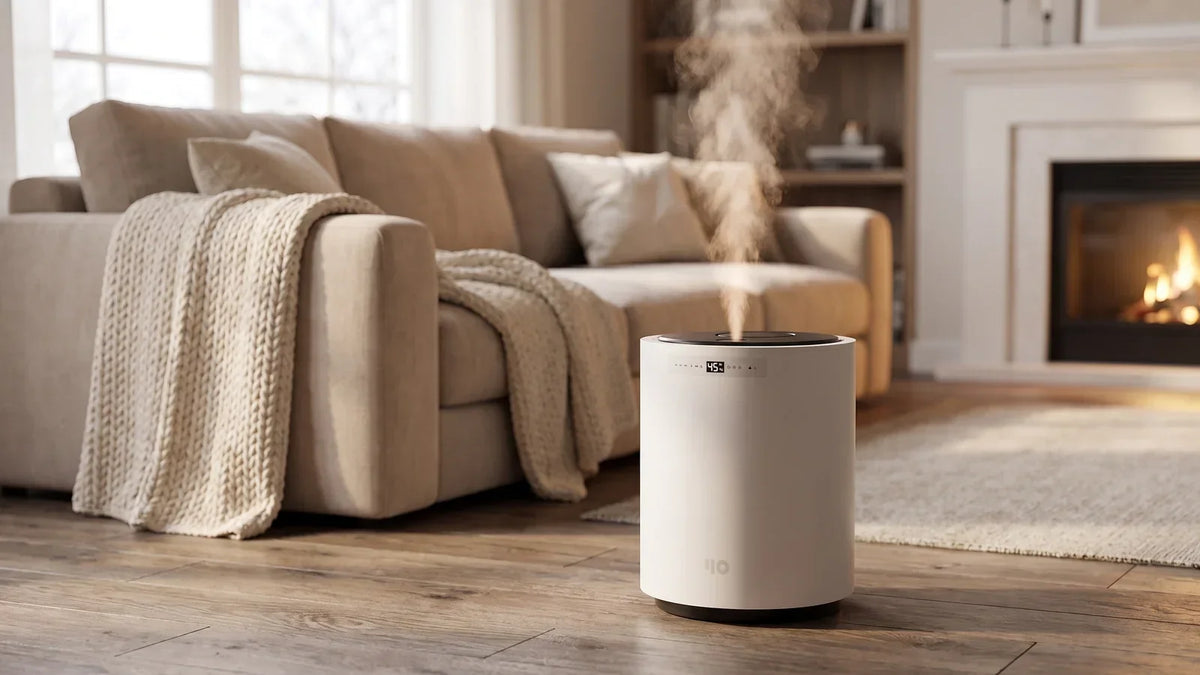

Every winter it's the same story: the heat kicks on, and within a week your skin feels tight, rough, and flaky no matter how much lotion you use. A humidifier helps because dry, heated indoor air actively pulls moisture out of your skin — but the model you pick decides whether you fix the problem or trade it for white dust and a moldy filter. This is a buying guide, not a “why skin gets dry” explainer: below, how to choose the right humidifier for dry skin this winter.
Does a humidifier actually help dry winter skin?
The U.S. Environmental Protection Agency recommends keeping indoor relative humidity between 30% and 50%, and always below 60%, for a comfortable, mold-resistant home — and that range is exactly what a humidifier for dry skin needs to hit. In a typical North American winter, a heated house often runs at just 10–25% relative humidity, drier than many deserts. That parched air behaves like a sponge and pulls moisture straight out of your skin, which is why it feels tight, rough, and flaky by mid-winter no matter how much lotion you use. A humidifier fixes the air so the air stops pulling on your skin. So yes, a humidifier helps — but the model worth buying is the one that reliably holds a room in the EPA's 30–50% range overnight, without trading dry skin for white mineral dust or a musty filter.
The connection to your skin is direct. The American Academy of Dermatology lists “use a humidifier” among its top tips for relieving dry skin, recommending you place a portable unit in the bedroom and run it while you sleep, then clean it regularly to keep it from growing mold. That last clause matters more than most buying guides admit — a humidifier only helps if you'll actually keep it clean.
For dry winter skin, the humidifier that helps most is the one that reliably holds your room in the 30–50% relative-humidity range the EPA recommends, overnight, without adding new problems — white mineral dust settling on your nightstand, or a wet filter that turns musty. Every type of humidifier can raise the number on your hygrometer. The differences that matter for skin are what else the machine puts into the room, and how much upkeep it demands before you quietly stop using it.
That framing — comfort humidity, minus the side effects, minus the babysitting — is what separates a humidifier you'll run all winter from one that ends up in a closet by January. The best humidifier for dry skin is the one you will still be running in February.
Why winter air pulls moisture out of your skin
Cold outdoor air holds very little water. When your furnace heats that air to room temperature, the relative humidity crashes — the air is now warm but nearly empty of moisture, and warm dry air behaves like a sponge. Physics doesn't let it stay empty: it pulls water vapor from the nearest available source, which indoors is your skin, lips, and the wood in your floors and furniture.
Your skin's outer layer loses water to dry air through simple evaporation, and heated winter air speeds that loss up dramatically. Moisturizer slows the water leaving your skin, but it can't refill air that's parched to begin with. A humidifier works the other end of the problem: it raises the moisture content of the room so the air stops pulling so hard.
We've written the full physics of why heated homes get this dry in why your skin feels dry indoors in winter — if you want the “why,” start there. This page is about the “which one do I buy.” The takeaway you need for shopping: your goal is a steady 30–50% relative humidity in the room where you spend the night, and the machine that hits that number cleanly is the one worth your money.
The three humidifier types — and the tradeoff each makes
Almost every humidifier sold in the U.S. is one of three types, and each makes a genuine tradeoff. None is a scam; they just fail dry-skin buyers in different ways. Here's the honest version, with the brands you'll actually see in the store.
Ultrasonic cool-mist units are the cheapest and quietest, but in a hard-water home they spray your minerals into the room as white dust. A vibrating plate flings water into a fine fog. Popular Levoit cool-mist models work this way, and they're excellent in a soft-water house. The catch: whatever is dissolved in your tap water — calcium, magnesium — gets atomized right along with the water and settles as a fine white film on furniture and electronics.
Evaporative (wick) humidifiers solve the white-dust problem by design. A fan blows air through a wet wicking filter; the water evaporates and the minerals stay trapped in the wick. Honeywell's germ-free cool-mist line is the classic example. The tradeoff is the wick itself: it's a consumable you replace every 1–3 months, and a damp filter is exactly the kind of surface the American Academy of Dermatology warns can grow mold if you don't stay on top of cleaning.
Warm-mist and steam humidifiers boil the water. Because minerals and grime are left behind in the tank rather than sprayed into the air, they produce no white dust and use no filter. Vicks warm-mist vaporizers are the drugstore version; they boil water and emit a genuinely hot steam, which means real burn caution around kids and pets. Boiling also puts a little warmth into the room, which feels more comfortable in winter than the faint chill of a cool-mist plume. The honest downsides: steam units draw more electricity than ultrasonic models, and in hard-water areas you have to descale them regularly.

Here's how the three stack up on the things that actually matter to a dry-skin buyer in winter:
| What matters for dry skin | Ultrasonic cool mist (e.g. Levoit) |
Evaporative wick (e.g. Honeywell) |
Steam / warm mist (Vicks; Y&O YO-M2) |
|---|---|---|---|
| White dust on furniture (hard water) | High risk — minerals atomized into air | None — wick traps minerals | None — minerals stay in tank |
| Filter / consumable to replace | Usually none | Yes — wick every 1–3 mo, can go musty | None — filterless |
| Adds warmth to the room | No — mist can feel chilly | No — cool output | Yes — boiling warms the air |
| Burn caution | Cool output | Cool output | Depends — Vicks emits hot steam; YO-M2 cools vapor first |
| Main upkeep | Frequent tank cleaning; distilled water to avoid dust | Replace & clean wick on schedule | Descale in hard-water homes |
Read the table for your own house: if your water is hard, the two columns that don't spray minerals into the air — evaporative and steam — are the only real candidates for dry skin. If you also don't want to buy and babysit a filter, that narrows it to one. For the full head-to-head on all three technologies, see our steam vs ultrasonic vs evaporative comparison.
White dust, filters, and warm vs cool mist
Three details decide whether a humidifier quietly makes your winter better or becomes a chore. Take them one at a time.
White dust is a water-quality problem, not a bad-machine problem — and most U.S. homes have hard water. The U.S. Geological Survey classifies water above 180 mg/L of dissolved calcium carbonate as “very hard,” and much of the country sits in the hard-to-very-hard range. An ultrasonic unit atomizes every one of those minerals into a dust that lands on your nightstand and screens. You can dodge it by running distilled water, but that's an ongoing cost most people abandon by mid-winter. We dug into the air-quality and cleaning side of this in our hard-water white-dust breakdown.
Filters are the second silent tax. A wick works, but it's a damp surface, and a damp surface indoors wants to grow things. The most common reason a humidifier stops helping your skin isn't the technology — it's that the owner got tired of replacing the filter and cleaning the tank, and stopped running it. A filterless machine removes that failure point entirely; the only recurring job is descaling, which we walk through in our descaling guide.
“Warm mist” on a store label usually means the unit emits hot steam — comfortable, no white dust, but a real burn risk if a toddler tips it. Not all steam humidifiers work this way. Some, including the Y&O YO-M2 Steam Plus, boil the water and then cool the vapor before it leaves the unit, so the mist is comfortable to the touch rather than scalding. This isn't a contradiction with steam feeling warm in winter: a boiling unit still radiates heat into the room as it runs, so the air feels a touch warmer even when the mist plume itself has been cooled before it exits. If you have young kids and like the idea of steam, check whether the mist itself comes out hot.
Warm versus cool mist is the third factor, and for dry skin in winter it tilts toward warm. Cool mist can leave a room feeling slightly damp-chilly; a boil-based machine adds a touch of warmth that most people find more comfortable when the heat is running. At the same humidity level, mist temperature doesn't change how much a humidifier helps your skin — it's a comfort preference — but in a cold-winter home, most of our customers prefer the warmer feel. If you want to go deeper on the differences, see warm mist vs cool mist.
So which humidifier should you buy for dry skin?
Match the machine to your water and your patience, not to a star rating:
- Soft water, tight budget, small bedroom: an ultrasonic cool-mist unit (Levoit-style) is fine — you won't get much white dust, and it's quiet and cheap.
- You don't mind a filter and want no dust: an evaporative wick unit (Honeywell-style) is a solid middle path — just commit to the wick schedule.
- Hard water, a bigger room, and you're done babysitting consumables: a filterless steam humidifier is the lowest-maintenance way to hit comfortable humidity without white dust.
That last case is the most common one we hear from winter dry-skin shoppers, and it's where our own machine fits. The Y&O YO-M2 Steam Plus is a filterless steam humidifier with two 5-liter tanks — 10 liters total — rated for spaces up to 1,000 sq ft, which is enough to hold a dry, heated living room or open-plan bedroom in the EPA's 30–50% comfort range overnight. Because it boils the water, minerals and grime stay in the tank instead of dusting your furniture, and there's no wick to replace or grow musty. It boils to leave the vapor clean, then cools that vapor before it exits, so the mist is comfortable to the touch — the clean, no-dust, no-filter benefits of steam without the scalding output of a drugstore vaporizer. The honest tradeoffs stay on the table: it uses more electricity than an ultrasonic unit, and in a hard-water home you'll descale it periodically. We test our own units against ordinary tap water rather than laboratory-pure water, so those tradeoffs are ones we've measured, not marketed.

One customer running it through a Canadian heating season told us it held the relative humidity in their connected living room and kitchen steady at 50–53%, and noted that because it boils rather than atomizes, the tank didn't develop the film they'd seen in previous humidifiers. That's the pattern behind the recommendation: in a hard-water, heavy-heating home, a filterless steam unit is the one people are still running in February — and the one you keep running is the one that keeps your skin comfortable. If your room is on the larger side, our large-room humidifier guide covers sizing in more detail.
Built for dry, hard-water winters
The Y&O YO-M2 Steam Plus is filterless, leaves no white dust, and holds comfortable humidity in rooms up to 1,000 sq ft — with two 5-liter tanks you can lift out and clean separately. See full specs and current pricing on the product page.
Dry-skin humidifier FAQ
What humidity level is best for dry skin in winter?
Aim for 30–50% relative humidity, the range the U.S. EPA recommends for indoor comfort and mold resistance. A cheap hygrometer lets you confirm the number rather than guess; in a heated winter home the untreated level is often 10–25%, which is what leaves skin feeling tight.
Does a humidifier really help dry skin, or just the air?
It helps skin by fixing the air. Heated winter air is parched and evaporates water out of your skin's outer layer; raising the room to a comfortable 30–50% humidity slows that loss. The American Academy of Dermatology lists using a humidifier among its top tips for relieving dry skin, especially run in the bedroom overnight.
Which humidifier type is best if I have hard water?
An evaporative (wick) or steam humidifier, because neither sprays minerals into the room. Ultrasonic cool-mist units atomize dissolved minerals into white dust that settles on furniture — much of the U.S. has hard water above the USGS “hard” threshold, so this is a common problem. Steam units add no dust and use no filter, at the cost of higher electricity use and periodic descaling.
Is warm mist or cool mist better for dry skin?
At the same humidity level there's no skin advantage to either — it's a comfort choice. Cool mist can feel slightly chilly; warm mist and steam add a little warmth that many people prefer in a cold-winter home. Warm-mist safety varies: some units emit hot steam, while the Y&O YO-M2 Steam Plus cools the vapor before it exits so the mist isn't scalding.
Do I need a big humidifier for dry skin, or a small one?
Match the tank and coverage to your room. A small ultrasonic unit is fine for a single closed bedroom; an open-plan living space or a whole floor needs more output and water capacity, like the 10-liter, up-to-1,000-sq-ft Y&O YO-M2 Steam Plus, so it can hold the target humidity overnight without refills. Real coverage depends on how sealed and how large the space is — use a hygrometer to verify.
Related reading
- Why your skin feels dry indoors in winter
- Steam vs ultrasonic vs evaporative: which is worth it
- Warm mist vs cool mist humidifiers
- Hard water & white dust: what it does to your air
- Best humidifier for large rooms
- The complete humidifier buying guide
1. U.S. Environmental Protection Agency, “A Brief Guide to Mold, Moisture and Your Home” (indoor relative humidity 30–50%, below 60%) — epa.gov
2. American Academy of Dermatology, “Dermatologists' top tips for relieving dry skin” (use a humidifier; clean it to prevent mold) — aad.org
3. U.S. Geological Survey, “Hardness of Water” (water hardness classification; “very hard” above 180 mg/L) — usgs.gov