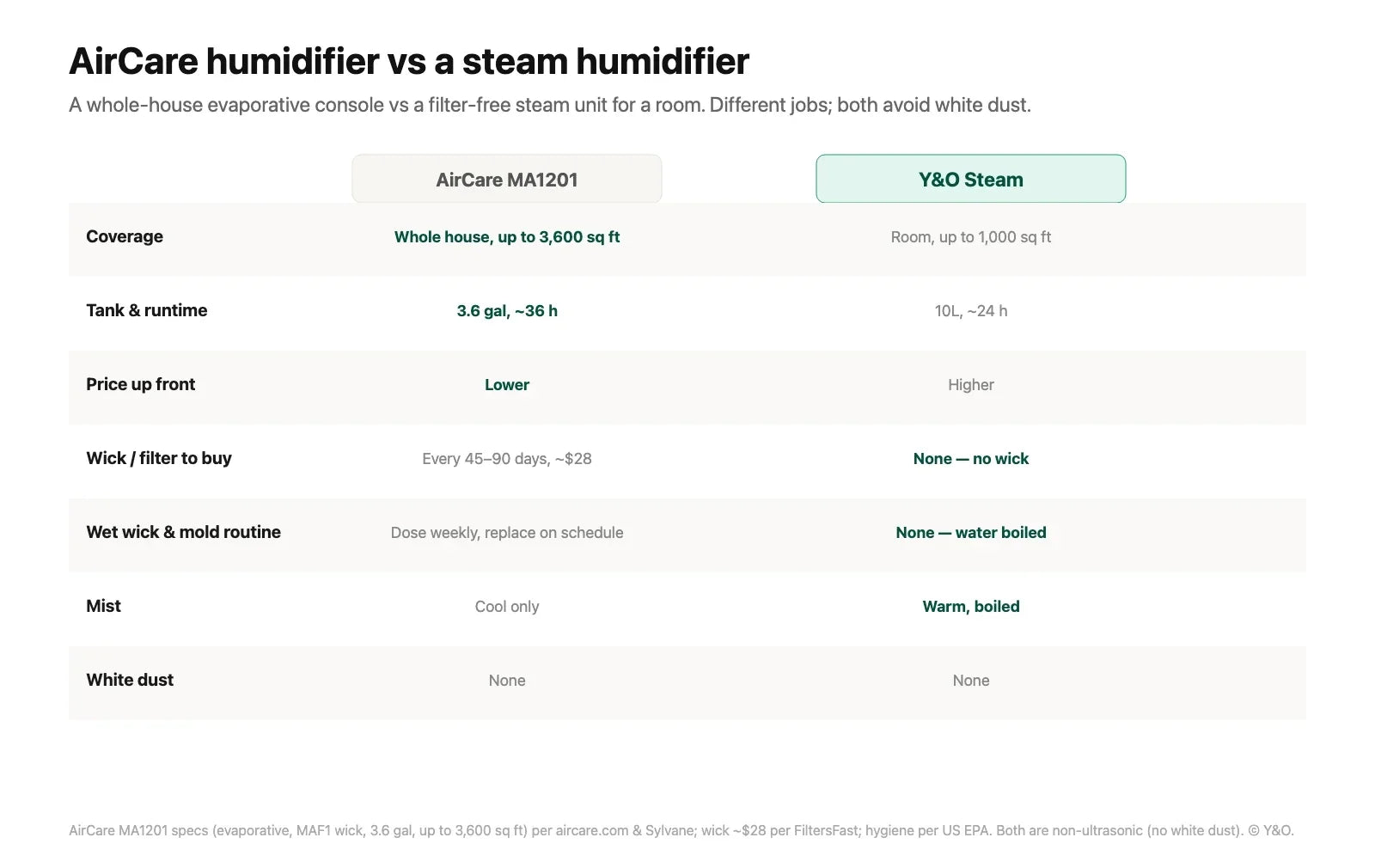

AirCare (formerly Essick Air) makes the big evaporative console humidifiers you see doing whole-house duty — the MA1201 and its siblings can humidify up to 3,600 sq ft from one cabinet, which is genuinely more area than most portable units touch. They’re also built around a large wicking filter you replace every couple of months and dose weekly to keep clean, and that wet-filter design is behind the things owners actually weigh. Judged on humidification, an AirCare console is a high-coverage, low-cost evaporative machine that lives and dies by its wick filter — while a steam humidifier covers a smaller area but needs no filter at all, sterilizes the water by boiling, and puts out warm rather than cold mist. Here’s the honest, principle-first comparison, using AirCare’s own specs and EPA guidance.
The short answer
Choose an AirCare evaporative console if you need to humidify a whole large house cheaply and you don’t mind buying and dosing a wick filter. Choose a steam humidifier if you want no filter to buy or grow mold on, warm mist for a cold dry room, and sterilized output — for a room or mid-sized space rather than a whole 3,600 sq ft floor plan. Both avoid white dust, so that isn’t the deciding factor. The real trade is AirCare’s big coverage and low price against its replaceable wet wick, versus steam’s filter-free, boiled, warmer mist over a smaller area.
| If you want… | Better pick | Why |
|---|---|---|
| To humidify a whole large house on a budget | AirCare | One console covers up to 3,600 sq ft; low up-front price |
| Never to buy or treat a filter again | Steam | Boiling needs no wick; nothing to replace, treat, or reorder |
| No wet wick to grow mold and be told to dose weekly | Steam | The water is sterilized by boiling; there’s no filter to foul |
| Warm mist for a cold, dry room | Steam | Warm boiled vapor; AirCare is cool-mist only |
1. How each one makes moisture
Everything below follows from one mechanical choice, so it’s worth being clear on it first.
An AirCare console is evaporative. A large wicking filter stands in a reservoir and draws water up, and a fan blows air through the wet wick, carrying invisible cool moisture into the room (AirCare). Because the minerals stay trapped in the wick, it doesn’t throw white dust, and because the wick and reservoir are large, one unit can cover a lot of floor. The catch is the part doing the work: that wick is wet, disposable, and central to how the machine behaves.
A steam humidifier, like the Y&O Steam Plus, boils the water instead. A heating element brings it to a boil, which turns it to pure vapor and kills bacteria in the water on the way; the vapor is cooled before it leaves so it isn’t scalding. There’s no wick and no filter — the water is purified by boiling before it ever becomes mist. Hold that difference in mind: AirCare wicks water off a big replaceable filter, steam boils it clean with no filter at all — the rest of this page is the consequences.
2. The wick filter you keep buying
This is the AirCare design’s defining ongoing cost, and it runs deeper than most filter systems. An AirCare console runs on a Super Wick — the MAF1 on the MA1201 — that AirCare says to replace at least once a season, and every 45 days in hard water, at around $28 a filter (AirCare, FiltersFast). Two details make it stickier than a typical filter: the paper wicks are marked “do not clean,” so a crusted wick can’t be rinsed and reused — it has to be thrown out and replaced — and the warranty treats wicks as disposable, covering them for just 30 days against a 2-year warranty on the machine itself.
A steam humidifier has no wick or filter to buy, ever. Boiling doesn’t need one, so there’s nothing to replace, treat, or reorder; upkeep is descaling the tank now and then instead of buying a part on a schedule. It’s the clearest practical difference between the two machines, and it’s the same filter-free logic set out in the filter-free steam guide. If you’ve ever kept a humidifier running on a tired, crusty wick because a new one wasn’t on hand, this is the difference you’d feel.
3. The wet wick & hygiene
A wicking filter isn’t just a cost — it’s a large wet surface that sits damp between uses, and wet surfaces are where things grow. Tellingly, AirCare’s own guidance is to add a capful of bacteriostatic treatment to the water weekly to inhibit bacterial and mold growth and extend wick life — a genuinely useful step, but also a plain admission that a damp wick is somewhere microbes want to be, which is exactly why it needs dosing and replacing on schedule. AirCare’s Super Wicks carry an antimicrobial to help, which slows the problem rather than removing it.
A steam humidifier sidesteps the whole question: boiling sterilizes the water before it becomes vapor, so there’s no living thing to launch and no wet wick to foul in the first place. The EPA draws the same line, noting that evaporative and steam humidifiers “generally disperse less, if any” of the microorganisms and minerals a poorly maintained unit can spread (EPA) — but where the evaporative console relies on a treated wick you must dose and keep changing, the steam unit relies on heat and has no wick at all. Either way, hygiene comes down to upkeep, set out in how to clean and descale a humidifier.
4. Cool mist vs warm steam
The two machines also feel different in the room. An AirCare evaporative console produces cool, invisible mist only — there is no warm setting — which is fine year-round but does nothing to take the chill off a cold, dry room in the depths of the heating season. Its fan also moves a lot of air to cover a big space, so it makes a noticeable white noise.
A steam humidifier boils the water and cools the vapor just enough that what reaches the room is warm rather than cold. In a heated winter home — the exact season a humidifier earns its keep — warm mist feels more comfortable than cold, the trade-off set out in warm vs cool mist. The honest cost on steam’s side is electricity: boiling draws more power than an evaporative fan, so a steam unit costs a little more to run.
5. Coverage & tank: where AirCare leads
This is the dimension where the AirCare console genuinely wins, and it deserves a straight answer. The MA1201 holds a 3.6-gallon reservoir and is rated to humidify up to 3,600 sq ft — whole-house coverage from a single cabinet, running up to 36 hours a fill (Sylvane). No single portable unit matches that footprint; if the job is raising humidity across an entire large, open home, a big evaporative console is built for it.
A steam humidifier such as the Y&O Steam Plus is built for the room, not the whole floor plan: a 10-litre tank, about 1,200 ml per hour, and up to 1,000 sq ft of coverage. That’s plenty for a bedroom, nursery, office, or open living area, and it’s where steam’s filter-free, sterilized, warm mist is at its best — but it is not trying to blanket 3,600 sq ft. If your problem is a whole large house, AirCare covers more ground; if it’s a room or two done cleanly, steam is the better tool, a sizing question covered in humidifying large rooms.
6. White dust: an honest tie
One point the internet often gets wrong here deserves a straight answer. Neither of these machines throws white dust. AirCare’s wick traps the minerals in the filter, so an evaporative console doesn’t spray them into the room; a steam unit leaves the minerals behind in the tank because boiling doesn’t carry them into the vapor. So “no white dust” is not a reason to pick one over the other here — it’s the reason both beat an ultrasonic humidifier, a different comparison set out in steam vs ultrasonic vs evaporative. Between AirCare and steam, the deciding factors are the wick, the hygiene routine, the warmth of the mist, and how much area you need — not dust.
Who should buy which
Buy an AirCare evaporative console if you need to humidify a whole large house on a budget, you want the biggest coverage per dollar, and you don’t mind buying a wick every couple of months and dosing the water weekly to keep it clean. It’s a proven, high-coverage machine, and for a big open home it does something no single portable can.
Buy a steam humidifier such as the Y&O Steam Plus if you want no wick to buy or grow mold on, warm sterilized mist for a cold dry room, and clean simplicity over a room or mid-sized space — and you don’t need to blanket a whole 3,600 sq ft floor. And whichever you run, set your target with a hygrometer you’ve actually checked, because either machine is only as accurate as the gauge you aim it at.
Tired of buying and treating wick filters?
The Y&O Steam Plus is a dedicated 10L steam humidifier — no wick to buy, treat, or grow mold on, warm sterilized mist on ordinary tap water, and high output for a room or open living area.
See the Y&O Steam Plus 10L
FAQ
Is an AirCare humidifier worth it?
It is worth it if you need to humidify a whole large house on a budget and you are willing to replace the wick filter every couple of months and dose the water weekly. One AirCare console covers up to 3,600 square feet, which no single portable matches. If you want no filter to buy or clean, warm mist, or clean simplicity for a room, a steam humidifier does more over time.
How often do you replace an AirCare wick filter?
AirCare recommends replacing the Super Wick at least once a season, and about every 45 days in hard water, at roughly 28 dollars a filter. The paper wicks are marked do not clean, so a crusted wick has to be thrown out and replaced rather than rinsed, and the warranty covers wicks for only 30 days. A steam humidifier has no wick at all.
Does an AirCare humidifier leave white dust?
No. AirCare's wick traps the minerals, so an evaporative console does not spray white dust into the room. A steam humidifier also avoids white dust, because boiling leaves the minerals in the tank. White dust is a problem of ultrasonic humidifiers, not of AirCare or steam units.
AirCare humidifier vs steam, which is better?
They are built for different jobs. AirCare is better if you need cheap whole-house coverage up to 3,600 square feet and do not mind buying and treating a wick. A steam humidifier is better if you want no wick to buy or grow mold on, warm sterilized mist for a cold dry room, and clean simplicity for a room or mid-sized space rather than a whole large floor.
Does an AirCare wick grow mold?
It can, which is why AirCare’s wick carries an antimicrobial and AirCare recommends adding a bacteriostatic treatment to the water weekly to inhibit mold and bacteria, and why the wick must be replaced on schedule. A steam humidifier has no wet wick to grow mold, because it sterilizes the water by boiling instead.
Keep reading
- Why a filter-free steam humidifier
- The best humidifier for large rooms
- Warm mist vs cool mist
- Honeywell vs steam (another wicking-filter unit)
- Steam vs ultrasonic vs evaporative
Sources — AirCare specifications, retail listings and EPA guidance. Verified live.