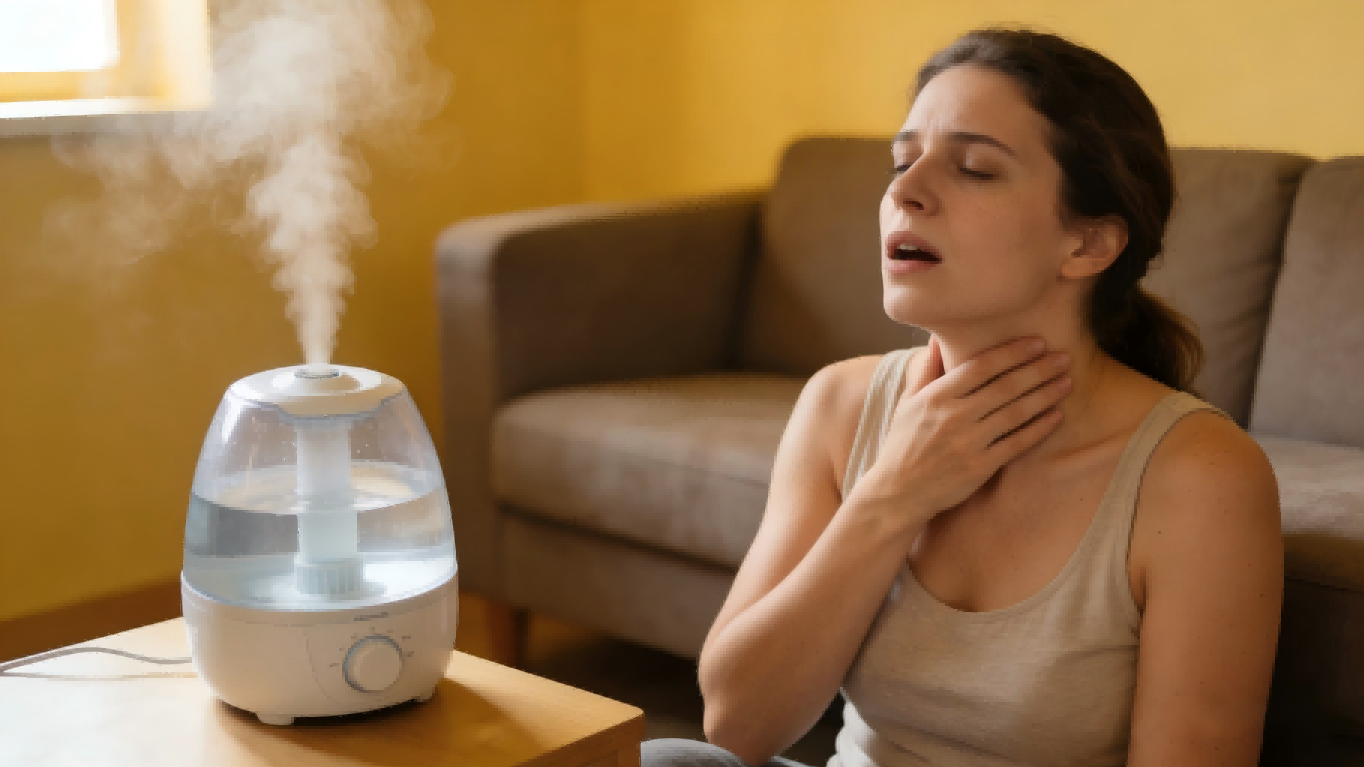
Wenn Sie jemals mit dem Gefühl aufgewacht sind, als hätten Sie eine Handvoll Sand verschluckt, sind Sie nicht allein. Dieses kratzende, irritierende Gefühl im Hals gehört zu den häufigsten Beschwerden, besonders in den Wintermonaten oder in trockeneren Klimazonen. Die meisten Menschen greifen zu einem Glas Wasser, doch die eigentliche Lösung könnte tatsächlich in der Luft liegen, die Sie atmen.
In diesem Leitfaden erfahren Sie, warum trockene Luft Ihrem Hals zusetzt und wie die Wahl des richtigen Luftbefeuchters für Ihre Atemwegsgesundheit den entscheidenden Unterschied machen kann.

Warum fühlt sich Ihr Hals bei trockener Luft so juckend an?
Trockene Luft verursacht einen juckenden Hals, weil sie die schützende Feuchtigkeit aus Ihren Atemwegen verdunsten lässt und die empfindliche Schleimhaut ungeschützt und gereizt zurückbleibt.
Ihr Hals ist mit einer zarten Schleimschicht ausgekleidet, die als primäres Abwehrsystem dient. Diese Feuchtigkeit dient nicht nur der Schmierung; sie beherbergt winzige, haarähnliche Strukturen, die Zilien genannt werden. Ihre Aufgabe ist es, Staub, Bakterien und Viren abzufangen, bevor sie tiefer in Ihr System gelangen.
Wenn die Luft in Ihrem Zuhause unter einen bestimmten Feuchtigkeitsgrad fällt, wirkt sie wie ein Schwamm und entzieht der Schleimhaut Ihres Halses direkt Feuchtigkeit. Dies führt dazu, dass die Schleimhaut austrocknet und die Zilien träge werden. Ohne diese schützende Feuchtigkeit wird Ihr Hals hypersensibel gegenüber jedem noch so kleinen Partikel in der Luft. Dieses "Jucken" ist tatsächlich die Art und Weise Ihres Körpers, zu signalisieren, dass seine Schutzbarriere versagt.
Wird Ihr juckender Hals tatsächlich durch niedrige Luftfeuchtigkeit verursacht?
Nein, nicht unbedingt. So erkennen Sie, ob niedrige Luftfeuchtigkeit tatsächlich die Ursache für Ihren juckenden Hals ist:
Der „Morgenkratzer“-Test
Wenn sich Ihr Hals direkt nach dem Aufwachen schrecklich anfühlt, aber deutlich besser wird, nachdem Sie sich bewegt oder eine warme Tasse Kaffee getrunken haben, ist trockene Luft wahrscheinlich die Ursache. Das liegt daran, dass Ihr Hals während des Schlafs acht Stunden lang Feuchtigkeit verloren hat.
Achtung bei Mundatmung
Wenn Sie dazu neigen, im Schlaf durch den Mund zu atmen – vielleicht wegen einer verstopften Nase –, umgehen Sie die natürliche Befeuchtungsfunktion Ihrer Nase. Dies zwingt Ihren Hals, die gesamte Arbeit der Luftbefeuchtung zu übernehmen, was zu einem knochentrockenen Gefühl führt.
Anzeichen in Ihrem Wohnumfeld
Wenn Sie beim Berühren von Türklinken oder Ihren Haustieren einen „Schlag“ bekommen, ist die Luftfeuchtigkeit in Ihrem Zuhause definitiv zu niedrig. Sie könnten auch Begleiterscheinungen wie rissige Lippen, trockene Haut oder sogar gelegentliches Nasenbluten bemerken.

Was ist der ideale Feuchtigkeitsbereich zur Linderung von Halsschmerzen?
Der ideale Feuchtigkeitsbereich zur Linderung eines kratzigen Halses liegt zwischen 40 % und 60 % relativer Luftfeuchtigkeit.
Um Ihr Atmungssystem gesund zu halten, müssen Sie die "Goldlöckchen-Zone" finden. Es sollte nicht zu trocken sein, aber auch kein tropischer Regenwald.
|
Luftfeuchtigkeit |
Auswirkungen auf Ihren Hals |
Risiken |
|
Unter 30 % |
Sehr schlecht: Schleimhäute trocknen schnell aus, was zu ständigem Juckreiz führt. |
Erhöhtes Überleben von Grippeviren; rissige Haut. |
|
40 % – 60 % |
Ideal: Der Hals bleibt geschmiert und die Zilien arbeiten effektiv. |
Minimal; dies ist der gesündeste Bereich für Menschen. |
|
Über 60 % |
Problematisch: Die Luft wird zu schwer und kann andere Probleme auslösen. |
Schnelles Wachstum von Schimmel und Hausstaubmilben, die Allergien verursachen können. |
Welcher Luftbefeuchter-Typ ist tatsächlich am besten für Ihren Hals?
Zur Linderung von Halsschmerzen sind Dampf-Luftbefeuchter die sicherste Wahl, da sie Bakterien abtöten, bevor sie Feuchtigkeit in die Luft abgeben.
Kaltnebel (Ultraschall): Leise, aber riskant
Diese funktionieren, indem sie Wasser in einen feinen Nebel zerstäuben. Der Vorteil? Sie sind flüsterleise. Der Nachteil? Sie sprühen alles im Wassertank – Mineralien, Bakterien und alles andere – direkt in die Luft, die Sie atmen.
Verdunstend: Saubere Luft, schmutzige Filter
Diese blasen Luft durch einen nassen Filter, um Feuchtigkeit hinzuzufügen. Sie werden keinen Mineralstaub bekommen, aber diese ständig nassen Filter werden zu Schimmelmagneten, wenn Sie sie nicht alle paar Wochen austauschen.
Warmer Nebel (Dampf): Die sauberste Option
Dampf-Luftbefeuchter kochen Wasser, bevor sie es abgeben, wodurch die meisten Keime und Bakterien abgetötet werden. Was Ihren Hals erreicht, ist im Wesentlichen sterile Feuchtigkeit – genau das, was Sie brauchen, wenn Ihr Hals bereits gereizt ist.

Warum gilt der Y&O Steam Plus als die beste Wahl für die Halsgesundheit?
Der Y&O Steam Plus wurde speziell entwickelt, um die Risiken herkömmlicher Luftbefeuchter durch einen 212°F (100°C) Hochtemperatur-Sterilisationsprozess zu eliminieren.
Wenn Sie einen juckenden Hals haben, ist das Letzte, was Sie wollen, „schmutzigen“ Nebel einzuatmen. Der Y&O Steam Plus löst die häufigsten Probleme mit Luftbefeuchtern durch einige wichtige Innovationen:
● Wirklich steriler Nebel: Durch das Kochen von Wasser bei 100°C eliminiert er die meisten Bakterien und Keime und stellt sicher, dass die Feuchtigkeit, die in Ihren Hals gelangt, rein und gesund ist.
● Keine „weiße Staub“-Irritation: Da er Dampftechnologie verwendet, bleiben Mineralien im Tank zurück, anstatt in Ihren Raum gesprüht zu werden, wodurch Ihre Luft (und Ihre Lungen) sauber bleiben.
● Unübertroffene Leistung für große Räume: Er kann Räume von bis zu 1000 Quadratfuß befeuchten und arbeitet bis zu 6x schneller als Standardmodelle, was entscheidend ist, um die 40%–60% Komfortzone in offenen Wohnbereichen aufrechtzuerhalten.
● Filterlose Einsparungen: Im Gegensatz zu Verdunstungsmodellen, die teure monatliche Filter benötigen, um „sauber“ zu bleiben, verwendet der Y&O Steam Plus ein filterloses Design, wodurch er hygienischer und langfristig kostengünstiger ist.
Kann ein schmutziger Luftbefeuchter Sie tatsächlich kränker machen?
Ja, ein schmutziger Luftbefeuchter kann "Luftbefeuchterfieber" oder Lungenentzündungen verursachen, indem er Bakterien und Schimmelsporen direkt in Ihren Atemraum pumpt.
Im Tank eines Luftbefeuchters kann sich eine dünne, schleimige Schicht bilden, die als Biofilm bezeichnet wird. Dies ist eine Bakterienkolonie, die in stehendem Wasser gedeiht. Wenn Ihr Luftbefeuchter nicht sterilisiert (wie eine Dampfeinheit) oder täglich gereinigt wird, versprühen Sie diese Bakterien im Grunde genommen. Anstatt Ihren juckenden Hals zu beruhigen, könnten Sie am Ende eine tatsächliche Atemwegsinfektion oder eine Entzündungsreaktion bekommen.
So verwenden Sie einen Luftbefeuchter für die besten Ergebnisse
Um das Beste aus Ihrem Luftbefeuchter herauszuholen, benötigen Sie eine Routine, die eine effektive Feuchtigkeitsabgabe mit strenger Hygiene in Einklang bringt, um Ihr Atmungssystem zu schützen.
Schritt 1: Wählen Sie den richtigen Platz für Ihr Gerät
Stellen Sie Ihren Luftbefeuchter auf eine ebene, wasserabweisende Oberfläche, etwa 90 bis 150 cm von Ihrem Bett entfernt und mindestens 60 cm über dem Boden. Dadurch wird sichergestellt, dass der Nebel gleichmäßig in der Luft verteilt wird, bevor er Sie erreicht, und es verhindert, dass Ihre Decken oder Matratze feucht werden, was zu Schimmel führen könnte.
Schritt 2: Beginnen Sie mit dem saubersten Wasser, das möglich ist
Wenn Sie ein Ultraschall- oder Verdunstungsmodell verwenden, verwenden Sie immer destilliertes oder demineralisiertes Wasser, um mineralischen „weißen Staub“ zu vermeiden. Wenn Sie einen Dampf-Luftbefeuchter wie den Y&O Steam Plus verwenden, übernimmt der Kochvorgang die Sterilisation, aber die Verwendung von gefiltertem Wasser kann dennoch dazu beitragen, die Kesselsteinbildung im Gerät zu reduzieren.
Schritt 3: Überwachen Sie den ganzen Tag über die Luftfeuchtigkeit
Verwenden Sie einen eingebauten Sensor oder ein separates Hygrometer, um die Luftfeuchtigkeit in Ihrem Raum zwischen 40 % und 60 % zu halten. Wenn Sie Nebel an Ihren Fenstern sehen oder die Luft „schwer“ anfühlt, schalten Sie das Gerät herunter, um zu verhindern, dass Hausstaubmilben und Schimmelpilze gedeihen.
Schritt 4: Führen Sie eine „tägliche Entleerungs“-Routine durch
Lassen Sie tagsüber, wenn das Gerät ausgeschaltet ist, niemals Wasser im Tank stehen. Leeren Sie jeden Morgen jegliches Restwasser, spülen Sie den Tank aus und lassen Sie ihn an der Luft trocknen. Füllen Sie ihn nur mit frischem Wasser auf, wenn Sie ihn abends wieder benutzen möchten.
Schritt 5: Führen Sie einmal pro Woche eine Tiefenreinigung durch
Selbst bei sterilen Dampfmodellen können sich Mineralien aus dem Wasser ansammeln. Verwenden Sie einmal pro Woche eine Mischung aus Wasser und weißem Essig, um den Tank und das Heizelement zu entkalken, damit das Gerät effizient läuft und die Luft frisch riecht.

Gibt es andere schnelle Methoden, um einen juckenden Hals zu beruhigen?
Sie können Ihren Luftbefeuchter ergänzen, indem Sie ausreichend Flüssigkeit zu sich nehmen, Kochsalzlösungen verwenden und Reizstoffe wie Rauch und starke Düfte meiden.
Von innen nach außen hydrieren
Ein Luftbefeuchter sorgt für die Luft, aber Sie müssen trotzdem viel Wasser trinken, um Ihr Gewebe von innen heraus mit Feuchtigkeit zu versorgen. Zielen Sie auf mindestens 8 Gläser pro Tag ab und stellen Sie eine Wasserflasche auf Ihren Nachttisch. Warme Flüssigkeiten wie Kräutertee oder Brühe wirken sogar noch besser, da sie helfen, Schleim zu lösen und gleichzeitig Entzündungen zu lindern.
Probieren Sie eine Salzlösung aus
Die Verwendung eines einfachen Salzwasser-Nasensprays oder einer Nasenspülkanne kann Reizstoffe ausspülen und Ihre Nasengänge rehydrieren, was auch Ihrem Hals hilft. Für direkte Linderung im Hals gurgeln Sie 30 Sekunden lang mit warmem Salzwasser (1/4 Teelöffel Salz in 8 Unzen warmem Wasser). Dies reduziert Schwellungen und schafft ein feindliches Milieu für Bakterien.
Vermeiden Sie häufige Halsreizstoffe
Zigarettenrauch, starke Parfüms, Lufterfrischer und Reinigungsmittel können Ihren Hals zusätzlich austrocknen und reizen. Wenn Sie Duftkerzen oder Diffusoren verwenden, schalten Sie diese aus, während sich Ihr Hals erholt. Schon leichter Kochrauch kann ein Auslöser sein, schalten Sie daher beim Kochen Ihre Dunstabzugshaube ein.
Fügen Sie feuchtigkeitsreiche Lebensmittel hinzu
Der Verzehr von Lebensmitteln mit hohem Wassergehalt – wie Gurken, Wassermelone, Orangen und Suppe – versorgt Ihren Körper zusätzlich mit Flüssigkeit. Honig ist besonders beruhigend; geben Sie einen Löffel in warmen Tee oder essen Sie ihn pur, um Ihren Hals mit einer Schutzschicht zu überziehen.
Lohnt sich ein Luftbefeuchter?
Ja. Wenn Sie jedes Mal, wenn das Wetter kalt wird oder die Heizung anspringt, mit einem kratzenden Hals zu kämpfen haben, ist ein hochwertiger Luftbefeuchter die Investition absolut wert.
Es geht nicht nur um Komfort; es geht darum, Ihrem Körper die Umgebung zu geben, die er braucht, um sich zu schützen. Für Menschen mit empfindlichen Systemen bietet eine professionelle Option wie der Y&O Steam Plus das Beste aus beiden Welten: eine starke Leistung für große Räume und eine medizinische Sterilisation für absolute Sicherheit. Sie werden wahrscheinlich feststellen, dass Sie mit mehr Energie, einem klareren Kopf und einem Hals aufwachen, der sich nicht anfühlt, als wäre er mit Sandpapier geschrubbt worden.
FAQ zu Luftfeuchtigkeit und Halsgesundheit
Q1. Kann trockene Luft wirklich einen juckenden Hals verursachen?
Ja. Wenn die Luftfeuchtigkeit in Innenräumen sinkt, wirkt die Luft wie ein Schwamm und entzieht den schützenden Schleimhäuten in den Atemwegen Feuchtigkeit. Dies trocknet Ihre Schleimhäute aus und verlangsamt die Zilien (winzige haarähnliche Strukturen), wodurch Ihr Hals empfindlich und gereizt wird.
F2. Welcher ist der ideale Feuchtigkeitsgehalt für einen juckenden Hals?
Laut der US-Umweltschutzbehörde EPA und Gesundheitsexperten liegt der „Goldlöckchen“-Bereich für die Linderung von Halsschmerzen zwischen 40 % und 60 % relativer Luftfeuchtigkeit. Innerhalb dieses Bereichs bleibt Ihr Hals ausreichend befeuchtet, während gleichzeitig das Wachstum von Schimmel oder Hausstaubmilben verhindert wird, das bei über 60 % auftreten kann.
F3. Warum ist ein Dampfbefeuchter für die Atemwegsgesundheit besser als ein Kaltnebelbefeuchter?
Während Kaltnebel- (Ultraschall-) Luftbefeuchter leise sind, können sie Mineralien und Bakterien aus dem Wassertank direkt in Ihre Lungen sprühen. Ein Dampfbefeuchter, wie der Y&O Steam Plus, kocht Wasser auf 100°C (212°F). Dieser Prozess tötet die meisten Bakterien und Keime ab und liefert sterile Feuchtigkeit, die für einen bereits gereizten Hals viel schonender ist.
F4. Wie kann ich feststellen, ob mein juckender Hals durch geringe Luftfeuchtigkeit verursacht wird?
Eine einfache Methode, dies festzustellen, ist der „Morgenkratz“-Test. Wenn sich Ihr Hals direkt nach dem Aufwachen schlechter anfühlt, sich aber bessert, nachdem Sie sich bewegt oder etwas Warmes getrunken haben, ist es wahrscheinlich, dass die Luft in Ihrem Zimmer zu trocken ist. Möglicherweise bemerken Sie auch statische Elektrizität in Ihrem Haus oder rissige Lippen.
F5. Kann ein schmutziger Luftbefeuchter meinen Hals verschlimmern?
Absolut. Wenn ein Luftbefeuchter nicht richtig sterilisiert oder gereinigt wird, kann sich ein Biofilm bilden – eine Bakterienkolonie, die in stehendem Wasser gedeiht. Wenn das Gerät läuft, zerstäubt es diese Bakterien und kann so statt Linderung das „Befeuchterfieber“ oder Atemwegsinfektionen verursachen.
Offenlegung zur Gesundheits- und Markentransparenz
Medizinischer Haftungsausschluss: Die in diesem Leitfaden bereitgestellten Informationen dienen ausschließlich Bildungs- und Informationszwecken und sind nicht als medizinische Beratung, Diagnose oder Behandlung gedacht. Während eine angemessene Luftfeuchtigkeit (40 %–60 %) für den Atemkomfort unerlässlich ist, sollten Sie bei Fragen zu einem medizinischen Zustand immer den Rat Ihres Arztes oder eines anderen qualifizierten Gesundheitsdienstleisters einholen. Missachten Sie niemals professionellen medizinischen Rat oder verzögern Sie dessen Einholung aufgrund von etwas, das Sie auf dieser Website gelesen haben.
Offenlegung von Partnern und Marken: Dieser Artikel wird Ihnen vom Y&O Team präsentiert. Wir engagieren uns leidenschaftlich für die Atemwegsgesundheit, weshalb wir den Y&O Steam Plus entwickelt haben, um gängige Risiken der Befeuchtung zu lösen. Als Hersteller haben wir ein begründetes Interesse an diesem Produkt, aber unsere Empfehlungen basieren auf strengen Tests und dem Kernprinzip, sterile, sichere Feuchtigkeit für Ihr Zuhause bereitzustellen.
Datenquellen & Referenzen
Centers for Disease Control and Prevention (CDC) – High Humidity Leads to Loss of Infectious Influenza Virus from Simulated Coughs
National Institutes of Health (NIH) – Indoor Environment and Viral Infections
U.S. Environmental Protection Agency (EPA) – Care for Your Air: A Guide to Indoor Air Quality
U.S. Environmental Protection Agency (EPA) – Use and Care of Home Humidifiers