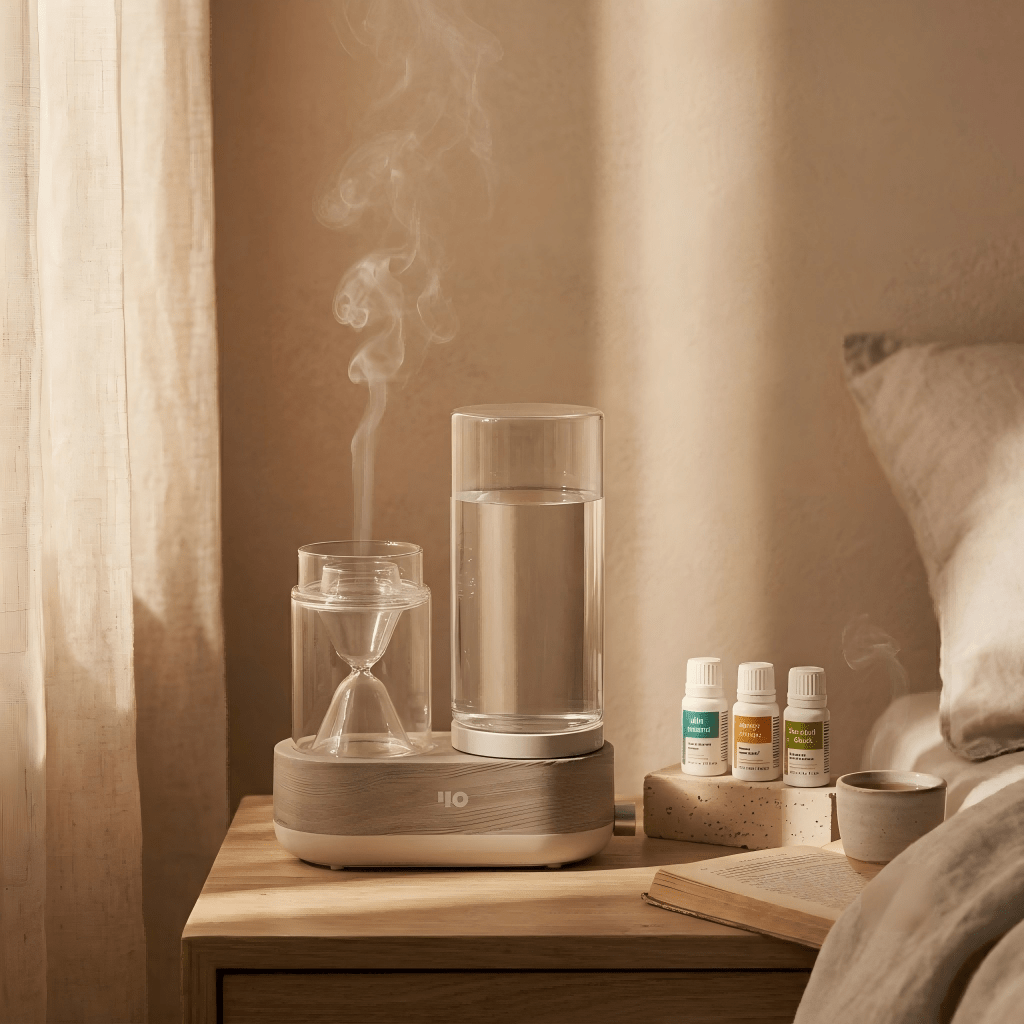

Kaffee bekommt die Anerkennung. Doch das Erste, was dein Gehirn am Morgen erreicht, ist nicht Koffein – es ist der Duft.
Bevor du einen Schluck getrunken hast, bevor sich deine Augen vollständig angepasst haben, verarbeitet deine Nase bereits die Luft um dich herum. Dieses Signal reist schneller als fast jeder andere sensorische Input, direkt zu dem Teil des Gehirns, der Stimmung und Wachheit steuert.
Das bedeutet, die Luft, in der du aufwachst, ist wichtiger, als die meisten Menschen denken.
Ein morgendliches Diffusor-Ritual ersetzt weder Kaffee noch erfindet es deine Routine neu. Es geht darum, deinen Sinnen etwas zu geben, woran sie sich orientieren können – ein konsistentes Signal, das deinem Nervensystem sagt, dass der Tag begonnen hat, und zwar zu deinen Bedingungen.
Warum Düfte schneller wirken als jedes andere Morgensignal
Jedes sensorische Signal, das dein Körper empfängt, durchläuft eine Relaisstation im Gehirn, bevor es ins Bewusstsein gelangt – außer der Geruch.
Aromatische Moleküle, die in deine Nase gelangen, binden direkt an Rezeptoren, die mit dem Riechkolben verbunden sind, welcher unmittelbar an das limbische System angrenzt: das Zentrum des Gehirns für Emotionen, Erinnerungen und das Gefühl des Wachseins oder Schlafens. Keine Weiterleitung. Keine Übersetzungsschicht. Das Signal kommt schneller an als Berührung, schneller als Geräusche, schneller als Licht durch deine Augenlider.
Deshalb kann ein spezifischer Duft dein Gefühl innerhalb von Sekunden nach dem Einatmen verändern – nicht wegen etwas Mystischem, sondern wegen der direkten Verbindung des Riechpfades zu den Strukturen, die Wachheit und Stimmung steuern.
Es gibt auch eine zeitliche Betrachtung. In den ersten 20-30 Minuten nach dem Aufwachen erreichen die Cortisolspiegel natürlich ihren Höhepunkt – ein biologischer Prozess, der als Cortisol-Aufwachreaktion bezeichnet wird. In diesem Zeitfenster ist Ihr Nervensystem am besten darauf vorbereitet, die Signale zu empfangen, die den Ton für die nächsten Stunden angeben werden. Was Sie sich in diesem Fenster aussetzen, hat einen überproportionalen Einfluss darauf, wie sich der Morgen entwickelt.
Die erste halbe Stunde nach dem Aufwachen ist die natürliche Übergangsphase des Körpers von der Ruhe zur Bereitschaft. Wenn man diesem Fenster ein konsistentes aromatisches Signal – denselben Duft jeden Morgen – zuordnet, kann der Übergang im Laufe der Zeit bewusster und weniger abrupt wirken.
Die ätherischen Öle, die am besten zu einem frischen Start passen
Nicht alle Öle eignen sich morgens gleichermaßen gut. Diejenigen, die sich am besten für ein Aufwachritual eignen, teilen eine gemeinsame Eigenschaft: Sie sind hell, sauber und mühelos wahrnehmbar.
Sie lassen sich in drei natürliche Gruppen einteilen.
Zitrus – Der schnellste Muntermacher
Öle aus Zitrusschalen – Süßorange, Zitrone, Grapefruit, Bergamotte – sind die am weitesten verbreiteten Morgendüfte. Ihre Kopfnoten sind flüchtig, das heißt, sie verteilen sich schnell und erreichen die Nase rasch. Die Assoziation mit Frische ist teils kulturell (sie sind überall in Morgenprodukten zu finden) und teils sensorisch: Der scharfe, süß-helle Charakter von Zitrusfrüchten macht es einfach schwer, sich schläfrig zu fühlen.
Minze & Eukalyptus – Der öffnende Atem
Pfefferminze und Eukalyptus erzeugen ein Gefühl von freien, offenen Atemwegen – das olfaktorische Äquivalent eines tiefen Atems. Sie sind besonders wirksam an Morgen, wenn die Luft abgestanden oder schwer ist. Sparsam verwenden: 1–2 Tropfen genügen. Ihre Intensität kann in einem unbelüfteten Raum überwältigend wirken.
Rosmarin & Nadelhölzer – Der geerdete Start
Für Morgen, die eher Beständigkeit als einen Schock erfordern, bieten Rosmarin und Waldnadelöle (Tanne, Kiefer, Fichte) eine geerdete, grüne Qualität. Sie werden mit einem Gefühl von Präsenz und ruhiger Konzentration assoziiert, anstatt mit Dringlichkeit. Gut für langsame Morgenstunden, kreative Arbeitstage oder jeden, für den Zitrusfrüchte am Morgen zu scharf wirken.
| Ätherisches Öl | Sensorischer Charakter | Beste Morgenstimmung | Tropfen (pro Sitzung) |
|---|---|---|---|
| Süßorange | Warm, süß, belebend | Fröhlicher Start in den Tag | 2–3 |
| Zitrone | Frisch, sauber, scharf | Produktivitätstag steht bevor | 2–3 |
| Grapefruit | Hell, leicht bitter, energisch | Morgen mit körperlicher Aktivität | 2–3 |
| Bergamotte | Blumig-zitrisch, nuanciert, raffiniert | Ruhiger, aber präsenter Start | 2 |
| Pfefferminze | Kühl, scharf, öffnend | Träger oder schwerer Morgen | 1–2 |
| Eukalyptus | Sauber, kampferartig, luftig | Abgestandene Luft / Wintermorgen | 1–2 |
| Rosmarin | Kräuterartig, grün, erdend | Langsamer Morgen / kreativer Tag | 2–3 |
| Tanne / Kiefer | Waldig, frisch, beständig | Geerdeter, unaufgeregter Start | 2–3 |

Das 10-minütige Morgenritual gestalten
Das Ritual erfordert keine zusätzliche Zeit. Es fügt sich in das ein, was du bereits tust.
- Am Vorabend: Fülle den Behälter und gib dein Morgenöl hinein – sodass du beim Aufwachen nur noch einen Knopf drücken musst
- Beim Aufwachen: Schalte den Diffusor ein, bevor du etwas anderes tust – lass den Duft ankommen, während du noch liegst, wenn du möchtest
- In den ersten 10 Minuten: Lass das Aroma wirken, während du Kaffee kochst, dich streckst oder einfach nur sitzt
- Konsistenz: Verwende dasselbe Öl (oder dieselbe Mischung) eine Woche lang jeden Morgen – die Assoziation von Duft und Wachheit verstärkt sich durch Wiederholung
- Lüftung: Öffne nach 20–30 Minuten ein Fenster, besonders im Winter, wenn die Räume abgedichtet sind
- Verwende nicht mehr als 3 Tropfen in einem geschlossenen Schlafzimmer – morgens sind Räume oft unbelüftet, und der Duft konzentriert sich schnell
- Verwende keine Zitrusöle, wenn du kurz darauf direkter Sonneneinstrahlung ausgesetzt bist – einige sind lichtempfindlich, wenn sie auf die Haut aufgetragen werden (obwohl die Verneblung unbedenklich ist)
- Betreibe den Diffusor nicht während des Frühstücks, wenn kleine Kinder oder Haustiere im Raum sind – gib ihnen eine Ausweichmöglichkeit
- Gehe nicht davon aus, dass mehr Tropfen eine stärkere Wirkung bedeuten – ab einer bestimmten Konzentration wirkt der Duft eher ermüdend als belebend
Warum das Gerät, das du benutzt, für ein Morgenritual wichtig ist
Die meisten Diffusor-Anleitungen konzentrieren sich ausschließlich auf die Wahl des Öls. Sie überspringen den Teil, in dem das Gerät selbst etwas zu deiner Morgenluft beiträgt – und das nicht immer etwas, das du haben möchtest.
Ein Ultraschall-Diffusor aus Kunststoff, der über Nacht in einem geschlossenen Schlafzimmer läuft, bedeutet stundenlang erhitztes Wasser in einem Kunststoffbehälter. Ätherische Öle sind natürliche Lösungsmittel – mit der Zeit kann diese Interaktion die Kunststoffoberfläche zersetzen. Was morgens in die Luft gelangt, sind nicht nur die von dir gewählten aromatischen Verbindungen. Es können auch Mineralpartikel aus hartem Leitungswasser und Spuren von VOCs aus der Kunststoffzersetzung enthalten sein.
Dies ist der leise Widerspruch eines morgendlichen Wellness-Rituals, das auf einem minderwertigen Gerät basiert: Die Absicht ist saubere Luft und gezielter Duft, aber der Liefermechanismus kann eigene unerwünschte Elemente einführen.
Die Luft in einem geschlossenen Schlafzimmer nach einer nächtlichen Ultraschall-Session kann mineralisches Aerosol aus hartem Leitungswasser und VOCs durch Öl-Kunststoff-Kontakt enthalten. Für ein Ritual, das auf der Qualität deines ersten morgendlichen Atemzugs basiert, ist das Material des Diffusors kein kleines Detail.
Damit ein Morgenritual es wert ist, beibehalten zu werden, sollte es völlig reibungslos und eindeutig sauber sein. Das bedeutet ein Gerät, das du am Vorabend vorbereiten, mit einer Bewegung einschalten und dem du vertrauen kannst, dass es nur das in die Luft abgibt, was du beabsichtigt hast.
Am Abend vorbereiten. Morgens nur einen Knopf drücken.
Der 1.600 ml Glasbehälter des Yo-A1 reicht für eine Übernacht-Ruhepause und eine volle Morgensession – kein Nachfüllen, kein Plastikkontakt, kein Mineralstaub. Nur das Öl, das du gewählt hast.
Lerne den Yo-A1 kennen →Der Yo-A1 als Anker des Morgenrituals
Die Details, die den Yo-A1 so gut für ein Morgenritual geeignet machen, sind dieselben, die am wichtigsten sind, wenn man halb schläft und noch keine sorgfältigen Entscheidungen trifft.
Der Behälter besteht aus 1.600 ml Borosilikatglas – kein Plastik im Wasser- oder Ölweg. Ätherische Öle treffen nur auf Glasoberflächen, was keine Zersetzung, kein Ausgasen und nichts Unbeabsichtigtes in den Dampf bedeutet. Der erste Atemzug deines Morgens ist genau das, was du am Vorabend hineingegeben hast.
Das Heizelement bringt das Wasser vor jeder Session auf 100°C (212°F), was bedeutet, dass der über Nacht gestandene Behälter sterilisiert wird, bevor der Dampf dich erreicht. Kein Biofilm. Keine Frage, was sich im Schlaf angesammelt hat.
Da es reinen Dampf anstelle von zerstäubtem Wasser produziert, gibt es keine mineralische Übertragung aus Leitungswasser. Keine weißen Rückstände auf dem Nachttisch. Keine Partikel in der Morgenluft.
Die Geräuschentwicklung – unter 25 dB – sorgt dafür, dass das Ritual leise bleibt. Kein Brummen, kein Gurgeln, kein Geräusch, das die Stille des frühen Morgens stört. Nur der Duft, der stetig ankommt, während alles andere still ist.
Und die 8-Stunden-Abschaltautomatik bedeutet, dass du es einstellen, schlafen und den Morgen ohne zusätzliche Entscheidungen erleben kannst. Das Ritual ist bereits vorbereitet. Du wachst einfach darin auf.

Unabhängige Bewertungen des Yo-A1 in häuslicher Umgebung:
Deine besten Morgen beginnen am Vorabend
Glasbehälter · 100°C Sterilisation · <25 dB · 8 Stunden Laufzeit. Fülle ihn heute Abend. Drücke morgen einen Knopf. Der Rest erledigt sich von selbst.
Den Yo-A1 kaufen →Häufig gestellte Fragen
Kann ich ätherische Öle schon am Vorabend in meinen Diffusor geben?
Ja – und es ist eines der praktischsten Dinge, die du für ein Morgenritual tun kannst. Gib dein gewähltes Öl am Vorabend hinein, und du musst beim Aufwachen nur noch den Knopf drücken. Das Öl wird morgens noch im Behälter sein. Bei einem Glasdampfgerät besteht keine Sorge, dass das Öl über Nacht Plastik zersetzt. Bei Ultraschallmodellen aus Plastik lohnt es sich, die Herstellerangaben zu prüfen, da längerer Öl-Plastik-Kontakt im Laufe der Zeit zu Zersetzung führen kann.
Welche ätherischen Öle eignen sich am besten zum Aufwachen?
Die Öle, die am häufigsten in Morgenroutinen verwendet werden, sind Zitrusöle – Süßorange, Zitrone und Grapefruit – wegen ihres hellen, sauberen und belebenden Charakters. Pfefferminze und Eukalyptus sind beliebt, wenn man ein Gefühl von Offenheit und klarer Luft wünscht. Rosmarin- und Tannenöle eignen sich für Morgen, an denen man etwas Erdendes statt Scharfes möchte. Das "beste" Öl ist das, auf das du dich tatsächlich freust – Konsistenz ist wichtiger als das spezifische Öl, das du wählst.
Wann ist die beste Zeit, den Diffusor morgens einzuschalten?
Direkt nach dem Aufwachen, oder sogar 20–30 Minuten vorher, falls Ihr Diffusor über eine Zeitschaltuhr verfügt. Die erste halbe Stunde nach dem Aufwachen ist die natürliche Übergangsphase des Körpers – eine konsistente Kombination eines aromatischen Signals mit dieser Zeit kann dazu beitragen, dass das Ritual im Laufe der Zeit automatischer wird. Manche Menschen finden es hilfreich, den Diffusor einige Minuten lang laufen zu lassen, während sie noch im Bett liegen; andere ziehen es vor, ihn einzuschalten, wenn sie aufstehen und sich bewegen. Beides funktioniert – der Schlüssel liegt darin, es jeden Tag zum gleichen Zeitpunkt in Ihrer Routine zu tun.
Wie viele Tropfen ätherisches Öl sollte ich morgens verwenden?
Beginne mit 2–3 Tropfen für ein typisches Schlafzimmer oder Wohnzimmer. Morgens sind die Räume oft vom Vorabend her geschlossen, was bedeutet, dass sich der Duft schneller konzentriert als in einem belüfteten Raum. Mehr Tropfen bedeuten nicht eine stärkere oder bessere Wirkung – ab einer bestimmten Konzentration kann ein starker Duft eher ermüdend als erfrischend wirken. Wenn du ein starkes Öl wie Pfefferminze oder Eukalyptus verwendest, beginne mit 1–2 Tropfen. Du kannst jederzeit mehr hinzufügen; einmal in der Luft, kannst du es nicht mehr rückgängig machen.
Ist es sicher, einen Diffusor im Schlaf laufen zu lassen und damit aufzuwachen?
Das kann es sein, mit der richtigen Einrichtung. Verwenden Sie ein Gerät mit automatischer Abschaltung, damit es nicht unbegrenzt läuft. Halten Sie die Ölkonzentration niedrig – maximal 2 Tropfen für den Gebrauch über Nacht. Sorgen Sie für etwas Belüftung (auch eine leicht geöffnete Tür hilft). Vermeiden Sie starke Öle wie Nelke, Zimt oder hochdosierte Pfefferminze für nächtliche Sessions; sanftere Optionen wie Lavendel oder ein einziger Tropfen Zedernholz sind besser geeignet. Wenn Sie Asthma oder Atemwegsempfindlichkeiten haben, konsultieren Sie vor dem nächtlichen Betrieb eines Diffusors Ihren Arzt.
Warum riecht mein Diffusor morgens nach Plastik?
Das ist ein Zeichen für eine Wechselwirkung zwischen Öl und Kunststoff im Behälter. Ätherische Öle sind natürliche Lösungsmittel – wenn sie über Nacht mit Kunststoff in Kontakt bleiben (insbesondere Polypropylen oder ABS), können sie die Oberfläche mit der Zeit angreifen und einen schwachen Plastik- oder Chemiegeruch in den Dampf abgeben. Dies ist einer der Gründe, warum Glasbehälter für jeden wichtig sind, der regelmäßig einen Diffusor benutzt. Bei einem Glasgerät kommt Öl nur mit einer inerten Oberfläche in Kontakt – was Sie morgens riechen, ist nur das, was Sie hineingetan haben.
Referenzen
- U.S. EPA — Raumluftqualität: epa.gov/indoor-air-quality-iaq
- CDC — Innenraumumweltqualität: cdc.gov/niosh/topics/indoorenv
- Justia Patente — Patent zur Dampfdiffusion 11052167: patents.justia.com/patent/11052167