Zum Inhalt springen

The world's healthiest humidifier: Up to 15% off | Shop now

Why Your Diffuser Leaves White Dust Everywhere — And What It's Actually Doing to Your Air

Why Your Diffuser Leaves White Dust Everywhere — And What It's Actually Doing to Your Air

You wiped it off yesterday. This morning it's back.

That fine white coating on your nightstand, your lamp, your books — it isn't household dust. It's coming directly out of your diffuser every time it runs.

Most people go through three or four attempted fixes before realizing they're solving the wrong problem.

White mineral dust is a structural side effect of how ultrasonic diffusers work — not a sign that yours is defective. Here's what's in that powder, what it means for your air quality, and the one design change that stops it at the source.


What that white powder actually is

Tap water isn't pure H₂O. In most North American cities it carries dissolved minerals — primarily calcium (Ca²⁺) and magnesium (Mg²⁺) — suspended in every drop.

Your ultrasonic diffuser uses a small ceramic plate vibrating at roughly 1.7 million cycles per second. That vibration breaks the water into a fine mist — and it breaks everything dissolved in it along with it.

When that mineral-laden mist hits the air, the water evaporates. The minerals don't. They stay airborne for hours, then settle as that white film you keep finding on every surface within six feet of the unit.

This isn't a defect. It's physics. The ultrasonic plate doesn't discriminate between water molecules and dissolved minerals — it atomizes whatever is in the tank.

300 mg/L avg total dissolved solids — Phoenix, AZ tap water
43 mg/L avg — Seattle, WA tap water. Same diffuser, very different result.
4–8 hrs How long mineral particles stay airborne before settling
32K+ Views on Non-Toxic Dad's viral video about humidifier safety risks

Cities drawing from hard water sources — Phoenix, Las Vegas, Dallas, Denver, Calgary — produce dramatically more white dust per hour of diffuser use than soft-water cities like Seattle, Portland, or Vancouver.

Check your water utility's total dissolved solids report. It explains more about your white dust problem than anything else.

How ultrasonic diffusers produce white mineral dust Four-step flow showing tap water with dissolved minerals being atomized by ultrasonic vibration, releasing mineral-laden mist into the air, which settles as white dust on surfaces. Tap water Ca²⁺ · Mg²⁺ dissolved in every drop Ultrasonic plate Vibrates 1.7M times/sec Breaks water + minerals Mineral mist rises Water evaporates in air Minerals stay airborne White dust settles On furniture, books, bedding, surfaces
The ultrasonic plate atomizes everything in the tank — minerals exit the diffuser alongside the water vapor and settle as fine white powder.

Is it actually harmful?

For most healthy adults, white mineral dust is primarily a cleaning annoyance. The full picture is more nuanced.

The particles produced by ultrasonic diffusers fall into the PM2.5 category — particulate matter under 2.5 micrometers in diameter. The EPA's PM2.5 research identifies this size range as a respiratory concern because particles this small can bypass your upper airways entirely.

Mineral dust from a diffuser isn't diesel exhaust. But it is fine inhalable particulate — and it's entering your airways during the hours you're most stationary: sleeping.

⚠ Higher-risk groups

People with asthma, allergies, or existing respiratory conditions face greater exposure risk. The same applies to infants, toddlers, and household pets. If your diffuser runs overnight in a bedroom shared with any of these groups, white mineral dust and standing-water biofilm are both worth taking seriously — not dismissing.

Community members in r/Asthma have repeatedly traced worsening nighttime symptoms to bedroom diffuser use. The pattern is consistent enough across different users and cities that it warrants attention.

"I finally realized my night cough was worse on diffuser nights. Switched to distilled water and it helped, but I still had the unit running all night in standing water. That part still bothers me."

— Community discussion, r/Asthma

"The white dust was bad enough in Phoenix — but once I started reading about biofilm in ultrasonic tanks, that's when I knew I needed to switch. The invisible stuff was what got me."

— Community discussion, r/nontoxic

The EPA's indoor air quality guidance specifically lists humidifiers and diffusers as potential biological pollutant sources when not maintained correctly. That applies to both the white dust you can see and the microbial content you can't.

Why every fix you've tried has limits

Most diffuser owners cycle through the same progression of workarounds. Here's what each one actually does — and where it stops:

  • Wiping down surfaces more often — addresses the symptom, not the mechanism. The dust reappears as soon as you run the unit again.
  • Descaling and cleaning tablets — essential maintenance, but they remove mineral buildup inside the tank. They don't prevent mineral release during operation.
  • Demineralization cartridges — reduce (not eliminate) the mineral load. They're an ongoing cost of $10–20 every 4–6 weeks, and effectiveness degrades between replacements.
  • Running on lower output — less mist, less mineral release, but also less fragrance diffusion and less humidity. Defeats the purpose.
  • Distilled water — the most effective quick fix for white dust. Still doesn't address the standing-water biofilm concern, and $1–2/gallon adds up fast with daily use.

None of these change the underlying sequence: the ultrasonic plate atomizes water before any mineral removal has occurred.

As long as vibration comes first, minerals exit the unit. It's not a maintenance failure. It's a technology limitation.

"I've tried distilled water, the cartridge, cleaning it religiously. It's still there every morning. At what point do I accept this is just how diffusers work?"

r/BuyItForLife — thread on long-term diffuser ownership

The technology comparison nobody shows you

White dust is specific to one diffusion technology. Understanding the differences makes the choice straightforward.

Feature Ultrasonic (water) Steam (heated) Waterless (cold mist)
White mineral dust ✗ Yes — minerals exit with mist ✓ None — minerals stay in tank ✓ None — no water used
Biofilm / mold risk ✗ High — standing room-temp water ✓ Low — water boiled before use ✓ None — no water contact
Essential oil purity Oils diluted in water tank Oils on separate tray, no dilution Purest — undiluted cold diffusion
Tank material (typical) ABS or PP plastic Borosilicate glass (best option) Glass or stainless
Humidification Yes — dual function Yes — dual function ✗ No — fragrance only
Coverage (typical) 150–250 sq. ft. Up to 350 sq. ft. Varies — can cover large spaces
Price range $20–$80 $80–$150 $80–$300+
Filter / cartridge required Optional demineralization cartridge No filter needed No filter needed

Ultrasonic wins on price. It loses on everything related to what enters your air.

Waterless cold diffusion wins on oil purity but adds nothing for humidity. Steam handles both — with the added benefit that 212°F water is self-sterilizing.


But wait — what's actually entering your lungs?

White dust is the visible problem. There's a less visible one worth understanding before moving on.

Ultrasonic diffusers hold water at room temperature — typically 65–75°F. That's the exact range where bacteria and mold spores thrive and form biofilm.

Biofilm is the thin microbial layer that develops on surfaces in contact with standing water. You've seen it inside water bottles left too long, on shower corners, on faucet aerators. In a diffuser tank with narrow internal geometry and hard-to-reach corners, it can establish within 48–72 hours.

🚨 What happens when biofilm meets your ultrasonic plate

When a diffuser runs with biofilm present in the tank, those microorganisms join the mist alongside the minerals. You're inhaling what's in the water — not just the essential oil. The ASHRAE ventilation standards flag standing-water humidification devices as requiring rigorous maintenance schedules precisely because of this biology.

Most people don't think of a diffuser as something that needs the same maintenance attention as a humidifier. Functionally, it's the same device with the same water biology.

A short-form video by Non-Toxic Dad flagging this exact topic reached over 32,000 views. Families are actively searching for answers on this — it's not a niche concern.

"I forgot to change the water for about a week. When I finally opened the tank, there was a smell I couldn't identify. After reading about biofilm I understood exactly what it was. Never again."

r/nontoxic — thread on biofilm in diffusers

"I specifically went looking for a non-plastic, non-ultrasonic diffuser after my daughter's pediatrician mentioned particulate concerns with cold-mist diffusers in bedrooms. Glass and steam was the combination I landed on."

r/nontoxic

Multiple independent reviewers publishing in 2025–2026 specifically investigated this category. Here's what they found:

Non-Toxic Dad — "The Wrong Humidifier Can Be TOXIC!"

32,000+ views. Flags biofilm and mineral particulate as the core reasons to reconsider ultrasonic diffusers in family spaces.

The Nutmeg Home — "What Kind of Diffuser Is Best?"

Side-by-side review of glass vs. plastic vs. waterless. Emphasizes: "Most people don't think about what their diffuser is made of — but it matters."

NReluctant — "Best Essential Oil Diffusers of 2026"

Premium vs. cheap diffuser full comparison: design, materials, scent quality, and real-world air impact. Conclusion: "The difference is bigger than I expected."

How steam diffusion fixes both problems at once

Steam-based diffusers invert the sequence entirely. Instead of vibrating water into mist before minerals are removed, they boil the water first.

At 212°F (100°C), dissolved calcium and magnesium ions precipitate out of solution. They drop to the tank bottom — exactly like the scale inside your kettle. The steam that rises from boiling water is essentially mineral-free.

By the time that steam reaches you, it's been cooled to a comfortable 122°F (50°C) for diffusion. The mineral removal already happened during the boil. There's nothing mineral-laden to release.

The 212°F sterilization step eliminates the biofilm and bacteria concern simultaneously. Boiling water is inhospitable to biological growth — the same principle behind sterilizing baby bottles.

Steam vs Ultrasonic Diffusion: Where Do Minerals Go? Side-by-side comparison. Left column shows ultrasonic diffusers releasing minerals into the air producing white dust. Right column shows steam diffusers where minerals stay in the tank and only pure sterile steam exits. ✗ Ultrasonic diffuser ✓ Steam diffuser Hard tap water in tank Full mineral load — Ca²⁺, Mg²⁺ dissolved Plate vibrates at 1.7 MHz Water AND minerals atomized together Mineral mist released into room Water evaporates · minerals settle as dust ⚠ White powder on all surfaces Same tap water in glass tank Same mineral load — but what happens next differs Boiled to 212°F (100°C) first Minerals precipitate · drop to tank bottom Cooled to 122°F (50°C) for output Pure water vapor only — minerals stayed behind ✓ Zero white dust. Sterile mist.
The only difference is sequence. Ultrasonic vibrates first, releasing minerals. Steam boils first — minerals never make it into the output.
Y&O glass steam aroma diffuser emitting clean pure steam on a marble surface — borosilicate glass tank with essential oil bottles beside it

Here's what you get with the steam approach:

  • Zero white mineral dust — minerals precipitate during the boil and stay in the tank. None enter the mist.
  • 99.9% sterile steam — 212°F eliminates bacteria, mold spores, and biofilm before any steam is released.
  • Essential oils never touch heated water — a dedicated oil tray keeps oils separate, preserving their aromatic integrity.
  • No demineralization cartridge needed — the boil handles mineral removal. No recurring filter cost.
  • Mist diffuses upward — warm steam rises and distributes evenly across the room, unlike cold mist which sinks toward the floor.
  • Up to 350 sq. ft. coverage — larger effective range than most ultrasonic units at comparable output settings.

What the best option looks like in 2026

The Y&O Yo-A1 Glass Aroma Steam Diffuser is the clearest current example of this approach done right.

Multiple independent reviewers — KG Simple Reviews, Antonio Sanson, and others publishing in early 2026 — confirmed zero white dust across extended testing. Community members in r/essentialoils specifically debating the glass steam format largely concluded: if white dust or sterility concerns drove the search, yes — worth the price step.

The 1,600ml borosilicate glass tank runs through a full 212°F sterilization cycle, then cools output steam to 122°F. A dedicated oil tray keeps essential oil entirely separate from the water. Auto-shutoff and an anti-tip suction base make it practical for overnight bedroom use.

KG Simple Reviews — 2026's Best Non-Toxic Glass Diffuser

"212°F sterilization, no white powder, consistent scent — exactly what I was looking for."

Antonio Sanson — Best Aroma Diffuser in 2026

"If you're tired of weak ultrasonic diffusers, this is the best diffuser-humidifier combo right now."

GoTechGeek — Unique Design, Easy to Clean

Glass tank + wooden base; confirmed appropriate for households with infants and pets due to auto-shutoff and sterile output.

  • 1,600 ml borosilicate glass tank — up to 8 hours continuous runtime
  • Sterilization at 212°F (100°C) — eliminates 99.9% of bacteria and mold before output
  • Output at 122°F (50°C) — comfortable, warm, even diffusion
  • Under 25 dB noise level — quieter than a whisper; safe for sleep environments
  • Water-oil separation tray — oils never contact the heated water
  • Auto-shutoff + anti-tip suction base — runs safely unattended overnight
  • No filter cartridge required — the 212°F boil replaces demineralization filters

See the Y&O Yo-A1 Steam Diffuser

Borosilicate glass · 1,600 ml · 212°F sterilization · 8-hour runtime · zero white dust

View Product →

Before you switch — four things to know

The steam approach genuinely solves the white dust and sterility problems. It's not the right choice for every situation, and being honest about that matters.

  • Uses more water than ultrasonic — boiling is less water-efficient than vibration. For the same runtime, steam diffusers consume more water.
  • Some heat-sensitive oils perform differently — lavender, eucalyptus, citrus, and peppermint are all fine at 122°F. A small number of delicate floral or resinous specialty oils may have slightly altered profiles. Test before committing.
  • The base housing contains plastic — "glass diffuser" refers to the water tank, not every component. The base electronics unit uses plastic. If your goal is 100% plastic-free, this doesn't fully deliver — though the water-contact surface (the glass tank) is what matters most.
  • Higher energy draw per hour — heating water to boiling uses more electricity than ultrasonic vibration. The difference is modest in real-world terms but worth knowing.

The third point — the plastic base — has come up directly in community discussions.

"I appreciated that the reviews were upfront about the base being plastic. I care about what the water touches, not every external component. Glass tank = glass where it matters."

r/essentialoils — thread on glass steam diffusers

An independent third-party review (UNOVISION, cited on the product page) gave the unit 3.8/5, specifically noting that "glass diffuser" requires the qualifier that it applies to the water-contact zone. That's a fair and accurate distinction. Anyone evaluating this category deserves to know it going in.

For most diffuser users whose primary concern is white dust and cleaner mist, the glass tank is where the material decision actually matters — and that's where this design delivers.


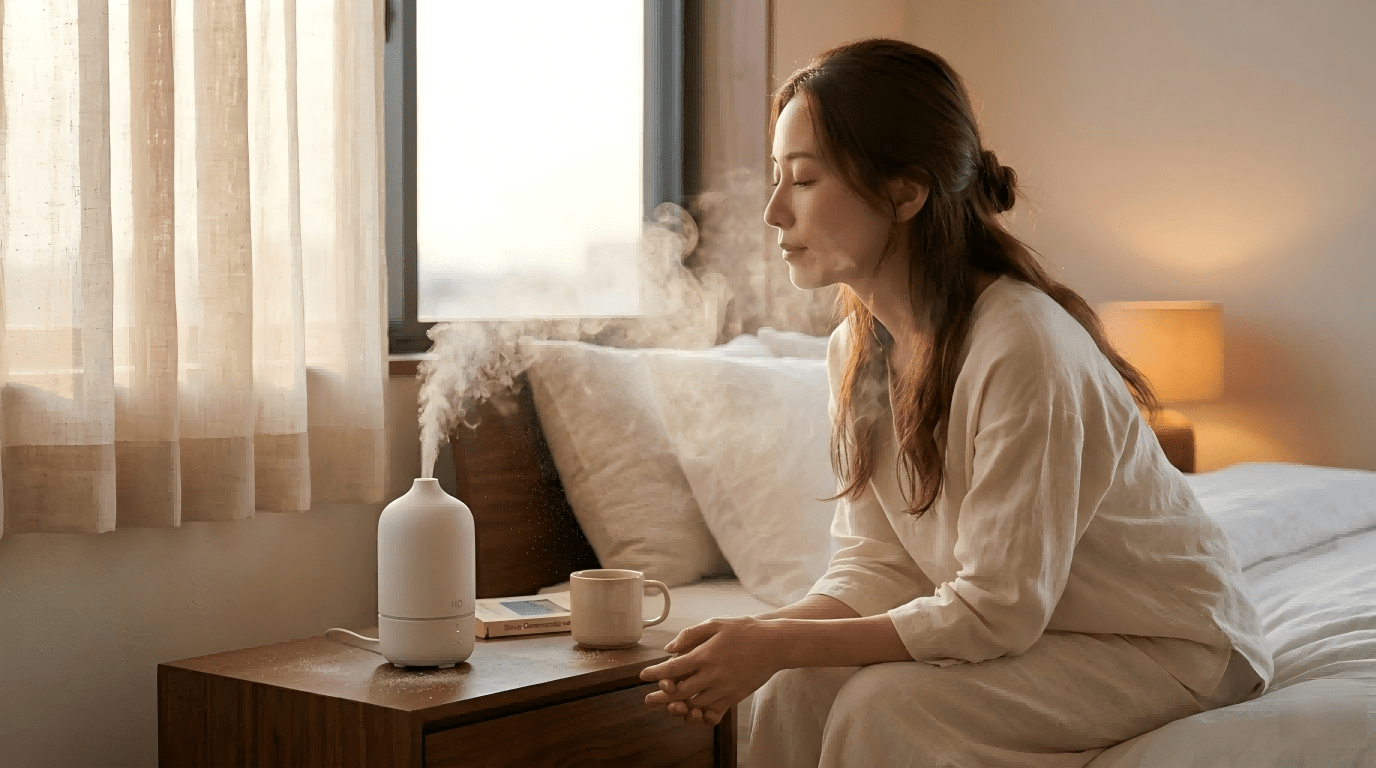
Y&O glass steam diffuser on nightstand in warm evening bedroom — book, tea cup, soft amber light, pure steam rising — sleep ritual scene

Stop Wiping White Dust Off Your Furniture

The Y&O Yo-A1 uses 212°F steam sterilization to keep minerals in the tank — not in your air. Borosilicate glass, 8-hour runtime, zero white dust.

Shop the Yo-A1 Steam Diffuser →

Frequently asked questions

If I switch to distilled water, does that completely fix the white dust problem?

For white mineral dust specifically — yes, distilled water is effective. Minerals have been removed before the water enters the tank, so there's nothing mineral-laden to aerosolize.

It doesn't address the biofilm and bacteria concern, because standing water at room temperature supports microbial growth regardless of mineral content. It's also an ongoing logistical commitment at $1–2/gallon — one most people start with good intentions and gradually abandon.

Distilled water is the right fix if you want to keep your current ultrasonic unit running. It's treating the symptom rather than the mechanism.

How do I know if my city's water is making the problem worse?

Your water utility publishes a Consumer Confidence Report (CCR) annually — it lists total dissolved solids (TDS) and water hardness. You can also find regional averages via the USGS water hardness database.

Under 120 mg/L = soft water. 120–180 mg/L = moderately hard. Above 180 mg/L = hard water. Phoenix, Las Vegas, Los Angeles, Denver, and Calgary are all significantly above 180 mg/L. Seattle, Portland, and Vancouver are well below 60 mg/L.

If you've relocated recently and suddenly find white dust far worse than before, your new city's water hardness is almost certainly the explanation.

Is a steam diffuser safe to run in a baby's room overnight?

Steam diffusers with borosilicate glass tanks, auto-shutoff, and anti-tip bases are generally considered appropriate for family environments. Several parents in community discussions specifically cited the sterile steam output as the reason they felt comfortable running one in an infant's room.

That said, any decision about what runs unattended in a space shared with an infant should involve your pediatrician. The EPA's indoor air quality guidance recommends caution with any humidification device near infants, with particular attention to cleanliness and water quality.

Steam diffusion addresses the microbial concern that applies to ultrasonic units. The pediatrician conversation still stands.

Will my essential oils smell different in a steam diffuser vs. an ultrasonic?

For the most commonly used oils — lavender, eucalyptus, peppermint, citrus blends, tea tree, frankincense — the experience is comparable or better. Multiple reviewers noted that warm steam delivers a more even room distribution than cold ultrasonic mist, which tends to project strongly near the unit and fade quickly.

A small number of highly heat-sensitive floral or resinous specialty oils (some jasmine absolutes, certain rose extracts) can have slightly altered aromatic profiles at 122°F. If you work with expensive or specialized oils, test a small quantity before committing to the switch.

The oil tray design — which keeps oils separate from the water — means the steam carries the fragrance rather than diluting it, which most users experience as a purer scent profile compared to oils mixed directly into an ultrasonic tank.

How often does a steam diffuser need to be cleaned?

Significantly less often than an ultrasonic diffuser, because the 212°F boil cycle prevents biofilm formation. A weekly rinse and occasional wipe-down of the oil tray is typically sufficient for regular use.

Scale (mineral deposits from the boiling process) will accumulate in the tank bottom over time — the same way it builds inside a kettle. A periodic soak with diluted white vinegar dissolves it easily. The transparent glass tank makes it simple to see when cleaning is due.

Glass doesn't absorb essential oil residue, so there's no scent carry-over between different oils — another maintenance advantage over plastic-tank ultrasonic units.


Reviewed by Olivia Chen

Product Engineering · Air Quality & Diffusion Systems

Technical review covers diffusion mechanism accuracy, PM2.5 characterizations, materials science claims (borosilicate glass properties, plastic leaching literature), and water hardness data sourcing. Last reviewed May 2026.

Health & Medical Notice: The information in this article is for general educational purposes only and does not constitute medical advice. References to EPA particulate matter research and community-reported experiences are provided for informational context and do not imply medical conclusions. If you or anyone in your household experiences respiratory symptoms you believe may be related to diffuser or humidifier use, consult a qualified healthcare provider. Decisions about running any diffusion device in spaces occupied by infants, children, or individuals with respiratory conditions should be made in consultation with a physician or pediatrician.

Data sources & references

  1. U.S. Environmental Protection Agency — Particulate Matter (PM) Pollution. epa.gov/pm-pollution
  2. U.S. Environmental Protection Agency — Indoor Air Quality. epa.gov/indoor-air-quality-iaq
  3. U.S. Geological Survey — Water Hardness. usgs.gov — water hardness
  4. ASHRAE — Indoor Air Quality Standards. ashrae.org
  5. Justia Patents — Patent No. 11,052,167 (Thermal sterilization glass diffuser). patents.justia.com/patent/11052167
  6. Non-Toxic Dad — "The Wrong Humidifier Can Be TOXIC!" (32,020 views, Jan 2026). youtube.com/watch?v=sdjsRDdcGS8
  7. KG Simple Reviews — "2026's Best Non-Toxic Glass Essential Oil Diffuser Review." youtube.com/watch?v=PEzLVU8vZ5M
  8. Antonio Sanson — "Best Essential Oil Aroma Diffuser in 2026." youtube.com/watch?v=LftzAfIxdmc
  9. The Nutmeg Home — "What Kind of Diffuser Is Best? Y&O Non Toxic Glass Diffuser Review." youtube.com/watch?v=CdlD08m6kKQ
  10. NReluctant — "Best Essential Oil Diffusers of 2026." youtube.com/watch?v=ppZqnr4aeuk
  11. Reddit r/Asthma — community thread on diffuser use and respiratory symptoms. reddit.com/r/Asthma/comments/1s90gxo/
  12. Reddit r/nontoxic — thread on biofilm and diffuser safety. reddit.com/r/nontoxic/comments/1s3ww02/
  13. Reddit r/BuyItForLife — thread on long-term diffuser value. reddit.com/r/BuyItForLife/comments/1rvys6d/
  14. Reddit r/essentialoils — thread on glass steam diffusers. reddit.com/r/essentialoils/comments/1sl0xhj/
  15. Y&O Product Page — 1.6L Glass Essential Oil Aroma Steamer Humidifier. yoairpro.com/products/…