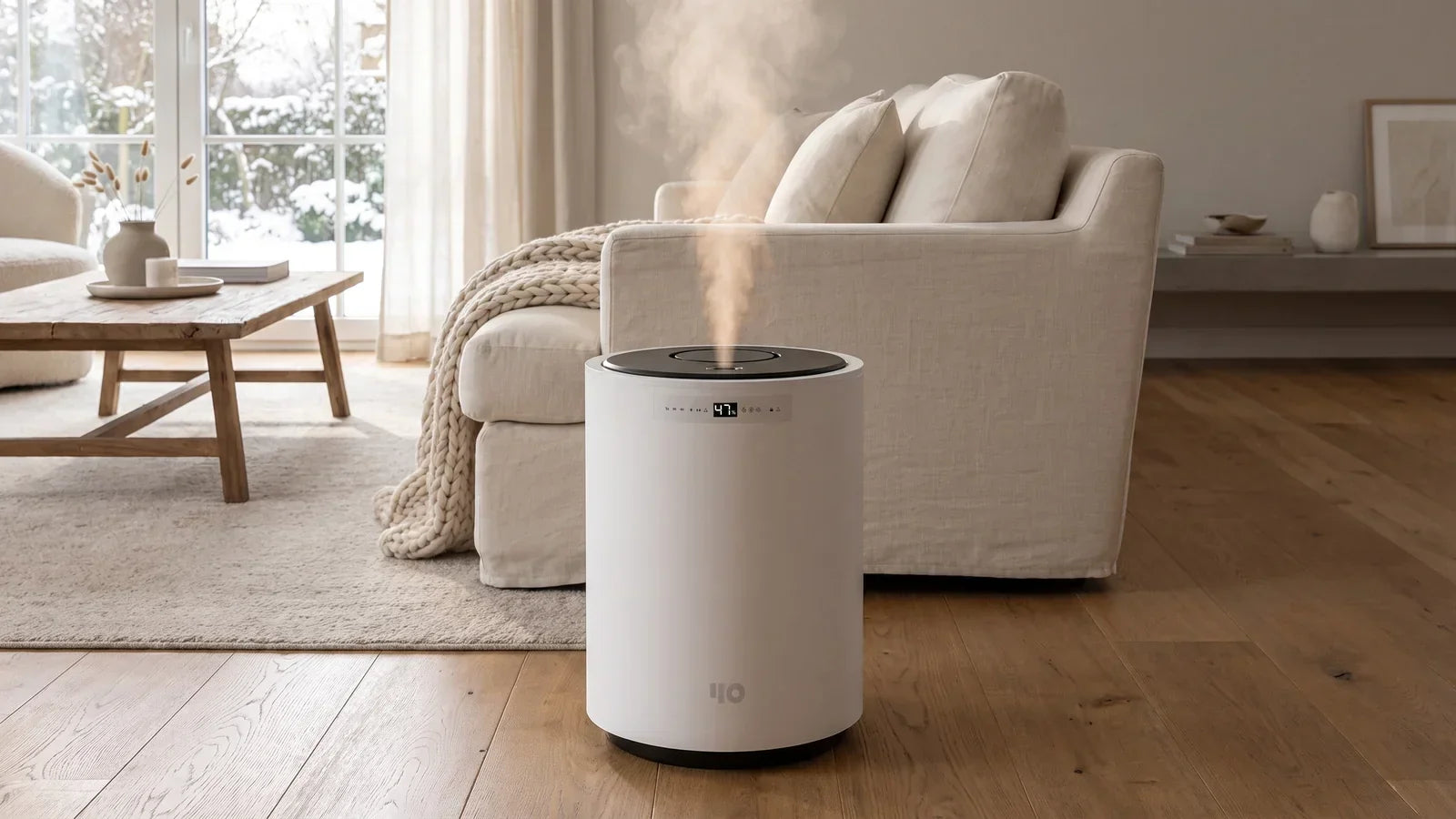

Carepod, Canopy, and Levoit are the three humidifiers most people cross-shop before they land on a steam unit — so we put all four side by side on the dimensions buyers actually ask us about, using each brand's own published numbers. The short version: they win on different things. Levoit is the cheapest and quietest. Carepod is the easiest to clean. Canopy keeps tap water dust-free. A 10L steam unit moves the most moisture and takes tap water without a filter — but costs the most and runs the loudest. Below is the full head-to-head, dimension by dimension, including where ours loses.
Across the Carepod One, Canopy Humidifier Plus, Levoit OasisMist 1000S, and the Y&O 10L Steam humidifier, no single unit wins every row — the pick depends on your water, your room size, and your budget, and every figure below comes from each brand's own page (checked July 2026). The Y&O 10L Steam puts out about 1,200 mL/h, roughly 3.4× the ~350–400 mL/h of the Carepod and Levoit ultrasonic units, and holds an open 1,000 sq ft on tap water with no filter — but it is the loudest and, at about $399, the priciest. The Levoit is the cheapest (~$150) and near-silent (≤28 dB), yet its own page prefers distilled water. The Carepod ($279) is the easiest to clean — stainless and dishwasher-safe — but recommends filtered water. The Canopy ($255) leaves no white dust, at the cost of a filter subscription near $138 a year. Read the "ongoing cost" column, not the sticker: the cheapest machine on day one is rarely the cheapest to own.
The short answer
| If you want… | Buy | Why |
|---|---|---|
| The lowest price + near silence | Levoit OasisMist 1000S | ~$150, ≤28 dB, 10L runs for days |
| The easiest cleaning, premium feel | Carepod One | Stainless, 3 washable parts, dishwasher-safe |
| No white dust on tap water, no fuss | Canopy Humidifier Plus | Evaporative, UV, covers 1,000 sq ft |
| Most output for a big/hard-water home, no filters | Y&O 10L Steam | 1,200 mL/h, tap water, no filter — costs more, louder |
Every competitor figure below comes from that brand's own product page, checked July 2026. Prices and specs move, so confirm before you buy.
1. Humidifying power & room size
This is the dimension that separates these machines most, and the one shoppers most often get wrong by staring at tank size. What matters is output — how much moisture the machine actually puts into the air per hour — and it varies more than 3× across these four.
| Carepod One | Levoit 1000S | Canopy Plus | Y&O 10L Steam | |
|---|---|---|---|---|
| Max output | ~400 mL/h* | 350 mL/h | Evaporative (self-limiting) | 1,200 mL/h |
| Rated coverage | 500 sq ft | 300–600 sq ft | 1,000 sq ft | 1,000 sq ft |
| Tank | 4L | 10L | 18–36 hr/fill | 10L (dual 5L) |
*Carepod publishes 30 hr at level 1 and 10 hr at level 3 on its 4L tank, which works out to roughly 400 mL/h at the top setting.
At full tilt a steam unit puts out about three times what the ultrasonic units do — 1,200 mL/h versus 350–400 — which is why it's rated to hold humidity across an open 1,000 sq ft space while the Levoit, despite its big tank, is rated for 300–600. Canopy also claims 1,000 sq ft, but evaporative output is self-limiting by design: it slows as the air gets damp, which is gentle and safe but slow to recover a very dry room.
Now the tank-size trap. The Levoit and our steam unit both carry 10L, which looks like a tie and isn't. Run the numbers at full output: at 350 mL/h the Levoit drains 10L in about 29 hours, while at 1,200 mL/h our steam unit empties the same tank in roughly eight. Same 10L, but the steam unit clears it in a night because it is doing about 3.4 times the work — which is exactly why it is rated for a far larger room. (Levoit advertises "up to 100 hours," but that is its lowest, barely-misting setting, not the output that fills a room.) The big tank isn't a brag; it's the minimum that keeps a high-output machine from running dry overnight. Buyers in large, open-plan spaces tell us it holds a comfortable mid-range humidity through deep winter — that reach is what the output buys, and the refill frequency is what it costs. More on real-room coverage in choosing a humidifier for large rooms.

2. White dust & water quality
This is where the ultrasonic units carry a hidden cost. An ultrasonic humidifier vibrates water into a cold fog, and whatever is dissolved in the water — calcium, magnesium — gets flung into the room with it. On hard tap water that becomes the fine white dust that settles on furniture and screens.
| Carepod | Levoit | Canopy | Y&O Steam | |
|---|---|---|---|---|
| White dust on tap water | Yes | Yes | No | No |
| Water the brand asks for | "Filtered recommended" | "Distilled preferred" | Tap | Tap |
You don't have to take our word for it — it's why Carepod's own page recommends filtered water and Levoit's recommends distilled or purified. Neither uses a filter, so both read as "filter-free," but they move the cost onto your water supply for the life of the machine. Evaporative and steam both dodge dust entirely: Canopy traps minerals in its wick, and a steam unit leaves them in the boiling chamber. If you have soft water this whole row is a non-issue; on hard municipal water it's the single biggest reason people abandon an ultrasonic unit. Our tap-water guide shows how to tell which camp you're in.

3. Sterilization & what's in the mist
Every brand here has a hygiene story, but they mean different things, and the difference matters. The honest distinction most listings blur: sterilizing the water or the parts is not the same as putting out a clean mist.
- Carepod advertises "99.9% sterilizable" — which refers to the stainless-steel parts you can wash or boil clean, not to the mist itself. A clean tank still sprays whatever minerals are in the water.
- Canopy runs the water past a UV light and uses mold-inhibiting parts to keep the inside of the device clean. That treats the water and the machine; the output is invisible evaporation.
- Levoit makes no sterilization claim — it's a straightforward ultrasonic unit, which is part of why it recommends distilled water.
- Steam (ours) takes a different route: it boils the water to 100 °C before releasing it as vapor, so the water is heat-treated as part of making humidity, not in a separate step — the microbe question is answered by the boil itself, not by a filter or a lamp.
The practical takeaway: boiling and UV both act on the water; a "sterilizable" stainless tank is about how easily you can clean it, not about the mist. If clean output on ordinary tap water is your priority, the boil-first and evaporative designs have the structural edge, because an ultrasonic unit is only ever as clean as the water you pour in.
4. Cleaning, mold & consumables
In the communities we follow, the most common humidifier complaint is mold, and right behind it, "I stopped cleaning it because it was a hassle." So the real cleaning question isn't what the box says — it's whether the design survives the week you're too busy to care.
| Carepod | Levoit | Canopy | Y&O Steam | |
|---|---|---|---|---|
| Consumable to buy | None | None | Wick, ~$17/45 days | None |
| Where mold can grow | Standing tank water | Standing tank water | The wet wick | Boil-off, no wick |
| Ease of cleaning | Best (3 parts, dishwasher) | Rinse plastic tank | Dishwasher parts + wick swap | Dual tanks; descale element |
Carepod genuinely earns its reputation here — a stainless body, three washable parts, dishwasher-safe, the easiest of the four to keep clean. Canopy's UV-and-airflow system fights mold inside the device, but the wick is still a damp surface you must replace on schedule and pay for. Our steam unit has no wick to grow anything and splits into two 5L tanks you wash one at a time — but we'll name our own asterisk plainly: heating water leaves scale on the element, so a steam unit needs descaling more often than a cool-mist one, not less. Anyone who calls a heated humidifier maintenance-free has never run one in a hard-water city. Mold risk tracks the technology — it lives on wet wicks and in standing water — which is why filter-free and boil-first designs sidestep the worst of it; more in humidity, humidifiers, and mold.
5. Noise, warm vs. cool mist
| Carepod | Levoit | Canopy | Y&O Steam | |
|---|---|---|---|---|
| Noise | Very quiet | ≤28 dB | Soft fan | Loudest (boil + fan) |
| Mist temperature | Cool | Cool | No mist | Warm |
Ultrasonic wins noise and it isn't close — the Levoit's rated 28 dB is near-silent, which is exactly why ultrasonic owns the bedside category. Steam is the loudest of the four: you hear water coming to a boil plus a low fan, and on a high setting it's audible. Our light-sleeper buyers are blunt about it and run the low sleep setting overnight; if silence in a small bedroom is non-negotiable, that's a real mark against steam and we'll say so. The flip side is warmth: boiling produces warm vapor, which in a cold, over-heated winter room reads as a comfort feature — several buyers who worried it would feel hot report the opposite once it mixes in. Cool-mist units, by design, don't add that warmth. Which you want is a climate question, not a budget one.
6. Dry-air comfort & the baby question
People ask us to just name the "healthiest" or "safest" pick, and the honest answer is that it depends on which risk you'd rather manage — so here's the plain version, kept to comfort and hygiene rather than any medical promise.
All four raise humidity, which is what eases the dry-air discomfort — dry skin, dry nasal passages, static, cracking wood — that sends people shopping in heating season. The differences are about what each machine doesn't put in the air. Ultrasonic units on hard tap water add mineral particles (the white-dust issue), which is why they steer you to filtered water for a nursery. Evaporative and steam keep those minerals out — the wick traps them, boiling leaves them behind. On safety, the tradeoff flips: ultrasonic mist is cool and touch-safe, which is why Carepod markets hard to nurseries; a steam unit produces heat and a hot surface, so placement matters more — it belongs on the floor, out of reach, never on a changing table. There's no universally "safest" humidifier here; there's the cool-but-mineral tradeoff of ultrasonic and the mineral-free-but-hot tradeoff of steam, and which you prefer depends on your water and your room.
7. Price & the cost after checkout
| Carepod | Levoit | Canopy | Y&O Steam | |
|---|---|---|---|---|
| Upfront | $279 | ~$150 | $255 | $399 |
| Ongoing | Filtered water | Distilled water | ~$138/yr filters | Tap water only |
The sticker order is Levoit, Canopy, Carepod, then us — but the sticker is only half the bill. Canopy's filters run roughly $138 a year at the one-time price, about $122 on subscription; the ultrasonic units cost you in distilled water or filtration for as long as you own them; a steam unit's ongoing cost is just tap water and a bit more of your time refilling. Over three years the gaps narrow more than the price tags suggest — which is the whole reason we told you to read the "ongoing" column first.
Who should actually buy which
We sell one of these, so the useful thing we can do is tell you when not to buy ours:
- Soft water, a bedroom, tight budget, silence matters → the Levoit. Cheap, near-silent, runs for days. Paying $399 for steam to sit in a small quiet room is a waste and we'd rather you didn't.
- Lowest-effort cleaning, a premium object, small-to-mid room, soft or filtered water → the Carepod earns its price. Just don't run hard tap through it and expect no dust.
- Zero dust on tap water and a filter subscription doesn't bother you → Canopy, especially up to 1,000 sq ft.
- A large or open space, hard water, and you're done buying distilled water or filters → this is the case a 10L steam unit is built for. You accept more refills, periodic descaling, and more noise for tap-water simplicity and the output to hold a big room. Full spec on our 10L steam humidifier.
One line ties it together: several of these give you two of the three things people want — no dust, no filters, no special water — but only steam gives all three at once, because boiling is the one method that both leaves minerals behind and needs no consumable to do it. That combination is what the higher price and extra refills buy. If it's not what your home needs, one of the others is the smarter purchase, and we just told you which. Background in steam vs ultrasonic vs evaporative and our filter-free steam guide.
FAQ
Which puts out the most moisture?
The steam unit, by a wide margin — about 1,200 mL/h versus roughly 350–400 mL/h for the Carepod and Levoit ultrasonic units, with Canopy's evaporative output self-limiting by design. That's why the steam unit is rated to hold humidity across an open 1,000 sq ft, while the 10L Levoit is rated for 300–600.
Why is a 10L Levoit rated for a smaller room than a 10L steam unit?
Tank size isn't coverage. At full output the Levoit runs ~350 mL/h, draining 10L in about 29 hours while covering 300–600 sq ft. A steam unit runs up to ~1,200 mL/h — about 3.4× more — so it holds a larger space but empties the same tank in a night. (Levoit's "up to 100 hours" is its lowest, barely-misting setting.)
Which humidifier doesn't leave white dust or need distilled water?
Evaporative (Canopy) and steam (ours) both take tap water without white dust — the wick traps minerals, boiling leaves them in the chamber. The ultrasonic units, Carepod and Levoit, are the ones whose own pages recommend filtered or distilled water, because they spray whatever is dissolved in the tank.
Which is easiest to keep clean and mold-free?
Carepod for sheer ease — stainless, three parts, dishwasher-safe. For mold specifically, the risk lives on wet wicks and in standing water, so the filter-free and boil-first designs avoid the worst of it. Steam's tradeoff is that the heating element needs descaling more often than a cool-mist unit.
Is a $399 steam humidifier worth it over a $150 Levoit?
Only in the right home. Soft water and a bedroom? The Levoit is the smarter buy. Hard water or an open floor plan? A steam unit avoids both white dust and filters while covering more space and putting out far more moisture — which is where the higher price and extra upkeep start to pay for themselves.
Keep reading
- Steam vs ultrasonic vs evaporative
- Hard water, white dust, and your air
- Why filter-free steam changes the upkeep
- Can you use tap water in a humidifier?
- Humidifiers for large rooms
- Humidity, humidifiers, and mold
Sources (each brand's own page, checked July 2026)