
If your tap water is hard, the question isn't which humidifier is "best" in the abstract — it's which one deals with the minerals in your water without turning into a chore or a running bill. The short version: ultrasonic units spray minerals into the air as white dust, evaporative units trap them in a wick you replace every 30–60 days, and steam units boil them off into the tank so you can run plain tap water and just descale. Below we sort the three types by exactly that — using each brand's own published specs — and say plainly where our own steam machine is the right answer and where it's overkill.
The short answer for hard water
The best humidifier for hard water is a steam unit like the Y&O-M2 Steam Plus, because on hard water the machine you choose is really a decision about where the dissolved minerals end up — and boiling is the only common method that keeps them out of your air without a filter or a jug of distilled water. Hard water, by the USGS definition, carries more than 180 mg/L of dissolved calcium and magnesium (that's the "very hard" band), and every bit of that mineral has to go somewhere. An ultrasonic humidifier flings it into the room as white dust. An evaporative unit catches it in a wick you throw away on a schedule. A steam humidifier boils the water, leaves the minerals behind in the tank as scale, and releases mineral-free vapor — so you run ordinary tap water and only have to descale. Match the method to your water, not the sticker price, and most of the hard-water complaints disappear before you ever buy.
Humidifier types on hard water, side by side
Here are the three humidifier technologies scored on the four things that actually matter when your water is hard: whether they throw white dust, what you have to keep buying, the yearly upkeep that creates, and a real representative model you can look up. Notice that no type is free — each one moves the hard-water cost to a different place, and the right pick is the one whose cost you'd rather live with.
| Type | White dust on hard water | Consumable you keep buying | Yearly upkeep | Representative model |
|---|---|---|---|---|
| Ultrasonic (cool mist) | Yes — atomizes minerals into the air | Distilled water, if you switch to stop the dust | Ongoing distilled-water runs; no filter | Levoit Classic 300S |
| Evaporative (wick) | No — wick captures the minerals | Wick filter (Honeywell HAC-504) | ~6–12 wicks a year (30–60-day interval) | Honeywell HCM-350 |
| Steam (boils water) | No — minerals stay in the tank | None — plain tap water, no filter | Descaling only (citric acid, no purchases) | Y&O-M2 Steam Plus |
Every competitor figure here comes from that brand's own product page or manual, checked September 2026: Levoit's Classic 300S is ultrasonic, Honeywell's HCM-350 is evaporative and its manual calls for replacing the HAC-504 wick every 30–60 days, and the USGS "very hard" threshold above is straight from its water-science pages. Read the "consumable" column before anything else — on hard water, that column, not the purchase price, is what people end up regretting.
Why each type struggles on hard water
Two of these three types don't put minerals in your air, but each one still hands you a hard-water bill somewhere. Start with ultrasonic, because it's the most popular category and the one that surprises people. An ultrasonic humidifier vibrates water into a cold fog, so whatever is dissolved in the water rides that fog into the room; on hard water that's the fine white dust that settles on furniture and dark screens (we cover the mechanism in that piece — here we're only ranking machines). The practical hard-water problem with ultrasonic is that the fix — switching to distilled water — becomes a permanent grocery-run cost that never shows up on the box.
Evaporative wick machines solve the dust honestly: a fan pulls air through a wet wick, the minerals stay in the wick, and only clean vapor leaves. The catch is that the wick is doing the mineral-trapping, so hard water loads it up faster. Honeywell's own manual for the HCM-350 says to replace the HAC-504 wick every 30–60 days — and hard water pushes you toward the short end of that window, because a mineral-stiffened wick wicks less water and can start to smell. An evaporative unit trades white dust for a wick you buy six to twelve times a year, which on hard water is the fastest-cycling consumable of the three types. If a filter you forget to change is your real worry, our filter-free steam guide explains why removing the wick removes that whole failure mode.
Why steam is the hard-water answer
A steam humidifier sidesteps both bills at once. It boils the water inside a sealed chamber, which leaves the calcium and magnesium behind as scale on the heating element and sends out mineral-free water vapor — so there's no white dust to wipe up and no reason to buy distilled water. That's the core reason steam exists as a category: it's the one common method that gives you dust-free humidity and lets you keep filling from the tap. On hard water, steam is the only type in the table that charges you nothing on a recurring basis — no distilled water, no wick — because the minerals it captures cost you effort, not money.
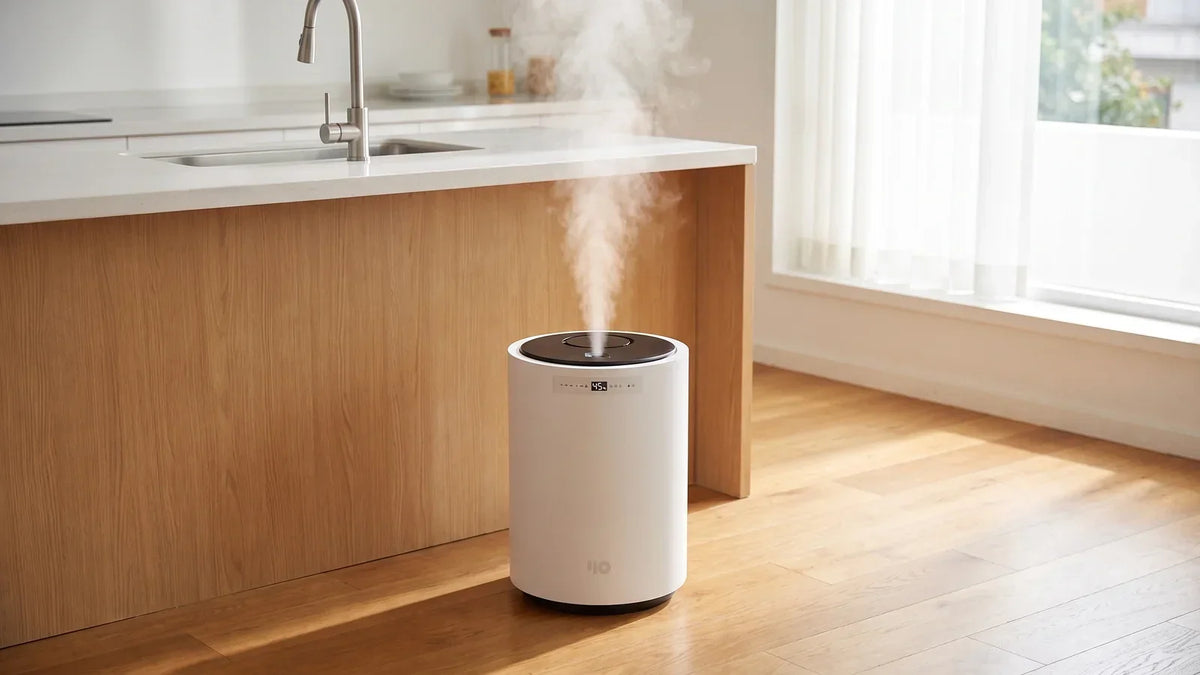
For a concrete example on the same dimensions, our Y&O-M2 Steam Plus runs up to 1,200 mL/h from a 10 L dual-tank design and is rated for spaces up to 1,000 sq ft on ordinary tap water, with no wick to reorder. It boils in a sealed chamber to handle the minerals, then cools the vapor before it exits, so the mist that reaches the room is cool to the touch rather than the hot steam of a warm-mist unit. We test our own units on ordinary tap water rather than laboratory water, and across the 400-plus homes we've shipped to, the buyers who love ours most are the hard-water ones who were tired of hauling distilled water or swapping wicks. If scent is what you want, don't reach for the tank — the Steam Plus isn't built for essential oils, so Y&O sells a separate glass Steam Aroma diffuser for that instead.

Built for hard-water homes
The Y&O-M2 Steam Plus boils away the minerals so you run straight tap water — no white dust, no wick, no distilled-water runs. Just descale on a schedule.
The honest downside of steam
Steam is not a free lunch, and on hard water its one real chore gets more frequent, not less. Because boiling concentrates the minerals in the tank, a steam unit builds scale faster than a cool-mist machine — so on very hard water you should plan to descale every 1–2 weeks rather than monthly. Steam trades a recurring purchase for a recurring cleaning: you stop buying distilled water and wicks, but you pick up a descaling routine you can't skip. The routine itself is cheap and quick — for the Y&O-M2 that's about 20 g of citric acid in the tank, heated 10–15 minutes and soaked 20–30 minutes, then rinsed; the step-by-step is in our descaling guide.
The other honest notes: a steam unit uses more electricity because it's heating water, and it's the loudest of the three types since you can hear the water come to a boil. If you have a small bedroom on soft water, a quiet ultrasonic or an evaporative unit is the smarter buy, and we'd rather you got one — steam earns its keep in large, hard-water rooms, not everywhere. For a side-by-side of the underlying methods, see our tap-water humidifier guide.
How to check how hard your water is
Before you pick a type, confirm you actually have hard water — a lot of "white dust" panic is really soft-water homes over-worrying, and a lot of wick frustration is very-hard-water homes under-estimating. The fastest checks: read your municipal water report (utilities publish hardness in mg/L or grains per gallon), drop in a $10 hardness test strip, or look up your city. If your water tests above 180 mg/L you're in the USGS "very hard" band, and the consumable column above matters more than any other spec on the page. Our U.S. water-hardness map and hardest-water-cities list let you look up your area in a few seconds.
FAQ
What is the best type of humidifier for hard water?
A steam humidifier. On hard water the real question is where the dissolved minerals go: ultrasonic units spray them into the air as white dust, evaporative units trap them in a wick you replace every 30–60 days, and steam units boil them off into the tank so the vapor is mineral-free. Steam is the only common type that gives you dust-free humidity while still letting you fill from the tap.
Which humidifier does not need distilled water?
Steam and evaporative units both run fine on hard tap water. A steam humidifier boils the minerals off into the tank, and an evaporative unit traps them in its wick, so neither needs distilled water. Ultrasonic units are the ones that push owners toward distilled water, because they atomize whatever is dissolved in the water into visible white dust.
Does a steam humidifier make white dust on hard water?
No. A steam humidifier heats water to a boil, which leaves the calcium and magnesium behind as scale in the tank and sends out mineral-free vapor. That's why it produces no airborne white dust even on very hard water (above 180 mg/L by the USGS scale) — the trade-off is that you descale the tank more often.
Is an evaporative humidifier good for hard water?
It's a reasonable dust-free option, with one recurring cost. The wick captures the minerals so nothing sprays into the room, but Honeywell's manual for the HCM-350 says to replace the HAC-504 wick every 30–60 days, and hard water pushes you toward the shorter end of that window. Budget for roughly six to twelve wicks a year if you go this route.
How often do I have to descale a humidifier on hard water?
On a steam unit with very hard water, plan on descaling every 1–2 weeks rather than monthly, because boiling concentrates minerals faster. For the Y&O-M2 Steam Plus that's about 20 g of citric acid in the tank, heated 10–15 minutes and soaked 20–30 minutes, then rinsed. Cool-mist units scale more slowly but still need periodic cleaning.
Keep reading
- Steam vs ultrasonic vs evaporative
- Hard water, white dust, and your air
- Can you use tap water in a humidifier?
- Why filter-free steam changes the upkeep
- How to descale and clean a humidifier
- The hardest-water cities in the U.S.
Sources (each brand's own page/manual + USGS, checked September 2026)
- USGS — Water hardness classifications (soft, moderately hard, hard, very hard >180 mg/L)
- Honeywell HCM-350 — official product page (evaporative, 1.1 gal, HAC-504 wick, replace every 30–60 days, captures minerals)
- Levoit Classic 300S — official product page (ultrasonic cool mist, 6 L tank)
- RTINGS — Levoit Classic 300S independent review (ultrasonic mineral output / white dust)
- Y&O-M2 Steam Plus 10L — product page (1,200 mL/h, up to 1,000 sq ft, tap water, no filter)