
The Canopy Bedside Humidifier is one of the most loved bedroom humidifiers on the market — it’s beautifully designed, it has a reading light and a white-noise machine, and it’s built around a hygiene-first, no-white-dust story. It’s also a filter machine, which shapes almost everything about how it performs and what it costs to live with. Judged on humidification alone, an evaporative filter humidifier like the Canopy is gentle and clean but inherently slower, smaller in reach, and tied to a filter you replace forever — while a steam humidifier makes moisture a fundamentally different way that trades the bedside niceties for far more power and no filter at all. Here’s the honest, principle-first comparison, using Canopy’s own specs, an independent lab-style review, and EPA guidance.
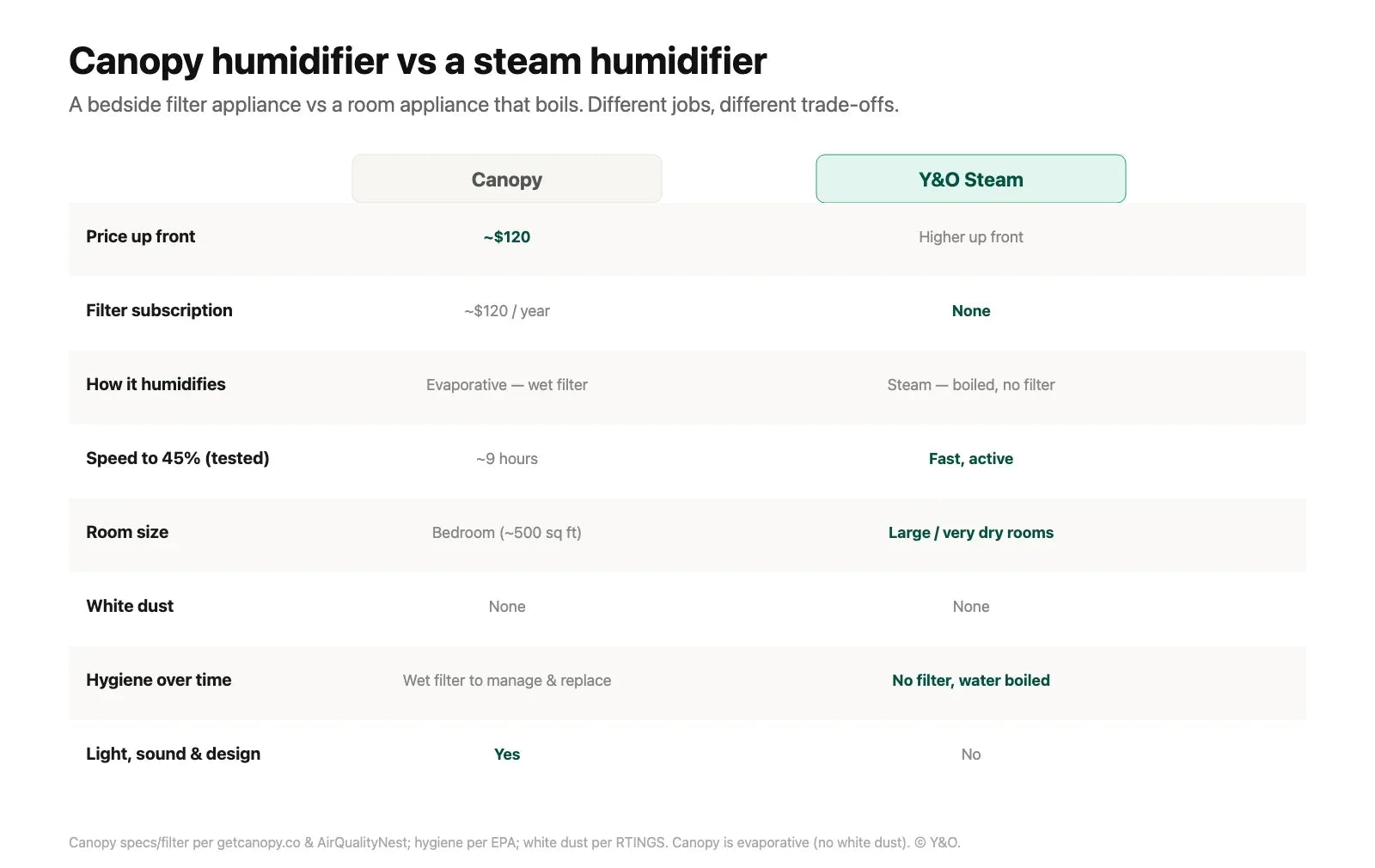
The Canopy Bedside Humidifier (about $120, per AirQualityNest) and the Y&O Steam Plus are built for different jobs, and the filter is what separates them. The Canopy is a design-led evaporative unit — a reading light, a white-noise machine, and an aroma pod wrapped around a humidifier that wicks water off a replaceable paper filter and leaves no white dust on tap water. But evaporative output is slow: independent testing clocked it at about 9 hours to bring a room to 45% humidity, and its reach is rated near 500 sq ft (AirQualityNest). The paper filter is replaced roughly every 45 days at $15 — close to $120 a year, indefinitely. The Y&O Steam Plus boils its 10L tank for roughly 1,200 mL/h of active output rated to about 1,000 sq ft (Y&O), sterilizes the water by boiling, and has no filter or wick to buy — ever. Both machines avoid white dust; only steam avoids the recurring filter bill.
| Spec | Canopy Bedside Humidifier | Y&O Steam Plus |
|---|---|---|
| Humidifying method | Evaporative — fan through a wet paper filter | Steam — boils water to vapor |
| Speed & reach | ~9 hrs to 45%; rated ~500 sq ft (AirQualityNest) | ~1,200 mL/h; rated ~1,000 sq ft (Y&O) |
| Filter / consumable | Paper filter ~$15 / 45 days ≈ $120/yr (AirQualityNest) | None — no filter, no wick |
| White dust on tap water | None (minerals trapped in filter) | None (minerals stay in tank) |
| Hygiene | UV-treated water + dishwasher parts, but a permanently wet filter | Boiling sterilizes the water; no wick to foul |
| Extras | Reading light, white-noise machine, aroma pod | Humidifies only |
| Price up front | ~$120 (AirQualityNest) | Higher up front; no filter bill after |
Canopy figures come from an independent review; the Y&O numbers are our own published specs. To see the Canopy measured against Carepod and Levoit as well, read Carepod vs Canopy vs Levoit vs a steam humidifier.
The short answer
The Canopy humidifier is an excellent bedside appliance — a humidifier wrapped in a reading light, a sound machine, and a genuinely nice design. But as a humidifier it’s an evaporative, filter-based unit, which means it’s slow to raise a room, capped at bedroom-sized coverage, and carries a filter you pay for indefinitely; a steam humidifier is the opposite trade. The quick version:
| If you want… | Better pick | Why |
|---|---|---|
| A bedside piece with a light, sound & great looks | Canopy | Genuinely nice design and features a bare humidifier doesn’t have |
| To actually raise a large or very dry room, fast | Steam | Active boiling; evaporative took 9 hrs to hit 45% in testing |
| No filter to buy and no ~$120/year subscription | Steam | No paper filter to replace ever; Canopy’s runs $15 every 45 days |
| The lowest-maintenance hygiene over years | Steam | Boils the water, no wet filter to foul; a filter is a managed problem |
1. How each one makes moisture
Everything below follows from one mechanical choice, so it’s worth being clear about the three methods first.
The Canopy is evaporative, with a filter at its heart. Water wicks up through a paper filter — Canopy’s is “90% paper” (Canopy) — and a fan blows room air through the wet filter, which carries moisture off as an invisible vapor. The minerals in your water are trapped in the paper rather than sprayed into the room, which is the source of Canopy’s clean, no-white-dust reputation. The catch built into the method: the moisture-making part is a permanently wet paper filter.
A steam humidifier, like the Y&O Steam Plus, boils the water. A heating element brings it to a boil, which turns it to pure vapor and kills bacteria in the water along the way; the minerals stay in the tank, and the vapor is cooled before it leaves so it isn’t scalding. There is no filter and no wet wick anywhere in the machine — the water goes in, gets boiled, and comes out as clean vapor.
Ultrasonic units — most cheap humidifiers — vibrate a disc to fling water into a visible cool mist, which throws whatever is in the water, minerals and microbes alike, into the air. It’s the method the EPA warns about most, and it’s worth knowing where it sits, but it isn’t what the Canopy humidifier or a steam unit does. Hold these three in mind: evaporative wicks off a wet filter, steam boils, ultrasonic atomizes — the rest of this page is just consequences.
2. Humidifying power, speed & room size
This is where the evaporative principle shows its hard ceiling. An evaporative humidifier can only add moisture as fast as air can lift it off the wet filter — and that rate is slow, and it falls further as the room gets more humid, because moister air evaporates water more slowly. It isn’t a tuning problem; it’s the physics of evaporation. In independent testing, the Canopy humidifier took about 9 hours to bring a room to 45% humidity, versus roughly 3.5 hours for a high-output unit (AirQualityNest). That’s fine for gently holding a bedroom overnight, which is exactly what it’s built for — its coverage is rated to about 500 sq ft, bedroom scale.
Steam works the opposite way: it’s an active, high-output method that keeps pushing moisture at the same rate no matter how humid the room gets, because it’s boiling water rather than waiting for evaporation. That’s what a large open-plan space or a bone-dry winter apartment actually needs — the ability to drive humidity up quickly and hold it in a big volume, which is the case laid out in humidifying large rooms and the driest winter indoor air. The honest flip side is that this active output uses more electricity than a quiet evaporative fan, and evaporative’s self-limiting gentleness is a genuine plus if all you ever want is a steady bedroom level. But if the job is raising the humidity of real square footage, evaporative simply can’t keep up with steam, and no amount of design changes that.
3. The filter you keep buying
The single biggest difference in ownership isn’t the sticker price — it’s the filter. The Canopy’s paper filter has to be replaced roughly every 45 days at $15 a time, which works out to about $120 a year, every year you own it (AirQualityNest). Canopy sells it as a subscription for exactly that reason: the machine is designed around a consumable, so the cost never really stops.
A steam humidifier has no filter to buy, ever — there’s nothing to subscribe to. Because it boils rather than wicks, the only routine job is periodic descaling to clear the mineral scale that collects in the tank, using a cheap bottle of descaler covered in the descaling guide. That’s a real chore in a hard-water home, and it’s the honest cost of the steam method, but it isn’t a recurring purchase on a 45-day clock. Over three or four years, the difference between “$0 in filters” and “$120 a year in filters” quietly becomes larger than the gap in purchase price — the point the price section below returns to.
4. What a wet filter becomes over time
Here is the part the marketing is quietest about, and it’s pure principle rather than any one brand’s failing. A humidifier whose moisture-making part is a permanently damp paper filter is, by definition, keeping a wet organic surface in warm air — and a wet surface in warm air is where mold and bacteria grow. Canopy’s own guidance confirms the filter loads up over its life: as it captures minerals and impurities, “the white paper of the filter will change color,” turning “pink, brown, orange, or other hues” (Canopy). That discoloration is the filter fouling, and a filter that isn’t swapped on schedule is what turns into the yellowed, sour, musty smell people notice — the smell of microbial growth, and the same growth the EPA links to health effects: it warns that “breathing mist containing these pollutants has been implicated as causing a certain type of inflammation of the lungs” (EPA).
To be fair, the Canopy humidifier fights this harder than most: it uses a UV light that treats bacteria in the water, and dishwasher-safe parts, and it’s well regarded for hygiene among filter units. But it’s worth reading those features as what they are — measures that slow the problem, not physics that removes it. UV that treats the water doesn’t change the fact that the filter itself is a damp surface; a filter that must be thrown away every 45 days is, by that very schedule, admitting it fouls; and the water sitting in the tray still needs changing often or it goes off. The EPA notes that even evaporative and steam types can still grow microorganisms when they hold standing water, so no humidifier is maintenance-free. The difference is structural: with a filter, you are permanently managing a wet surface. A steam humidifier removes the surface entirely — it boils the water, and there is no filter to discolor, sour, or grow anything. That’s not a cleaning tip; it’s the failure mode designed out. What grows inside humidifiers is covered in the hidden risk inside your tank.
5. White dust & water quality
Here the two machines agree, and it deserves saying plainly so no one buys on a myth. Neither the Canopy humidifier nor a steam humidifier produces white dust. The Canopy traps your tap water’s minerals in its paper filter, and steam leaves them behind in the tank — so in both cases the calcium and magnesium never reach your furniture, and neither one needs distilled water.
The machine that does coat the room in white powder is the ultrasonic one, because its vibrating disc atomizes minerals straight into the air (RTINGS); where that’s worst is mapped in the white-dust map. So if avoiding white dust is the reason you’re looking at the Canopy, know that a steam humidifier gets you there too — the dust question is really about avoiding ultrasonic, not choosing between these two.
6. The extras: light, sound & design
This is the Canopy humidifier’s home turf, and it’s a real part of the value, not a gimmick. The Bedside 2.0 folds a reading light, a white-noise machine, and an aroma pod into a genuinely attractive object designed to live on a nightstand (AirQualityNest). If you want a bedside device that does a little of everything and looks good doing it — and the humidifying is a gentle background job — that bundle is exactly what Canopy is for, and a bare humidifier can’t match the experience.
A steam humidifier makes no attempt at any of that: it’s a functional appliance whose entire job is putting a lot of moisture into the air. No light, no sound machine, usually not something you’d call beautiful. Whether that matters is entirely about what you’re buying for — a nightstand companion, or a machine to fix dry air in a whole room. It’s a fair trade, and it cuts both ways.
7. Price & the cost after checkout
The Canopy Bedside 2.0 lists at about $120 (AirQualityNest), which for a design-led bedside piece with a light and sound machine is reasonable. The number that changes the math is the one after checkout: roughly $120 a year in filters, indefinitely. Buy the machine and run it for three years and you’ve spent around $120 on the unit and another ~$360 on filters — the consumable quietly becomes the bigger line item.

A steam humidifier such as the Y&O Steam Plus costs more up front for the machine but has no filter bill afterward, just electricity and the occasional descaler. Because of that, the two lines cross: past the first couple of years, the no-filter steam unit ends up costing less to own than the filter-subscription one, and the gap keeps widening. Which is cheaper on day one and which is cheaper over its life are two different questions, and the filter is what separates them.
Who should buy which
Buy the Canopy humidifier if you want a beautiful bedside device with a reading light and sound machine, gentle overnight humidity in a bedroom, and you don’t mind the filter subscription. It’s a lovely object and a well-made one, and for a nightstand in a normal-sized room it does its job pleasantly. It’s the wrong tool if you’re trying to actually humidify real square footage, or you’d rather not manage a wet filter and a recurring bill.
Buy a steam humidifier such as the Y&O Steam Plus if you want to raise the humidity of a large or very dry room quickly, with no filter to buy, no wet filter to foul, and lower cost over the years — and you don’t need the bedside light-and-sound extras. And whichever you choose, set your target with a hygrometer you’ve actually checked, because either machine is only as accurate as the gauge you aim it at.
Want real humidifying power with no filter to buy?
The Y&O Steam Plus is a dedicated 10L steam humidifier — high output for a large, dry room, sterilized by boiling, with no filter and no subscription to replace it.
See the Y&O Steam Plus 10L
FAQ
Is the Canopy humidifier worth it?
It is worth it if you want a beautiful bedside humidifier with a reading light and sound machine for gentle bedroom humidity, and you accept the filter subscription. If you want to actually raise the humidity of a large or dry room, or avoid a recurring filter cost, a steam humidifier does more for less over time.
How much do Canopy filters cost?
Canopy filters are replaced roughly every 45 days at about 15 dollars each, which comes to around 120 dollars a year for as long as you own the humidifier. The machine is built around this consumable, so the cost continues indefinitely. A steam humidifier has no filter to buy.
Does the Canopy humidifier get moldy or smell?
Its moisture-making part is a permanently wet paper filter, and any damp filter can grow mold and bacteria and develop a sour, musty smell if it is not replaced on schedule. Canopy uses UV and dishwasher-safe parts to slow this, but the wet filter is inherent to the design. A steam humidifier boils the water and has no filter to foul.
Does the Canopy humidifier leave white dust?
No. The Canopy is evaporative and traps your water minerals in its filter, so it does not spray white dust into the room, and it runs on tap water. Steam humidifiers also produce no white dust because the minerals stay in the tank. White dust is a problem specific to ultrasonic humidifiers.
Canopy vs a steam humidifier, which is better?
They are built for different jobs. The Canopy is better as a bedside appliance with a light and sound machine for gentle bedroom humidity. A steam humidifier is better if you want fast, high output for a large or dry room, no filter to buy, and lower cost over the years, without the bedside extras.
Keep reading
- Steam vs ultrasonic vs evaporative
- Best humidifier for large rooms
- What grows inside a humidifier
- The filter-free steam guide
- The white-dust map by water hardness
- How to check your hygrometer with salt
Sources — Canopy documentation, an independent review, and EPA guidance. Verified live.
- AirQualityNest — Canopy Bedside Humidifier 2.0 review (price, coverage, speed test, filter cost)
- Canopy — The Canopy Humidifier Filter (paper filter, replacement, color change)
- Canopy — Replacement Filter (evaporative filter subscription)
- US EPA — Use and Care of Home Humidifiers (microbial growth, dispersal by type)
- RTINGS — White Dust and Ultrasonic Humidifiers