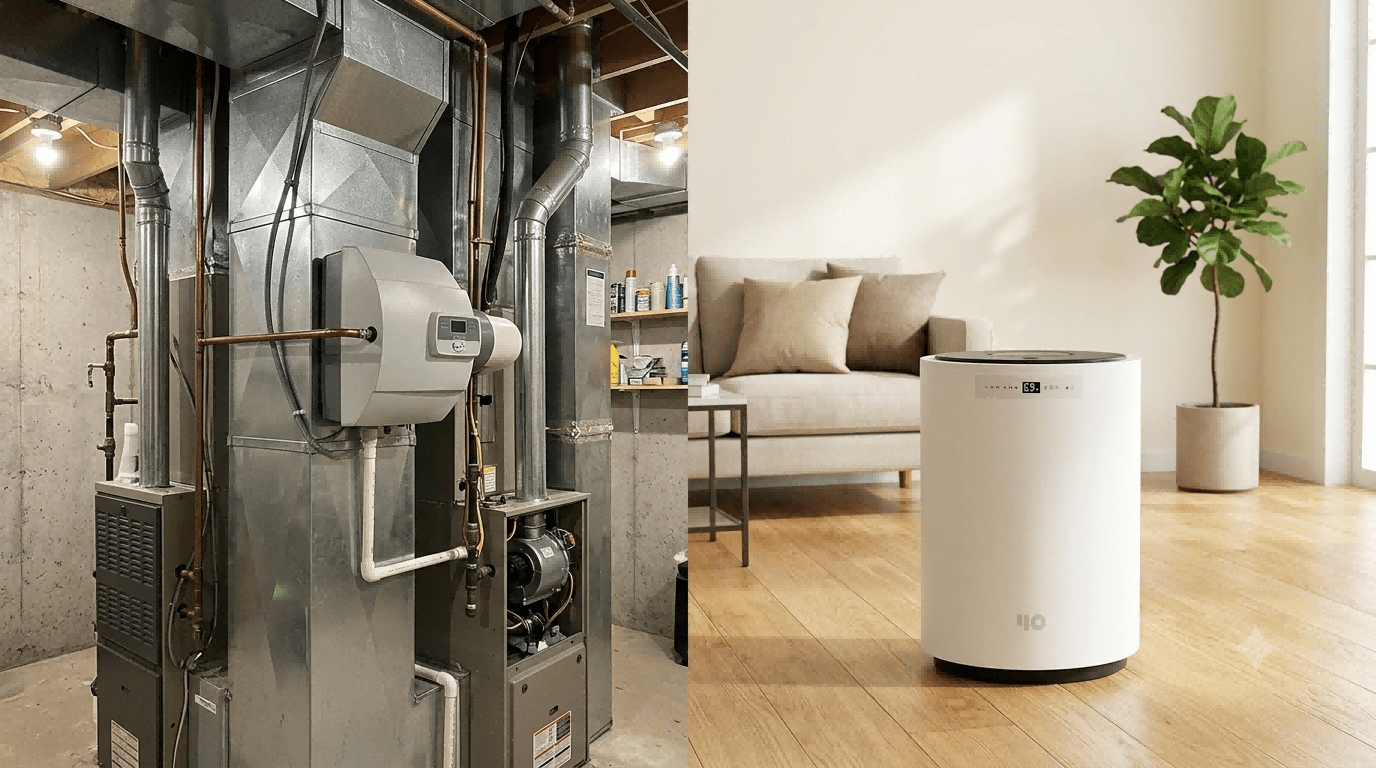

You know you need whole-house humidity. Your home gets dry in winter, your wood floors are complaining, and you're tired of running three bedroom units that still don't cover the main floor.
The question is: HVAC-integrated humidifier, or a high-output portable steam unit?
Both genuinely work. Both have real advantages. The right answer depends entirely on your specific situation — not on which technology is objectively "better."
These five questions cut through the noise. Answer them honestly and you'll know exactly which direction makes sense for your home, your budget, and how you actually live in your house.
Before the Questions: What You're Actually Choosing Between
An HVAC-integrated humidifier connects to your forced-air heating system and water line. It adds moisture to the air as it moves through your ductwork, distributing humidity automatically to every room. Installation requires a licensed HVAC technician and typically costs $600–$1,400 depending on unit type and complexity.
A high-output portable steam humidifier sits on your floor, plugs into a standard outlet, and outputs 1,000–1,200 ml/h of steam — enough to cover an open floor plan up to 1,000 sq ft. No installation, no contractor, no water line connection. You fill the tank, set the target humidity, and it runs.
The 5 Questions
HVAC humidifiers work by adding moisture to air as it moves through your ductwork. If you don't have forced-air heating — if you have radiant heat, baseboard heaters, a ductless mini-split, or any system without air ducts — an HVAC humidifier literally cannot work in your home.
This single question eliminates HVAC as an option for a significant portion of North American homes, particularly older homes in cities like Chicago, New York, Boston, and Toronto that use steam radiators or hot-water baseboard heating.
If your answer is "No," stop here — portable steam is your only whole-house option. If "Yes," continue.
HVAC humidification has a real cost structure that most guides understate. Here's the honest breakdown:
| Cost Item | HVAC Humidifier | Portable Steam (Y&O) |
|---|---|---|
| Hardware | $300–$800 (unit only) | $180–$280 |
| Installation | $300–$600 (licensed HVAC technician) | $0 — plug and play |
| Annual filter/pad replacement | $40–$80/year | $0 — filterless |
| Annual service call | $100–$200/year (recommended) | $0 |
| Annual electricity | $20–$50/year (low wattage) | $60–$90/year (higher wattage, cycles on/off) |
| Year 1 total | $760–$1,730 | $240–$370 |
| Year 5 total | $1,360–$2,930 | $480–$730 |

This is where HVAC has a genuine advantage that portable steam can't fully replicate. An HVAC humidifier delivers humidity through every duct in your home simultaneously — the guest bedroom, the home office, the basement, the master bedroom — all at once, automatically.
A portable steam unit covers its immediate zone very well — an open floor plan of 800–1,000 sq ft from a central placement. Bedrooms further away benefit partially. A closed guest bedroom at the far end of the house benefits minimally unless you put a unit there specifically.
The honest question is: do you actually need every room humidified at all times? Most households primarily care about the main living floor and the bedrooms they sleep in. If that describes you, portable steam covers it. If you genuinely need every corner of a large multi-zone home at consistent RH, HVAC wins this round.
Hard water affects HVAC humidifiers significantly. Most HVAC units use an evaporative pad or drum that mineral-laden water flows over — in hard-water cities like Phoenix, Las Vegas, Denver, and Calgary, these pads calcify rapidly and require more frequent replacement. Some bypass humidifier designs also produce mineral aerosol similar to ultrasonic units.
Portable steam handles hard water cleanly. The boiling process leaves minerals in the tank as scale rather than dispersing them into your air. Monthly descaling with citric acid or white vinegar removes the buildup. No pad replacement, no mineral aerosol regardless of water hardness.
For the full hard water picture: Hard-Water Humidifier Disaster: White Dust & Your Lungs →
This is the lifestyle question that often decides the tie. An HVAC humidifier, once installed and set, runs automatically with zero daily interaction. You set the humidity target on your thermostat, and the system maintains it through your ductwork. There's no tank to fill, no unit to move, no decision to make. It's genuinely invisible.
A portable steam unit requires periodic tank refilling — at 1,200 ml/h, a 10L tank lasts approximately 8–10 hours at full output, longer at moderate settings. This means filling every 1–3 days depending on how hard your climate is. The humidistat handles the cycling automatically, but you're physically involved in the process.
Some homeowners find the tank-filling a minor inconvenience. Others find it genuinely annoying over a 6-month heating season. Neither reaction is wrong — it's just a lifestyle fit question.
Reading Your Answers
Fig. 1 — Decision tree summary. Most homeowners reach a clear answer before Question 5. If you reach Q5, the decision comes down to lifestyle preference — both options work, and the cost difference is the deciding factor for most.
If Your Answers Point to HVAC
You have forced-air heating, you're comfortable with the upfront investment, you genuinely need every room covered simultaneously, you're in a soft-water city, and you want true automation. HVAC humidification is the right choice for you.
- Get quotes from two HVAC contractors — installation prices vary significantly
- Ask specifically about bypass vs fan-powered vs steam HVAC humidifiers — they have meaningfully different output rates and maintenance requirements
- Budget for annual service and pad/filter replacement from the start
- Verify your ductwork is in good condition before installing — leaky ducts reduce effective humidity distribution
If Your Answers Point to Portable Steam
You don't have ductwork, or you're not comfortable with the cost, or you primarily care about the living areas and bedrooms you actually use, or you're in a hard-water city, or you simply prefer the lower-cost option. Portable steam is your answer.
- Size correctly for your space — 1,200 ml/h for open floor plans up to 1,000 sq ft in extreme climate zones
- Place centrally in your main living area, not in a corner or against a wall
- Use a separate hygrometer to verify actual room humidity — built-in sensors read 5–10% high
- Descale monthly with citric acid or white vinegar — this maintains full output efficiency
- For homes over 1,500 sq ft with multiple closed floors, consider one unit per primary zone
For help calculating exact output for your space: Humidifier Output Calculator →
The One Scenario Where Both Make Sense
There's a legitimate case for running both systems in the same home: HVAC humidification for whole-house baseline coverage, plus a portable steam unit in the primary bedroom for overnight targeted humidification.
The HVAC system maintains 35–40% RH throughout the house passively. The bedroom steam unit brings the sleeping environment to 48–50% RH for the hours that matter most. This combination provides the automation benefit of HVAC with the targeted precision of portable steam — at the cost of running both systems.
For most homeowners, this is unnecessary. A well-placed high-output portable steam unit handles both jobs adequately. But for large homes in extreme Prairie or Midwest climates where bedroom RH consistently falls short of the main-floor level, the combination approach is legitimate.

If Your Answers Point to Portable Steam
The Y&O Steam Plus at 1,200 ml/h handles open floor plans up to 1,000 sq ft, works with hard tap water in any city, and requires no installation — just a standard outlet and a floor to stand on.
See the Y&O Steam Plus →Your Questions Answered
Is an HVAC humidifier worth the cost?
It depends on what you value. If you genuinely want zero daily interaction with your humidity system — no tank to fill, no unit to clean, nothing to think about — and you have the ductwork to support it, the HVAC premium buys real automation value. If your priority is cost-effectiveness or you're in a hard-water city where HVAC pad maintenance is frequent, the math generally favors portable steam. Over five years, the total cost difference between a well-maintained HVAC humidifier and a portable steam unit is typically $800–$2,200 in favor of portable — that's the cost of the automation premium.
Can a portable steam humidifier really replace a whole-house HVAC humidifier?
For most households: yes, with conditions. A 1,200 ml/h portable steam unit placed centrally in an open floor plan can maintain 40–50% RH across the primary living areas of a home up to approximately 1,000 sq ft. What it can't do is simultaneously and automatically humidify every room including closed bedrooms, a basement, and a rarely-used guest room. If your home is under 1,500 sq ft, open-plan on the main floor, and you primarily care about the living area and the bedrooms you sleep in — portable steam covers it. For larger or more complex multi-zone homes, HVAC integration or multiple portable units are more appropriate. For the sizing guide: Coverage Truth →
What type of HVAC humidifier is best if I go that route?
Three main types: bypass humidifiers (cheapest, use evaporative pads, good for moderate climates), fan-powered humidifiers (more output than bypass, work when heating isn't running), and steam HVAC humidifiers (highest output, most consistent, highest cost — $500–$1,200 for the unit alone). For most North American homeowners in moderate climates with soft water, a fan-powered bypass unit ($200–$400 hardware) is the sweet spot. For hard-water cities or very large homes, an HVAC steam humidifier provides the most consistent results despite the higher cost. Consult a licensed HVAC contractor for your specific system — ductwork layout, furnace type, and home size all affect which unit is appropriate.
How much does HVAC humidifier installation actually cost?
Hardware ranges from $150 (basic bypass) to $1,200 (HVAC steam unit). Labor typically adds $300–$600 depending on your location and system complexity. Total installed cost for a mid-range fan-powered unit in a typical North American home: $600–$1,000. For an HVAC steam humidifier in a large home: $1,200–$2,000 or more. These numbers vary significantly by region — get quotes from two contractors before committing. Annual ongoing costs (service call, pad or filter replacement) add $150–$300 per year. Budget for these when evaluating total cost of ownership.
Does hard water damage HVAC humidifiers?
It accelerates wear on evaporative pad and drum-style HVAC units significantly. In cities with water hardness above 300 mg/L (Phoenix, Las Vegas, Calgary, Denver), evaporative pads may need replacement every 4–6 weeks instead of the recommended annual replacement — substantially increasing ongoing costs. Some HVAC steam humidifiers handle hard water better by heating water to boiling (similar to portable steam), but at a higher unit cost. If you're in a hard-water city and committed to HVAC, specify an HVAC steam unit to your contractor and budget for regular descaling service. For the full hard water impact: Hard-Water Humidifier Disaster →
Related Reading
Sources & References
- ASHRAE Standard 55 — Thermal Environmental Conditions for Human Occupancy
- U.S. Environmental Protection Agency — Use and Care of Home Humidifiers
- U.S. Geological Survey — Hardness of Water — Regional Data
- Reddit Community Discussions — r/hvac · r/homeowners
- Y&O — YO-M2 Steam Plus Product Page