Blog
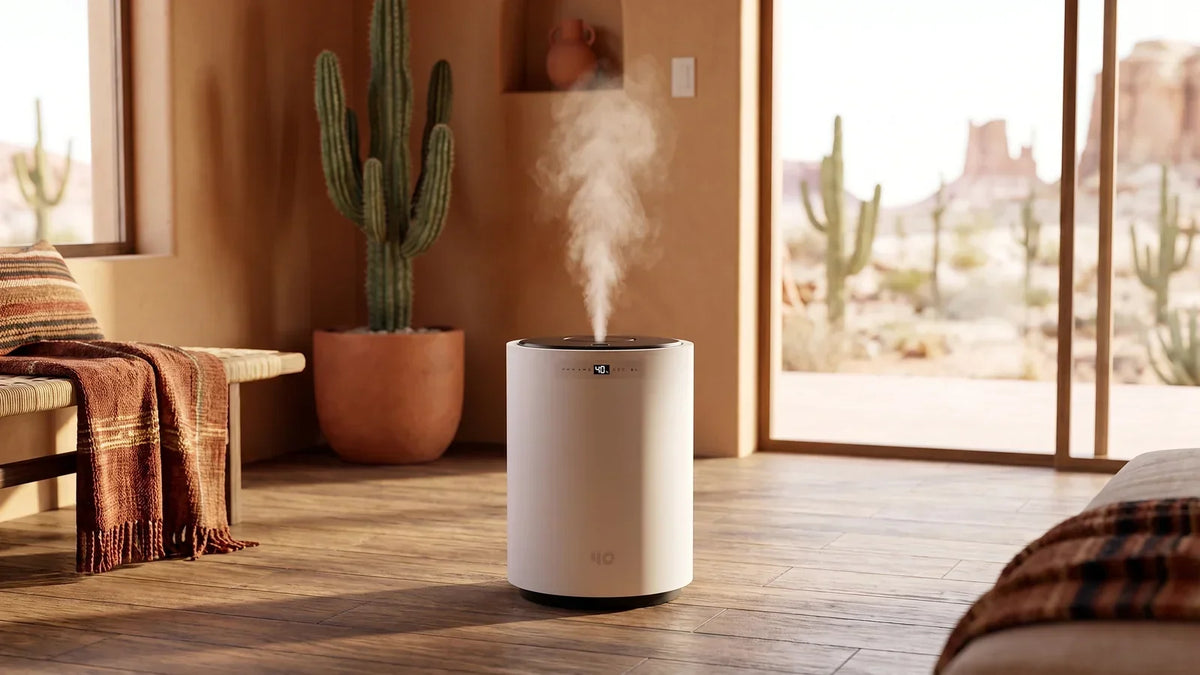

Best Humidifier for a Plant Room or Indoor Jungle (2026)
In a plant room the deciding question isn't mist output — it's where the water's minerals end up. Ultrasonic puts them on your leaves; steam leaves them in the tank. Published September 24, 2026 · Last updated September 2026 If you have a whole room of plants or a floor-to-ceiling green wall — not a couple of pots on a windowsill — the humidifier that keeps a shelf happy is usually the wrong tool. A jungle room needs humidity held steady across the whole space all night, and it needs mist that won't dust your leaves with minerals — which rules out most small cool-mist units on both counts. Below we rank the three humidifier types for exactly that job, using each brand's own specs, and say plainly where our own steam machine fits and where a cheap ultrasonic is still the smarter buy. On this page The short answer for a plant room What a whole plant room actually demands Why white dust is a plant-specific problem The three types for a plant room, side by side So which should you buy? The honest trade-offs of steam for plants FAQ The short answer for a plant room For a whole plant room or a floor-to-ceiling green wall, the humidifier we'd reach for is a steam unit like the Y&O-M2 Steam Plus, and the reasoning is about plants, not about us. It runs up to 1,200 mL/h from a 10 L dual-tank body, is rated for spaces up to 1,000 sq ft on ordinary tap water, and has no wick filter to reorder. Because it boils the water and leaves the calcium and magnesium behind as scale in the tank, the vapor it releases is mineral-free — so no white film settles on your foliage. A jungle room has a two-part problem: tropical plants want humidity near the top of the 30–60% indoor band that ASHRAE recommends, while heated winter air routinely drops below 30% (Penn State Extension). A 0.3–6 L cool-mist unit can lift the air around a shelf; holding a whole room of transpiring plants above 50% through the night is where a 10 L tank stops being overkill and starts being the point. What a whole plant room actually demands Start with why a room of plants is different from a room of people. Every plant is constantly moving water out through its leaves — transpiration — and a densely planted room has dozens of leaf surfaces all pulling the same trick at once. That plant-driven moisture demand is real, but it works against you in a heated home: warm indoor air can hold more water vapor, so the same amount of moisture reads as a lower relative humidity, and your tropicals feel the drop first. The core plant-room challenge isn't hitting a high number once — it's holding it, because a room full of foliage and a running furnace both pull humidity down faster than a single small tank can replace it. The target itself is not mysterious. ASHRAE's recommended indoor range is 30–60% relative humidity, and Penn State Extension notes that during the heating season indoor levels "can easily fall below 30%." Tropical and aroid-heavy collections — monstera, calathea, ferns, anthurium — sit at the top of that band and above, which is precisely the range a heated winter room fights hardest to maintain. We won't reprint the per-species numbers here; our houseplant humidity reference already lays out what each plant likes. For buying purposes the useful takeaway is simpler: a plant room needs a machine sized to refill humidity continuously, not one that empties in three hours and lets the room dry back down before morning. This is where tank size stops being a spec-sheet vanity number. A 6 L cool-mist unit running hard in a dry, plant-dense room can empty overnight, so humidity sags in the early hours — the exact window when a heated house is driest. Two independent 5 L tanks totaling 10 L, at up to 1,200 mL/h, buy the runtime to ride through that gap. For a full green wall, runtime is the spec that decides whether your plants wake up to 55% or to 32%. Why white dust is a plant-specific problem Here's the part most "best humidifier for plants" lists skip. An ultrasonic humidifier makes fog by vibrating water at high frequency, so anything dissolved in that water — the calcium and magnesium in hard tap water — rides the fog out and settles as a fine white powder on nearby surfaces. On a coffee table that's an annoyance you wipe away. On a leaf, it lands on the surface where the plant breathes. The same white dust that films your furniture also settles directly onto foliage, and leaves aren't surfaces you can casually wipe every day without damaging them. Why that matters comes down to plant physiology. Leaves exchange gas — taking in carbon dioxide, releasing water vapor — through microscopic pores called stomata. Peer-reviewed plant-physiology research on particulate deposition finds that dust settling on leaves lowers stomatal conductance and the photosynthetic rate, because the particles physically interfere with that gas exchange (see Sources). Mineral dust from a humidifier is the same kind of fine particulate settling on the same pores — so on hard water, an ultrasonic unit in a plant room is quietly working against the plants it's meant to help. To be precise about proven versus inferred: that research measured atmospheric and road dust, not humidifier white dust specifically, so we're reasoning from a well-established mechanism, not a study of this exact scenario. Where the minerals go, though, isn't in dispute — we cover it in our piece on hard water and white dust. Left: mineral white dust settling over leaf stomata, where the plant exchanges gas. Right: mineral-free steam vapor leaves those pores clear. The clean way out is to keep the minerals out of the mist entirely. A steam humidifier boils the water, which leaves the minerals behind in the tank as scale and sends out mineral-free vapor — no white dust to land on a single leaf, even on hard water, without buying jugs of distilled water. An evaporative wick unit also keeps dust out of the air, by trapping the minerals in a filter you replace on a schedule. Only ultrasonic units put the minerals into the room, which is the one behavior you least want around foliage. The three types for a plant room, side by side Here are the three humidifier technologies scored on what actually matters for a room full of plants: whether they dust your leaves with minerals, whether they can hold humidity all night without a refill, the upkeep they create, and a real model you can look up. No type is free of trade-offs — each one moves the cost somewhere, and the right pick is the one whose trade-off you'd rather live with next to your plants. Type White dust on leaves (hard water) Runtime for a whole room Upkeep Representative model Ultrasonic (cool mist) Yes — sprays minerals onto foliage ~6 L tank; can empty overnight in a dense room Distilled water if you want to stop the dust Levoit LV600S (6 L hybrid) Evaporative (wick) No — wick captures the minerals ~1 gal; fan-driven, no mist plume Replace wick every 30–60 days Honeywell HCM-350 Steam (boils water) No — minerals stay in the tank 10 L dual tank, up to 1,200 mL/h Descale the tank; no filters or distilled water Y&O-M2 Steam Plus Every competitor figure here comes from that brand's own product page, checked September 2026: Levoit's LV600S is a 6 L ultrasonic, and Honeywell's HCM-350 is an evaporative unit whose manual calls for replacing the wick every 30–60 days. Read the first two columns together — for a plant room, "does it dust my leaves" and "does it last the night" are the two questions that separate the types, and only steam answers both with a clean yes. So which should you buy? Be honest with yourself about scale first, because the answer flips on it. If your "plant room" is really a shelf or two — a handful of pots by a window — buy a small cool-mist ultrasonic and skip the rest of this article; a Levoit LV600S or similar 6 L unit is quieter, cheaper, and perfectly matched to a small cluster. On soft water it won't even dust much, and grouping a few plants around it creates a humid pocket that's genuinely enough. We'd rather you spent less and got the right-sized tool than talked yourself into a floor unit you don't need. The calculus changes when you have a whole room, a green wall, or a shelving rig packed with tropicals. Now you're fighting two things a small tank can't win: leaf-dusting minerals across a lot of foliage, and a room that dries back down before a 6 L tank can carry it through the night. For a full plant room on hard water, a steam unit is the type that solves both at once — mineral-free vapor that never films a leaf, plus a 10 L tank sized to hold humidity through the driest overnight hours. An evaporative unit is a reasonable dust-free middle option, as long as you're disciplined about swapping the wick every 30–60 days; skip that and a mineral-stiffened wick moves less water and can start to smell. Across the 400-plus homes we've shipped steam humidifiers to, and reading our own returns and support tickets, the plant owners who love ours most are the hard-water ones who were tired of seeing white film settle back onto leaves they'd just cleaned. We test our own units on ordinary tap water rather than laboratory water, which is exactly the water a real plant room runs on. If you want scent in the room, don't reach for the tank — the Steam Plus isn't built for essential oils, so Y&O makes a separate glass Steam Aroma diffuser for that instead. The Y&O-M2 Steam Plus in a densely planted room — the minerals stay in the tank as scale, so the vapor reaching the leaves is dust-free. Built for a full plant room The Y&O-M2 Steam Plus boils the minerals out of the water, so mineral-free vapor reaches your leaves — no white dust — and its 10 L dual tank holds humidity through the night, not just for three hours. See the Y&O-M2 Steam Plus The honest trade-offs of steam for plants Steam is not a free lunch, and there are three things we'd rather you hear from us than discover after buying. First, it uses more electricity than a cool-mist unit, because it's heating water to a boil — that's the price of dust-free vapor. Second, it's the loudest of the three types, since you can hear the water come up to a boil; in a plant room that's usually a non-issue, but in a bedroom-plant-room combo it's worth knowing. Third, and most relevant on hard water: boiling concentrates minerals in the tank, so you'll descale every 1–2 weeks rather than monthly — for the Y&O-M2 that's about 20 g of citric acid in the tank, heated 10–15 minutes and soaked 20–30, then rinsed. The full routine is in our descaling guide, and the reason steam skips filters entirely is in our filter-free steam guide. There's also a placement rule that matters more with plants than with people. Set any humidifier a few feet back from your foliage rather than blasting mist straight at the nearest leaves — a jet of moisture on the same leaves all night keeps them wet long enough to invite fungal spotting. The goal in a plant room is even, room-wide humidity that settles around 50–60%, not a soaked corner — so pair the unit with a cheap hygrometer and don't chase numbers above 60%, because a closed, over-humid room is where mold starts. We dig into that risk in do humidifiers cause mold. And if you're sizing by floor area rather than plant load, our large-room humidifier guide works through the square-footage math. FAQ What is the best humidifier for a whole plant room or indoor jungle? For a full room of plants or a green wall, a steam humidifier is the strongest pick because it solves the two plant-room problems at once. It boils the water and leaves the minerals in the tank, so the vapor is mineral-free and no white dust settles on your leaves; and a large tank — 10 L on the Y&O-M2 Steam Plus, at up to 1,200 mL/h — holds humidity through the night instead of emptying in a few hours. For just a shelf of plants, a small cool-mist ultrasonic is the smarter, cheaper choice. Is white dust from a humidifier bad for plants? It's not helpful. Ultrasonic humidifiers spray the minerals in hard tap water into the air as fine white dust, which settles on leaves. Leaves breathe through microscopic pores called stomata, and peer-reviewed research shows dust deposition on leaves lowers stomatal gas exchange and the photosynthetic rate. Steam and evaporative units keep those minerals out of the mist, so nothing films the foliage. We're reasoning from an established dust-on-leaves mechanism, not a study of humidifier dust specifically. How big a humidifier tank do I need for a plant room? It depends on how densely planted and how dry the room is. A 6 L cool-mist unit can empty overnight in a plant-packed, heated room, letting humidity sag in the early morning hours when the air is driest. For a full green wall, a 10 L tank — like the Y&O-M2's dual 5 L tanks at up to 1,200 mL/h — gives you the runtime to hold humidity through the night. If a single fill lasts all day in your room, you don't need a large machine. What humidity level should a plant room be? ASHRAE's recommended indoor range is 30–60% relative humidity, and most tropical houseplants prefer the top of that band. Aim for roughly 50–60% in a plant room and pair the humidifier with a hygrometer, but don't push past 60% in a closed room — over-humid, poorly ventilated spaces invite mold and fungal leaf spotting. During winter heating, indoor humidity can fall below 30%, which is why plant rooms need active humidification most in the cold months. Can I use tap water in a humidifier for plants? With a steam or evaporative unit, yes. A steam humidifier boils the minerals off into the tank, and an evaporative unit traps them in its wick, so neither sends them onto your leaves — you just descale or replace the wick on schedule. Ultrasonic units are the ones that push you toward distilled water for plants, because they atomize whatever is dissolved in the water into visible white dust that settles on foliage. Keep reading Ideal humidity for houseplants (by species) Hard water, white dust, and your air Best humidifier for large rooms Do humidifiers cause mold? Why filter-free steam changes the upkeep How to descale and clean a humidifier About the author — The Y&O Team We design and build steam humidifiers and have shipped them to over 400 homes. We test our own units on ordinary tap water rather than laboratory water — the same water a real plant room runs on — and we read our own returns and support tickets, which is where the honest parts of this piece come from. Every Levoit and Honeywell figure here is taken from that brand's own published page or manual, the humidity ranges are from ASHRAE via Penn State Extension, and the leaf-dust mechanism is from peer-reviewed plant-physiology research, all linked in Sources so you can check each one yourself. Disclosure: We sell steam humidifiers, so we have a commercial interest. Where we have a preference, we say so. We've kept every competitor number to what those brands publish, named steam's real drawbacks — more electricity, more noise, more descaling — and told you outright that for a shelf of plants a cheaper cool-mist unit is the better buy. Sources (extension + peer-reviewed research + each brand's own page, checked September 2026) Penn State Extension — Humidity and Houseplants (ASHRAE 30–60% indoor range; winter levels can fall below 30%) Impact of atmospheric particulate matter retention on physiological characters of plant species (dust deposition lowers stomatal conductance and photosynthetic rate) — PMC Levoit LV600S — official product page (6 L ultrasonic, cool/warm mist) Honeywell HCM-350 — official product page (evaporative, wick replaced every 30–60 days, captures minerals) Y&O-M2 Steam Plus 10L — product page (1,200 mL/h, up to 1,000 sq ft, tap water, no filter)
Explore Now
The Best Humidifier for Dry Skin in Winter: How to Choose (2026)
Published September 23, 2026 · Last updated September 2026 The right humidifier for dry winter skin is the one that holds your room in a comfortable humidity range without adding white dust or a filter to babysit. Every winter it's the same story: the heat kicks on, and within a week your skin feels tight, rough, and flaky no matter how much lotion you use. A humidifier helps because dry, heated indoor air actively pulls moisture out of your skin — but the model you pick decides whether you fix the problem or trade it for white dust and a moldy filter. This is a buying guide, not a “why skin gets dry” explainer: below, how to choose the right humidifier for dry skin this winter. On this page Does a humidifier actually help dry winter skin? Why winter air pulls moisture out of your skin The three humidifier types — and the tradeoff each makes White dust, filters, and warm vs cool mist So which humidifier should you buy for dry skin? Dry-skin humidifier FAQ Does a humidifier actually help dry winter skin? The U.S. Environmental Protection Agency recommends keeping indoor relative humidity between 30% and 50%, and always below 60%, for a comfortable, mold-resistant home — and that range is exactly what a humidifier for dry skin needs to hit. In a typical North American winter, a heated house often runs at just 10–25% relative humidity, drier than many deserts. That parched air behaves like a sponge and pulls moisture straight out of your skin, which is why it feels tight, rough, and flaky by mid-winter no matter how much lotion you use. A humidifier fixes the air so the air stops pulling on your skin. So yes, a humidifier helps — but the model worth buying is the one that reliably holds a room in the EPA's 30–50% range overnight, without trading dry skin for white mineral dust or a musty filter. The connection to your skin is direct. The American Academy of Dermatology lists “use a humidifier” among its top tips for relieving dry skin, recommending you place a portable unit in the bedroom and run it while you sleep, then clean it regularly to keep it from growing mold. That last clause matters more than most buying guides admit — a humidifier only helps if you'll actually keep it clean. The buying question in one paragraph For dry winter skin, the humidifier that helps most is the one that reliably holds your room in the 30–50% relative-humidity range the EPA recommends, overnight, without adding new problems — white mineral dust settling on your nightstand, or a wet filter that turns musty. Every type of humidifier can raise the number on your hygrometer. The differences that matter for skin are what else the machine puts into the room, and how much upkeep it demands before you quietly stop using it. That framing — comfort humidity, minus the side effects, minus the babysitting — is what separates a humidifier you'll run all winter from one that ends up in a closet by January. The best humidifier for dry skin is the one you will still be running in February. Why winter air pulls moisture out of your skin Cold outdoor air holds very little water. When your furnace heats that air to room temperature, the relative humidity crashes — the air is now warm but nearly empty of moisture, and warm dry air behaves like a sponge. Physics doesn't let it stay empty: it pulls water vapor from the nearest available source, which indoors is your skin, lips, and the wood in your floors and furniture. Your skin's outer layer loses water to dry air through simple evaporation, and heated winter air speeds that loss up dramatically. Moisturizer slows the water leaving your skin, but it can't refill air that's parched to begin with. A humidifier works the other end of the problem: it raises the moisture content of the room so the air stops pulling so hard. We've written the full physics of why heated homes get this dry in why your skin feels dry indoors in winter — if you want the “why,” start there. This page is about the “which one do I buy.” The takeaway you need for shopping: your goal is a steady 30–50% relative humidity in the room where you spend the night, and the machine that hits that number cleanly is the one worth your money. The three humidifier types — and the tradeoff each makes Almost every humidifier sold in the U.S. is one of three types, and each makes a genuine tradeoff. None is a scam; they just fail dry-skin buyers in different ways. Here's the honest version, with the brands you'll actually see in the store. Ultrasonic cool-mist units are the cheapest and quietest, but in a hard-water home they spray your minerals into the room as white dust. A vibrating plate flings water into a fine fog. Popular Levoit cool-mist models work this way, and they're excellent in a soft-water house. The catch: whatever is dissolved in your tap water — calcium, magnesium — gets atomized right along with the water and settles as a fine white film on furniture and electronics. Evaporative (wick) humidifiers solve the white-dust problem by design. A fan blows air through a wet wicking filter; the water evaporates and the minerals stay trapped in the wick. Honeywell's germ-free cool-mist line is the classic example. The tradeoff is the wick itself: it's a consumable you replace every 1–3 months, and a damp filter is exactly the kind of surface the American Academy of Dermatology warns can grow mold if you don't stay on top of cleaning. Warm-mist and steam humidifiers boil the water. Because minerals and grime are left behind in the tank rather than sprayed into the air, they produce no white dust and use no filter. Vicks warm-mist vaporizers are the drugstore version; they boil water and emit a genuinely hot steam, which means real burn caution around kids and pets. Boiling also puts a little warmth into the room, which feels more comfortable in winter than the faint chill of a cool-mist plume. The honest downsides: steam units draw more electricity than ultrasonic models, and in hard-water areas you have to descale them regularly. Three ways to add moisture, three different tradeoffs — the right choice depends on your water and how much upkeep you'll tolerate. Here's how the three stack up on the things that actually matter to a dry-skin buyer in winter: What matters for dry skin Ultrasonic cool mist(e.g. Levoit) Evaporative wick(e.g. Honeywell) Steam / warm mist(Vicks; Y&O YO-M2) White dust on furniture (hard water) High risk — minerals atomized into air None — wick traps minerals None — minerals stay in tank Filter / consumable to replace Usually none Yes — wick every 1–3 mo, can go musty None — filterless Adds warmth to the room No — mist can feel chilly No — cool output Yes — boiling warms the air Burn caution Cool output Cool output Depends — Vicks emits hot steam; YO-M2 cools vapor first Main upkeep Frequent tank cleaning; distilled water to avoid dust Replace & clean wick on schedule Descale in hard-water homes Read the table for your own house: if your water is hard, the two columns that don't spray minerals into the air — evaporative and steam — are the only real candidates for dry skin. If you also don't want to buy and babysit a filter, that narrows it to one. For the full head-to-head on all three technologies, see our steam vs ultrasonic vs evaporative comparison. White dust, filters, and warm vs cool mist Three details decide whether a humidifier quietly makes your winter better or becomes a chore. Take them one at a time. White dust is a water-quality problem, not a bad-machine problem — and most U.S. homes have hard water. The U.S. Geological Survey classifies water above 180 mg/L of dissolved calcium carbonate as “very hard,” and much of the country sits in the hard-to-very-hard range. An ultrasonic unit atomizes every one of those minerals into a dust that lands on your nightstand and screens. You can dodge it by running distilled water, but that's an ongoing cost most people abandon by mid-winter. We dug into the air-quality and cleaning side of this in our hard-water white-dust breakdown. Filters are the second silent tax. A wick works, but it's a damp surface, and a damp surface indoors wants to grow things. The most common reason a humidifier stops helping your skin isn't the technology — it's that the owner got tired of replacing the filter and cleaning the tank, and stopped running it. A filterless machine removes that failure point entirely; the only recurring job is descaling, which we walk through in our descaling guide. The warm-mist safety nuance “Warm mist” on a store label usually means the unit emits hot steam — comfortable, no white dust, but a real burn risk if a toddler tips it. Not all steam humidifiers work this way. Some, including the Y&O YO-M2 Steam Plus, boil the water and then cool the vapor before it leaves the unit, so the mist is comfortable to the touch rather than scalding. This isn't a contradiction with steam feeling warm in winter: a boiling unit still radiates heat into the room as it runs, so the air feels a touch warmer even when the mist plume itself has been cooled before it exits. If you have young kids and like the idea of steam, check whether the mist itself comes out hot. Warm versus cool mist is the third factor, and for dry skin in winter it tilts toward warm. Cool mist can leave a room feeling slightly damp-chilly; a boil-based machine adds a touch of warmth that most people find more comfortable when the heat is running. At the same humidity level, mist temperature doesn't change how much a humidifier helps your skin — it's a comfort preference — but in a cold-winter home, most of our customers prefer the warmer feel. If you want to go deeper on the differences, see warm mist vs cool mist. So which humidifier should you buy for dry skin? Match the machine to your water and your patience, not to a star rating: Soft water, tight budget, small bedroom: an ultrasonic cool-mist unit (Levoit-style) is fine — you won't get much white dust, and it's quiet and cheap. You don't mind a filter and want no dust: an evaporative wick unit (Honeywell-style) is a solid middle path — just commit to the wick schedule. Hard water, a bigger room, and you're done babysitting consumables: a filterless steam humidifier is the lowest-maintenance way to hit comfortable humidity without white dust. That last case is the most common one we hear from winter dry-skin shoppers, and it's where our own machine fits. The Y&O YO-M2 Steam Plus is a filterless steam humidifier with two 5-liter tanks — 10 liters total — rated for spaces up to 1,000 sq ft, which is enough to hold a dry, heated living room or open-plan bedroom in the EPA's 30–50% comfort range overnight. Because it boils the water, minerals and grime stay in the tank instead of dusting your furniture, and there's no wick to replace or grow musty. It boils to leave the vapor clean, then cools that vapor before it exits, so the mist is comfortable to the touch — the clean, no-dust, no-filter benefits of steam without the scalding output of a drugstore vaporizer. The honest tradeoffs stay on the table: it uses more electricity than an ultrasonic unit, and in a hard-water home you'll descale it periodically. We test our own units against ordinary tap water rather than laboratory-pure water, so those tradeoffs are ones we've measured, not marketed. A filterless steam humidifier running overnight in the bedroom — where the American Academy of Dermatology says a dry-skin humidifier does the most good. One customer running it through a Canadian heating season told us it held the relative humidity in their connected living room and kitchen steady at 50–53%, and noted that because it boils rather than atomizes, the tank didn't develop the film they'd seen in previous humidifiers. That's the pattern behind the recommendation: in a hard-water, heavy-heating home, a filterless steam unit is the one people are still running in February — and the one you keep running is the one that keeps your skin comfortable. If your room is on the larger side, our large-room humidifier guide covers sizing in more detail. Built for dry, hard-water winters The Y&O YO-M2 Steam Plus is filterless, leaves no white dust, and holds comfortable humidity in rooms up to 1,000 sq ft — with two 5-liter tanks you can lift out and clean separately. See full specs and current pricing on the product page. View the YO-M2 Steam Plus → Dry-skin humidifier FAQ What humidity level is best for dry skin in winter? Aim for 30–50% relative humidity, the range the U.S. EPA recommends for indoor comfort and mold resistance. A cheap hygrometer lets you confirm the number rather than guess; in a heated winter home the untreated level is often 10–25%, which is what leaves skin feeling tight. Does a humidifier really help dry skin, or just the air? It helps skin by fixing the air. Heated winter air is parched and evaporates water out of your skin's outer layer; raising the room to a comfortable 30–50% humidity slows that loss. The American Academy of Dermatology lists using a humidifier among its top tips for relieving dry skin, especially run in the bedroom overnight. Which humidifier type is best if I have hard water? An evaporative (wick) or steam humidifier, because neither sprays minerals into the room. Ultrasonic cool-mist units atomize dissolved minerals into white dust that settles on furniture — much of the U.S. has hard water above the USGS “hard” threshold, so this is a common problem. Steam units add no dust and use no filter, at the cost of higher electricity use and periodic descaling. Is warm mist or cool mist better for dry skin? At the same humidity level there's no skin advantage to either — it's a comfort choice. Cool mist can feel slightly chilly; warm mist and steam add a little warmth that many people prefer in a cold-winter home. Warm-mist safety varies: some units emit hot steam, while the Y&O YO-M2 Steam Plus cools the vapor before it exits so the mist isn't scalding. Do I need a big humidifier for dry skin, or a small one? Match the tank and coverage to your room. A small ultrasonic unit is fine for a single closed bedroom; an open-plan living space or a whole floor needs more output and water capacity, like the 10-liter, up-to-1,000-sq-ft Y&O YO-M2 Steam Plus, so it can hold the target humidity overnight without refills. Real coverage depends on how sealed and how large the space is — use a hygrometer to verify. Related reading Why your skin feels dry indoors in winter Steam vs ultrasonic vs evaporative: which is worth it Warm mist vs cool mist humidifiers Hard water & white dust: what it does to your air Best humidifier for large rooms The complete humidifier buying guide The Y&O Team We design and build filterless steam humidifiers and have shipped them to more than 400 homes across North America and beyond. We test our own units against ordinary tap water rather than laboratory-pure water, so the tradeoffs we describe — white dust, descaling, electricity use — are ones we've measured firsthand. Disclosure: We sell steam humidifiers. Where we have a preference, we say so. Sources 1. U.S. Environmental Protection Agency, “A Brief Guide to Mold, Moisture and Your Home” (indoor relative humidity 30–50%, below 60%) — epa.gov 2. American Academy of Dermatology, “Dermatologists' top tips for relieving dry skin” (use a humidifier; clean it to prevent mold) — aad.org 3. U.S. Geological Survey, “Hardness of Water” (water hardness classification; “very hard” above 180 mg/L) — usgs.gov
Explore Now
Best Humidifier for Hard Water: Pick by Type (2026)
On hard water, the minerals have to go somewhere — the humidifier you choose only decides where. That is the whole decision. Published September 23, 2026 · Last updated September 2026 If your tap water is hard, the question isn't which humidifier is "best" in the abstract — it's which one deals with the minerals in your water without turning into a chore or a running bill. The short version: ultrasonic units spray minerals into the air as white dust, evaporative units trap them in a wick you replace every 30–60 days, and steam units boil them off into the tank so you can run plain tap water and just descale. Below we sort the three types by exactly that — using each brand's own published specs — and say plainly where our own steam machine is the right answer and where it's overkill. On this page The short answer for hard water Humidifier types on hard water, side by side Why each type struggles on hard water Why steam is the hard-water answer The honest downside of steam How to check how hard your water is FAQ The short answer for hard water The best humidifier for hard water is a steam unit like the Y&O-M2 Steam Plus, because on hard water the machine you choose is really a decision about where the dissolved minerals end up — and boiling is the only common method that keeps them out of your air without a filter or a jug of distilled water. Hard water, by the USGS definition, carries more than 180 mg/L of dissolved calcium and magnesium (that's the "very hard" band), and every bit of that mineral has to go somewhere. An ultrasonic humidifier flings it into the room as white dust. An evaporative unit catches it in a wick you throw away on a schedule. A steam humidifier boils the water, leaves the minerals behind in the tank as scale, and releases mineral-free vapor — so you run ordinary tap water and only have to descale. Match the method to your water, not the sticker price, and most of the hard-water complaints disappear before you ever buy. Humidifier types on hard water, side by side Here are the three humidifier technologies scored on the four things that actually matter when your water is hard: whether they throw white dust, what you have to keep buying, the yearly upkeep that creates, and a real representative model you can look up. Notice that no type is free — each one moves the hard-water cost to a different place, and the right pick is the one whose cost you'd rather live with. Type White dust on hard water Consumable you keep buying Yearly upkeep Representative model Ultrasonic (cool mist) Yes — atomizes minerals into the air Distilled water, if you switch to stop the dust Ongoing distilled-water runs; no filter Levoit Classic 300S Evaporative (wick) No — wick captures the minerals Wick filter (Honeywell HAC-504) ~6–12 wicks a year (30–60-day interval) Honeywell HCM-350 Steam (boils water) No — minerals stay in the tank None — plain tap water, no filter Descaling only (citric acid, no purchases) Y&O-M2 Steam Plus Every competitor figure here comes from that brand's own product page or manual, checked September 2026: Levoit's Classic 300S is ultrasonic, Honeywell's HCM-350 is evaporative and its manual calls for replacing the HAC-504 wick every 30–60 days, and the USGS "very hard" threshold above is straight from its water-science pages. Read the "consumable" column before anything else — on hard water, that column, not the purchase price, is what people end up regretting. Why each type struggles on hard water Two of these three types don't put minerals in your air, but each one still hands you a hard-water bill somewhere. Start with ultrasonic, because it's the most popular category and the one that surprises people. An ultrasonic humidifier vibrates water into a cold fog, so whatever is dissolved in the water rides that fog into the room; on hard water that's the fine white dust that settles on furniture and dark screens (we cover the mechanism in that piece — here we're only ranking machines). The practical hard-water problem with ultrasonic is that the fix — switching to distilled water — becomes a permanent grocery-run cost that never shows up on the box. Evaporative wick machines solve the dust honestly: a fan pulls air through a wet wick, the minerals stay in the wick, and only clean vapor leaves. The catch is that the wick is doing the mineral-trapping, so hard water loads it up faster. Honeywell's own manual for the HCM-350 says to replace the HAC-504 wick every 30–60 days — and hard water pushes you toward the short end of that window, because a mineral-stiffened wick wicks less water and can start to smell. An evaporative unit trades white dust for a wick you buy six to twelve times a year, which on hard water is the fastest-cycling consumable of the three types. If a filter you forget to change is your real worry, our filter-free steam guide explains why removing the wick removes that whole failure mode. Why steam is the hard-water answer A steam humidifier sidesteps both bills at once. It boils the water inside a sealed chamber, which leaves the calcium and magnesium behind as scale on the heating element and sends out mineral-free water vapor — so there's no white dust to wipe up and no reason to buy distilled water. That's the core reason steam exists as a category: it's the one common method that gives you dust-free humidity and lets you keep filling from the tap. On hard water, steam is the only type in the table that charges you nothing on a recurring basis — no distilled water, no wick — because the minerals it captures cost you effort, not money. For a concrete example on the same dimensions, our Y&O-M2 Steam Plus runs up to 1,200 mL/h from a 10 L dual-tank design and is rated for spaces up to 1,000 sq ft on ordinary tap water, with no wick to reorder. It boils in a sealed chamber to handle the minerals, then cools the vapor before it exits, so the mist that reaches the room is cool to the touch rather than the hot steam of a warm-mist unit. We test our own units on ordinary tap water rather than laboratory water, and across the 400-plus homes we've shipped to, the buyers who love ours most are the hard-water ones who were tired of hauling distilled water or swapping wicks. If scent is what you want, don't reach for the tank — the Steam Plus isn't built for essential oils, so Y&O sells a separate glass Steam Aroma diffuser for that instead. The Y&O-M2 Steam Plus filled straight from the tap — the minerals stay in the tank as scale instead of dusting the room. Built for hard-water homes The Y&O-M2 Steam Plus boils away the minerals so you run straight tap water — no white dust, no wick, no distilled-water runs. Just descale on a schedule. See the Y&O-M2 Steam Plus The honest downside of steam Steam is not a free lunch, and on hard water its one real chore gets more frequent, not less. Because boiling concentrates the minerals in the tank, a steam unit builds scale faster than a cool-mist machine — so on very hard water you should plan to descale every 1–2 weeks rather than monthly. Steam trades a recurring purchase for a recurring cleaning: you stop buying distilled water and wicks, but you pick up a descaling routine you can't skip. The routine itself is cheap and quick — for the Y&O-M2 that's about 20 g of citric acid in the tank, heated 10–15 minutes and soaked 20–30 minutes, then rinsed; the step-by-step is in our descaling guide. The other honest notes: a steam unit uses more electricity because it's heating water, and it's the loudest of the three types since you can hear the water come to a boil. If you have a small bedroom on soft water, a quiet ultrasonic or an evaporative unit is the smarter buy, and we'd rather you got one — steam earns its keep in large, hard-water rooms, not everywhere. For a side-by-side of the underlying methods, see our tap-water humidifier guide. How to check how hard your water is Before you pick a type, confirm you actually have hard water — a lot of "white dust" panic is really soft-water homes over-worrying, and a lot of wick frustration is very-hard-water homes under-estimating. The fastest checks: read your municipal water report (utilities publish hardness in mg/L or grains per gallon), drop in a $10 hardness test strip, or look up your city. If your water tests above 180 mg/L you're in the USGS "very hard" band, and the consumable column above matters more than any other spec on the page. Our U.S. water-hardness map and hardest-water-cities list let you look up your area in a few seconds. FAQ What is the best type of humidifier for hard water? A steam humidifier. On hard water the real question is where the dissolved minerals go: ultrasonic units spray them into the air as white dust, evaporative units trap them in a wick you replace every 30–60 days, and steam units boil them off into the tank so the vapor is mineral-free. Steam is the only common type that gives you dust-free humidity while still letting you fill from the tap. Which humidifier does not need distilled water? Steam and evaporative units both run fine on hard tap water. A steam humidifier boils the minerals off into the tank, and an evaporative unit traps them in its wick, so neither needs distilled water. Ultrasonic units are the ones that push owners toward distilled water, because they atomize whatever is dissolved in the water into visible white dust. Does a steam humidifier make white dust on hard water? No. A steam humidifier heats water to a boil, which leaves the calcium and magnesium behind as scale in the tank and sends out mineral-free vapor. That's why it produces no airborne white dust even on very hard water (above 180 mg/L by the USGS scale) — the trade-off is that you descale the tank more often. Is an evaporative humidifier good for hard water? It's a reasonable dust-free option, with one recurring cost. The wick captures the minerals so nothing sprays into the room, but Honeywell's manual for the HCM-350 says to replace the HAC-504 wick every 30–60 days, and hard water pushes you toward the shorter end of that window. Budget for roughly six to twelve wicks a year if you go this route. How often do I have to descale a humidifier on hard water? On a steam unit with very hard water, plan on descaling every 1–2 weeks rather than monthly, because boiling concentrates minerals faster. For the Y&O-M2 Steam Plus that's about 20 g of citric acid in the tank, heated 10–15 minutes and soaked 20–30 minutes, then rinsed. Cool-mist units scale more slowly but still need periodic cleaning. Keep reading Steam vs ultrasonic vs evaporative Hard water, white dust, and your air Can you use tap water in a humidifier? Why filter-free steam changes the upkeep How to descale and clean a humidifier The hardest-water cities in the U.S. About the author — The Y&O Team We design and build steam humidifiers and have shipped them to over 400 homes. We test our own units on ordinary tap water rather than laboratory water, and we read our own returns and support tickets — which is where the honest parts of this piece come from. Every Levoit and Honeywell figure here is taken from that brand's own published page or manual, and the hardness thresholds are from the USGS, all linked in Sources so you can check each one yourself. Disclosure: We sell steam humidifiers, so we have a commercial interest. Where we have a preference, we say so. We've kept every competitor number to what those brands publish, named steam's real drawbacks — more descaling, more electricity, more noise — and told you outright when a cheaper ultrasonic or evaporative unit is the better buy. Sources (each brand's own page/manual + USGS, checked September 2026) USGS — Water hardness classifications (soft, moderately hard, hard, very hard >180 mg/L) Honeywell HCM-350 — official product page (evaporative, 1.1 gal, HAC-504 wick, replace every 30–60 days, captures minerals) Levoit Classic 300S — official product page (ultrasonic cool mist, 6 L tank) RTINGS — Levoit Classic 300S independent review (ultrasonic mineral output / white dust) Y&O-M2 Steam Plus 10L — product page (1,200 mL/h, up to 1,000 sq ft, tap water, no filter)
Explore Now
Levoit vs Honeywell vs Vicks: Which Humidifier Wins?
Levoit vs Honeywell vs Vicks at a glance — no single machine wins every row, and every figure is from each brand's own page or manual. Published September 22, 2026 · Last updated September 2026 Levoit, Honeywell, and Vicks are the three names most people bounce between under $100 — and they use three completely different methods to add moisture, which is why they behave nothing alike after you buy. The short version: Levoit is the quiet ultrasonic one that throws white dust on hard water, Honeywell is the evaporative one that stays dust-free but makes you buy a new wick every 30–60 days, and Vicks is the warm-mist one that boils water for a small bedroom. Below we put all three side by side using each brand's own published specs — and, at the end, we're honest about where a bigger steam unit is the better answer and where it's overkill. On this page The short answer: who each one is for The full comparison table Levoit Classic 300S — the quiet ultrasonic Honeywell HCM-350 — the dust-free evaporative Vicks V745A — the warm-mist bedroom unit Which should you actually buy? When none of the three is the right category FAQ The short answer: who each one is for The Levoit Classic 300S, Honeywell HCM-350, and Vicks V745A win on three different things, so the right pick depends on your water and your room size. The Levoit is an ultrasonic cool-mist unit — the quietest of the three at ≤30 dB, with the biggest tank at 6 L — but because ultrasonic sprays whatever minerals are dissolved in the water, on hard tap water it leaves white dust, which usually pushes owners to buy distilled water. The Honeywell HCM-350 is evaporative: a wick traps the minerals so there's no white dust, but Honeywell's own manual says replace that wick every 30–60 days, a recurring cost the others don't have. The Vicks V745A is a warm-mist unit that boils water — no white dust, no filter, and it accepts Vicks scented pads — but it holds one gallon and is built for a small bedroom, not an open floor plan. None of the three covers a large, hard-water home without a tradeoff. If you want… Buy Why Near-silence + a big tank for a bedroom Levoit Classic 300S ≤30 dB, 6 L, up to 60 hr per fill — soft water only No white dust without buying distilled water Honeywell HCM-350 Evaporative wick traps minerals; you buy wicks instead Warm mist for a small room, scented-pad option Vicks V745A Boils water, filter-free, 1-gallon tank, VapoPad-ready Every competitor number below comes from that brand's own product page, manual, or an independent lab (RTINGS), checked September 2026. Prices and specs move, so confirm before you buy. The full comparison table Here is the head-to-head on the dimensions buyers actually ask us about. The reason these machines feel so different in a real room is that they don't share a technology — ultrasonic, evaporative, and warm mist each solve the dust, noise, and coverage questions in opposite ways. Levoit Classic 300S Honeywell HCM-350 Vicks V745A Type Ultrasonic cool mist Evaporative (cool moisture) Warm mist (boils water) White dust on hard tap water Yes No (wick traps minerals) No (boiled off) Consumable to reorder None, but distilled water on hard water Wick, every 30–60 days None (optional scent pads) Tank 6 L / 1.58 gal 1.1 gal (~4.2 L) 1 gal (~3.8 L) Rated coverage 215–505 sq ft Medium rooms Medium room / bedroom Mist temperature Cool Room temp (no visible mist) Warm / hot Noise ≤30 dB (very quiet) Audible fan Quiet (no fan) Street price (Sep 2026) ~$72 ~$60–90 ~$40–50 Read the "white dust" and "consumable" rows before the price row — those two lines, not the sticker, are what people regret. On the communities and support tickets we watch, the two most common humidifier complaints are white dust from ultrasonic units on hard water and mold or hassle from a filter people stopped replacing. Every machine here answers those two questions differently, and that is the whole decision. Levoit Classic 300S — the quiet ultrasonic The Levoit Classic 300S is the smart, quiet pick of the three. It's an ultrasonic cool-mist unit with a 6 L / 1.58 gal top-fill tank, rated for 215–505 sq ft, and rated at ≤30 dB with up to 60 hours of runtime on its lowest setting — all figures from Levoit's own product page. It has app and voice control, an auto mode that targets 40–50% humidity, and an aroma pad if you like a little scent. At around $72 it's the value option here. If you have soft water and want a near-silent bedroom humidifier with a tank you rarely refill, the 300S is hard to beat. The honest short side is the one every ultrasonic unit shares. An ultrasonic humidifier vibrates water into a cold fog, and whatever minerals are dissolved in the water get flung into the room with it — on hard tap water that becomes the fine white dust that settles on furniture, screens, and dark surfaces. Independent testing by RTINGS documents exactly this mineral output on ultrasonic models. The practical result is that hard-water owners end up buying distilled water for the life of the machine — a cost that never shows up on the price tag. If you're not sure which camp you're in, our tap-water guide shows how to check your water in about a minute. On soft water, this whole issue disappears and the 300S is genuinely excellent. Honeywell HCM-350 — the dust-free evaporative The Honeywell HCM-350 solves the white-dust problem a different way: it's evaporative. A fan blows air through a wet wick, so water leaves as invisible vapor and the minerals stay trapped in the wick rather than blowing into the room. It carries a 1.1-gallon tank, is sized for medium rooms, and adds a UV step that Honeywell says kills up to 99.9% of certain bacteria, mold, and fungus in the water, with an antimicrobial wick that inhibits mold growth on the filter itself. Because it never atomizes minerals, the HCM-350 gives you dust-free humidity on ordinary tap water — no distilled water required. That dust-free output has a standing cost, and it's the wick. Honeywell's own manual calls for replacing the HAC-504 wick filter every 30–60 days, which means roughly six or more wicks a year at about $8–12 each once you run it through a heating season. There's also a fan, so it isn't silent the way the ultrasonic Levoit is, and the wet wick is a damp surface that has to be swapped on schedule or it can develop odor — the classic reason people get frustrated with wick machines, which we cover in humidity, humidifiers, and mold. The HCM-350's trade is simple: you skip the white dust and the distilled water, but you pay in wicks and a bit of fan noise, year after year. Vicks V745A — the warm-mist bedroom unit The Vicks V745A takes the third route: warm mist. It boils water inside the unit and releases it as warm vapor, so — like a steam humidifier — the minerals stay behind in the chamber and there's no white dust and no filter to buy. It's a compact, filter-free machine with a 1-gallon tank, an auto shut-off, and a night light, and it accepts Vicks VapoPads and VapoSteam (both sold separately) if you want a scented or menthol vapor. For a small bedroom or nursery where you want gentle warmth and zero white dust on tap water, the V745A is the simplest and cheapest of the three at roughly $40–50. Its limits are size and heat. One gallon and a bedroom-scale output mean it isn't built to hold humidity across a living room or an open floor plan — it's a single-room machine. And because it produces genuinely warm, hot mist, placement matters: it needs to sit out of reach of children and pets, never on a nightstand within grabbing distance. We'll keep this strictly factual, as the FTC requires of anyone: the V745A is a warm-mist humidifier that can be paired with Vicks scented and medicated pads — we make no health claim about it, and neither should you when you shop. Like any boiling design, it also builds scale and needs periodic descaling. Note too that a warm-mist Vicks does not add the aromatherapy-via-cold-diffuser trick the ultrasonic Levoit offers; it's a different kind of scent, through Vicks' own pads. Which should you actually buy? Here's the plain-language triage, by the two things that decide it — your water and your room: Soft water, a bedroom, silence matters, tight budget → the Levoit Classic 300S. Quiet, big tank, low price. On soft water it has no downside worth the words. Hard water, a medium room, you want no white dust but don't want heat, and buying wicks doesn't bother you → the Honeywell HCM-350. It's the dust-free, cool option — just budget for wicks. A small room or nursery, you want warmth and the option of Vicks scented pads → the Vicks V745A. Cheapest, simplest, single-room. A large or open space on hard water, and you're done buying either distilled water or wicks → none of these three is really built for that. See the next section. Notice the pattern: on hard water, the two dust-free choices here are Honeywell (which costs you wicks) and Vicks (which is warm and small). If you want dust-free tap-water humidity and no consumables and enough output for a big room, you've walked out of the budget cool/warm-mist category entirely — which is worth saying out loud rather than pretending one of these does it all. When none of the three is the right category All three of these are consumer cool- or warm-mist humidifiers sized for one room. If your actual problem is a large, open, hard-water home in deep winter, you're comparing the wrong shelf. A steam humidifier is a different category: it boils water in a sealed chamber to handle the minerals and microbes, then cools the vapor before it leaves the unit, and it's built for output and coverage rather than a bedside footprint. We build one, so treat the next paragraph as disclosure, not a verdict. For contrast on the same dimensions: our Y&O-M2 Steam Plus runs up to 1,200 mL/h from a 10 L dual-tank design and is rated for spaces up to 1,000 sq ft — roughly double the Levoit's rated ceiling — on ordinary tap water, with no wick to reorder and no distilled water to buy. Because it boils, minerals stay in the chamber (no white dust) and the vapor is cooled before it exits, so the mist is cool to the touch rather than the hot mist of a warm-mist unit. Every household in the three-brand comparison above has to choose between "no white dust" and "no consumables" — boiling is the one method that delivers both at once, which is the entire reason a steam unit exists. The Y&O-M2 Steam Plus in a large open room — a different category from the three bedside cool- and warm-mist units above. Now the honest short side, because there always is one. A steam unit is the loudest option — you hear water come to a boil plus a low fan — it costs more up front (around $399), it uses more electricity to heat the water, and heating leaves scale, so it needs descaling more often than a cool-mist unit, not less. In our own testing we run our units on ordinary tap water rather than laboratory water, and descaling is a real chore: roughly 20 g of citric acid in the tank, heated 10–15 minutes and soaked 20–30 minutes, then rinsed. We've shipped these to over 400 homes, and the buyers who love ours are the large-room, hard-water ones; if you have a small soft-water bedroom, one of the three machines above is the smarter purchase and we'd rather you bought it. One note if scent matters to you: the Steam Plus is not built for essential oils (they can clog a heating element), so Y&O sells a separate glass Steam Aroma diffuser for that instead. For the underlying method comparison, see steam vs ultrasonic vs evaporative. FAQ Levoit vs Honeywell vs Vicks — what's the real difference? Method. The Levoit Classic 300S is ultrasonic (cold fog, ≤30 dB, 6 L tank) and throws white dust on hard water. The Honeywell HCM-350 is evaporative (a wick traps minerals, so no dust) but needs a new wick every 30–60 days per Honeywell's manual. The Vicks V745A is warm mist (boils water, no dust, no filter) but is a 1-gallon, single-room unit. Your water hardness and room size decide which method fits. Which one doesn't leave white dust? The Honeywell HCM-350 and the Vicks V745A both avoid white dust — the Honeywell's wick captures minerals, and the Vicks boils them off in the chamber. The Levoit Classic 300S, being ultrasonic, atomizes whatever is dissolved in the water, so on hard tap water it produces white dust and owners often switch to distilled water. Which is quietest for a bedroom? The Levoit Classic 300S, rated ≤30 dB by Levoit — ultrasonic units are near-silent because there's no fan or boiling. The Vicks V745A is also quiet (no fan, just warm mist), while the evaporative Honeywell HCM-350 has an audible fan blowing through its wick. Which is cheapest to own, not just to buy? It depends on your water. The Vicks (~$40–50) has no filter and takes tap water, so it's cheap to run in a small room. The Honeywell (~$60–90) adds wick costs — roughly six-plus wicks a year at about $8–12 each. The Levoit (~$72) has no filter, but on hard water you may buy distilled water indefinitely. Match the machine to your water to find the real running cost. Can any of the three cover a large open room? Not really. The Levoit is rated to 505 sq ft, the Honeywell for medium rooms, and the Vicks for a single bedroom. For a large, open, hard-water space that also needs to stay dust-free without consumables, a high-output steam humidifier (rated to ~1,000 sq ft on tap water, no filter) is the category built for it — at the cost of more noise, more descaling, and a higher price. Keep reading Steam vs ultrasonic vs evaporative Hard water, white dust, and your air Can you use tap water in a humidifier? Why filter-free steam changes the upkeep Humidifiers for large rooms Humidity, humidifiers, and mold About the author — The Y&O Team We design and build steam humidifiers and have shipped them to over 400 homes. We test our own units on ordinary tap water rather than laboratory water, and we read our own returns and support tickets — which is where the honest parts of this comparison come from. Every Levoit, Honeywell, and Vicks figure here is taken from that brand's own published page or manual (or independent lab RTINGS), linked in Sources so you can check each one yourself. Disclosure: We sell steam humidifiers, so we have a commercial interest. Where we have a preference, we say so. We've kept every competitor number to what those brands publish, named steam's real drawbacks — more noise, more descaling, more electricity, higher price — and told you outright when a cheaper Levoit, Honeywell, or Vicks is the better buy. Sources (each brand's own page/manual + independent lab, checked September 2026) Levoit Classic 300S — official product page (type, 6 L tank, 215–505 sq ft, ≤30 dB, 60 hr, price) RTINGS — Levoit Classic 300S independent review (ultrasonic mineral output / white dust) Honeywell HCM-350 — official product page (evaporative, 1.1 gal, UV 99.9%, wick model) Vicks V745A — official brand listing (warm mist, 1-gallon tank, filter-free, VapoPad/VapoSteam) Y&O-M2 Steam Plus 10L — product page (1,200 mL/h, up to 1,000 sq ft, tap water, no filter)
Explore Now
Humidifier for Hot Yoga at Home: How to Choose + Setup
Published September 2, 2026 · Last updated September 2, 2026 A home hot yoga room needs two numbers held at once: heat from a heater, and about 40% humidity from a steam humidifier. A hot yoga room lives or dies on two numbers: temperature and humidity. Heaters are the easy part. Holding the moisture is where most at-home setups fall apart — the room heats up, the air dries out, and your practice turns into breathing sandpaper. This guide is about the second number. On this page Quick answer: which humidifier and what settings Hot yoga temperature & humidity targets (with a comparison table) Why a steam humidifier fits a hot room — the physics Sizing it: room size, output, and the dome/tent case Home hot yoga room setup: a quick checklist Want scent during practice? Read this first The honest trade-offs (before you buy) FAQ Quick Answer: Which Humidifier for Hot Yoga at Home The short version If you're building a hot yoga space at home, use a high-output steam (warm-mist) humidifier and aim for roughly 95–100°F with about 40% relative humidity — the low end of the hot-yoga range, not the 105°F Bikram maximum. Bikram studios run 105°F at ~40% RH, a heat index of 121–149°F (ThermoPro). The physics most guides skip: heating a room drives its relative humidity down, because warm air holds far more moisture — so a hot room actively pushes you toward dry, throat-scratching air. A steam or warm-mist unit fits because it adds moisture without spraying the cold droplets and mineral "white dust" that ultrasonic misters leave on your mat and skin. As a sizing floor from Y&O's own VaporFlow-26 testing, budget about 300 ml/h of output per 250 sq ft; a small, well-sealed room is easier and cheaper to heat (Yoga Design Lab). This is a home guide — it is not studio-grade equipment advice. Most "hot yoga at home" articles tell you to "add a humidifier" and move on. That's the part worth slowing down on, because the humidifier is the piece people get wrong. A hot yoga room is one of the few home spaces where you are heating and humidifying at the same time, and the two work against each other. Get the machine wrong and you either can't hold the humidity, or you coat your mat in white mineral dust every session. We build and stress-test high-output steam humidifiers, so we'll be upfront about where they fit and where they don't. Studios that want humidity piped into a ducted HVAC system use industrial electrode steam units — that's a different category, and we'll point you to it. This guide is for the person turning a spare bedroom, garage corner, or a yoga dome into a home hot yoga room. Hot Yoga Temperature and Humidity: What to Actually Target Hot yoga isn't one temperature. It's a family of styles, each with its own heat and humidity. The classic Bikram sequence runs the hottest; power and core styles sit lower. Knowing your style's numbers is what tells you how hard your humidifier has to work. Here's the range, style by style, with sources you can check. Practice / setting Room temp Humidity (RH) Source At-home sweet spot (our pick) 95–100°F ~40% Low end of the range, chosen for at-home safety (see note below) Bikram (classic) 105°F 40% (some raise to 60%) Feels like 121–149°F — ThermoPro Moksha / Modo 103°F 40–60%* Temp: ThermoPro CorePower 93–98°F 40–60%* Temp: ThermoPro Baptiste Power Vinyasa 90–95°F 40–60%* Gentler entry point — temp: ThermoPro General hot yoga range 95–105°F 40–60% Crunch Home safety ceiling Don't exceed 105°F — 105°F ceiling per Crunch; without professional ventilation, stay at the low end — our take * ThermoPro specifies the temperature for these styles; the 40–60% figure is the general hot yoga humidity band per Crunch, not a per-style number. Our take: at home, start at 95–100°F and about 40% RH, not the 105°F Bikram ceiling. A commercial studio has purpose-built ventilation and staff monitoring the room; your spare bedroom doesn't. The lower end of the range still gives you the warm, pliable-muscle feel of hot yoga with more margin for error on airflow. You can always nudge up once you've practiced in the space and trust your setup. One number worth internalizing: 40% RH is a floor, not a nicety. As the room climbs toward 100°F, relative humidity naturally collapses — the same water in the air reads as a much lower percentage when the air is hot. That's why a heater alone gives you a dry, harsh room, and why the humidifier is doing real work the entire session, not just topping off. Why a Steam Humidifier Fits a Hot Room — the Physics There are three humidifier technologies you'll see recommended, and only one of them is a clean fit for a room you're deliberately heating. Let's reason from how each actually works, not from marketing. Ultrasonic (cool mist) is the wrong tool for a hot room, for two concrete reasons. First, it sprays a cool, dense fog of water droplets — you're pushing cool moisture into a room you're paying to keep at 100°F, and the droplets tend to fall and settle near the machine rather than spreading. Second, ultrasonic units atomize whatever is dissolved in the water, so with typical tap water they scatter mineral "white dust" onto surfaces — in a yoga room, that means your mat, your skin, and the floor you're pressing your face into. That's not a fit. Evaporative (wick) units are gentler but fight the environment: a hot, dry room drives hard against the wick, output sags as the wick mineralizes, and you're back to buying and swapping filters. Steam is the technology that shares the same job as your heater instead of fighting it — it warms and moistens at once, and because it boils the water it leaves minerals behind in the tank rather than throwing them into the air. No white dust on the mat, no wick to replace. Here's the honest nuance we won't hide: our steam humidifier is not a space heater, and it shouldn't be your heat source. The Y&O Steam Plus (model YO-M2) boils water in a sealed chamber to 212°F (100°C) to sterilize it, then cools the vapor before it leaves the unit so the mist is warm-to-cool to the touch rather than scalding steam. That design choice is about burn safety, especially around kids and pets — but it also means the machine contributes some warmth without doing the heavy lifting on temperature. You still need a dedicated heater to reach 95–105°F; the humidifier's job is to hold ~40% RH while that heater tries to dry the room out. Reality check No portable humidifier "makes" a room hot yoga-ready on its own. You need a heater for temperature and a humidifier for moisture. The steam unit's advantage is that it doesn't cool the room or coat it in mineral dust the way a cool-mist ultrasonic does — not that it replaces the heater. Sizing It: Room Size, Output, and the Dome/Tent Case The number that decides coverage is hourly output (ml/h), not tank size. A big tank just means fewer refills; it does nothing to push moisture across the room. In Y&O's in-house VaporFlow-26 testing, our rule of thumb is roughly 300 ml/h of output for every 250 sq ft of open floor to hold a target humidity band. A 10 L dual-tank unit like the YO-M2 tops out at 1,200 ml/h, which is far more headroom than a small practice room needs — and that headroom matters here for a specific reason. Output rate (ml/h), not tank size, decides how much room a humidifier can hold at target humidity. A floor hygrometer confirms the room is sitting near 40% RH. One honest caveat on the numbers Our 300 ml/h-per-250-sq-ft figure comes from testing at 70°F room temperature. A hot yoga room at 95–105°F sheds relative humidity faster, so treat that figure as a floor, not a measured hot-yoga throughput. We have not yet run the VaporFlow protocol at 100°F, so the exact ml/h needed to hold 40% RH in a heated room is [to be confirmed] — we won't invent a number we haven't measured. The practical takeaway holds: buy more output headroom than a same-size unheated room would need. For most home setups — a spare bedroom, a garage corner, or a sectioned-off basement — you're working with roughly 100–200 sq ft. On paper that's a small load. But because the heat is constantly wringing humidity out of the air, you want a unit that can run continuously without gasping, which is exactly where a 10 L dual-tank machine earns its place: the two independent 5 L tanks mean you can refill one side without stopping the session. The hot yoga dome or tent A growing number of home practitioners use a hot yoga dome or tent — a zippered, insulated enclosure that traps heat and humidity in a much smaller volume. A dome is the easiest space to humidify because it's small and sealed, but it's also the easiest to over-saturate. In an enclosure of a few dozen cubic feet, a full 1,200 ml/h blast will blow past 40% RH fast. Run the unit on a low setting, and — more than anywhere else — watch a hygrometer, because a sealed dome gives you very little air exchange to buffer mistakes. The upside: a dome reaches temperature quickly and keeps your heating bill sane. Home Hot Yoga Room Setup: a Quick Checklist Recreating a studio at home isn't complicated, but the order and the details matter. Here's the setup we'd tell a friend to build, front to back. Pick a small, well-sealed room. Smaller volume reaches temperature faster and costs less to run (Yoga Design Lab). A spare bedroom beats an open basement. Heat first, humidify second. A space heater sets the temperature; the humidifier holds the moisture. They are two jobs, two machines. Put a hygrometer down at mat level, not up on a wall or ledge. You breathe near the floor. Aim for ~40% RH and no more than 105°F. A cheap digital thermo-hygrometer is the single most useful $15 you'll spend. Start the humidifier 15–20 minutes before you begin, so the room is at target when you step on the mat — not climbing to it during your first sun salutation. Plan for ventilation between sessions. Crack a window and let the room dry out afterward. A room held warm and moist and then sealed up is exactly the condition you don't want lingering (more on this in the trade-offs below). For the deeper "what size machine for what space" math — output rate versus floor area, with our full test data — see our guide to sizing a humidifier by room and output. If you're actually building out a commercial studio rather than a home room, that's a different spec entirely; start with our large-space and commercial humidification guide instead of this page. Want Scent During Practice? Read This First A lot of studios diffuse a light scent — eucalyptus, lavender — and it's a reasonable thing to want at home. Do not put essential oils in your main steam humidifier. Oils clog and damage the heating element and void the warranty; that's true of the YO-M2 and of most humidifiers, not a quirk of ours. The tank is for water. If you want fragrance, use a machine built for it. Y&O makes a separate Steam Aroma glass diffuser designed to run essential oils safely — humidity from one machine, scent from another. Keep the jobs separate and both machines last longer. The Honest Trade-offs (Before You Buy) We sell steam humidifiers, so here's where we tell you the parts a sales page skips. A steam unit is the right tool for a home hot yoga room, but it isn't free of downsides. It uses real electricity. Boiling water takes power — a steam unit this size draws on the order of 1,250 W on a US 120 V circuit. Running it alongside a space heater in a hot yoga room means two energy-hungry appliances at once. Budget for it. You need ventilation. A warm, ~40% RH room is comfortable to practice in, but sealing it up warm and damp afterward invites problems. Air the room out after each session. Hard water means descaling. Because steam leaves minerals in the tank, you'll descale periodically — for the YO-M2, that's about 20 g of citric acid in water, heated 10–15 minutes, then soaked 20–30 minutes and rinsed. It's simple, but it's a recurring chore that cool-mist owners don't fully escape either. It is not studio-grade equipment. A portable 10 L unit is built for a home room, not a 40-person Bikram studio piped into ducted HVAC. Commercial studios use industrial electrode/resistive steam humidifiers integrated into the building's air system (Condair). If that's your project, buy that class of machine, not this one. Where we land: for practicing hot yoga in a spare room, garage, or dome at home, a high-output steam humidifier held at ~40% RH is the cleanest fit — no white dust, no wicks, and it works with your heat instead of against it. Match it with a heater and a hygrometer, keep it at the low end of the temperature range, and air the room out afterward. Building a home hot yoga room? The Y&O Steam Plus (YO-M2) is a filter-free, no-white-dust 10 L steam humidifier with dual tanks for continuous running — the moisture half of your setup. See the steam humidifier range Frequently Asked Questions What humidity should a home hot yoga room be? Aim for about 40% relative humidity. Classic Bikram runs 105°F at ~40% RH, with some studios raising humidity toward 60% (ThermoPro). At home we recommend holding the low end — roughly 40% — and measuring it with a hygrometer at mat level, because a hot room's relative humidity drops fast as the temperature climbs. What temperature is hot yoga at home? Hot yoga generally runs 95–105°F depending on style (Crunch): Bikram at 105°F, Moksha/Modo at 103°F, CorePower at 93–98°F, and Baptiste Power Vinyasa at 90–95°F (ThermoPro). At home, without professional ventilation, start at the low end — 95–100°F — and don't exceed 105°F. Can I use an ultrasonic (cool mist) humidifier for hot yoga? It's a poor fit. Ultrasonic units spray cool droplets into a room you're trying to keep hot, and with tap water they scatter mineral "white dust" onto your mat, skin, and floor. A steam or warm-mist unit adds moisture without cooling the room or leaving mineral residue. Does the humidifier heat the hot yoga room? No — not on its own. The Y&O YO-M2 boils water to 212°F to sterilize it, then cools the vapor before it exits for burn safety, so it adds only modest warmth. You still need a dedicated space heater to reach 95–105°F; the humidifier's job is to hold humidity while the heater dries the air out. What size humidifier do I need for a home hot yoga room? Most home setups are 100–200 sq ft. As a floor, budget roughly 300 ml/h of output per 250 sq ft (from Y&O's VaporFlow-26 testing at 70°F); a heated room sheds humidity faster, so buy extra headroom. A 10 L dual-tank steam unit at up to 1,200 ml/h has ample capacity and lets you refill one tank without stopping practice. About the author The Y&O Team designs, builds, and stress-tests high-output steam humidifiers for North American homes. Our steam humidifiers have shipped to over 400 homes, and we test our own units against ordinary tap water rather than laboratory water. Disclosure: We sell steam humidifiers. Where we have a preference, we say so. Disclosures & Disclaimer Transparency note: This article features the Y&O Steam Plus (model YO-M2), a product from our brand line. Our recommendations are based on internal testing and product specifications, and we flag the trade-offs honestly. General note: This guide covers the practice environment — temperature, humidity, and equipment. It is not medical, fitness, or safety advice for hot yoga itself. Practice within your own limits, stay hydrated, and consult a qualified instructor or physician about whether heated exercise is appropriate for you. Sources & references Crunch — The Perfect Heat: What Temperature Is Best for Hot Yoga? ThermoPro — Best Temperature and Humidity for Hot Yoga Yoga Design Lab — How to Build a Hot Yoga Room for Home Practice Condair — Humidification for Yoga Studios
Explore Now
Why Your Humidifier Is Leaking From the Bottom — and Which Kind Doesn't (2026)
The failure points on a gravity-fed tank and base — and only a cracked tank means the machine is actually broken. Published August 21, 2026 · Last updated August 2026 A humidifier leaking from the bottom almost always traces to one of six things, and only one of them means the machine is broken. On a gravity-fed cool-mist unit — the kind of Honeywell, Vicks or Levoit tank you flip onto a base — the most common culprit is the tank cap: a loose, cross-threaded, or missing rubber gasket, often stiffened by mineral crust, breaks the vacuum that holds the water back, so the base reservoir overflows and runs out the bottom vents, a cause Honeywell’s own troubleshooting guide lists first. The other five are overfilling past the max line, a hairline tank crack, an unlevel surface, an ultrasonic unit’s seeping transducer well, and warm mist condensing on a cold floor. Water boils at 212°F, and a sealed-chamber steam design removes the two failure points behind most base leaks — the ultrasonic transducer well and the wet wick tray. Here is how to tell which one you have, in about two minutes, as of 2026. On this page The 2-minute diagnosis: which of the six is yours Why a cap seal or hairline crack floods the base Overfill and unlevel surfaces: fixed in a minute Condensation vs a real leak — how to tell Which humidifier design leaks least — honestly FAQ The 2-minute diagnosis: which of the six is yours Before you buy a replacement, run down this table — five of the six causes are a fix, not a funeral. The single most useful test is the paper-towel test: fill the tank, stand it on a dry paper towel on a level counter for ten minutes, and see where the first damp ring appears — under the cap points to the seal, at a corner points to a crack, and a puddle away from the unit points to condensation, not a leak at all. The last column is the honest part of a buyer’s question: some leak points are baked into the machine’s design, and switching technology is the only thing that removes them. Cause Where it shows up 2-minute check Which design removes this leak point Overfilled past the MAX line Spills from the tank collar or base the moment it runs Empty to the MAX line; agitation from an ultrasonic plate makes a too-full tank spill even level None — any tank overfills, steam included. Fill to the line. Cap gasket loose, missing or cross-threaded Base reservoir overflows out the bottom vents Remove cap; the rubber gasket should lie flat, no tears or mineral crust; re-seat the cap straight Sealed steam has no flip-tank base float valve to overflow Hairline tank crack (often above the water line) Slow seep from a corner that worsens over days Paper-towel test 10 min; a crack lets air in and breaks the seal even if you can’t see it None — any tank can crack. Replace it; never glue. Unlevel surface (tilt) One side runs over the rim; uneven base pooling Set on a hard, level floor; check with a phone level app before blaming the unit None — a design issue only in that a wide base tolerates tilt better. Ultrasonic transducer-well seepage / clogged drain Underside of the base, near the vents Look in the misting well for mineral-clogged drain holes or a degraded seal around the metal plate Steam & evaporative have no transducer well at all Warm-mist condensation (not a true leak) Puddle a foot or two away, under the mist stream Move the unit off cold tile and aim mist upward; if the puddle stops, it was condensation A steam unit that cools its vapor before it exits sends out a mist closer to room temperature, so there is less of a warm-plume-on-cold-surface gap — though aim and placement matter most Read the table as a decision, not a checklist: if your damp ring is under the cap, you have a ninety-second fix; if it is at a seam and returns after you re-seat everything, the tank is cracked and no amount of cleaning will save it. The rest of this guide explains the two mechanisms people find most confusing — the vacuum seal and condensation — and then answers the buyer’s real question: which kind of humidifier is least likely to put you back here next winter. Why a cap seal or hairline crack floods the base A gravity-fed cool-mist humidifier is a physics trick. You fill the tank, screw on the cap, and flip it upside down onto the base; the water does not gush out because atmospheric pressure and a small float valve hold it in a standoff, releasing just enough to keep the base reservoir topped up as the unit evaporates it. That entire system depends on one perfect seal at the cap — and the moment air can sneak past it, the standoff collapses and the tank dumps into a base that was never meant to hold a full tank’s worth of water. This is why two very different-looking problems produce the identical symptom of water under the machine. A cap gasket that fell out during cleaning, hardened with age, or sits cross-threaded lets air in at the cap. A hairline crack — even one above the water line, from dropping the tank or over-tightening it — lets air in at the crack. Either way the fix is the same diagnosis: air is defeating the vacuum, so the base overflows and the water appears at the bottom vents, not at the actual point of failure. Honeywell’s troubleshooting guide makes the same point and adds the rule that matters most: inspect the rubber gasket so it “lie[s] flat without tears, stretching, or mineral crust,” and never seal a cracked tank with household glue or tape — replace the tank or gasket with a part made for that model. Hard water quietly accelerates the seal failure. Every fill leaves a little calcium and magnesium behind, and that mineral crust builds on the exact rubber gasket that needs to stay soft and flat to seal. In hard-water regions — where US tap water can top 180 mg/L, roughly three times the under-60 mg/L that counts as soft — a gasket that sealed fine in October can be crusted stiff by January, which is why descaling is really leak prevention in disguise. If you are on hard water, our US water-hardness map shows where you stand on that 60-to-180 mg/L scale, and our step-by-step descaling routine keeps the seal clean; running tap versus distilled water changes how fast that crust forms. A sealed-chamber steam unit has no transducer well and no wet wick tray — two of the leak points that never fully go away on other designs. Overfill and unlevel surfaces: fixed in a minute The two most common leaks are also the two least serious, and neither needs a replacement part. Overfilling is the number-one avoidable cause: the MAX line exists because the base needs headroom, and an ultrasonic unit’s vibrating plate will slosh a brim-full tank over the edge even when it is sitting perfectly level. The fix is to empty back to the line and wipe the base dry; the fix is not to run it half-empty forever, just to respect the line the manufacturer printed there. An unlevel surface is the sneakiest of the six because nothing is broken at all. A soft rug, a warped floorboard, or a wobbly shelf tilts the reservoir a few degrees, and water that would sit safely below the rim now runs over one side. Set the unit on a hard, level floor — not carpet, not a side surface — and confirm it with the level app already on your phone before you conclude the humidifier is faulty. Placing a unit on the floor also keeps a genuine overflow from cascading onto furniture or electronics, which is the more expensive version of this problem. One myth worth killing: cranking the output does not “push through” a leak, it usually creates one. Running a small unit flat-out in a very dry, 10–15% room means constant refilling and more chances to overfill, and it can tip a room into the kind of localized over-humidity that condenses on cold surfaces. The US EPA recommends keeping indoor relative humidity between 30% and 50%, and a unit sized to the room hits that band without being run at a leak-prone maximum. If you are guessing at size, our output calculator gives the ml/h a given room actually needs. Condensation vs a real leak — how to tell Plenty of “my humidifier is leaking” reports are not leaks at all — they are condensation, and the tell is location. A true leak pools directly under or beside the machine. Condensation pools a foot or two away, under the path of the mist, because the water never came from inside the unit — it came out as vapor and turned back to liquid when it met a colder surface. Warm-mist and high-output units cause this most, since a heavy plume aimed low at a cold tile floor or an exterior wall gives that vapor a cold surface to collect on. The physics is the same dew-point effect the National Weather Service describes: air can only hold so much moisture at a given temperature, and when moist air touches a surface below its dew point, the excess condenses out as liquid water. Fixing condensation is about aim and placement, not parts — raise the unit off the cold floor, angle the mist upward and away from cold walls and windows, and lower the output a notch so the room is not saturated right at the nozzle. This is also where warm-mist steam units differ from each other: some blow hot vapor that condenses readily, while a design that cools the vapor before it leaves the unit puts out a cooler mist, closer to room temperature, to begin with. Which humidifier design leaks least — honestly We design and build a portable steam humidifier, so read this section as disclosure, not a verdict. The honest truth is that no humidifier is leak-proof: overfilling, a hairline crack and an unlevel surface can happen to any machine on the market, ours included, so anyone promising a “leak-proof” humidifier is overselling it. What technology does change is whether a machine carries the two design-specific leak points that generate the most bottom-leak complaints. Ultrasonic units carry a transducer well — a small pool of water in the base around the vibrating plate. If the seal around that plate degrades or the tiny drain holes clog with minerals, water seeps out the underside, and it is the hardest leak for an owner to diagnose because it hides inside the base. Evaporative units carry a wick sitting in a standing-water tray that can overflow and, left damp, is the classic home for the biofilm we cover in do humidifiers cause mold. A sealed-chamber steam design has neither: no transducer well to seep and no wet wick tray to overflow, because it boils water in a closed chamber rather than atomizing or wicking it. Our own machine is filterless for exactly that reason — there is no wick or filter in the water path at all. Here is our honest ledger, because a buyer deserves the trade-offs, not a sales pitch. A steam unit boils water at 212°F, so it draws more electricity than a cool-mist unit; on hard water it needs descaling more often because heat drives scale onto the element; and a portable covers the rooms you put it in, not a whole house you have to plumb. What you get in return, on the leaking question specifically, is a machine with two fewer places to fail: our Y&O 10L runs two removable 5L tanks you fill to a clear line, boils the water in a sealed chamber, then cools the vapor before it leaves the unit so the mist is cool to the touch and less prone to condensing on your floor. It still needs to be filled to the line and descaled — we will not pretend otherwise — but it removes the transducer well and the wick tray from the equation. If you are weighing the three technologies head to head, steam vs ultrasonic vs evaporative and our humidifier buying guide lay out who each one suits. Design-specific leak points only. Overfill, cracks and an unlevel surface can still affect any machine — including a steam unit. Tired of mopping under the humidifier? Our 10L steam humidifier boils water in a sealed chamber and cools the vapor before it leaves the unit — no transducer well, no wet wick, no filters to buy. Two 5L tanks you fill to a clear line. See whether it fits your space. See the Y&O Steam Plus 10L FAQ Why is my humidifier leaking from the bottom? Almost always one of six things: the tank is overfilled past the MAX line, the cap gasket is loose, missing or cross-threaded, there is a hairline crack in the tank, the unit is on an unlevel surface, an ultrasonic transducer well is seeping, or warm mist is condensing on a cold floor. On gravity-fed cool-mist units the cap seal is the most common cause, because once air gets past the seal the base reservoir overflows and runs out the bottom vents. How do I know if it's a leak or just condensation? Look at where the water sits. A true leak pools directly under or beside the machine. Condensation pools a foot or two away, under the path of the mist, because that water left the unit as vapor and turned back to liquid on a colder surface. If moving the unit off a cold floor and aiming the mist upward stops the puddle, it was condensation, not a leak. Can a hairline crack in the tank cause a bottom leak? Yes, and it is one of the most confusing causes because the crack can be above the water line and invisible. A gravity-fed tank holds water by vacuum, so any breach that lets air in defeats the seal and the base overflows. The test is to fill the tank, stand it on a dry paper towel for ten minutes, and look for a damp ring. A cracked tank should be replaced, never glued or taped. Do steam humidifiers leak? They can, but from fewer places. Overfilling, a cracked tank or an unlevel surface can leak on any machine, steam included. What a sealed-chamber steam design does not have is an ultrasonic transducer well or a wet wick tray, which are the two design-specific leak points behind most bottom leaks on other technologies. A steam unit still needs to be filled to the line and descaled on hard water. How do I stop my humidifier from leaking? Work through the fixable causes first: empty to the MAX line, remove and inspect the cap gasket so it lies flat with no mineral crust, re-seat the cap straight, and set the unit on a hard, level floor. Descale regularly so mineral crust does not stiffen the seal. If a paper-towel test still shows a damp ring at a seam after all that, the tank is cracked and needs replacing. Keep reading The humidifier buying guide Steam vs ultrasonic vs evaporative The filter-free steam humidifier Tap water vs distilled: what to use How to descale a humidifier The US water-hardness & white-dust map About the author — The Y&O Team We design and build steam humidifiers and have shipped them to over 400 homes, so we spend our winters on the unglamorous end of this problem: why a machine leaks, why a seal fails, and what it takes to keep a room at the right humidity without water on the floor. We test our own units against ordinary tap water rather than laboratory water, which is exactly the water that leaves the mineral crust behind most seal failures. For the mechanical causes here we used the manufacturers’ own troubleshooting guidance and standard dew-point physics rather than guesswork. Disclosure: We sell steam humidifiers. Where we have a preference, we say so. No humidifier is leak-proof: a steam unit still needs filling to the line and descaling on hard water, draws more power than a cool-mist unit, and a portable covers the rooms you put it in rather than a whole house. Sources — manufacturer troubleshooting guidance and dew-point physics. All links verified live. Honeywell Store — Humidifier Troubleshooting Guide (leaking: cap, gasket, cracked tank, level surface) NOAA National Weather Service — Relative Humidity and Dew Point US EPA — Mold Course, Chapter 2 (indoor RH ideally 30–50%)
Explore Now
The U.S. Indoor Winter Humidity Map: Where Heated Homes Fall Below 30% (2026)
Estimated indoor relative humidity in each state once its average January air (NOAA normals) is heated to 68°F with no moisture added. 41 of the 50 states and DC land below the 30% floor. This is a modeled baseline index, not a measured reading inside homes — the full method is below. Published August 18, 2026 · Last updated August 2026 Using NOAA’s 1991–2020 temperature normals and morning/afternoon humidity data, this map estimates how dry indoor air gets in every US state once winter outdoor air is drawn in and heated to a normal 68°F. North Dakota (Fargo) lands the driest at about 7% indoor relative humidity, with Minnesota, South Dakota, Vermont and New Hampshire in single digits or low teens; 41 of the 50 states and DC fall below the 30% floor that the US EPA calls the low end of its recommended range (ideally 30–50%). Only the deep South, Texas and the Pacific coast — where homes barely run the furnace — stay at or above 30% as of 2026. These are transparent physics estimates of heated outdoor air, not measured readings inside homes; every input and the formula are shown below so you can recalculate any state yourself. On this page The full state-by-state table Why heating cold air makes it this dry How we calculated it — and what it doesn’t claim What your state’s number means at home What actually raises the number FAQ The full table: all 50 states and DC, indoor humidity after the heat comes on The table ranks every US state and DC by our estimate of the indoor relative humidity a home is left with after the average January day’s outdoor air is heated to 68°F. Each state is represented by one major NOAA city (named in the row), using that city’s January mean temperature and its January morning/afternoon outdoor humidity. Not one state north of the Sun Belt clears the EPA’s 30–50% ideal range once the furnace is running, and the coldest — the Dakotas, Minnesota, northern New England — sit around a desert-like 7–12%. Rank State — NOAA city Avg Jan air Outdoor RH Est. indoor RH at 68°F 1 ND — Fargo 9.2°F 74% ~7% 2 MN — Minneapolis 16.2°F 72% ~9% 3 AK — Anchorage 16.9°F 74% ~10% 4 SD — Sioux Falls 17.9°F 73% ~10% 5 VT — Burlington 20.9°F 69% ~11% 6 NH — Concord 22.3°F 67% ~11% 7 WY — Cheyenne 29.2°F 53% ~12% 8 ME — Portland 24.0°F 67% ~12% 9 IA — Des Moines 22.3°F 73% ~12% 10 MT — Billings 27.0°F 61% ~13% 11 WI — Milwaukee 24.0°F 72% ~13% 12 NE — Omaha 24.4°F 72% ~13% 13 CT — Hartford 27.1°F 65% ~13% 14 CO — Denver 32.1°F 54% ~14% 15 IL — Chicago 25.2°F 73% ~14% 16 MI — Detroit 25.8°F 74% ~15% 17 MA — Boston 29.9°F 64% ~15% 18 RI — Providence 30.2°F 64% ~15% 19 MO — Kansas City 29.0°F 71% ~16% 20 NM — Albuquerque 37.4°F 51% ~16% 21 IN — Indianapolis 28.5°F 76% ~17% 22 NY — Islip 31.9°F 66% ~17% 23 OH — Columbus 29.6°F 73% ~17% 24 NJ — Newark 32.8°F 64% ~17% 25 PA — Philadelphia 33.7°F 66% ~18% 26 MD — Baltimore 34.3°F 64% ~18% 27 DE — Wilmington 33.5°F 67% ~18% 28 UT — Salt Lake City 31.4°F 74% ~18% 29 KS — Wichita 33.2°F 70% ~19% 30 ID — Boise 32.2°F 74% ~19% 31 DC — Washington 37.5°F 63% ~20% 32 WV — Charleston 35.0°F 70% ~20% 33 KY — Louisville 35.7°F 71% ~21% 34 NV — Las Vegas 49.5°F 42% ~21% 35 VA — Richmond 38.3°F 66% ~22% 36 OK — Oklahoma City 38.2°F 68% ~22% 37 TN — Nashville 39.6°F 72% ~25% 38 NC — Charlotte 42.1°F 66% ~25% 39 AR — Little Rock 40.7°F 70% ~26% 40 GA — Atlanta 44.8°F 68% ~29% 41 SC — Columbia 45.7°F 67% ~29% 42 AL — Birmingham 44.7°F 70% ~30% 43 OR — Portland 41.9°F 80% ~30% 44 AZ — Phoenix 56.8°F 46% ~31% 45 WA — Seattle 42.8°F 80% ~31% 46 TX — Dallas 47.8°F 67% ~32% 47 MS — Jackson 47.0°F 74% ~34% 48 CA — Los Angeles 58.4°F 50% ~36% 49 LA — New Orleans 54.3°F 74% ~45% 50 FL — Orlando 60.6°F 71% ~54% 51 HI — Honolulu 73.6°F 70% ~84% Two results are worth calling out because they cut against reputation. Denver, famous as one of the driest cities to live in, lands mid-pack at about 14% — drier than most, but not the driest — because its sunny winter days are milder than a Great Lakes city’s, so the air it heats starts warmer. Meanwhile Seattle, which nobody pictures as arid, only just clears 30% once the heat is on. The lesson of the whole table is that winter indoor dryness tracks how cold your outdoor air is, not how humid your region’s reputation is. If your state isn’t the one you live in — Texas covers El Paso and Houston alike — use the row whose January temperature is closest to yours; the physics is identical everywhere. Why heating cold air makes it this dry Air holds moisture as invisible vapor, and warm air can hold far more of it than cold air. On a 20°F January morning, even outdoor air sitting at 75% relative humidity is carrying only a trace of actual water, because 20°F air physically cannot hold much. When your furnace pulls that air in and warms it to 68°F, it adds zero moisture — it only raises the air’s capacity, so the same trace of water now has to fill a much larger tank, and the relative humidity collapses. That collapse is the last column of the table. Take Minneapolis: average January air near 16°F, warmed to a living-room 68°F, ends up around 9% relative humidity — drier indoors than a Phoenix afternoon is outdoors. It isn’t that northern air is unusually parched to begin with; it’s that heating cold air acts like a dehumidifier you run all winter without noticing. This is also why a dry-climate reputation doesn’t decide a winter indoor ranking: the driver is the temperature you heat the air through, and the physics is spelled out plainly by the National Weather Service. We walk through the same effect from the homeowner’s side in why winter dry air defeats most humidifiers. How we calculated it — and what it doesn’t claim A data map is only as good as its inputs, so here is exactly how each number was built, with nothing hidden. Every temperature and outdoor-humidity figure is a real NOAA value; the indoor percentage is a transparent psychrometric estimate, not a measured reading in anyone’s living room. Outdoor temperature (input, sourced): each state’s representative city January mean from the NOAA NCEI 1991–2020 Normal Daily Mean Temperature table. Outdoor humidity (input, sourced): the average of that city’s January morning and afternoon relative humidity from the NOAA NCEI Comparative Climatic Data humidity table (data through 2023). Using the real per-city outdoor humidity — rather than assuming one national figure — is what makes this a per-state result. The physics (standard, disclosed): heating a parcel of air at constant pressure conserves its water vapor, so indoor RH = outdoor RH × es(Toutdoor) / es(68°F). We compute the saturation vapor pressure es with the WMO Magnus formula, es(T) = 6.112 · exp(17.62T / (243.12+T)) hPa, and use an indoor setting of 68°F (es = 23.33 hPa). The single assumption that matters is that the furnace adds no moisture and the air’s water content is conserved on the way in — a worst-case “dry-out” baseline that ignores the moisture a real home adds from cooking, showers, plants and people. So read each figure as a solid baseline index, not a lab measurement: your own home can read a few points higher if it’s tightly sealed and full of moisture sources, or even lower if you keep the thermostat above 68°F, since a warmer room pushes relative humidity down further still. Because the inputs are public and the formula is standard, anyone can reproduce or update it — the per-city worksheet is published alongside this map. What your state’s number means at home Below about 30%, dry air stops being an abstraction and starts showing up around the house. At the 7–15% many northern states hit, the everyday signs are the ones people rarely connect to humidity: skin that feels tight and flaky, chapped lips, a dry nose and throat that’s worst first thing in the morning, static shocks off every doorknob, and hair that won’t sit right. None of it is dangerous; it’s a low-grade daily nuisance that runs for months. We field these questions every heating season, and they come overwhelmingly from customers in the cold-winter states at the top of this table — the same people who tell us their home felt fine in October and bone-dry the week the furnace kicked on. Your house feels it too, and here the damage can be permanent. Wood is hygroscopic — it surrenders moisture to dry air and shrinks — so a long stretch below 30% is what opens gaps between hardwood boards, cracks trim and furniture, and knocks acoustic instruments out of tune. We cover those cases in humidifiers for hardwood floors and keeping a guitar room at the right humidity, and your houseplants struggle in the same air. Winter dryness is one problem that hits your comfort, your belongings and your home’s finishes at the same time, which is why the states in red on the map are worth acting on rather than tolerating. What actually raises the number The fix is to put moisture back into the air the heat keeps stripping out — with a humidifier sized to the space you actually live in. The common mistake isn’t picking the wrong technology; it’s buying something far too small for a house sitting at 10–15%, so it runs all day and never moves the reading. Before buying anything, our output calculator tells you the capacity a given room actually needs, and how many humidifiers you really need pushes back on covering every room in the house. We design and build a portable steam humidifier, so read the rest as disclosure. Our honest case for steam in air this dry: it boils water in a sealed chamber and then cools the vapor before it leaves the unit, so it puts out clean moisture with no white mineral dust the way an ultrasonic unit does, and it doesn’t depend on ductwork the way a built-in whole-house system does. The trade-offs are just as real and we’d rather you hear them from us: a portable covers the rooms you put it in, not the whole house; you refill it by hand; boiling water draws more electricity than a cool-mist unit; and hard water means you’ll descale it more often than a non-heated machine. If you’re weighing options, steam vs ultrasonic vs evaporative lays out who each one suits. Live in one of the states in red? Our 10L steam humidifier is built for exactly these conditions — big output for a dry, heated home, pure steam with no white dust, and no filters to buy. See whether it fits your space. See the Y&O Steam Plus 10L In a home reading 10–15% in January, the job is to put clean moisture back — sized to the rooms you actually use. FAQ Which US state has the driest indoor air in winter? By this estimate, North Dakota. Once average January air in Fargo (about 9 degrees Fahrenheit outdoors) is heated to 68 degrees indoors, relative humidity falls to roughly 7 percent. Minnesota, South Dakota, Vermont and New Hampshire are close behind in the single digits and low teens, because the colder the outdoor air, the lower indoor humidity ends up once heating is running. What is a good indoor humidity level in winter? The US EPA recommends keeping indoor relative humidity below 60 percent and ideally between 30 and 50 percent. Many heated homes in northern states sit far below that in winter, in the 10 to 20 percent range, which is why dry skin, static shocks and cracking wood are so common during the heating season. Is this map a measurement of humidity inside homes? No. It is a transparent physics estimate, not a measured reading. It takes each state's average January outdoor temperature and humidity from NOAA and calculates what the relative humidity would be if that air were heated to 68 degrees with no moisture added. A real home reads a little higher when it is well sealed and full of moisture sources like cooking and showers, or lower when the thermostat is set above 68 degrees. Why is my house so dry in winter even in a humid state? Because cold outdoor air holds very little moisture, and your heating system warms it without adding any back. Warming air raises how much moisture it could hold, so the small amount actually present fills a bigger capacity and the relative humidity drops. That is why even states with humid reputations, like Washington or Michigan, still see dry indoor air once the furnace runs. Does a humidifier fix low winter humidity? Yes, that is what it is for. A humidifier adds moisture back into air that heating has dried out. The key is sizing it to the space, because a unit that is too small for a house at 10 to 15 percent humidity will run constantly without raising the reading much. Steam units add the benefit of a clean vapor with no white mineral dust. Keep reading Why winter dry air defeats most humidifiers The heating-season humidity guide The hardest tap water in America The US water-hardness & white-dust map Humidifier output calculator Steam vs ultrasonic vs evaporative About the author — The Y&O Team We design and build steam humidifiers and have shipped them to over 400 homes, so we spend our winters on exactly this problem: how dry a heated house really gets, and what it takes to bring it back. We test our own units against ordinary tap water rather than laboratory water, and the questions we answer every heating season come overwhelmingly from the cold-winter states at the top of this map. For the map itself we used NOAA’s published temperature and humidity normals and a standard psychrometric formula rather than inventing numbers, and we’ve shown the full worksheet so you can check any state. Disclosure: We sell steam humidifiers. Where we have a preference, we say so. A portable steam unit covers the rooms you use rather than the whole house, needs refilling by hand, and uses more power than a cool-mist unit — and the map itself doesn’t depend on what anyone buys. Sources — temperature and humidity normals from NOAA NCEI; humidity guidance from the US EPA and NOAA NWS. All links verified live. NOAA NCEI — U.S. Climate Normals (1991–2020) NOAA NCEI — Normal Daily Mean Temperature table (January) NOAA NCEI — Comparative Climatic Data (relative humidity) NOAA NCEI — CCD morning/afternoon relative humidity table (data through 2023) NOAA National Weather Service — Relative Humidity and Dew Point US EPA — Mold Course, Chapter 2 (indoor RH ideally 30–50%)
Explore Now
Why Your House Has So Much Static in Winter (and How to Stop It)
The same walk across a carpet builds about 35,000 volts in dry winter air and only about 1,500 volts in humid air. Static isn’t random — it tracks how dry your air is. Published August 17, 2026 If every winter your home turns into a minefield of doorknob zaps, clingy laundry, and hair that stands on end, the cause isn’t the carpet or your shoes — it’s the dry air. Static electricity is a symptom of low humidity: when the air is dry it acts as an insulator and lets charge pile up on your body, and when it’s humid a thin film of moisture on every surface quietly drains that charge away before it can build into a shock. That’s why static arrives with the heating season and disappears in summer. The single most effective fix is to raise the humidity back into the normal 30–50% range — here’s the science, the numbers, and every practical way to stop the shocks. On this page The short answer Why static gets so bad in winter The humidity–static numbers The threshold: ~40% and the shocks stop How to actually stop the static Why humidity is the durable fix FAQ The short answer Winter static is caused by dry indoor air, and the most effective fix is to raise your humidity back to about 30–50%. Static-control standards from the electronics industry, where a stray spark can destroy a chip, converge on the same number: keep relative humidity at roughly 40–60% and static stops being a problem; let it fall below about 30% and charge starts building fast (KEYENCE). A heated winter home routinely sits at 15–25%, well inside the shock zone. The tricks — dryer sheets, touching metal, natural fibers — help at the margins, but the root cause is the moisture missing from your air. Why static gets so bad in winter It comes down to two things stacking up. Cold winter air holds far less moisture than warm air to begin with, and then your heating system warms that already-dry air, which drops its relative humidity even lower (Northeastern University). The result is indoor air that’s bone dry — often drier than a desert — for months at a time, exactly when you’re shuffling around in socks and sweaters. Dry air matters because it’s an electrical insulator. When you walk across a carpet, friction strips electrons off one surface and onto another, leaving your body with a net charge. In humid air, a microscopically thin layer of water vapor coats every surface, including your skin, and that film is just conductive enough to bleed the charge away continuously, so it never gets a chance to accumulate (DESCO). In dry air there’s no such film, the charge has nowhere to go, and it keeps climbing until you touch a doorknob and it all lets go at once. The humidity–static numbers The relationship is dramatic, and it’s been measured. Walking across a carpeted floor, a person builds only about 1,500 volts of static in humid air (around 65–90% relative humidity) — but in dry winter air (10–20%), that same walk builds around 35,000 volts (MIL-HDBK-263B). That’s not a typo: dropping the humidity from a comfortable level to a dry-winter level multiplies the charge your body carries more than twenty-fold. You don’t feel a shock until the voltage is high enough to jump the gap to a grounded object — a few thousand volts for a noticeable zap. In humid air you rarely get there; in dry winter air you’re building tens of thousands of volts with every crossing of the room, which is why the same house that never shocks you in July zaps you constantly in January. The chart above lays that out: the charge on your body far higher in dry air than in humid. The threshold: ~40% and the shocks stop Here’s the useful part. You don’t need tropical humidity to kill static — you need to clear roughly 40%. The electronics industry, which spends real money keeping static under control, targets about 40–60% relative humidity in sensitive areas, and treats anything below 30% as the zone where charge builds rapidly and discharges unpredictably (KEYENCE). That lines up neatly with the 30–50% range the EPA recommends for a comfortable, healthy home for other reasons entirely. So the target is simple: get your rooms up into the 40–50% band and the shocks mostly vanish — comfortably below the ~50–60% ceiling where you’d start inviting condensation or mold. The problem is that a heated winter home, left alone, sits far below that at 15–25%, which we mapped city by city in the driest winter indoor air data. Closing that gap is the whole job. How to actually stop the static There are two kinds of fixes: the ones that treat the room, and the ones that treat the symptom. Both have a place. Treat the room (fixes the cause): Raise the humidity to 40–50%. This is the one fix that addresses why static is happening at all, and it works on every shock in the house at once — laundry, hair, doorknobs, and electronics. A humidifier sized to the space is the direct route; measure with a hygrometer so you actually reach the band rather than guess. Add moisture where you can. Houseplants, drying laundry indoors, and leaving the bathroom door open after a shower all nudge humidity up a little — helpful, but rarely enough on their own to lift a whole dry house into the 40s. Treat the symptom (helps at the margins): Moisturize your skin. Dry skin holds more charge; lotion makes your body a little less of a static generator. Choose natural fibers. Cotton and wool generate and hold less static than synthetics like polyester and nylon, in both clothing and bedding. Use dryer sheets and fabric softener, which leave an anti-static coating on laundry so it clings less. Discharge yourself deliberately. Touch a metal doorframe or key to a grounded object before you reach for electronics or another person, so the charge leaks off gently instead of as a zap. Go easy on rubber-soled shoes on carpet, which are especially good at building charge as you walk. The symptom fixes are worth doing, but notice they’re all local and temporary — a lotion here, a dryer sheet there. None of them changes the fact that the air itself is dry, which is why the shocks keep coming back until the humidity does. Raising a room from the winter teens into the 40–50% range is the one fix that stops every static shock in the house at once. Why humidity is the durable fix Everything on the symptom list is a patch on one shock at a time; raising the humidity removes the condition that creates all of them. Get a room into the 40–50% band and the laundry stops clinging, your hair lies down, the doorknob stops biting, and your electronics are safer — all from the same change, because you’ve restored the thin conductive film of moisture that lets charge drain away instead of building up. For a bedroom or an office, a portable unit is enough; for a large or very dry space, you want the output to actually move the whole room’s humidity rather than just the air right around the machine, which is where a higher-output unit like a steam humidifier earns its place. And because winter dryness does more than shock you — it also dries skin and airways — getting the humidity right fixes several problems at once, as we cover in why your skin feels dry indoors and the heating-season checklist. Stop the winter shocks at the source The Y&O Steam Plus is a high-output 10L steam humidifier — enough to lift a whole room back into the 40–50% range where static, dry skin, and dry air all ease off at once. See the Y&O Steam Plus 10L FAQ Why is there so much static in my house in winter? Because winter air is dry. Cold air holds little moisture, and heating dries it further, so indoor humidity often falls to 15 to 25%. Dry air is an electrical insulator, so the charge you build walking around has no way to drain off and keeps climbing until it discharges as a shock. Raising humidity back to 30 to 50% is the direct fix. What humidity level stops static electricity? Roughly 40% and above. Static-control standards target about 40 to 60% relative humidity, and treat below 30% as the zone where charge builds quickly. Getting your rooms into the 40 to 50% band stops most static while staying below the level where condensation or mold become a concern. Does a humidifier get rid of static electricity? Yes, when it raises the room into the 40 to 50% range. Adding moisture restores a thin conductive film on surfaces that lets static charge drain away instead of building up, which stops shocks on laundry, hair, doorknobs, and electronics at once. It is the one fix that addresses the cause rather than each symptom. How much does dry air increase static? A lot. Measurements show a person builds only about 1,500 volts walking across a carpet in humid air (about 65 to 90% relative humidity), but about 35,000 volts doing the same thing in dry winter air (10 to 20%). Dropping from a comfortable humidity to a dry-winter level multiplies the charge more than twentyfold, which is why the same house shocks you constantly in winter and never in summer. What are quick ways to reduce static without a humidifier? Moisturize your skin, wear cotton and wool instead of synthetics, use dryer sheets on laundry, and touch a metal doorframe before reaching for electronics so the charge leaks off gently. These help at the margins, but they treat one shock at a time and do not change the dry air that causes them. Keep reading The US cities with the driest winter indoor air Why your skin feels dry indoors in winter The heating-season humidity checklist How to check your hygrometer with salt About this guide This guide draws on static-control guidance from the electronics industry, university science communication, and EPA humidity recommendations, plus the physics of how charge behaves in humid versus dry air. The figures are sourced below so you can check them. Disclosure: this article was compiled by The Y&O Team and is published by Y&O, which makes steam humidifiers — one of several ways to raise a room’s humidity. The static-and-humidity science here holds regardless of which humidifier you use. Sources — static-control and humidity guidance. Verified live. MIL-HDBK-263B — US ESD Control Handbook, Typical Electrostatic Voltages table (walking across carpet ~35,000 V at 10–20% RH vs ~1,500 V at 65–90% RH) KEYENCE — How Humidity Affects Static Electricity (40–60% RH static-control target; below 30% charge builds rapidly) Northeastern University — How to Get Rid of Static This Winter (why heating dries the air) DESCO — Static Control and Relative Humidity (the conductive moisture film) US EPA — Mold and Health (30–50% indoor humidity)
Explore Now
AirCare Humidifier vs a Steam Humidifier: Tired of Buying Wicks?
An AirCare console wicks water off a large replaceable filter to cover a whole house; a steam humidifier boils it, filter-free, for a room. Different jobs, different trade-offs. Published August 15, 2026 · Last updated August 2026 AirCare (formerly Essick Air) makes the big evaporative console humidifiers you see doing whole-house duty — the MA1201 and its siblings can humidify up to 3,600 sq ft from one cabinet, which is genuinely more area than most portable units touch. They’re also built around a large wicking filter you replace every couple of months and dose weekly to keep clean, and that wet-filter design is behind the things owners actually weigh. Judged on humidification, an AirCare console is a high-coverage, low-cost evaporative machine that lives and dies by its wick filter — while a steam humidifier covers a smaller area but needs no filter at all, sterilizes the water by boiling, and puts out warm rather than cold mist. Here’s the honest, principle-first comparison, using AirCare’s own specs and EPA guidance. On this page The short answer 1. How each one makes moisture 2. The wick filter you keep buying 3. The wet wick & hygiene 4. Cool mist vs warm steam 5. Coverage & tank: where AirCare leads 6. White dust: an honest tie Who should buy which FAQ The short answer Choose an AirCare evaporative console if you need to humidify a whole large house cheaply and you don’t mind buying and dosing a wick filter. Choose a steam humidifier if you want no filter to buy or grow mold on, warm mist for a cold dry room, and sterilized output — for a room or mid-sized space rather than a whole 3,600 sq ft floor plan. Both avoid white dust, so that isn’t the deciding factor. The real trade is AirCare’s big coverage and low price against its replaceable wet wick, versus steam’s filter-free, boiled, warmer mist over a smaller area. If you want… Better pick Why To humidify a whole large house on a budget AirCare One console covers up to 3,600 sq ft; low up-front price Never to buy or treat a filter again Steam Boiling needs no wick; nothing to replace, treat, or reorder No wet wick to grow mold and be told to dose weekly Steam The water is sterilized by boiling; there’s no filter to foul Warm mist for a cold, dry room Steam Warm boiled vapor; AirCare is cool-mist only 1. How each one makes moisture Everything below follows from one mechanical choice, so it’s worth being clear on it first. An AirCare console is evaporative. A large wicking filter stands in a reservoir and draws water up, and a fan blows air through the wet wick, carrying invisible cool moisture into the room (AirCare). Because the minerals stay trapped in the wick, it doesn’t throw white dust, and because the wick and reservoir are large, one unit can cover a lot of floor. The catch is the part doing the work: that wick is wet, disposable, and central to how the machine behaves. A steam humidifier, like the Y&O Steam Plus, boils the water instead. A heating element brings it to a boil, which turns it to pure vapor and kills bacteria in the water on the way; the vapor is cooled before it leaves so it isn’t scalding. There’s no wick and no filter — the water is purified by boiling before it ever becomes mist. Hold that difference in mind: AirCare wicks water off a big replaceable filter, steam boils it clean with no filter at all — the rest of this page is the consequences. 2. The wick filter you keep buying This is the AirCare design’s defining ongoing cost, and it runs deeper than most filter systems. An AirCare console runs on a Super Wick — the MAF1 on the MA1201 — that AirCare says to replace at least once a season, and every 45 days in hard water, at around $28 a filter (AirCare, FiltersFast). Two details make it stickier than a typical filter: the paper wicks are marked “do not clean,” so a crusted wick can’t be rinsed and reused — it has to be thrown out and replaced — and the warranty treats wicks as disposable, covering them for just 30 days against a 2-year warranty on the machine itself. A steam humidifier has no wick or filter to buy, ever. Boiling doesn’t need one, so there’s nothing to replace, treat, or reorder; upkeep is descaling the tank now and then instead of buying a part on a schedule. It’s the clearest practical difference between the two machines, and it’s the same filter-free logic set out in the filter-free steam guide. If you’ve ever kept a humidifier running on a tired, crusty wick because a new one wasn’t on hand, this is the difference you’d feel. 3. The wet wick & hygiene A wicking filter isn’t just a cost — it’s a large wet surface that sits damp between uses, and wet surfaces are where things grow. Tellingly, AirCare’s own guidance is to add a capful of bacteriostatic treatment to the water weekly to inhibit bacterial and mold growth and extend wick life — a genuinely useful step, but also a plain admission that a damp wick is somewhere microbes want to be, which is exactly why it needs dosing and replacing on schedule. AirCare’s Super Wicks carry an antimicrobial to help, which slows the problem rather than removing it. A steam humidifier sidesteps the whole question: boiling sterilizes the water before it becomes vapor, so there’s no living thing to launch and no wet wick to foul in the first place. The EPA draws the same line, noting that evaporative and steam humidifiers “generally disperse less, if any” of the microorganisms and minerals a poorly maintained unit can spread (EPA) — but where the evaporative console relies on a treated wick you must dose and keep changing, the steam unit relies on heat and has no wick at all. Either way, hygiene comes down to upkeep, set out in how to clean and descale a humidifier. 4. Cool mist vs warm steam The two machines also feel different in the room. An AirCare evaporative console produces cool, invisible mist only — there is no warm setting — which is fine year-round but does nothing to take the chill off a cold, dry room in the depths of the heating season. Its fan also moves a lot of air to cover a big space, so it makes a noticeable white noise. A steam humidifier boils the water and cools the vapor just enough that what reaches the room is warm rather than cold. In a heated winter home — the exact season a humidifier earns its keep — warm mist feels more comfortable than cold, the trade-off set out in warm vs cool mist. The honest cost on steam’s side is electricity: boiling draws more power than an evaporative fan, so a steam unit costs a little more to run. 5. Coverage & tank: where AirCare leads This is the dimension where the AirCare console genuinely wins, and it deserves a straight answer. The MA1201 holds a 3.6-gallon reservoir and is rated to humidify up to 3,600 sq ft — whole-house coverage from a single cabinet, running up to 36 hours a fill (Sylvane). No single portable unit matches that footprint; if the job is raising humidity across an entire large, open home, a big evaporative console is built for it. A steam humidifier such as the Y&O Steam Plus is built for the room, not the whole floor plan: a 10-litre tank, about 1,200 ml per hour, and up to 1,000 sq ft of coverage. That’s plenty for a bedroom, nursery, office, or open living area, and it’s where steam’s filter-free, sterilized, warm mist is at its best — but it is not trying to blanket 3,600 sq ft. If your problem is a whole large house, AirCare covers more ground; if it’s a room or two done cleanly, steam is the better tool, a sizing question covered in humidifying large rooms. 6. White dust: an honest tie One point the internet often gets wrong here deserves a straight answer. Neither of these machines throws white dust. AirCare’s wick traps the minerals in the filter, so an evaporative console doesn’t spray them into the room; a steam unit leaves the minerals behind in the tank because boiling doesn’t carry them into the vapor. So “no white dust” is not a reason to pick one over the other here — it’s the reason both beat an ultrasonic humidifier, a different comparison set out in steam vs ultrasonic vs evaporative. Between AirCare and steam, the deciding factors are the wick, the hygiene routine, the warmth of the mist, and how much area you need — not dust. Who should buy which Buy an AirCare evaporative console if you need to humidify a whole large house on a budget, you want the biggest coverage per dollar, and you don’t mind buying a wick every couple of months and dosing the water weekly to keep it clean. It’s a proven, high-coverage machine, and for a big open home it does something no single portable can. Buy a steam humidifier such as the Y&O Steam Plus if you want no wick to buy or grow mold on, warm sterilized mist for a cold dry room, and clean simplicity over a room or mid-sized space — and you don’t need to blanket a whole 3,600 sq ft floor. And whichever you run, set your target with a hygrometer you’ve actually checked, because either machine is only as accurate as the gauge you aim it at. Tired of buying and treating wick filters? The Y&O Steam Plus is a dedicated 10L steam humidifier — no wick to buy, treat, or grow mold on, warm sterilized mist on ordinary tap water, and high output for a room or open living area. See the Y&O Steam Plus 10L A steam humidifier has no wick to reorder, treat, or throw out — upkeep is descaling the tank, not buying a part. FAQ Is an AirCare humidifier worth it? It is worth it if you need to humidify a whole large house on a budget and you are willing to replace the wick filter every couple of months and dose the water weekly. One AirCare console covers up to 3,600 square feet, which no single portable matches. If you want no filter to buy or clean, warm mist, or clean simplicity for a room, a steam humidifier does more over time. How often do you replace an AirCare wick filter? AirCare recommends replacing the Super Wick at least once a season, and about every 45 days in hard water, at roughly 28 dollars a filter. The paper wicks are marked do not clean, so a crusted wick has to be thrown out and replaced rather than rinsed, and the warranty covers wicks for only 30 days. A steam humidifier has no wick at all. Does an AirCare humidifier leave white dust? No. AirCare's wick traps the minerals, so an evaporative console does not spray white dust into the room. A steam humidifier also avoids white dust, because boiling leaves the minerals in the tank. White dust is a problem of ultrasonic humidifiers, not of AirCare or steam units. AirCare humidifier vs steam, which is better? They are built for different jobs. AirCare is better if you need cheap whole-house coverage up to 3,600 square feet and do not mind buying and treating a wick. A steam humidifier is better if you want no wick to buy or grow mold on, warm sterilized mist for a cold dry room, and clean simplicity for a room or mid-sized space rather than a whole large floor. Does an AirCare wick grow mold? It can, which is why AirCare’s wick carries an antimicrobial and AirCare recommends adding a bacteriostatic treatment to the water weekly to inhibit mold and bacteria, and why the wick must be replaced on schedule. A steam humidifier has no wet wick to grow mold, because it sterilizes the water by boiling instead. Keep reading Why a filter-free steam humidifier The best humidifier for large rooms Warm mist vs cool mist Honeywell vs steam (another wicking-filter unit) Steam vs ultrasonic vs evaporative About this review This comparison was researched using AirCare’s own product specifications, retail listings, and the EPA’s guidance on humidifier use and care, rather than any manufacturer’s marketing. Each humidification method was judged on the same criteria, from the physics of how it makes moisture. Disclosure: this review was compiled by The Y&O Team and is published by Y&O, which makes the Steam Plus steam humidifier referenced here. Every option was held to the same standard and the claims are sourced to third parties so you can check them; where the AirCare console is the better tool — whole-house coverage on a budget — that’s been said plainly. Sources — AirCare specifications, retail listings and EPA guidance. Verified live. AirCare — MA1201 Console Humidifier (evaporative, MAF1 Super Wick, 3.6 gal, up to 3,600 sq ft) Sylvane — AirCare MA1201 Whole-House Console (coverage, tank, 36-hour runtime) FiltersFast — AirCare MAF1 Super Wick (~$28 replacement filter) US EPA — Use and Care of Home Humidifiers
Explore Now