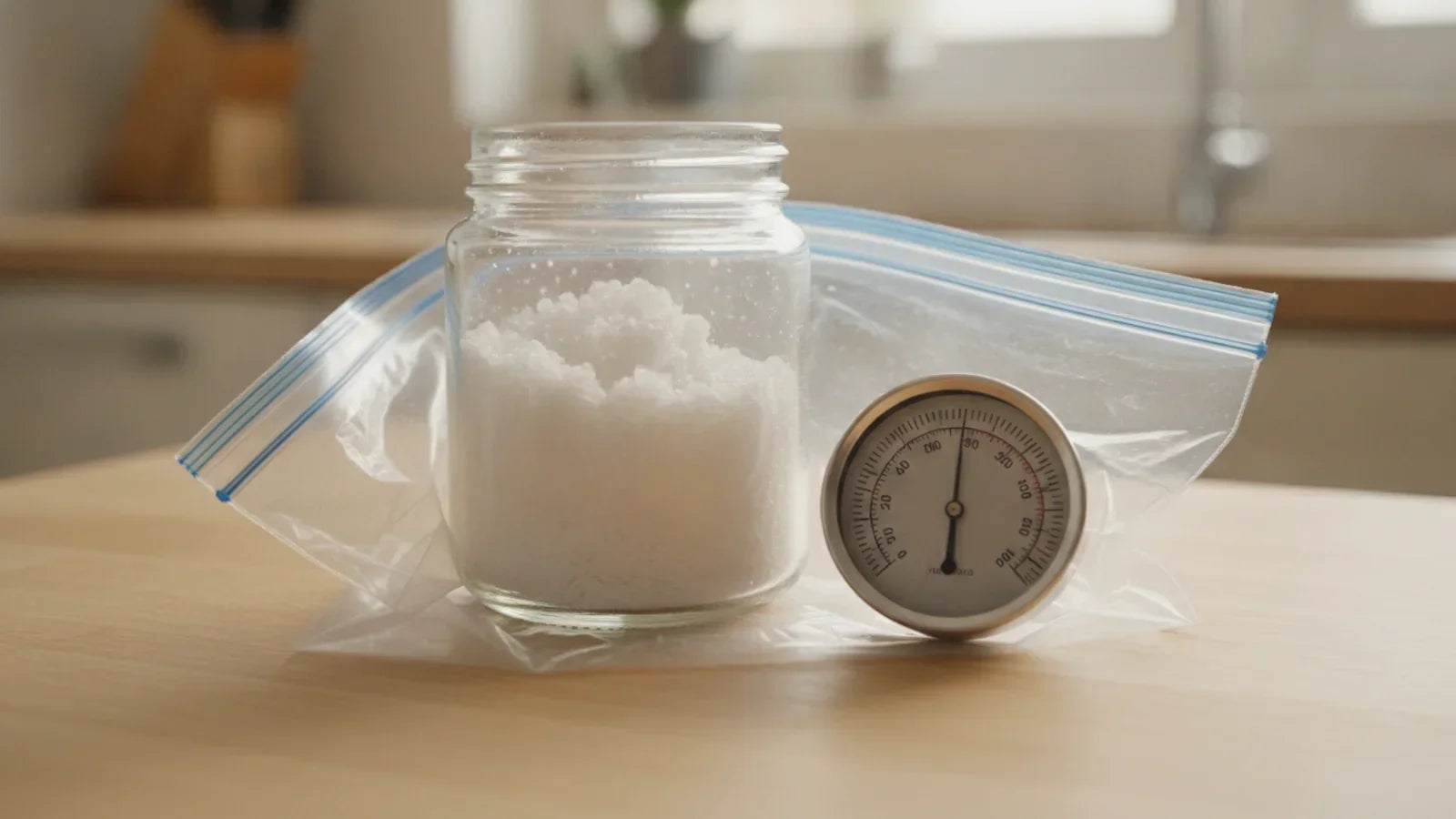

Cheap hygrometers — the little humidity gauges in a humidor, a guitar case, or on the shelf next to your humidifier — are often wrong by 5 to 10 percentage points straight out of the box, and they drift further as they age. You can check any of them for free with the salt test, which works because a saturated table-salt solution, sealed in a container, always produces almost exactly 75% relative humidity — a known reference you can measure your gauge against. Here’s the method step by step, how to read the result, the honest limits of it, and why an accurate reading matters more than people think.
Why an off hygrometer matters
A humidity gauge that reads wrong isn’t a harmless quirk — it quietly makes every decision you base on it wrong too. If your hygrometer reads high, you’ll under-humidify: the gauge says 45% while the room is really at 35%, so you leave the air drier than you think and keep getting dry skin, static, and cracking wood. Read the guitar or wine numbers you’re protecting and the stakes get sharper.
The opposite error is worse for your house. If your hygrometer reads low, you’ll over-humidify — pushing the real humidity past 60% while the gauge still shows a “safe” number — and that’s the condensation-and-mold territory we cover in do humidifiers cause mold. Either way, a $12 gauge that’s 8% off is steering a decision that affects your comfort, your belongings, and your walls. Checking it costs nothing but table salt and a day.
The salt test, step by step
The whole method rests on one fact from humidity science: a saturated salt solution in a sealed space equilibrates to a known, repeatable humidity, and for ordinary sodium chloride — table salt — that value is about 75% relative humidity (Vaisala, Ruuvi). It barely moves across the temperatures a room actually sits at, so 75% is a dependable target. Here is the process:
- Make a salt slurry. Put a couple of tablespoons of table salt in a small cap or dish and add a few drops of water — just enough to dampen it into a grainy paste. You want wet salt with no standing water, not salt dissolved in water.
- Seal it with the hygrometer. Place the salt and the hygrometer together in an airtight container or a zip-top bag, without the gauge touching the salt. Squeeze out as much air as you can and seal it tight.
- Wait. Leave it undisturbed somewhere with a steady temperature for at least 12 hours; some makers suggest up to a couple of days for a fully settled reading. Don’t open it to peek — that lets the humidity out and restarts the clock.
- Read it against 75%. Open it just long enough to read the gauge. A perfectly accurate hygrometer shows about 75%. Whatever the gap is between its reading and 75, that’s its error.
That’s the entire test: you’re not trusting the gauge, you’re trusting the salt, which physics pins at 75%.

How to read the result
The number you care about is the difference from 75%. If the gauge reads 70%, it runs 5 points low, so add 5 to whatever it tells you in real life; if it reads 80%, it runs 5 points high, so subtract 5. A gauge that lands within a couple of points of 75 is doing fine — most consumer hygrometers are rated to about ±5%, so anything from roughly 70 to 80 is within spec.
What you do next depends on the gauge. Some digital models have a calibration button that lets you set the displayed value to 75% while it sits in the bag — the cleanest fix. Most cheap ones aren’t adjustable, so you simply write the offset on a piece of tape and do the mental math from then on. Either way you’ve turned an unknown gauge into a known one, which is the entire point. Because electronics drift, it’s worth repeating the test about once a year.
The honest limits
The salt test is genuinely useful, but it isn’t a laboratory calibration, and it’s worth knowing where it’s soft. Vaisala, which makes professional humidity references, notes that saturated-salt methods stabilize slowly and are sensitive to ambient conditions — the reading is only reliable if you run the test at a stable temperature and give it time. Do it in a spot that isn’t swinging between hot and cold, and don’t rush the wait.
It also only checks one point on the scale — 75% — so a gauge that’s accurate there could still be off at 30% or 90%. For a home humidifier that’s a minor concern, because 75% is close to the range you actually care about. Treat the salt test for what it is: a free, reliable sanity check that catches the badly-wrong gauges, not a certificate of precision. For most people, catching a gauge that’s 8% off is the whole win.
Getting your humidity right
The reason any of this matters is that a trustworthy reading is what lets you actually hit the target. Once you know your gauge is honest, the goal is simple: keep indoor air in the 30–50% range — enough to stop the dryness, not so much that you invite condensation. In winter that usually means adding moisture back, which is the whole job of a humidifier, and in a heated home the gap can be large — we mapped just how dry it gets in the driest winter indoor air by city.
We build a portable steam humidifier, so read that as disclosure — but the principle holds whatever you run: measure with a gauge you trust, aim for the middle of the healthy band, and let the humidifier do the rest. Steam has the side benefit of a clean vapor with no white mineral dust, and if you want the seasonal targets by month, the heating-season humidity guide lays them out. A $12 hygrometer you’ve actually checked is worth more than an expensive one you’ve simply trusted.
FAQ
How do I calibrate a hygrometer with salt?
Dampen a couple of tablespoons of table salt with a few drops of water into a grainy paste, seal it in an airtight container or bag together with the hygrometer, and leave it undisturbed at a steady temperature for at least 12 hours. A saturated salt solution holds about 75 percent relative humidity, so a correct hygrometer should read about 75 percent. The difference from 75 is the gauge's error.
What should a hygrometer read in the salt test?
About 75 percent relative humidity. A saturated table-salt solution settles at close to 75 percent and barely changes across the temperatures a room sits at. If your hygrometer reads within a couple of points of 75, it is accurate; most consumer models are rated to about plus or minus 5 percent.
Why does salt read 75 percent humidity?
Because a saturated solution of a given salt always equilibrates to a fixed, repeatable humidity in a sealed space, and for ordinary sodium chloride that value is about 75 percent. If the sealed air rises above it, moisture condenses onto the salt; if it falls below, the salt releases vapor, so the space self-corrects back to about 75 percent.
How long does the hygrometer salt test take?
At least 12 hours, and some manufacturers suggest up to a couple of days for a fully settled reading. Keep the container sealed and at a steady temperature the whole time, and do not open it to check early, because that lets the humidity escape and restarts the process.
How accurate is the salt test?
It is a reliable sanity check rather than a laboratory calibration. Done correctly at a stable temperature it is good to within a couple of percent, but it only checks one point, 75 percent, and it stabilizes slowly and is sensitive to temperature swings. It reliably catches a gauge that is badly off, which for a home humidifier is the main thing you need.
Keep reading
- The heating-season humidity guide
- The driest winter indoor air by city
- Do humidifiers cause mold?
- The right humidity for houseplants
- Ideal humidity for valuables
- Humidifier for a guitar room
Sources — saturated-salt humidity references and hygrometer guidance. Verified live.