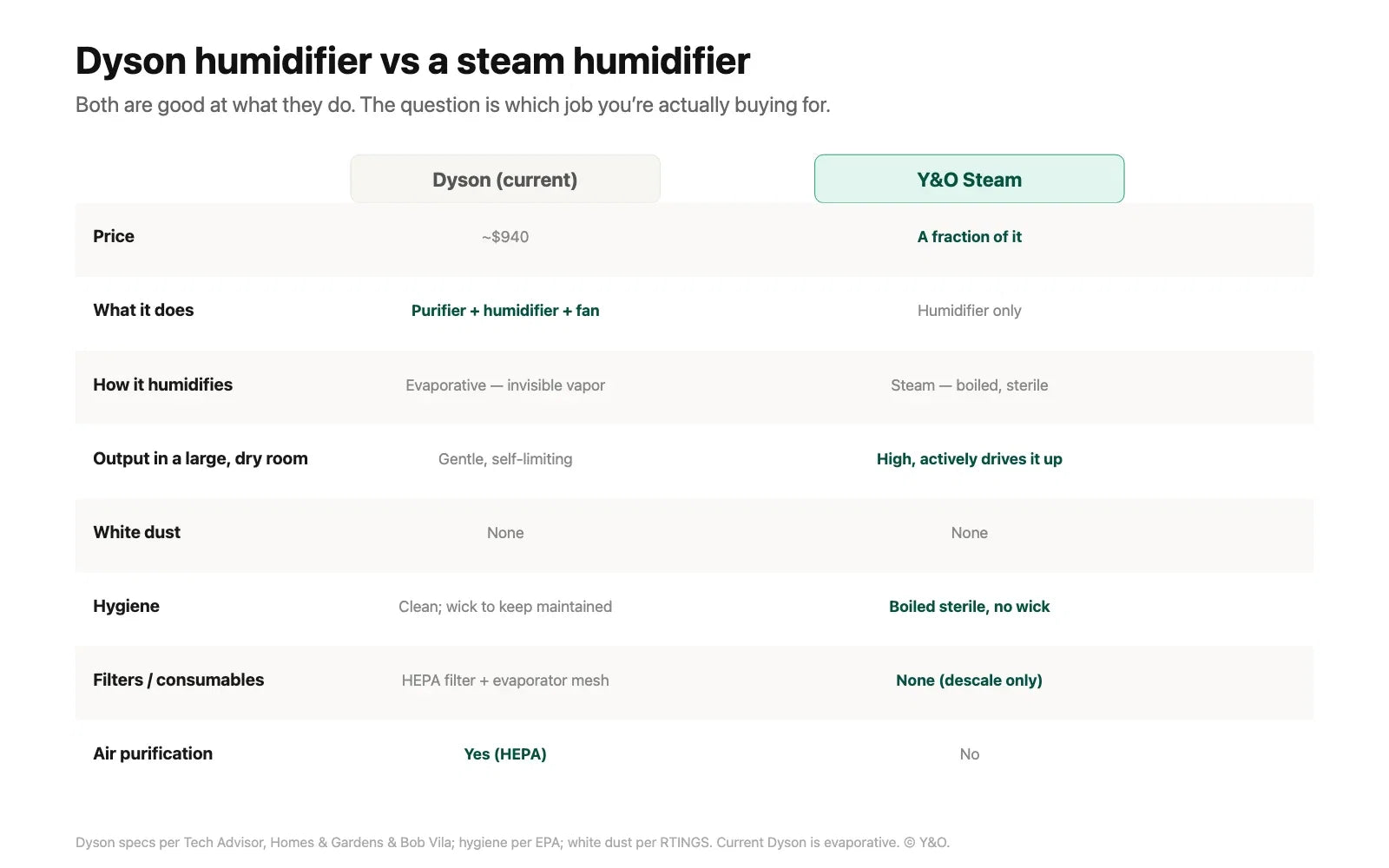

The Dyson Purifier Humidify+Cool is the humidifier people cross-shop against almost everything else, usually because it’s beautiful, it does three jobs, and it costs around $940. But “is it worth it” can’t be answered in the abstract — it depends on how it makes humidity compared with the alternatives, because that one difference decides output, hygiene, running cost, and who each machine actually suits. This review compares the evaporative Dyson humidifier against steam humidifiers (using the Y&O Steam Plus as the reference steam unit) and ultrasonic units, on the seven things that actually differ — using independent reviews and EPA guidance rather than any single maker’s marketing.
The short answer
The Dyson humidifier is a genuinely excellent premium appliance, and for what it is — a three-in-one purifier, humidifier, and fan — it earns its reviews. The catch is that it’s an evaporative humidifier, which is gentle and clean but output-limited; a steam humidifier makes moisture a different way that trades the extra functions for far more humidifying power and a lower price. Here’s the quick version before the detail:
| If you want… | Better pick | Why |
|---|---|---|
| Purify + humidify + cool in one appliance | Dyson | Genuinely does all three well; nothing else here purifies the air |
| The most humidity for a large or very dry room | Steam | Active boiling drives humidity up; evaporative self-limits |
| The lowest price and no filters to buy | Steam | A fraction of $940; no HEPA filter, no wick to replace |
| The cleanest mist with the least fuss | Either — not ultrasonic | Evaporative and steam both disperse little; ultrasonic is the one to avoid |
1. How each one makes moisture
Every real difference in this comparison comes from one thing: the method each machine uses to turn water into humidity. There are three, and it’s worth understanding them before comparing anything else.
The Dyson humidifier is evaporative. A fan pulls room air through a wet biostatic mesh, and the moving air lifts water off the mesh as an invisible vapor — there’s no visible mist at all. Because the water is evaporated rather than sprayed, the minerals and most of what’s in the water are left behind on the mesh rather than launched into the room (Bob Vila confirms it runs on ordinary tap water). That’s the same principle as a wet towel drying on a radiator, done with a fan and a controller.
A steam humidifier, like the Y&O Steam Plus, boils the water. A heating element brings the water to a boil, which turns it to pure vapor and, along the way, kills bacteria in the water; the minerals are left in the tank, and the vapor is cooled before it leaves so it isn’t scalding. It’s an active process — the machine is putting energy in to produce moisture, rather than waiting for air to pick it up.
Ultrasonic units — including Dyson’s older, discontinued AM10 and most cheap humidifiers — vibrate a disc to fling water into a fine cool mist. That mist is whatever was in the water, minerals and all, atomized into the room. It’s the method behind white dust, and the EPA singles it out below. Keep these three mechanisms in mind, because the next six sections are really just their consequences.
2. Humidifying power & room size
This is where evaporative’s gentleness becomes a real limit. An evaporative humidifier can only add moisture as fast as air can lift it off the wet mesh — and that rate falls as the room gets more humid, because moister air evaporates water more slowly. So the Dyson humidifier is genuinely good at holding a room at a set level once it’s there, but it’s working against its own mechanism when it has to drag a large or very dry room upward. In a normal room it does fine — one reviewer measured it moving a space from 31% to 50% in a couple of hours (Bob Vila) — but in a big open-plan space or the bone-dry depths of winter, evaporative is the method most likely to run flat out and still not get there.
Steam has the opposite character: it’s an active, high-output method that doesn’t slow down as the room fills. Because it’s boiling water rather than waiting for evaporation, a steam unit like the Y&O keeps pushing moisture at close to the same rate whether the room is at 20% or 45%, which is exactly what a large or stubbornly dry space needs. That’s why steam is the method that shows up in guides to humidifying large rooms and the driest winter indoor air. The trade-off is honest: that same active output is why steam uses more electricity than an evaporative fan, and why evaporative’s self-limiting nature is genuinely nice if all you want is to hold a steady, gentle level without ever over-humidifying.
3. White dust & water quality
Here the Dyson humidifier and steam actually agree, and it’s worth being fair about it. Neither the evaporative Dyson nor a steam humidifier produces white dust, because neither one sprays your tap water’s minerals into the air — evaporative leaves them on the mesh, and steam leaves them in the tank. Dyson’s manual says ordinary tap water is fine, and you don’t need distilled water for either type.
The machine that does have the white-dust problem is the ultrasonic one, because its vibrating disc atomizes minerals straight into the room — that powdery film on the furniture is your water’s calcium and magnesium, and the standard workaround is buying jugs of distilled water (RTINGS). How bad it gets by region is tracked in the white-dust map. So if you were choosing between the Dyson and a steam unit specifically to avoid white dust, that’s a tie — the real dust question is whether to avoid ultrasonic, not which of these two to pick.
4. What’s in the mist: hygiene
What a humidifier puts into your air matters as much as how much, and here the mechanism drives a real difference — though not the one people assume. The EPA’s guidance is the fair reference point. It states that “ultrasonic and impeller (or ‘cool mist’) humidifiers can disperse materials, such as microorganisms and minerals, from their water tanks into indoor air,” while evaporative and steam types “generally disperse less, if any, of these pollutants” (EPA). So both machines in this comparison are already on the better side of that line — another point where the Dyson humidifier does well.
The difference between them is narrower and structural. Steam sterilizes as it works: bringing the water to a boil kills bacteria before the vapor ever leaves the machine, and there’s no permanently damp wick left behind to grow anything. Evaporative’s weak point is exactly that permanently wet part — the mesh or wick. The EPA notes any humidifier with a standing-water reservoir can grow microorganisms if it isn’t kept clean, and an evaporative wick that stays damp between uses is the classic place for it, which is why evaporative makers build in cleaning cycles and wick replacement. Dyson addresses this with a deep-clean function, and to its credit disperses little into the air; but the upkeep is real, and a neglected wick is how any evaporative unit ends up blowing a musty smell around a room. The honest summary: steam has the structural hygiene edge because it boils and has no wick, the Dyson humidifier is clean but depends on you keeping the mesh maintained, and an ultrasonic unit is the one the EPA actually warns about. The whole topic is worth reading up on in what actually grows inside a humidifier.
5. Filters, cleaning & consumables
Because it’s a sealed air purifier as well as a humidifier, the Dyson humidifier carries the most upkeep of the three types. It has a HEPA air filter that’s a genuine consumable — you buy and replace it over the machine’s life — plus the evaporative mesh to keep clean, and a deep-clean routine to run. Reviewers also note a smaller quirk: it can only run one automatic mode at a time, auto-purifying or auto-humidifying but not both at once (Bob Vila). None of this is damning — it’s the price of a machine that does three jobs — but it’s worth counting.
A steam humidifier has no filter and no wick, so the only routine job is periodic descaling to clear the mineral scale that boiling leaves behind — the same minerals that would otherwise become white dust. In a hard-water area that descaling is more frequent, which is the honest cost of the steam method, and it’s covered in the descaling guide. But there’s nothing to buy on a schedule: no HEPA filter, no replacement wick, no cartridge. Every humidifier here still needs regular tank cleaning per the EPA — that part is universal — but the steam unit is the one with no consumable parts to keep buying.
6. What else it does: purify & cool
This is the Dyson humidifier’s home turf, and it’s a real advantage, not a footnote. The Purifier Humidify+Cool is a three-in-one: a sealed HEPA air purifier and a bladeless cooling fan on top of the humidifier (Tech Advisor), and reviewers who live with it are won over — Homes & Gardens called it “one of the best humidifiers that I’ve ever used”. If you were going to buy an air purifier and a fan anyway, the Dyson humidifier folding all three into one well-designed tower is a legitimately good deal on space and money.
A steam humidifier does exactly one job, and makes no pretense otherwise: it won’t clean your air or cool the room. Whether that’s a strength or a weakness is entirely about what you need. If you want air purification, the steam unit simply isn’t in the conversation and the Dyson humidifier wins outright. If you already have air handled — or you just want the dry air fixed — then the purifier and fan are features you’re paying for and stepping around, and a dedicated humidifier is the cleaner buy.
7. Price & the cost after checkout
The Dyson humidifier lands around $940 (Tech Advisor), which is fair for three premium appliances in one and steep for a humidifier alone. But the sticker isn’t the whole cost: the HEPA filter is an ongoing purchase, so the Dyson humidifier keeps costing a little every year you own it. A steam humidifier such as the Y&O Steam Plus is a fraction of that price up front and has no filter to buy afterward — its only running costs are electricity (higher than an evaporative fan, because it boils) and the odd bottle of descaler.
So the money question mirrors the whole comparison. If you’ll use the purifier and the fan, the Dyson’s price buys three machines and can be genuinely worth it; if you only want humidity, you’re paying roughly $940 plus filters for one of the three functions.
Who should buy which
Buy the Dyson humidifier if you want one premium appliance to purify, humidify, and cool, you’ll actually use all three, and a gentle, self-limiting humidity level suits your space. It’s beautifully made, it’s clean, and for that job it’s worth the money. It’s the wrong tool only if humidification is the real job and the other two are extras you don’t need.
Buy a steam humidifier such as the Y&O Steam Plus if you want the most humidifying power for a large or very dry room, the cleanest mist with no wick to maintain, no filters to buy, and a fraction of the price — and you don’t need air purification or cooling. And whichever you choose, set your target with a hygrometer you’ve actually checked, because both machines are only as accurate as the gauge you aim them at.
Want maximum humidity for the room, minus the $940?
The Y&O Steam Plus is a dedicated 10L steam humidifier — high output for a large, dry space, sterilized by boiling, with no filters and no wick to replace.
See the Y&O Steam Plus 10L
FAQ
Is the Dyson humidifier worth it?
It is worth it if you want a single premium appliance that purifies, humidifies, and cools, and you will use all three functions, because at around 940 dollars you are buying three good machines in one. If you mainly want to fix dry air, it is a lot to pay for one evaporative humidifier, and a dedicated steam humidifier does that job with more output for far less.
Is the Dyson humidifier ultrasonic or evaporative?
The current Dyson, the Purifier Humidify+Cool, is evaporative. A fan passes air over a wet mesh and carries the moisture off as an invisible vapor, leaving minerals behind, so it does not produce white dust and runs on tap water. Dyson's older, discontinued AM10 was ultrasonic, which is a different method that can leave white dust.
Can a Dyson humidifier keep up with a large room?
It is better at maintaining humidity than driving it up. Evaporative humidifiers add moisture only as fast as air can lift it off the wet mesh, and that slows as the room gets more humid, so a large or very dry space can outpace it. A steam humidifier uses active boiling that keeps its output up regardless of room humidity, which is why steam suits large or bone-dry rooms.
Which is more hygienic, the Dyson or a steam humidifier?
Both are on the cleaner side. The EPA notes evaporative and steam humidifiers disperse far less into the air than ultrasonic ones. Between them, steam has a structural edge because boiling sterilizes the water and there is no wick to keep damp, while an evaporative humidifier relies on you keeping its mesh clean and replaced. Any humidifier with a water tank still needs regular cleaning.
What is a good alternative to the Dyson humidifier?
If you want humidification rather than the purifier and fan, a dedicated steam humidifier is the honest alternative. It gives higher output for a large or very dry room, no filters or wick to replace, and a much lower price. The trade-off is that it only humidifies and does not purify the air or cool the room, and it uses more electricity because it boils.
Keep reading
- Steam vs ultrasonic vs evaporative
- Best humidifier for large rooms
- What grows inside a humidifier
- The white-dust map by water hardness
- The driest winter indoor air by city
- How to check your hygrometer with salt
Sources — independent reviews and EPA guidance. Verified live.
- Tech Advisor — Dyson Purifier Humidify+Cool Formaldehyde review (3-in-1, price)
- Homes & Gardens — Dyson Purifier Humidify+Cool review
- Bob Vila — Dyson Purifier Humidify+Cool review (evaporative, tap water, one auto mode)
- US EPA — Use and Care of Home Humidifiers (microbial dispersal by type, cleaning)
- RTINGS — White Dust and Ultrasonic Humidifiers