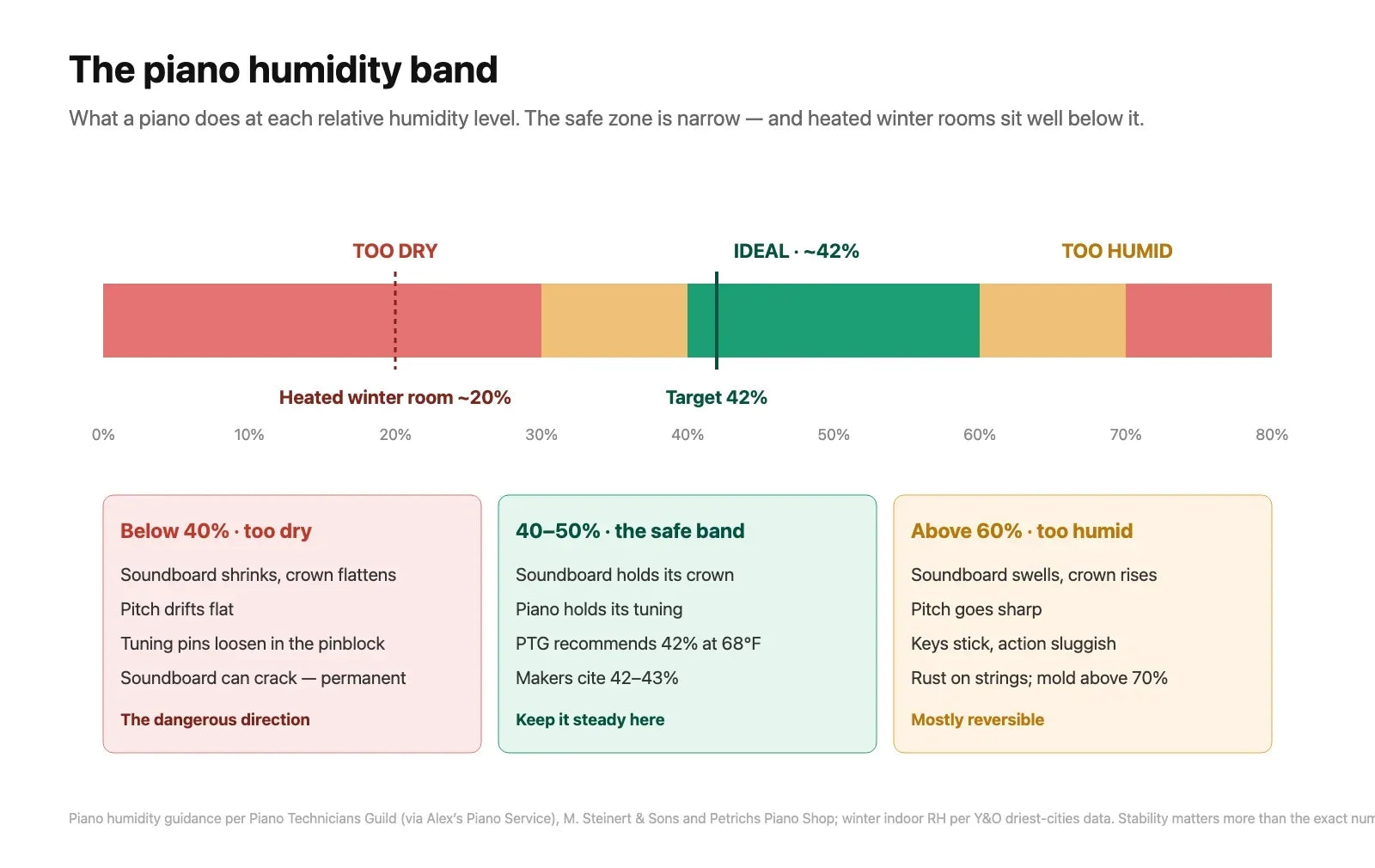

A piano is a large, precise wooden instrument under about 18–20 tons of string tension, and wood moves with the moisture in the air. That’s why the environment it sits in matters as much as how often it’s played. Piano makers and technicians converge on the same target: keep the room at a steady 42% relative humidity, and hold it there year-round without big swings. The number itself matters less than the stability — it’s the fluctuation, not any single reading, that cracks soundboards and knocks pianos out of tune. Here is what happens at each humidity level, why 42% is the magic number, and why winter is the season that quietly does the damage.
The short answer
Keep a piano at about 42% relative humidity, in a range of roughly 40–50%, and — above all — keep it steady. The Piano Technicians Guild recommends 42% (at 68°F), technicians consider roughly 40–50% a very safe band, and manufacturer-style guidance stretches to about 40–60% as long as you avoid rapid swings (Alex’s Piano Service, M. Steinert & Sons). The danger isn’t one bad day — it’s the swing from a humid summer to a bone-dry heated winter and back, which is the single biggest cause of a piano going out of tune (Petrichs Piano Shop).
What a piano does at each humidity level
Relative humidity is the single environmental number a piano cares about most. Here is how the instrument behaves as the room moves up the scale:
| Relative humidity | What happens to the piano | Verdict |
|---|---|---|
| Below 30% (heated winter room) | Soundboard shrinks, pitch drifts flat, tuning pins loosen in the pinblock, pressure ridges and cracks can form | Danger — too dry |
| 30–40% | Wood is drying out; pitch trending flat; the piano won’t hold a tuning well | Too dry |
| ~42% | The Piano Technicians Guild’s recommended setpoint; makers cite 42–43%. Soundboard movement minimized | Ideal |
| 40–50% | The very-safe band technicians aim for | Safe |
| 50–60% | Manufacturer-style guidance still allows this if you keep it steady; watch for mold near the top | Acceptable |
| 60–70% | Soundboard swells, pitch trends sharp, action feels sluggish | Caution — too humid |
| Above 70% | Sticky keys, sluggish action, rust on strings and pins, mold risk | Danger — too humid |
Notice how narrow the good zone is. The comfortable range runs about 40–50% at its best and 40–60% at the outside — and a heated home in January routinely sits well below it, near 20%. That gap is the entire problem.
Why 42% — and why stability beats the number
A piano’s soundboard is a thin sheet of spruce built with a slight upward curve called crown, held under tension by the strings pressing down through the bridge. Wood absorbs and releases moisture to match the air around it, swelling when it’s humid and shrinking when it’s dry — and when the soundboard changes size, it changes the tension on the strings, which changes the pitch. That’s the physics behind everything on this page, and it’s the same wood-and-moisture relationship we chart in the wood moisture guide.
42% is the target because it sits in the middle of the range where a piano’s spruce holds a moisture content that keeps the crown — and the tuning — where the maker intended. But the exact figure matters less than one word: steady. Humidity fluctuation is the number-one cause of a piano going out of tune, and repeated swelling and shrinking is what fatigues a soundboard into cracks over years (Petrichs Piano Shop). A piano held constantly at 38% will usually fare better than one that bounces between 25% in winter and 60% in summer, even though 38% is below the ideal.
Too dry: flat pitch, loose pins, cracks
Dryness is the piano’s more dangerous direction, because it’s where the permanent damage lives. As the air dries below 40%, the soundboard loses moisture and shrinks, its crown flattens, string tension eases, and the whole instrument drifts flat — a piano can go noticeably flat across a dry winter without a single note being played. At the same time the pinblock, the dense laminated slab that grips the tuning pins, shrinks and loosens its hold, so the piano stops holding a tuning even after it’s set.
Pushed far enough or long enough, dryness cracks the soundboard — the pressure ridges and splits that show up on old pianos from dry, heated homes. Glue joints in the case and action can fail too. None of this reverses on its own; it’s why technicians guard against sustained low humidity first, and why a hygrometer in the room is worth more than it costs. If you own one, it’s worth checking that it reads accurately before you trust it.
Too humid: sharp pitch, sticky keys, rust
The wet direction is mostly reversible, but it makes a piano unpleasant to play. Above about 60%, the soundboard swells, its crown rises, string tension increases, and the pitch trends sharp. The felt bushings in the action absorb moisture and swell, so keys feel sluggish or stick outright, and repetition slows. Sustained high humidity rusts strings and tuning pins and, past 70%, invites mold on felt and inside the case. Damp basements and unconditioned summer rooms are the usual culprits.
Winter is the real enemy
Here is the part most people miss. The season that damages pianos isn’t humid summer — it’s heated winter, because indoor heating drives relative humidity far below the piano-safe band. A heated home in a cold, dry climate often sits at 15–25% RH indoors, well under the 40% floor, right in the red zone for cracked soundboards and loose pins. We mapped just how low it gets, city by city, in the driest winter indoor air data.
And it’s not just the low reading — it’s the size of the annual swing. A piano that lives at 55% in July and 20% in January is asked to shrink and swell across a 35-point range twice a year, and that repeated movement is exactly what fatigues wood and destabilizes tuning. Cutting that swing down is the real goal, and winter is when the room needs the most help climbing back toward 42%.

How to hold 42%
Holding a steady humidity around a piano comes down to three moves, in order:
- Measure first. Put a hygrometer on or beside the piano and watch it across a week and across seasons. You’re looking for both the average and the swing. A gauge you haven’t checked can be off by 10 points, so it’s worth calibrating it with the salt test first.
- Fix the room in winter. When heating pulls the room into the 20s, adding moisture back to the space is what closes the gap to 42%. Because the enemy is the winter trough, the room’s humidity in the heating season is where most of the risk — and most of the fix — lives.
- Or control the piano directly. For a valuable instrument in a room that simply can’t be controlled, an in-piano system such as the Dampp-Chaser Piano Life Saver holds the case itself near 42%. Consider it a last resort, not a first move: makers generally prefer that you control the room instead, and some do not endorse in-piano systems for new pianos under warranty (M. Steinert & Sons).
Whichever route fits, the job is the same: keep the number near 42% and, more importantly, keep it from swinging. The instrument will hold its tune longer, its action will feel right, and the soundboard that gives it its voice will stay intact.
FAQ
What is the ideal humidity for a piano?
About 42% relative humidity, within a very safe band of roughly 40 to 50%. The Piano Technicians Guild recommends 42% at 68 degrees Fahrenheit, and manufacturer-style guidance stretches to about 40 to 60% as long as you avoid rapid swings. Keeping the level steady matters more than hitting the exact number.
What does low humidity do to a piano?
Below about 40%, the soundboard shrinks and its crown flattens, string tension eases and the pitch drifts flat, and the pinblock loosens its grip on the tuning pins so the piano stops holding a tuning. Sustained dryness can crack the soundboard and fail glue joints, which does not reverse on its own.
Why does my piano go out of tune every winter?
Because indoor heating drops relative humidity far below the piano-safe band, often to 15 to 25%. The soundboard dries and shrinks, string tension drops, and the whole piano drifts flat, even if no one plays it. The large swing between humid summer and dry winter is the main cause of tuning instability.
Is high or low humidity worse for a piano?
Low humidity is the more dangerous direction because it causes the permanent damage: cracked soundboards, loose tuning pins, and failed glue joints. High humidity mostly causes reversible problems such as sharp pitch, sticky keys, and rust, though sustained damp above 70% risks mold.
Does a piano really need a humidifier?
In a dry or heated climate, a piano benefits from added humidity in winter to keep the room near 42% rather than dropping into the 20s. The alternative is an in-piano humidity control system that manages the case directly. What matters is holding a steady level and shrinking the seasonal swing.
Keep reading
- The wood moisture chart: humidity, EMC and why wood moves
- The US cities with the driest winter indoor air
- How to calibrate a hygrometer with the salt test
Sources — piano technician and manufacturer humidity guidance. Verified live.
- Alex’s Piano Service — Complete Piano Humidity Guide (PTG recommends 42% at 68°F; 40–50% very safe; 40–60% manufacturer-style; in-piano systems as a room-uncontrollable fallback)
- M. Steinert & Sons — Do I Need a Piano Humidity Control System? (42–43% ideal; makers do not endorse in-piano systems for new pianos under warranty)
- Petrichs Piano Shop — Tuning Stability (humidity fluctuation is the number-one cause of tuning change; soundboard, pinblock and pitch effects)