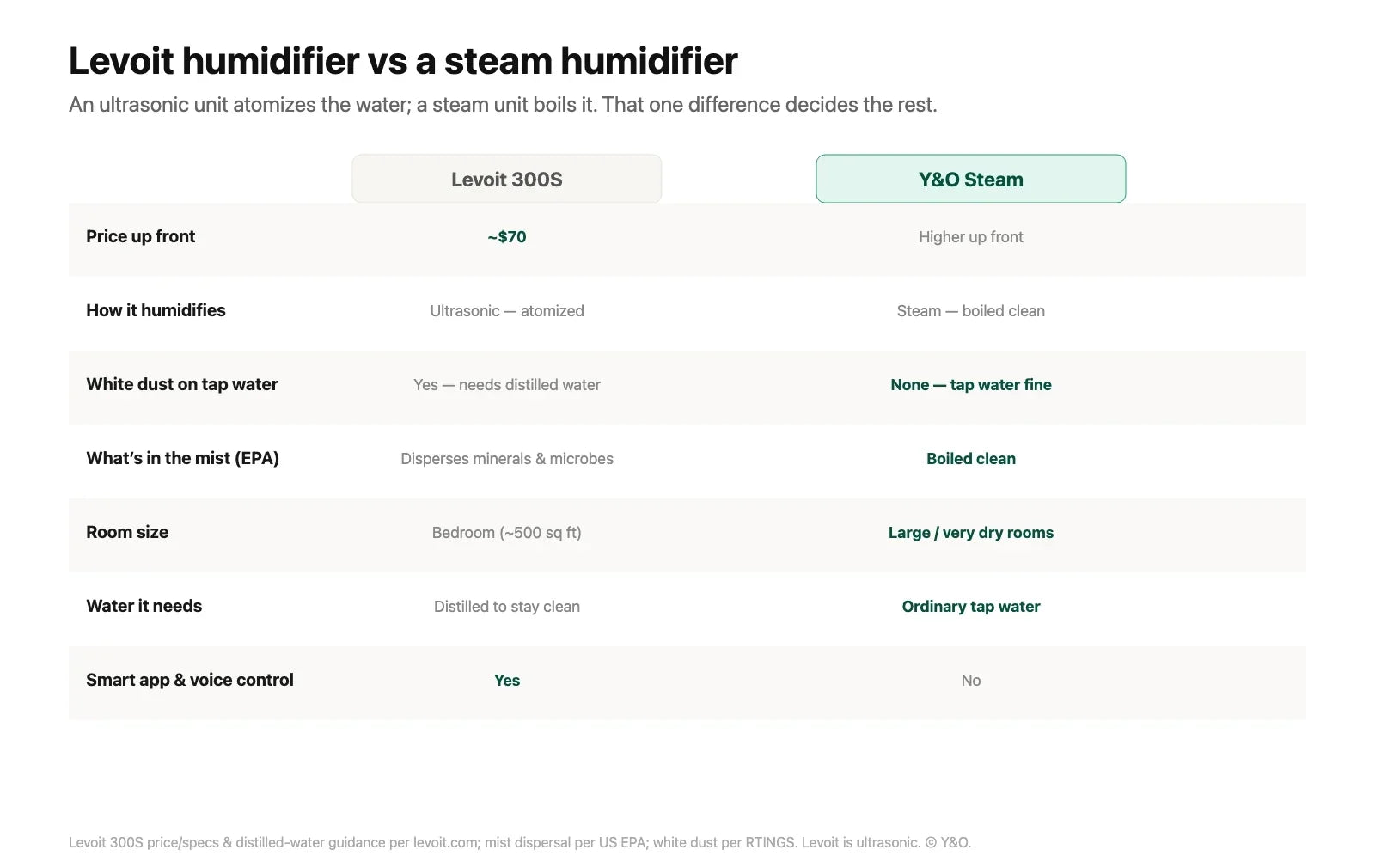

Levoit is the name most people meet first — the Classic 300S is cheap, smart, quiet, and all over the bestseller lists, and for a nightstand it does a lot right. It’s also an ultrasonic humidifier, and that single fact decides the things owners actually end up complaining about: the white film on the furniture, the jugs of distilled water, and what a vibrating mist puts into the air. Judged on humidification, an ultrasonic unit like the Levoit humidifier is inexpensive and feature-packed but sprays your tap water’s minerals into the room and needs distilled water to behave — while a steam humidifier makes moisture a fundamentally different way that leaves the minerals behind and runs on plain tap water. Here’s the honest, principle-first comparison, using Levoit’s own specs and EPA guidance.
The short answer
The Levoit is a genuinely good budget appliance — cheap, app-controlled, quiet, and easy to live with. But it’s an ultrasonic humidifier, which means it flings whatever is in your water into the room: minerals as white dust, and it works best only on distilled water you keep buying. A steam humidifier is the opposite trade — more up front, but clean mist on ordinary tap water. The quick version:
| If you want… | Better pick | Why |
|---|---|---|
| The cheapest smart humidifier with app & voice | Levoit | About $70, Wi-Fi, Alexa/Google, quiet — hard to beat on features per dollar |
| No white dust and no buying distilled water | Steam | Boils tap water; minerals stay in the tank, not on your shelves |
| The cleanest mist for a nursery or a sensitive household | Steam | The EPA flags ultrasonic for dispersing microbes and minerals |
| To raise a large or very dry room | Steam | High active output; the 300S is rated to ~500 sq ft |
1. How each one makes moisture
Everything below follows from one mechanical choice, so it’s worth being clear on the three methods first.
The Levoit is an ultrasonic humidifier. A small disc vibrates tens of thousands of times a second and shatters the water into a fine cool mist that a fan blows into the room. It’s cheap, quiet, and effective at making visible mist — but it’s indiscriminate: whatever is dissolved or floating in the tank water, minerals and microbes alike, gets atomized and launched into your air along with the moisture. That one trait is behind most of this comparison.
A steam humidifier, like the Y&O Steam Plus, boils the water. A heating element brings it to a boil, which turns it to pure vapor and kills bacteria in the water on the way; the minerals are left in the tank, and the vapor is cooled before it leaves so it isn’t scalding. Nothing gets sprayed — the water is purified by boiling before it ever becomes mist.
Evaporative units — the third type — wick water off a wet filter with a fan, which also leaves minerals behind but is slower and needs a filter. It isn’t what the Levoit humidifier or a steam unit does, but it’s worth knowing the field has three methods, not two. Hold these in mind: ultrasonic atomizes everything in the water, steam boils it clean, evaporative wicks it off a filter — the rest of this page is just consequences.
2. White dust & the distilled-water tax
This is the ultrasonic method’s signature problem, and Levoit is refreshingly blunt about it. Because the disc atomizes minerals straight into the air, the calcium and magnesium in your tap water settle out as a fine white powder on nearby furniture — and Levoit’s own guidance says the fix is to stop using tap water: “White dust prevention requires using distilled or purified water, not tap water. The 300S itself doesn’t filter minerals” (Levoit). In other words, to run it clean you commit to buying jugs of distilled water for as long as you own it — a quiet running cost the sticker price never mentions. How bad the dust is depends on your water; we map it in the white-dust map.
A steam humidifier sidesteps the whole thing: boiling leaves the minerals behind in the tank instead of misting them into the room, so there’s no white dust and no need for distilled water — ordinary tap water is fine. It’s the clearest, most concrete difference between the two machines, and it’s the reason ultrasonic is the one humidifier type where the water you pour in really matters. The mechanism behind it is laid out in steam vs ultrasonic vs evaporative.
3. What’s in the mist
Minerals aren’t the only thing an ultrasonic humidifier atomizes, and this is where the health authorities weigh in. The EPA specifically flags this method: it warns that “ultrasonic and impeller (or ‘cool mist’) humidifiers can disperse materials, such as microorganisms and minerals, from their water tanks into indoor air,” while evaporative and steam types “generally disperse less, if any, of these pollutants” (EPA). Because the disc throws whatever is in the tank into the air, any bacteria or mold that grows in a not-recently-cleaned reservoir can ride the mist straight into the room you’re breathing — which is why ultrasonic units need diligent, frequent cleaning.
Steam is on the opposite end of that same EPA line: boiling kills the bacteria in the water before it becomes vapor, so there’s no living thing to launch and nothing being aerosolized but clean water. None of this makes the Levoit humidifier dangerous — a clean, well-maintained ultrasonic unit on distilled water is fine — but it’s the type that asks the most of you to stay clean, and the one the EPA singles out. For a nursery or a home where someone is sensitive to what’s in the air, that difference is worth weighing, which we go deeper on in what grows inside a humidifier.
4. Output & room size
Here the Levoit humidifier is more competitive than its price suggests, and it deserves credit for it. Ultrasonic humidifiers put out a lot of visible mist for the money, and the Classic 300S is rated for rooms of about 215–505 sq ft with a 6-liter tank (Levoit) — plenty for a bedroom or a nursery, which is exactly what it’s built for. For that job, output isn’t where it falls short.
Where steam pulls ahead is the big, stubbornly dry space: an active boiling unit keeps driving humidity up in a large open-plan room or a bone-dry winter apartment, holding a level in volume that a bedroom-class humidifier can’t. If your problem is one room overnight, the Levoit’s output is genuinely enough; if it’s a whole floor in January, that’s the case we make in humidifying large rooms and the driest winter indoor air.
5. Cool mist vs steam
The two machines also feel different in the room. The Levoit puts out a cool mist, which carries no burn risk — a genuine plus in a child’s room — but it can leave a room feeling a touch cooler and damp right around the unit in the depths of winter. Ultrasonic mist is also visible, which some people like as reassurance and others find leaves a film on a nearby nightstand.
A steam humidifier boils the water and then cools the vapor before it exits, so what reaches the room is warm rather than cold, and invisible rather than a plume. The trade-off is honest on both sides: boiling uses more electricity than an ultrasonic disc, and a steam unit is a simpler, more utilitarian object than the Levoit’s tidy, app-connected design. Neither is wrong — it depends on whether you want a clever bedside gadget or a workhorse that just adds clean moisture.
6. Price, smart features & the hidden cost
This is the Levoit humidifier’s home turf, and it earns the reputation. At around $70 the Classic 300S is a fraction of a premium humidifier’s price, and it comes with genuinely useful smarts: Wi-Fi through the VeSync app, scheduling, an auto mode, and voice control with Alexa and Google Assistant (Levoit). For features per dollar, it’s hard to beat, and if a cheap, controllable bedside humidifier is the whole brief, it’s an easy recommendation.
The catch is the cost that doesn’t show up at checkout. Running an ultrasonic unit clean means distilled water — and a household that goes through jugs of it is quietly paying a recurring bill the steam humidifier simply doesn’t have, since it runs on tap. A steam humidifier such as the Y&O Steam Plus costs more up front, but between no distilled water and no white dust to wipe up, the gap narrows over time. Which is cheaper depends on how you count: the Levoit wins the sticker, and steam wins the years you run it on tap water.
Who should buy which
Buy the Levoit humidifier if you want the cheapest smart humidifier for a bedroom or nursery, you like app and voice control, and you don’t mind using distilled water and cleaning it often. It’s a well-made budget machine with features far above its price, and for a single room run on distilled water it does its job well.
Buy a steam humidifier such as the Y&O Steam Plus if you want clean mist on ordinary tap water with no white dust, the cleaner, boiled output the EPA’s guidance favors over ultrasonic, and the power for a large or very dry room — and you don’t need the bargain price or the smart-home gadgetry. And whichever you run, set your target with a hygrometer you’ve actually checked, because either machine is only as accurate as the gauge you aim it at.
Tired of white dust and distilled-water runs?
The Y&O Steam Plus is a dedicated 10L steam humidifier — clean, boiled mist on ordinary tap water, no white dust, and high output for a large, dry room.
See the Y&O Steam Plus 10L
FAQ
Is the Levoit humidifier worth it?
It is worth it if you want a cheap, smart humidifier for a bedroom or nursery and you are willing to use distilled water and clean it regularly. At around 70 dollars with app and voice control it is excellent value. If you want clean mist on tap water with no white dust, or output for a large room, a steam humidifier does more over time.
Does the Levoit humidifier leave white dust?
It can. The Levoit humidifier is ultrasonic, and Levoit's own guidance says the 300S does not filter minerals, so white dust prevention requires using distilled or purified water rather than tap water. A steam humidifier avoids white dust entirely because boiling leaves the minerals in the tank instead of misting them into the room.
Does the Levoit humidifier need distilled water?
To avoid white dust, yes. Because it is ultrasonic and does not filter minerals, Levoit recommends distilled or purified water rather than tap water. A steam humidifier does not need distilled water, because it boils ordinary tap water and keeps the minerals behind in the tank.
Is the Levoit humidifier safe for a nursery?
It is a cool-mist unit with no burn risk, which is good for a child's room, but the EPA notes ultrasonic humidifiers disperse more minerals and microorganisms into the air than evaporative or steam types, so they need frequent cleaning and distilled water. A steam humidifier boils the water, killing the bacteria in it, and disperses far less.
Levoit vs a steam humidifier, which is better?
They are built for different priorities. The Levoit is better if you want the cheapest smart humidifier with app and voice control for one room. A steam humidifier is better if you want clean mist on tap water with no white dust, the cleaner boiled output the EPA favors, and power for a large or dry room, without the low price or smart features.
Keep reading
- Steam vs ultrasonic vs evaporative
- The white-dust map by water hardness
- What grows inside a humidifier
- Best humidifier for large rooms
- The driest winter indoor air by city
- How to check your hygrometer with salt
Sources — Levoit specifications and EPA guidance. Verified live.