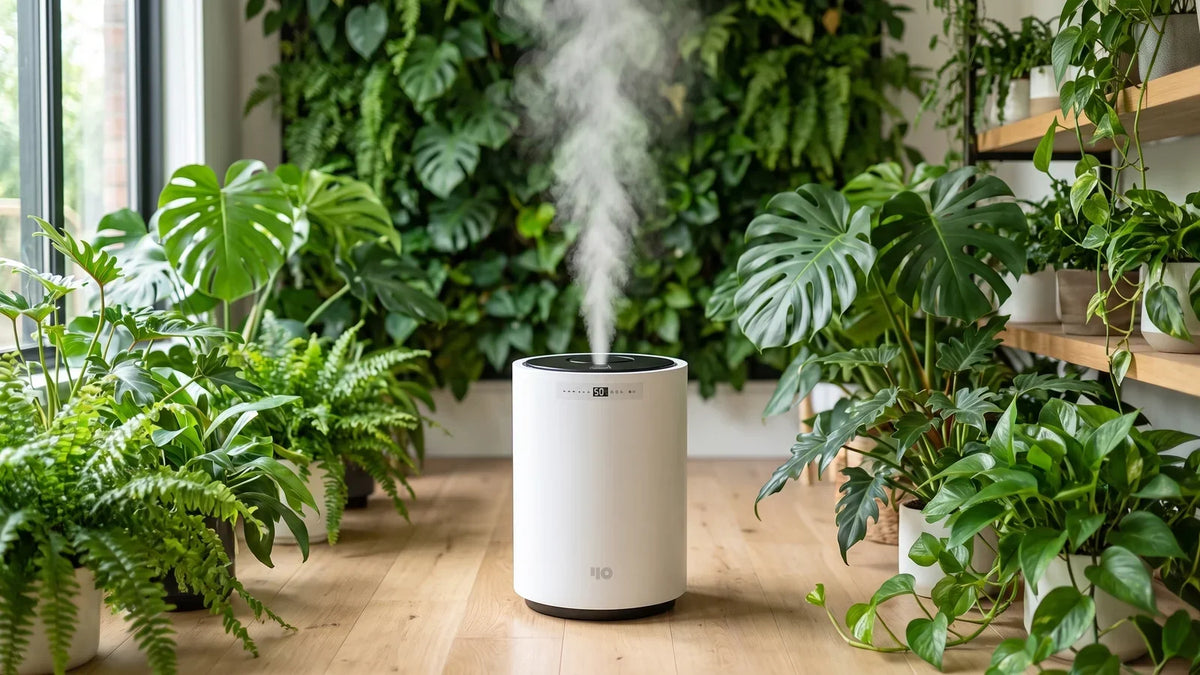

If you have a whole room of plants or a floor-to-ceiling green wall — not a couple of pots on a windowsill — the humidifier that keeps a shelf happy is usually the wrong tool. A jungle room needs humidity held steady across the whole space all night, and it needs mist that won't dust your leaves with minerals — which rules out most small cool-mist units on both counts. Below we rank the three humidifier types for exactly that job, using each brand's own specs, and say plainly where our own steam machine fits and where a cheap ultrasonic is still the smarter buy.
The short answer for a plant room
For a whole plant room or a floor-to-ceiling green wall, the humidifier we'd reach for is a steam unit like the Y&O-M2 Steam Plus, and the reasoning is about plants, not about us. It runs up to 1,200 mL/h from a 10 L dual-tank body, is rated for spaces up to 1,000 sq ft on ordinary tap water, and has no wick filter to reorder. Because it boils the water and leaves the calcium and magnesium behind as scale in the tank, the vapor it releases is mineral-free — so no white film settles on your foliage. A jungle room has a two-part problem: tropical plants want humidity near the top of the 30–60% indoor band that ASHRAE recommends, while heated winter air routinely drops below 30% (Penn State Extension). A 0.3–6 L cool-mist unit can lift the air around a shelf; holding a whole room of transpiring plants above 50% through the night is where a 10 L tank stops being overkill and starts being the point.
What a whole plant room actually demands
Start with why a room of plants is different from a room of people. Every plant is constantly moving water out through its leaves — transpiration — and a densely planted room has dozens of leaf surfaces all pulling the same trick at once. That plant-driven moisture demand is real, but it works against you in a heated home: warm indoor air can hold more water vapor, so the same amount of moisture reads as a lower relative humidity, and your tropicals feel the drop first. The core plant-room challenge isn't hitting a high number once — it's holding it, because a room full of foliage and a running furnace both pull humidity down faster than a single small tank can replace it.
The target itself is not mysterious. ASHRAE's recommended indoor range is 30–60% relative humidity, and Penn State Extension notes that during the heating season indoor levels "can easily fall below 30%." Tropical and aroid-heavy collections — monstera, calathea, ferns, anthurium — sit at the top of that band and above, which is precisely the range a heated winter room fights hardest to maintain. We won't reprint the per-species numbers here; our houseplant humidity reference already lays out what each plant likes. For buying purposes the useful takeaway is simpler: a plant room needs a machine sized to refill humidity continuously, not one that empties in three hours and lets the room dry back down before morning.
This is where tank size stops being a spec-sheet vanity number. A 6 L cool-mist unit running hard in a dry, plant-dense room can empty overnight, so humidity sags in the early hours — the exact window when a heated house is driest. Two independent 5 L tanks totaling 10 L, at up to 1,200 mL/h, buy the runtime to ride through that gap. For a full green wall, runtime is the spec that decides whether your plants wake up to 55% or to 32%.
Why white dust is a plant-specific problem
Here's the part most "best humidifier for plants" lists skip. An ultrasonic humidifier makes fog by vibrating water at high frequency, so anything dissolved in that water — the calcium and magnesium in hard tap water — rides the fog out and settles as a fine white powder on nearby surfaces. On a coffee table that's an annoyance you wipe away. On a leaf, it lands on the surface where the plant breathes. The same white dust that films your furniture also settles directly onto foliage, and leaves aren't surfaces you can casually wipe every day without damaging them.
Why that matters comes down to plant physiology. Leaves exchange gas — taking in carbon dioxide, releasing water vapor — through microscopic pores called stomata. Peer-reviewed plant-physiology research on particulate deposition finds that dust settling on leaves lowers stomatal conductance and the photosynthetic rate, because the particles physically interfere with that gas exchange (see Sources). Mineral dust from a humidifier is the same kind of fine particulate settling on the same pores — so on hard water, an ultrasonic unit in a plant room is quietly working against the plants it's meant to help. To be precise about proven versus inferred: that research measured atmospheric and road dust, not humidifier white dust specifically, so we're reasoning from a well-established mechanism, not a study of this exact scenario. Where the minerals go, though, isn't in dispute — we cover it in our piece on hard water and white dust.

The clean way out is to keep the minerals out of the mist entirely. A steam humidifier boils the water, which leaves the minerals behind in the tank as scale and sends out mineral-free vapor — no white dust to land on a single leaf, even on hard water, without buying jugs of distilled water. An evaporative wick unit also keeps dust out of the air, by trapping the minerals in a filter you replace on a schedule. Only ultrasonic units put the minerals into the room, which is the one behavior you least want around foliage.
The three types for a plant room, side by side
Here are the three humidifier technologies scored on what actually matters for a room full of plants: whether they dust your leaves with minerals, whether they can hold humidity all night without a refill, the upkeep they create, and a real model you can look up. No type is free of trade-offs — each one moves the cost somewhere, and the right pick is the one whose trade-off you'd rather live with next to your plants.
| Type | White dust on leaves (hard water) | Runtime for a whole room | Upkeep | Representative model |
|---|---|---|---|---|
| Ultrasonic (cool mist) | Yes — sprays minerals onto foliage | ~6 L tank; can empty overnight in a dense room | Distilled water if you want to stop the dust | Levoit LV600S (6 L hybrid) |
| Evaporative (wick) | No — wick captures the minerals | ~1 gal; fan-driven, no mist plume | Replace wick every 30–60 days | Honeywell HCM-350 |
| Steam (boils water) | No — minerals stay in the tank | 10 L dual tank, up to 1,200 mL/h | Descale the tank; no filters or distilled water | Y&O-M2 Steam Plus |
Every competitor figure here comes from that brand's own product page, checked September 2026: Levoit's LV600S is a 6 L ultrasonic, and Honeywell's HCM-350 is an evaporative unit whose manual calls for replacing the wick every 30–60 days. Read the first two columns together — for a plant room, "does it dust my leaves" and "does it last the night" are the two questions that separate the types, and only steam answers both with a clean yes.
So which should you buy?
Be honest with yourself about scale first, because the answer flips on it. If your "plant room" is really a shelf or two — a handful of pots by a window — buy a small cool-mist ultrasonic and skip the rest of this article; a Levoit LV600S or similar 6 L unit is quieter, cheaper, and perfectly matched to a small cluster. On soft water it won't even dust much, and grouping a few plants around it creates a humid pocket that's genuinely enough. We'd rather you spent less and got the right-sized tool than talked yourself into a floor unit you don't need.
The calculus changes when you have a whole room, a green wall, or a shelving rig packed with tropicals. Now you're fighting two things a small tank can't win: leaf-dusting minerals across a lot of foliage, and a room that dries back down before a 6 L tank can carry it through the night. For a full plant room on hard water, a steam unit is the type that solves both at once — mineral-free vapor that never films a leaf, plus a 10 L tank sized to hold humidity through the driest overnight hours. An evaporative unit is a reasonable dust-free middle option, as long as you're disciplined about swapping the wick every 30–60 days; skip that and a mineral-stiffened wick moves less water and can start to smell.
Across the 400-plus homes we've shipped steam humidifiers to, and reading our own returns and support tickets, the plant owners who love ours most are the hard-water ones who were tired of seeing white film settle back onto leaves they'd just cleaned. We test our own units on ordinary tap water rather than laboratory water, which is exactly the water a real plant room runs on. If you want scent in the room, don't reach for the tank — the Steam Plus isn't built for essential oils, so Y&O makes a separate glass Steam Aroma diffuser for that instead.

Built for a full plant room
The Y&O-M2 Steam Plus boils the minerals out of the water, so mineral-free vapor reaches your leaves — no white dust — and its 10 L dual tank holds humidity through the night, not just for three hours.
The honest trade-offs of steam for plants
Steam is not a free lunch, and there are three things we'd rather you hear from us than discover after buying. First, it uses more electricity than a cool-mist unit, because it's heating water to a boil — that's the price of dust-free vapor. Second, it's the loudest of the three types, since you can hear the water come up to a boil; in a plant room that's usually a non-issue, but in a bedroom-plant-room combo it's worth knowing. Third, and most relevant on hard water: boiling concentrates minerals in the tank, so you'll descale every 1–2 weeks rather than monthly — for the Y&O-M2 that's about 20 g of citric acid in the tank, heated 10–15 minutes and soaked 20–30, then rinsed. The full routine is in our descaling guide, and the reason steam skips filters entirely is in our filter-free steam guide.
There's also a placement rule that matters more with plants than with people. Set any humidifier a few feet back from your foliage rather than blasting mist straight at the nearest leaves — a jet of moisture on the same leaves all night keeps them wet long enough to invite fungal spotting. The goal in a plant room is even, room-wide humidity that settles around 50–60%, not a soaked corner — so pair the unit with a cheap hygrometer and don't chase numbers above 60%, because a closed, over-humid room is where mold starts. We dig into that risk in do humidifiers cause mold. And if you're sizing by floor area rather than plant load, our large-room humidifier guide works through the square-footage math.
FAQ
What is the best humidifier for a whole plant room or indoor jungle?
For a full room of plants or a green wall, a steam humidifier is the strongest pick because it solves the two plant-room problems at once. It boils the water and leaves the minerals in the tank, so the vapor is mineral-free and no white dust settles on your leaves; and a large tank — 10 L on the Y&O-M2 Steam Plus, at up to 1,200 mL/h — holds humidity through the night instead of emptying in a few hours. For just a shelf of plants, a small cool-mist ultrasonic is the smarter, cheaper choice.
Is white dust from a humidifier bad for plants?
It's not helpful. Ultrasonic humidifiers spray the minerals in hard tap water into the air as fine white dust, which settles on leaves. Leaves breathe through microscopic pores called stomata, and peer-reviewed research shows dust deposition on leaves lowers stomatal gas exchange and the photosynthetic rate. Steam and evaporative units keep those minerals out of the mist, so nothing films the foliage. We're reasoning from an established dust-on-leaves mechanism, not a study of humidifier dust specifically.
How big a humidifier tank do I need for a plant room?
It depends on how densely planted and how dry the room is. A 6 L cool-mist unit can empty overnight in a plant-packed, heated room, letting humidity sag in the early morning hours when the air is driest. For a full green wall, a 10 L tank — like the Y&O-M2's dual 5 L tanks at up to 1,200 mL/h — gives you the runtime to hold humidity through the night. If a single fill lasts all day in your room, you don't need a large machine.
What humidity level should a plant room be?
ASHRAE's recommended indoor range is 30–60% relative humidity, and most tropical houseplants prefer the top of that band. Aim for roughly 50–60% in a plant room and pair the humidifier with a hygrometer, but don't push past 60% in a closed room — over-humid, poorly ventilated spaces invite mold and fungal leaf spotting. During winter heating, indoor humidity can fall below 30%, which is why plant rooms need active humidification most in the cold months.
Can I use tap water in a humidifier for plants?
With a steam or evaporative unit, yes. A steam humidifier boils the minerals off into the tank, and an evaporative unit traps them in its wick, so neither sends them onto your leaves — you just descale or replace the wick on schedule. Ultrasonic units are the ones that push you toward distilled water for plants, because they atomize whatever is dissolved in the water into visible white dust that settles on foliage.
Keep reading
- Ideal humidity for houseplants (by species)
- Hard water, white dust, and your air
- Best humidifier for large rooms
- Do humidifiers cause mold?
- Why filter-free steam changes the upkeep
- How to descale and clean a humidifier
Sources (extension + peer-reviewed research + each brand's own page, checked September 2026)
- Penn State Extension — Humidity and Houseplants (ASHRAE 30–60% indoor range; winter levels can fall below 30%)
- Impact of atmospheric particulate matter retention on physiological characters of plant species (dust deposition lowers stomatal conductance and photosynthetic rate) — PMC
- Levoit LV600S — official product page (6 L ultrasonic, cool/warm mist)
- Honeywell HCM-350 — official product page (evaporative, wick replaced every 30–60 days, captures minerals)
- Y&O-M2 Steam Plus 10L — product page (1,200 mL/h, up to 1,000 sq ft, tap water, no filter)