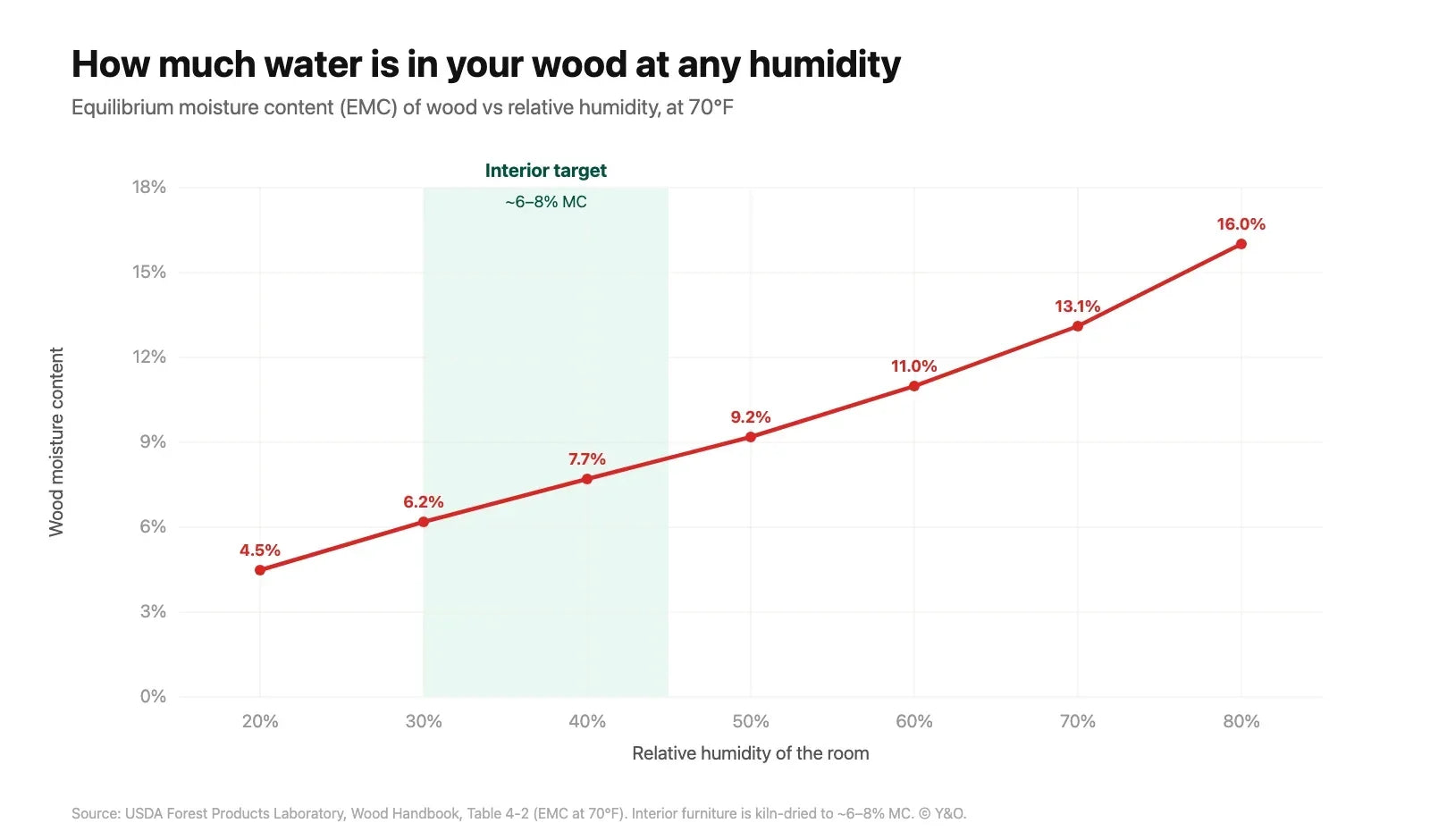

Every board in your shop is slowly trading moisture with the air until the two reach a truce — a point woodworkers call the equilibrium moisture content, or EMC. The single most useful fact in woodworking is that this point is predictable: at a given temperature and humidity, wood will always settle to a known moisture content, and the chart above — from the USDA’s Wood Handbook — tells you exactly what that number is. Get the humidity right and your wood holds still; get it wrong and it cracks, cups, and opens gaps months after the glue dried. Here’s how to read the chart, what to aim for, and why a stable shop is worth more than any clamp.
Why wood moves at all
Wood is hygroscopic: even after it’s cut, dried, and finished, it keeps absorbing moisture from humid air and releasing it into dry air, like a sponge that never fully stops. As its moisture content rises the wood swells, and as it falls the wood shrinks — and because a board shrinks far more across its width than along its length, that movement is uneven and relentless. A tabletop can grow and lose a quarter-inch across its width between a humid summer and a dry winter, and it will do that whether or not your joinery is ready for it.
The moisture the wood is chasing is set by the air. Leave a board long enough in a room and it stops changing — it has reached equilibrium with that room’s temperature and humidity, and that resting point is its EMC. This is the key idea the whole craft turns on: your wood isn’t at some fixed “dry” number, it’s always drifting toward whatever the air in the room dictates. Control the air and you control the wood.
How to read the EMC chart
The curve at the top of this page comes straight from the USDA Forest Products Laboratory’s Wood Handbook, Table 4-2, and it’s the reference the whole industry uses. Reading it is simple: find your room’s relative humidity along the bottom, go up to the line, and read the moisture content your wood will settle at. The table below is the 70°F standard; EMC shifts a little with temperature too, but across the range a heated shop actually sits at, it’s the humidity that does the work. At 70°F:
| Relative humidity | Wood settles at (EMC) | Meaning for interior work |
|---|---|---|
| 20% | 4.5% | Very dry — wood over-shrinks, joints stressed |
| 30% | 6.2% | Low edge of the interior range |
| 40% | 7.7% | Squarely in the target |
| 50% | 9.2% | Fine for many rooms; a touch high for dry climates |
| 60% | 11.0% | Too humid for interior furniture |
| 70% | 13.1% | Swelling, sticking drawers, mold risk |
| 80% | 16.0% | Well into trouble |
The line is steep enough that ordinary swings in room humidity move your wood by whole percentage points of moisture — and every one of those points is dimensional change waiting to happen. The green band on the chart is where interior furniture wants to live, which brings us to the number to actually aim for.

What moisture content to aim for
For furniture, cabinetry, and anything else that will live indoors in North America, the target is well established. Interior wood is kiln-dried to roughly 6–8% moisture content, and that’s the range you want your stock sitting at before you build (Wagner Meters). Reading it back off the chart, 6–8% MC corresponds to roughly 30–45% relative humidity — which, not coincidentally, is close to the comfortable indoor range for people, too.
The deeper rule is to match the wood to where the finished piece will end up. The most important habit in woodworking is acclimation: letting your lumber sit in the environment it will finally live in until it stops moving, so it does its shrinking and swelling before you cut joinery, not after (Gary Weeks & Company). A board trucked in from a humid yard at 12% MC and built the same week will keep drying to your shop’s EMC inside the finished piece — and that’s exactly when panels split and joints pull apart.
What happens when humidity swings
Wood movement isn’t a maybe; it’s a certainty you either design around or get bitten by. When a shop dries out — as almost every heated shop does in winter — boards give up moisture, shrink across their width, and the failures are textbook: flat panels crack, glued-up tops split along a seam, mitered corners open, and drawers that fit in July rattle in January. Run the humidity the other way, too high, and the same wood swells until drawers and doors bind shut.
None of this means you can stop wood from moving — you can’t. It means the movement has to be planned for and, where possible, minimized by keeping conditions stable. Good joinery buys tolerance — breadboard ends, floating panels, and slotted fasteners all exist because wood moves — but the cheapest insurance is simply not letting the humidity swing wildly in the first place. The same principle is why solid-wood floors gap and cup in dry winters, which we cover in humidifiers for hardwood floors, and why acoustic instruments crack, covered in the guitar-room guide.
Keeping a shop steady
The takeaway from the chart is not a single magic number but a direction: keep the air, and therefore the wood, from swinging. Aim to hold your shop and storage somewhere around 40% relative humidity, and — more important than the exact figure — keep it from crashing every heating season, because it’s the swings, not the level, that crack furniture. A cheap hygrometer tells you where you are; it’s worth checking that it’s honest with the salt test, since a gauge that reads 10% off will send you chasing the wrong target.
In a heated winter shop the humidity almost always falls too low — the same physics that dries out a whole house in cold weather, which we mapped in the driest winter indoor air by city. Adding moisture back with a humidifier to hold that ~40% is the practical fix, the same way a dehumidifier is the answer to a damp summer shop — the goal either way is a boring, stable number your wood can settle against and stay put. For the people who make their living on this, a controlled shop isn’t a luxury; it’s the difference between furniture that lasts a generation and callbacks in the spring.
FAQ
What is equilibrium moisture content (EMC)?
EMC is the moisture content wood settles at when it stops trading moisture with the surrounding air, for a given temperature and humidity. Wood always drifts toward its EMC, so the humidity of a room effectively decides how much moisture the wood in it will hold. The USDA Wood Handbook publishes the EMC for every humidity level.
What moisture content should wood be for furniture?
For interior furniture and cabinetry in North America, wood should be about 6 to 8 percent moisture content, the range kiln-dried lumber is dried to. On the EMC chart that corresponds to roughly 30 to 45 percent relative humidity, so keeping a shop near 40 percent holds wood in that target range.
What humidity should a woodworking shop be?
Around 40 percent relative humidity is a good target, because it puts wood at about 7 to 8 percent moisture content, the range for interior work. More important than the exact number is keeping it stable, since it is the swings in humidity, not the level, that crack panels and open joints.
Why does wood crack and warp after I build with it?
Because it kept moving after you built. If wood is not acclimated to its final environment, it will keep shrinking or swelling toward that room's EMC inside the finished piece, splitting panels and pulling joints apart. Letting lumber sit in its end-use conditions until it stops moving, and designing joinery for movement, prevents most of it.
Do I need to acclimate lumber before building?
Yes. Acclimation means letting new lumber sit in the environment it will finally live in until its moisture content stops changing, so it does its shrinking and swelling before you cut joinery rather than after. Skipping it is the most common reason a well-built piece fails months later.
Keep reading
- Humidifiers for hardwood floors
- Humidity for a guitar room
- The driest winter indoor air by city
- How to check your hygrometer with salt
- Ideal humidity for valuables
- The heating-season humidity guide
Sources — USDA wood-moisture data and woodworking guidance. Verified live.