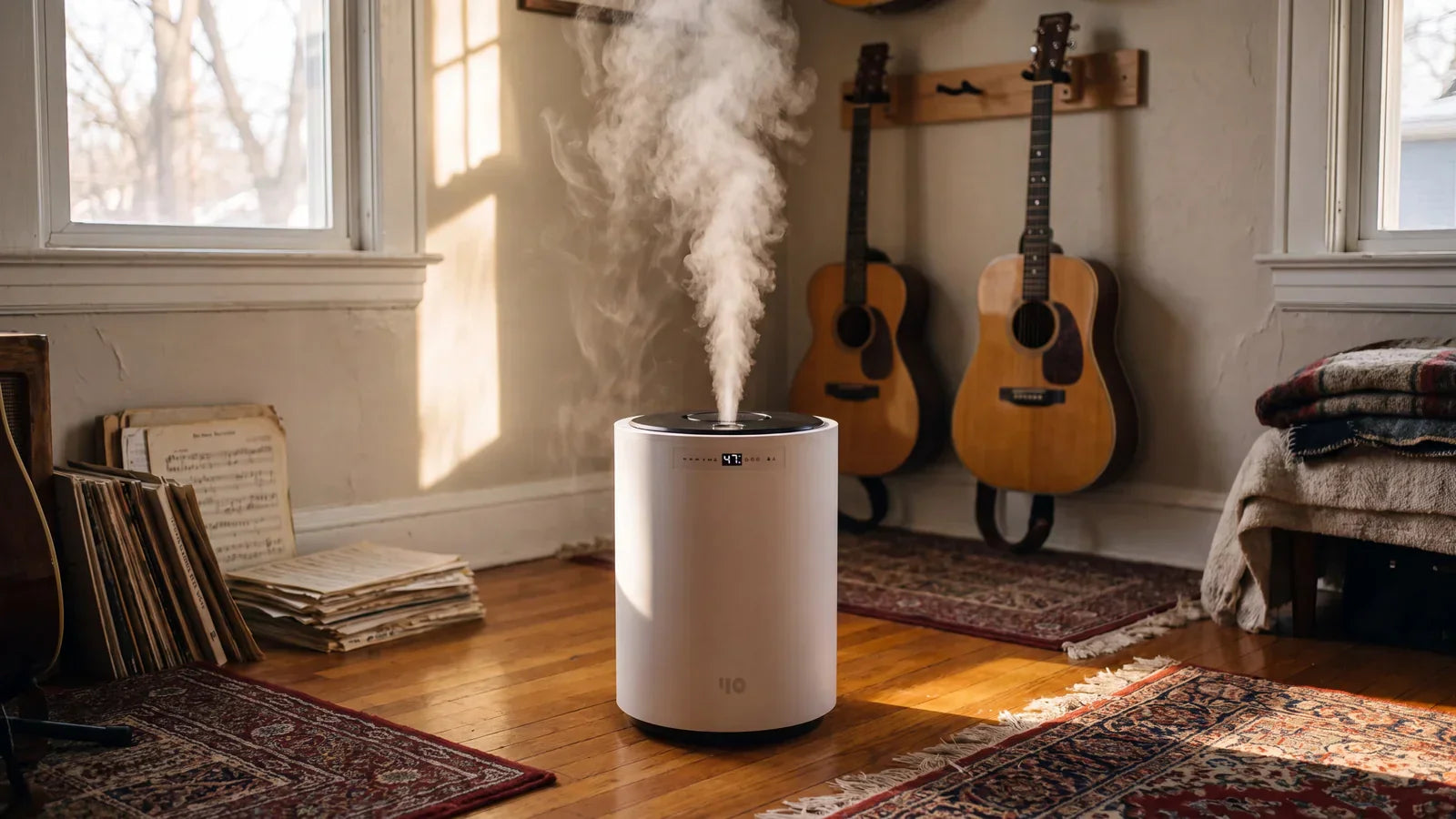

Wood instruments don't care how expensive your humidifier was. They care about one number, held steady. Taylor and Martin both publish 45–55% relative humidity for guitars; Steinway publishes 45–70% for pianos; the EPA says indoor humidity should stay below 60% and ideally under 50%. Stack those together and the band that sits inside every one of them is 45–50%. That narrow band — not a brand, not a feature list — is what you are actually shopping for. Here's how to hit it, and why the humidifier's technology matters more in an instrument room than anywhere else in the house.
What the instrument makers actually publish
Start with the primary sources rather than a round-up. Three manufacturers publish their own targets, and they don't perfectly agree.
| Maker | Published target | What they say happens outside it |
|---|---|---|
| Taylor Guitars | 45–55% RH (their guitars are built at 46% RH) | "bad string action and buzzing, protruding fret ends, wood cracking, top sinking, bridge lifting"¹ |
| Martin Guitar | 45–55% RH, 72–77°F (22–25°C) | Cracking and warping from dry conditions — and Martin states this damage is "not covered under warranty"² |
| Steinway & Sons | 45–70% RH, constant 20°C | "Large swings in humidity should be avoided"³ |
Note what Martin puts in writing: dryness damage is a warranty exclusion. That reframes the whole purchase. A room humidifier in a heated house through winter isn't a comfort upgrade for a collection — it's the condition under which the instrument's own maker will still stand behind it.
Steinway adds something the guitar makers only imply: steadiness matters as much as the number. A room that oscillates between 30% and 60% every week is harder on glue joints and soundboards than a room parked slightly off-target but stable.
The 45–50% window nobody points out
Here's the part most guitar-room articles skip. The instrument targets are not the only constraint in the room. The EPA states indoor relative humidity "should be kept below 60 percent — ideally between 30 percent and 50 percent, if possible," and lists high humidity (60% RH) among the common moisture problems that let mold grow.⁴

So the ranges pull against each other. Follow Steinway's upper bound of 70% and you are well past the level the EPA warns about. Follow the EPA's lower ideal of 30% and you are far below what Taylor and Martin will warrant. To be clear about the arithmetic: the EPA's hard line is 60%, so 45–55% still complies with it. 45–50% is the band that sits inside the instrument makers' ranges and the EPA's stated ideal ceiling at the same time — the conservative choice, and where we'd set a humidistat in a room that holds instruments.
That also tells you what to buy. A five-point window is tight. It rules out running a machine wide open and hoping, and it makes a hygrometer non-optional. Taylor specifically recommends a digital hygrometer over analog models, which "fall out of calibration easily."¹ Buy the meter before you buy the machine.
Why humidifier type matters more here
In a bedroom, the difference between humidifier technologies is mostly a chore-and-cost question. In a room with instruments, it changes what lands on them.
An ultrasonic humidifier vibrates water into a fine cool mist. Whatever is dissolved in the water goes airborne with it, which is why hard tap water produces the fine white film known as white dust — the same reason it coats dark furniture and screens. On a guitar or piano, that settles on lacquer, into the gaps around tuners and bridges, and onto pickups and electronics. We've written the full mechanism up in what hard water does to a humidifier and the air around it.
An evaporative unit avoids the dust honestly — a wet wick traps the minerals before the air picks them up. The trade is that the wick is a consumable that stays damp between refills and has to be replaced on a schedule. A steam humidifier boils the water first, so the minerals stay behind in the boiling chamber rather than riding into the room, and there is no wick to replace. For a room where mineral fallout lands on finished wood and electronics, the meaningful question is not "warm or cool mist" but "does this machine put my tap water's minerals into the air?"
Each type has a real downside, and steam's is heat: it releases warm vapor, and Steinway asks for a constant temperature. That's a placement problem rather than a disqualifier, and we cover it below. If you want the full side-by-side, see steam vs ultrasonic vs evaporative.
Room humidifier or in-case system?
Search this topic and you'll be pushed toward in-case guitar humidifiers and in-piano climate systems. Both exist for good reasons — but note who says what.
Taylor is explicit that in areas of severe dryness "you must use a guitar-humidifying device" inside the case, and recommends keeping a hygrometer in the case rather than only in the room.¹ That's sound advice for an instrument that lives in its case.
Steinway goes the other direction for pianos, advising owners to use "a humidifier or dehumidifier to regulate the humidity of the room rather than localising it in the piano with a climate control system."³ For a piano, the maker's own recommendation is to condition the room — not to install a system inside the instrument.
The practical read: if instruments are stored in cases, case humidifiers do the close-range work and the room only has to stop being extreme. If instruments live out — on wall hangers, on stands, or a piano that cannot be cased at all — the room is the humidifier, and its size is the spec that matters.
Sizing a humidifier for an instrument room
Two things break the coverage number printed on the box, and both are common in the rooms people keep instruments in.
The first is ceiling height: coverage ratings generally assume a standard ceiling, and a vaulted or double-height room holds far more air than its floor area suggests. The second is air exchange — an old house, a drafty room, or a door left open to the rest of the home keeps pulling your conditioned air away. Both push you toward a larger machine and a bigger tank than the square footage alone implies. We go deeper on this in choosing a humidifier for large rooms and in how many humidifiers a large home actually needs.
Refill frequency is the spec that quietly decides whether the room stays in the 45–50% band, because a machine that runs dry overnight isn't holding a range — it's producing a swing, which is the one thing every maker on this page warns against. That's the reasoning behind a large tank: our own 10L steam humidifier is built around a 1,000 ft² room and a filterless boiling chamber, so the routine is refilling and periodic descaling rather than buying wicks. That rating assumes standard ceilings and a reasonably closed room — which is exactly why we’d still size up and verify with a hygrometer rather than trust any coverage figure, ours included.
Placement, heat, and the mistakes we'd avoid
- Don't aim output at an instrument. Whatever the technology, put distance between the outlet and the wood so the room humidifies evenly instead of one surface getting the weather.
- Keep the unit away from the instruments, not beside them. Because steam adds warmth locally, place it away from the piano or rack and let the room mix — that respects Steinway's request for a constant temperature. Steinway separately asks that the piano itself not sit near a radiator or other heat source.
- Put the hygrometer where the instruments are, not next to the humidifier. Readings a meter from the outlet will flatter you.
- Close the door. A conditioned room with an open door is a hallway.
- Watch the walls and windows. Cold exterior surfaces condense first; if you see moisture there, you're running high for the building even if the room reads fine. Our notes on humidity and mold risk cover the warning signs.
- Clean on a schedule. Any humidifier is a water appliance; scale and residue build up regardless of type.

Finally, remember that wood in the room is not limited to the instruments. Floors, doors, and cabinetry respond to the same swings — which is why the humidity that protects a guitar is close to the humidity that protects the room it stands in. We covered that overlap in humidifiers and hardwood floors.
FAQ: humidifier for a guitar or piano room
What humidity should a guitar room be?
Taylor and Martin both publish 45–55% relative humidity for guitars. Because the EPA advises keeping indoor humidity below 60% and ideally under 50% to limit mold, the band that satisfies both is 45–50%. Steadiness matters as much as the exact figure.
What humidity does a piano need?
Steinway & Sons publishes 45–70% RH with a constant temperature of about 20°C, and stresses that large humidity swings should be avoided. Staying at the lower end of that range keeps you within general indoor mold guidance as well.
Is a room humidifier enough, or do I need an in-case humidifier?
It depends on how the instruments are stored. Taylor recommends an in-case humidifying device in severely dry conditions for cased guitars. Steinway recommends regulating the humidity of the room rather than installing a climate system inside the piano. Instruments that live out in the open depend on the room.
Will a humidifier leave residue on my instruments?
It depends on the type and your water. Ultrasonic units release whatever is dissolved in the tank, so hard tap water can leave a fine mineral film on surfaces. Evaporative units trap minerals in a replaceable wick. Steam units boil the water, so minerals stay in the boiling chamber.
Does a steam humidifier make the room too warm for instruments?
It adds warmth near the outlet rather than heating a whole room like a heater. Since makers ask for a steady temperature, place the unit away from the instruments and let the air mix, and keep the hygrometer beside the instruments so you're reading the conditions they actually experience.