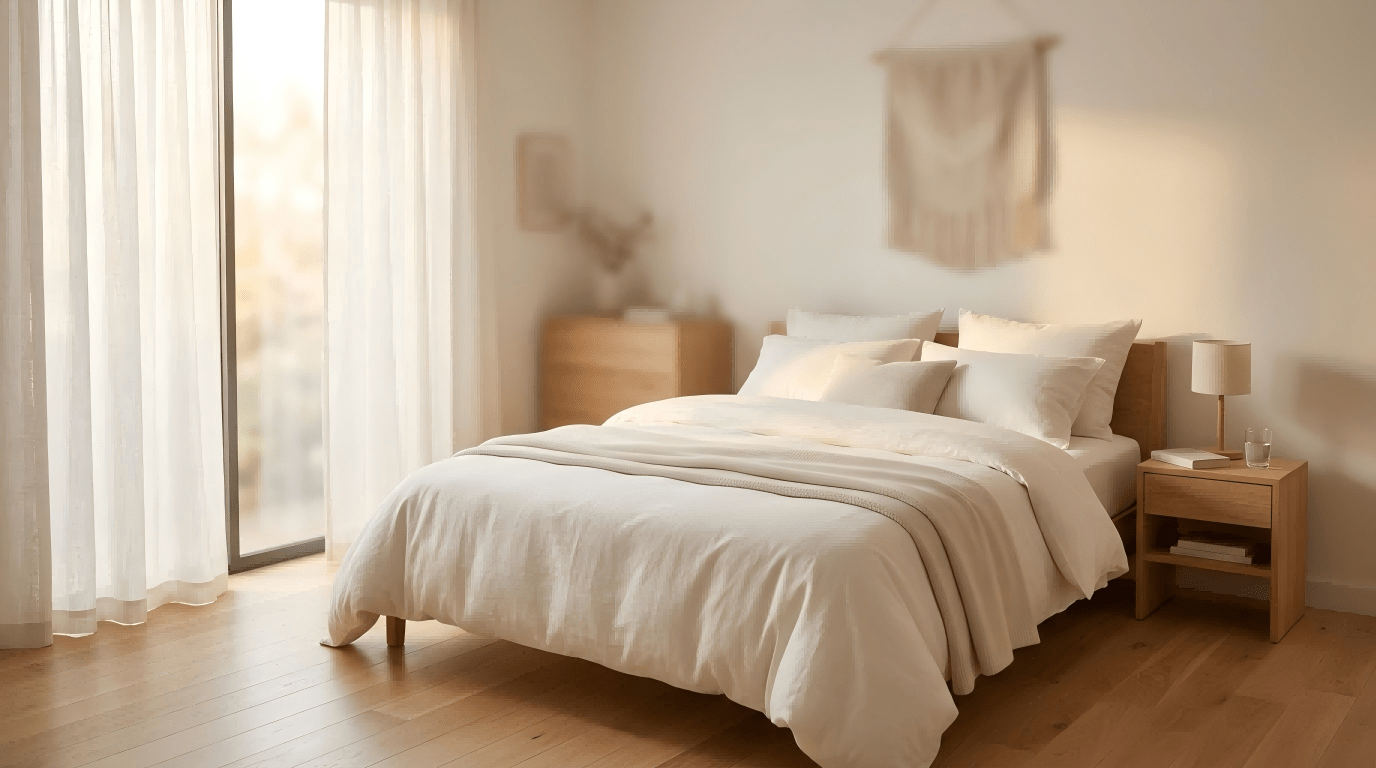

Think about how much effort you put into what goes into your body. You buy filtered water. You read nutrition labels. Maybe you take supplements. You'd never knowingly drink contaminated water for eight hours straight.
But every night, without a second thought, you seal yourself in a room and breathe whatever air happens to be there — for 2,880 hours a year. And during North American heating season, that air is, by multiple measurable standards, worse than the air in every other room in your home.
Your bedroom isn't just where you sleep. It's the single highest-exposure environment in your life — the room where your immune system does its repair work, your respiratory system runs unchecked for hours, and your body is most vulnerable to whatever is in the air. Here's what the evidence actually shows about bedroom air quality, and what it takes to get it right.
Why Your Bedroom Has the Worst Air in Your Home
Most people assume outdoor air is the primary air quality concern. The reality, documented extensively by the U.S. Environmental Protection Agency, is that indoor air is typically 2–5 times more polluted than outdoor air — and in some cases up to 100 times worse.
Your bedroom compounds this in three specific ways that no other room in your home does.
Fig. 1 — The three compounding factors that make bedroom air measurably worse than any other room in your home during North American heating season. Unlike every other environment you enter, you can't leave, ventilate, or avoid your bedroom air while you sleep.

The bedroom, more than any other space, is where indoor air quality interventions have the highest return. You spend more continuous time there than anywhere else. Your body is in a state of immune repair and cellular recovery. And your respiratory system processes bedroom air without any of the conscious filtering behaviors — moving away from a smoky area, opening a window, going outside — that you'd use during waking hours.
What's Actually in Your Bedroom Air While You Sleep
The bedroom air quality problem has three distinct components, each with different sources and different solutions. Most people address none of them.
Problem 1 — Humidity Collapse
North American forced-air heating systems pull cold, dry outdoor air into a furnace, heat it rapidly, and circulate it through ductwork. Cold winter air carries almost no moisture. Heated to room temperature, its relative humidity drops dramatically.
By the time you wake up after 8 hours of sleeping with the heating running and the door closed, the bedroom RH has often fallen to 15–20%. At those levels, nasal mucosal function is significantly impaired, skin barrier integrity is compromised, and airways become more susceptible to irritants and pathogens.
The ASHRAE Standard 55 recommends maintaining indoor relative humidity between 40–60% for healthy occupant comfort. The typical heated bedroom in January sits at less than half that lower threshold.
For a detailed look at how dry air affects rhinitis and nasal health specifically: Best Humidifier for Rhinitis & Dry Nose →
Problem 2 — Biological Aerosols From the Wrong Humidifier
Here's the paradox most people don't see coming: buying a humidifier to fix the dry air problem can introduce a new problem if you choose the wrong type.
An ultrasonic humidifier running overnight in a sealed bedroom with tap water is aerosolizing whatever has grown in the tank since the last cleaning — bacteria, mold spores, and mineral particles — directly into the closed environment you're breathing for 8 hours. For 8 consecutive hours. With no ventilation to dilute it.
This isn't a hypothetical. Research by Virginia Tech professor Andrea Dietrich (2025) found that ultrasonic humidifiers can measurably elevate indoor PM levels and disperse biological contaminants. In a sealed bedroom environment, the concentration effect is amplified compared to an open living space.
The full breakdown of what grows in unheated tanks and how fast: Is Your Humidifier Making You Sick? Mold & Bacteria Risk →
Problem 3 — White Dust Accumulation in a Sealed Space
In an open living space, mineral aerosol from an ultrasonic humidifier disperses across a larger volume of air and settles on a larger surface area. In a closed bedroom, it concentrates. The white dust you see on your nightstand and headboard represents the heavy fraction that settled. The lighter fraction — the PM2.5 particles — stays airborne longer and gets inhaled.
In hard-water cities like Phoenix, Calgary, Denver, or Dallas, this effect is dramatically more pronounced. The harder your water, the more mineral content gets aerosolized per hour of ultrasonic operation.
For the full picture on white dust and hard water: Hard-Water Humidifier Disaster: White Dust & Your Lungs →
What Science Says About Sleep and Air Quality
Fig. 2 — Sleep architecture and air quality impact. The body's most critical immune and recovery processes occur during Deep Sleep and REM — precisely when you have no control over what you're breathing and when cumulative air quality exposure is highest.
Research published in the Journal of Clinical Sleep Medicine has documented the relationship between sleep environment conditions — including humidity and particulate matter — and sleep architecture quality. The finding is consistent: environments outside the 40–60% RH range produce measurably worse sleep outcomes, including more frequent micro-arousals and reduced time in deep sleep stages.
The mechanism is direct. Dry nasal passages create physical discomfort that triggers micro-arousals — brief waking events you often don't consciously remember but that interrupt the sleep cycles your body needs for repair. If you've ever noticed you wake up feeling exhausted after what should have been enough sleep, disrupted sleep architecture from poor air conditions is a plausible, often overlooked factor.
During deep sleep, your body produces cytokines — proteins that play a critical role in immune signaling and inflammation response. Sleep Foundation research notes that cytokine production peaks during deep sleep stages. Airborne irritants — including mineral aerosols from ultrasonic humidifiers and mold spores from dirty tanks — that trigger low-grade inflammatory responses during this phase can theoretically interfere with the immune repair process that is the primary biological purpose of sleep.
The Bedroom Setup That Actually Works
Getting bedroom air quality right requires addressing all three problems simultaneously. A humidifier alone isn't enough if it's the wrong type. The right humidifier alone isn't enough without correct placement and a humidity target.
| Problem | Wrong Approach | Right Approach |
|---|---|---|
| Humidity collapse | No humidifier — or running it only while awake | Steam humidifier running throughout sleep, 40–50% RH target |
| Biological aerosols | Ultrasonic humidifier, tank cleaned weekly or less | Steam humidifier — 212°F eliminates biological load before output |
| White dust in sealed space | Ultrasonic + hard tap water in closed bedroom | Steam or evaporative — minerals stay in tank, not in sealed bedroom air |
| Humidity verification | Trusting the humidifier's built-in sensor | Separate hygrometer — built-in sensors often read 5–10% high |
| Placement | Next to bed, output directed at face/pillow | 3–5 ft from bed, output directed toward room center |
Why Steam Is the Bedroom-Specific Choice
Every humidifier type adds moisture. In an open living room, the differences between types are meaningful but not dramatic. In a sealed bedroom running for 8 hours, they become significantly more consequential.
A steam humidifier running overnight in a closed bedroom is releasing only water vapor — mineral-free, pathogen-free, biologically clean. The 212°F heating cycle ensures that whatever was in the tank doesn't make it into the output. The full argument for sterile output as the baseline standard applies with particular force in the environment where you're most exposed and most vulnerable.
The Y&O Steam Plus runs quietly enough for bedroom use on its lower settings — the boiling water sound is at a level most users describe as comparable to a white noise machine at low volume. Its 10L dual-tank design means no 3am refills. And the built-in humidistat targets your set RH and cycles accordingly, so you're not overshooting into dust-mite territory above 60%.
For a full comparison of how steam stacks up against ultrasonic and evaporative across all dimensions: Steam vs Ultrasonic vs Evaporative: Which Is Worth It? →
The Bedroom Setup Checklist

- Start humidifier 30–45 minutes before sleep — lets the room reach target humidity before you seal it for the night
- Set target to 45–50% RH — optimal for nasal function, with buffer below the 60% mold threshold
- Position 3–5 feet from the bed head on the floor — allows steam to diffuse and cool before reaching your breathing zone
- Keep bedroom door closed once humidity is building — prevents moisture loss to adjacent spaces
- Use a separate hygrometer to verify actual room humidity — don't rely on the humidifier's built-in reading
- Empty and rinse tank every morning — never leave standing water in the tank during the day
- Descale monthly — limescale on the heating element reduces output efficiency over time
- Running an ultrasonic humidifier in a sealed bedroom without daily cleaning — concentrates biological aerosols in a closed space for 8 hours
- Placing the humidifier directly beside the pillow — oversaturates the immediate breathing zone and can promote mold on bedding
- Targeting above 60% RH — increases dust mite activity and mold risk, potentially worsening allergic symptoms
- Using tap water in an ultrasonic humidifier in hard-water cities — mineral aerosol concentrates in a closed bedroom
- Relying only on daytime humidification — bedroom humidity drops during overnight heating regardless of daytime levels
What Real Users Discovered
Comprehensive review covering cleaning convenience and overnight bedroom use experience — specifically relevant for sleep environment assessment
Detailed walkthrough of humidity preset modes, noise level at different settings, and dual-tank refill logic — critical for bedroom overnight setup

2,880 Hours a Year. Make Them Count.
The Y&O Steam Plus delivers mineral-free, bacteria-free warm steam throughout the night — without the 3am refills, without the morning white dust, and without the biological risks of an unheated tank running in a sealed bedroom.
See the Y&O Steam Plus →Your Questions Answered
Is it safe to run a humidifier all night in a closed bedroom?
Yes — with the right type and a humidity target. The key constraints are: maintain RH between 40–60% (above 60% increases dust mite and mold activity), use a humidifier type that doesn't disperse biological aerosols from an unheated tank (steam is the safest for sealed overnight environments), and verify actual room humidity with a separate hygrometer. Running a steam humidifier overnight in a closed bedroom at a 45–50% RH target is, by most measures, an improvement on the alternative — a room that dries to 15–20% RH by morning. For more on overnight use specifically: Is It Good to Sleep With a Humidifier? →
Will a humidifier actually help me sleep better?
The evidence is clearest for users whose sleep is disrupted by dry-air symptoms — nasal congestion, dry throat, morning dryness. For these users, restoring bedroom humidity to the 40–60% RH range removes a known physical cause of sleep disruption. For users without dry-air symptoms, the sleep benefit is less direct but still present through the immune and respiratory health mechanisms described in this article. A humidifier won't overcome sleep disorders, poor sleep hygiene, or other primary causes of poor sleep — but it removes an environmental variable that, in heated North American homes during winter, is actively working against you. For more on this: Humidifier for Better Sleep →
What's the best humidity level for sleeping?
The ASHRAE-recommended range of 40–60% RH applies to sleeping environments. For most users, a target of 45–50% provides optimal nasal and respiratory comfort while maintaining a meaningful buffer below 60% — the threshold above which dust mite populations and mold growth accelerate meaningfully. Measure with a separate hygrometer rather than relying on your humidifier's built-in sensor; a 5–10% discrepancy is common. If you have allergies or rhinitis, staying closer to 45% rather than 50% may reduce dust mite exposure. For the full humidity science: The 40–60% Humidity Rule →
Can a humidifier cause mold in my bedroom?
Yes, in two specific scenarios. First, if RH is pushed above 60% consistently — at these levels, mold can develop on cold surfaces like window frames, exterior walls, and bedding. This is why a humidity target of 45–50% matters, not "as high as possible." Second, if the humidifier itself has mold growing inside an unheated tank — an ultrasonic unit with a neglected tank will disperse mold spores into the bedroom air. A steam humidifier eliminates the second risk through the boiling mechanism. The first risk is controlled by monitoring with a hygrometer and using a humidistat. For the full mold risk picture: Is Your Humidifier Making You Sick? →
Does bedroom air quality affect your immune system?
The relationship is indirect but documented. During deep sleep, your body produces cytokines and other immune signaling proteins critical to immune function. Conditions that disrupt deep sleep — including dry-air discomfort that causes micro-arousals — reduce the time spent in deep sleep and therefore the quality of this immune work. Additionally, dry nasal passages have reduced mucociliary clearance efficiency, meaning your body's first-line defense against inhaled pathogens is compromised during the period when you're breathing the most concentrated bedroom air. Restoring appropriate humidity supports both the sleep quality and the respiratory defense function that deep sleep is designed to provide. This is educational context — consult a healthcare provider for questions about immune health specifically.
Related Reading
Sources & References
- U.S. Environmental Protection Agency — Introduction to Indoor Air Quality
- ASHRAE Standard 55 — Thermal Environmental Conditions for Human Occupancy
- Sleep Foundation — Sleep and Immune Function
- Journal of Clinical Sleep Medicine — Sleep Environment Research
- Virginia Tech / Prof. Andrea Dietrich — Humidifiers and Indoor Air Quality (2025)
- U.S. Geological Survey — Hardness of Water
- Reddit Community Discussions — r/BuyItForLife · r/Humidifiers · r/sleep
- Y&O — YO-M2 Steam Plus Product Page & User Reviews
- YouTube Independent Reviews — NReluctant · Daniel Reviews