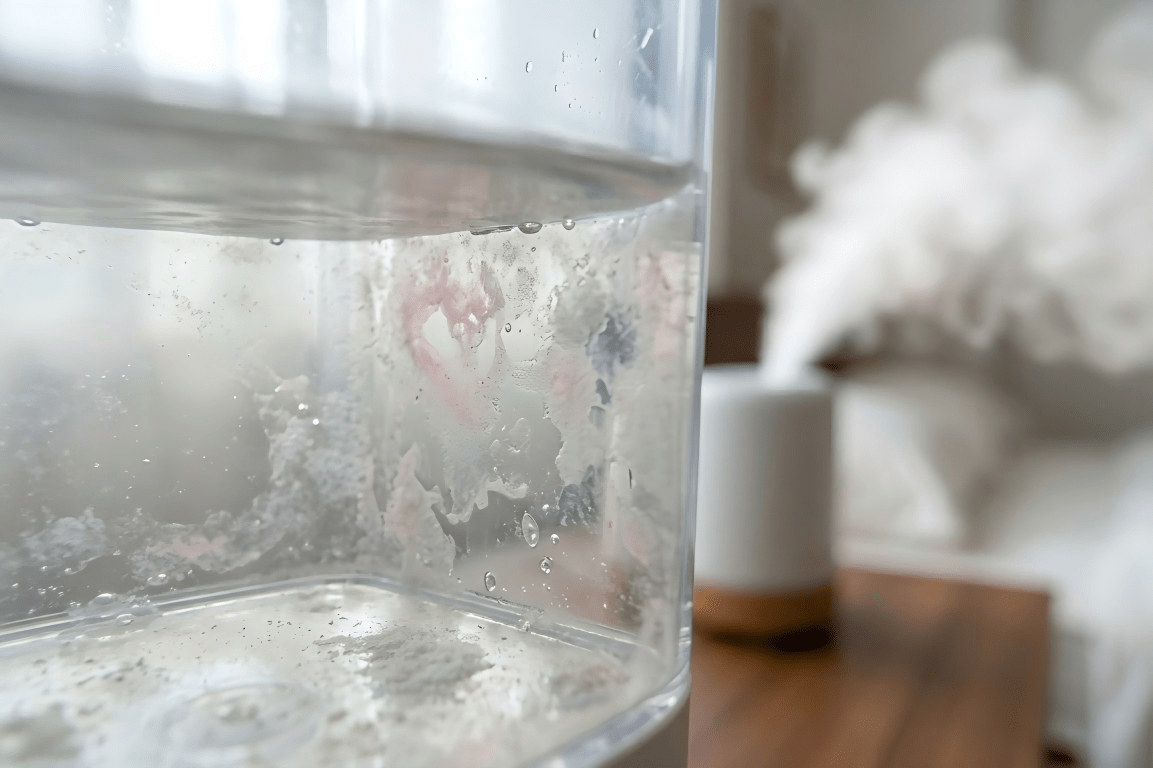

You clean it every week. You change the water regularly. You even let it dry out between uses.
But there's still something in there you can't see — and it's leaving the tank every time you run the diffuser.
Most people know about white mineral dust from their diffuser. That's the visible problem. We covered it in detail here. But the invisible problem — what's biologically growing inside a room-temperature water tank — is the one that gets talked about far less.
Biofilm is a living colony of microorganisms that forms inside your diffuser's water tank within 48 hours of use. When the ultrasonic plate runs, it doesn't just aerosolize water — it aerosolizes everything in that water, including whatever has colonized the tank. Here's what that means for the air in your home.
What biofilm actually is
Biofilm isn't just slime. It's an organized biological structure.
When microorganisms — bacteria, mold spores, yeast — come into contact with a wet surface, they don't just sit there. They attach, multiply, and secrete a protective matrix of polysaccharides around themselves. That matrix is what makes biofilm resilient: it shields the colony from detergents, light rinsing, and even some disinfectants.
You've seen biofilm your whole life. The slick coating inside a vase left with old flower water. The pink or orange film on a shower grout line. The film inside a water bottle you forgot to wash. All biofilm — all the same biology.
In a diffuser tank, biofilm forms faster than most people expect.
Ultrasonic diffusers are particularly vulnerable because of three compounding factors: standing water, room temperature, and complex internal geometry with hard-to-reach corners.
The tank is never fully dry between uses. The temperature never gets high enough to kill anything. And the internal surfaces give microorganisms plenty of places to anchor.
Why ultrasonic diffusers are a perfect biofilm environment

The physics of ultrasonic diffusion creates an environment that actively encourages microbial growth.
Room temperature water. Constant humidity. Plastic interior surfaces with microscopic surface texture. Partial filling and refilling rather than complete draining. This is textbook biofilm territory.
Most ultrasonic diffuser manufacturers recommend cleaning every 1–2 weeks. But biofilm establishes within 48 hours. That means for the majority of a typical use cycle, your diffuser is running with an established microbial colony in the water — and aerosolizing it into the room.
Plastic surfaces make this worse. Unlike glass, plastic has microscopic surface porosity — tiny pits and channels at the material level that provide anchor points for biofilm. Once biofilm is embedded in those surface irregularities, a wipe-down doesn't reach it. Even vinegar soaks, which are commonly recommended, only penetrate biofilm partially.
The EPA's indoor air quality guidance identifies cool-mist humidifiers as a specific source of biological pollutants — flagging that when not maintained with sufficient frequency, these devices can disperse bacteria and mold spores into indoor air. Ultrasonic diffusers operate on identical principles.
What actually comes out of the mist
When an ultrasonic diffuser runs with biofilm present in the tank, the vibrating plate doesn't filter anything out.
It atomizes whatever is in the water — including fragments of biofilm matrix, bacterial cells, mold spore fragments, and the metabolic byproducts microorganisms produce. All of it becomes airborne particulate at the same 1–10 micrometer size range as the water droplets themselves.
The ASHRAE indoor air quality standards classify biological aerosols — airborne particles of biological origin — as a primary indoor air quality concern. Ultrasonic diffusers running with unchecked biofilm are a direct source of biological aerosol in the rooms where people spend the most time.
For most healthy adults, exposure to low levels of household biofilm aerosol is unlikely to cause acute illness. But for infants, people with asthma, allergy sufferers, and immunocompromised individuals, the picture is meaningfully different. The CDC's indoor environmental quality guidance identifies biological aerosols as a contributor to respiratory symptoms and hypersensitivity reactions.
Infants, toddlers, people with asthma or allergies, and anyone with a compromised immune system face greater exposure risk from biological aerosols. If a diffuser runs unattended in a shared bedroom overnight — particularly a child's room — the cumulative inhalation exposure over hours of sleep is worth taking seriously.
The cleaning routines that don't fully work
Before getting to the structural fix, it's worth being honest about what the commonly recommended cleaning methods actually achieve.
- Daily water change — removes planktonic (free-floating) bacteria in the water column, but doesn't remove attached biofilm on tank surfaces. The colony survives and continues growing.
- Weekly vinegar soak — white vinegar is mildly effective at dissolving early-stage biofilm. Against established colonies (Day 3+), it penetrates the matrix partially but rarely eliminates it completely.
- Wiping with cotton swab or cloth — removes surface biofilm but leaves residue in plastic micropores. The colony regrows from the protected cells left behind — typically faster than the original colonization.
- Letting it dry completely between uses — desiccation kills some bacterial strains. Mold spores, however, are specifically adapted to survive drying and reactivate when moisture returns. Drying alone is insufficient.
- Essential oils as antimicrobials — some essential oils (tea tree, oregano) do have documented antimicrobial properties. But at diffuser concentrations in water, they don't maintain the contact time or concentration needed to reliably eliminate biofilm colonies.
This isn't a criticism of people who use these methods. It's a recognition that ultrasonic diffusers, by design, create an environment where biofilm is structurally difficult to prevent through cleaning alone.
White mineral dust is the other invisible problem with ultrasonic diffusers — visible, but often misunderstood. Read: Why Your Diffuser Leaves White Dust Everywhere →
The question nobody asks when buying a diffuser
Most people choose a diffuser based on design, price, and tank capacity.
Almost nobody asks: at what temperature does this unit hold its water?
That single question determines everything about biofilm risk. Water temperature is the master variable in microbial growth. Increase it past a threshold, and growth stops. Reach boiling point, and the organisms die.
Ultrasonic diffusers hold water at room temperature by design — the vibration mechanism requires it. The water is never heated. Biofilm has an unlimited growth window.
Steam diffusers invert this entirely. The water is boiled before any steam is released. At 212°F (100°C), bacteria die within seconds. Mold spores — the more heat-resistant organisms — are eliminated within minutes at sustained boiling temperature. The steam that exits the unit has passed through a complete sterilization cycle.
It's the same principle used to sterilize baby bottles, surgical instruments, and food processing equipment. Heat is the most reliable antimicrobial tool available — and it's built into the operating cycle of every steam diffuser.
32,000+ views. The most-watched short video on hidden biological risks in cool-mist devices — and why temperature matters.
"Most people don't think about what their diffuser is made of — or what temperature the water stays at. Both matter more than the design."
Detailed breakdown of why steam sterilization at 212°F changes the hygiene calculus compared to any ultrasonic unit.
How glass and steam change the equation
Two design choices determine whether a diffuser fights biofilm or feeds it: operating temperature and tank material.
Temperature we've covered. 212°F eliminates the biology before it reaches you.
Tank material determines what happens between cycles — and during cleaning.
Plastic has surface microporosity. Glass doesn't. At the material level, borosilicate glass presents a genuinely smooth surface with no anchor points for biofilm to embed in. What can't attach can't establish a colony. What can't establish a colony can't grow to the point of persistence.
Glass is also transparent. You can see the state of the tank interior without dismantling anything. Cloudiness, film, discoloration — all visible at a glance. With opaque plastic, you're cleaning blind.
| Factor | Ultrasonic + plastic | Steam + glass |
|---|---|---|
| Water temperature during operation | 65–75°F — ideal bacterial growth range | 212°F boil → cooled to 122°F output |
| Biofilm formation risk | High — establishes within 48 hours | Eliminated each cycle by boiling |
| Tank surface for biofilm anchor | Plastic micropores — biofilm embeds deeply | Glass — smooth, no anchor points |
| Cleaning visibility | Opaque — can't see tank interior | Transparent glass — state visible at a glance |
| Essential oil residue | Plastic absorbs oil — scent transfer between uses | Glass doesn't absorb — no cross-contamination |
| Cleaning frequency needed | Daily water change + weekly deep clean minimum | Weekly rinse typically sufficient |
| Biological aerosol output | Present when biofilm established in tank | 99.9% sterile steam — eliminated by boil cycle |
What this looks like in practice — Y&O Yo-A1

The Y&O Yo-A1 is the clearest current example of these two principles — steam sterilization and borosilicate glass — executed in a form designed for daily home use.
Every operating cycle starts with a 212°F boil. Bacteria and mold spores don't survive it. By the time steam reaches output temperature — 122°F — the sterilization has already happened.
The 1,600ml borosilicate glass tank gives the biology nowhere to hide. The smooth glass surface doesn't provide the anchor points plastic does. The transparency means you can confirm the tank state before every use, not guess.
- 212°F (100°C) sterilization — eliminates bacteria and mold spores before any steam is released. Every single cycle.
- Borosilicate glass tank — no surface microporosity, no biofilm anchor points, no embedded residue between uses.
- Transparent body — tank interior visible at all times. No guesswork about cleanliness.
- Water-oil separation — essential oils on a dedicated tray, never mixed into the water. Prevents oil residue in the tank entirely.
- 99.9% sterile steam output — the physics of boiling water, not a marketing filter claim.
- Weekly rinse maintenance — without biofilm risk, deep-cleaning frequency drops significantly.
- Auto-shutoff + anti-tip base — safe for overnight use in bedrooms and family spaces.
Zero Biofilm. Zero White Dust. Every Cycle.
The Y&O Yo-A1 boils before it diffuses — 212°F sterilization built into every run. Borosilicate glass tank, 1,600 ml, 8-hour runtime.
View the Yo-A1 Steam Diffuser →A few honest caveats
Steam diffusion solves the biofilm problem structurally. A few things are worth being upfront about before you switch.
- Scale still accumulates in the tank — the 212°F boil precipitates minerals out of the water, which means calcium deposits build up in the tank bottom over time, just like a kettle. A periodic vinegar soak dissolves it. Less frequent than biofilm cleaning, but not zero maintenance.
- The base housing contains plastic — "glass diffuser" refers to the water tank, not every component. The base unit includes plastic housing for the heating element and electronics. The water-contact surface is glass — which is where material choice matters most for biofilm and oil purity.
- Higher energy draw — boiling water uses more electricity than ultrasonic vibration. The real-world difference is modest but worth noting.
- Heat-sensitive essential oils — the vast majority of common oils perform well at 122°F output temperature. A small number of delicate floral absolutes may have slightly altered profiles. Test before committing if you work with specialty oils.

Clean Air While You Sleep
Sterile steam from a borosilicate glass tank. No biofilm risk. No white dust. 8 hours of quiet, clean diffusion.
Shop the Yo-A1 Steam Diffuser →Frequently asked questions
How quickly does biofilm actually form in a diffuser?
Initial bacterial attachment to wet surfaces begins within 2–4 hours of water contact. An established biofilm matrix — with the protective polysaccharide coating that makes it resistant to simple cleaning — forms within 24–48 hours at room temperature.
By day 3–5, mold spores typically join the colony. By day 7, the biofilm is mature and significantly resistant to light cleaning methods like rinsing or wiping. Most ultrasonic diffuser cleaning recommendations suggest weekly cleaning — which means the unit runs for most of the week with an established colony in the tank.
Does vinegar actually kill biofilm in a diffuser?
White vinegar (acetic acid at 5%) is mildly effective against early-stage biofilm and some bacterial strains. Against established biofilm colonies — particularly those that have been developing for more than 48 hours — vinegar penetrates the protective matrix incompletely.
Research published in microbiology literature consistently shows that acetic acid at household concentrations reduces but does not eliminate mature biofilm. It's better than nothing, and it's genuinely useful for scale removal in steam diffusers. But as a sole biofilm strategy in an ultrasonic tank, it's insufficient.
Is biofilm from a diffuser actually dangerous for healthy adults?
For most healthy adults with normal immune function, low-level exposure to household biofilm aerosol from a diffuser is unlikely to cause acute illness. The relevant concern is cumulative — overnight exposure in a closed bedroom, repeated nightly over months or years, adds up to a meaningful total inhalation dose.
The picture changes for higher-risk groups: infants, people with asthma or allergies, and immunocompromised individuals face greater potential for respiratory irritation or hypersensitivity reactions from biological aerosols. The CDC's indoor environmental guidance specifically identifies biological aerosols as a respiratory health concern in indoor environments.
See the medical notice at the end of this article.
How often does a steam diffuser actually need to be cleaned?
Because the 212°F boil cycle eliminates bacteria and mold spores before biofilm can establish, steam diffusers require significantly less frequent deep cleaning than ultrasonic units.
A weekly rinse of the glass tank and a periodic wipe of the oil tray is typically sufficient for regular daily use. The main maintenance task unique to steam diffusers is scale removal — calcium and mineral deposits that accumulate in the tank bottom from the boiling process, dissolved with diluted white vinegar every 2–4 weeks depending on your water hardness.
The transparent glass tank makes it simple to monitor — you can see when the interior needs attention without guessing.
Can essential oils prevent biofilm growth in a diffuser?
Some essential oils — particularly tea tree (melaleuca), oregano, and thyme — have documented antimicrobial properties in laboratory settings. The question is whether diffuser-concentration use translates to meaningful biofilm prevention in practice.
The answer is generally no. Antimicrobial efficacy in lab studies typically requires direct contact at concentrations far higher than what's present in a water tank with a few drops of oil. The dilution factor, limited contact time, and protective biofilm matrix all reduce real-world effectiveness significantly.
Essential oils may slow initial bacterial attachment slightly. They don't reliably prevent or eliminate established biofilm colonies in an ultrasonic diffuser tank.
Data sources & references
- U.S. Environmental Protection Agency — Indoor Air Quality: Biological Pollutants. epa.gov/indoor-air-quality-iaq
- CDC — NIOSH Indoor Environmental Quality. cdc.gov/niosh/topics/indoorenv
- ASHRAE — Indoor Air Quality Standards and Resources. ashrae.org
- U.S. Environmental Protection Agency — Particulate Matter (PM2.5). epa.gov/pm-pollution
- Non-Toxic Dad — "The Wrong Humidifier Can Be TOXIC!" (32,020 views, Jan 2026). youtube.com/watch?v=sdjsRDdcGS8
- The Nutmeg Home — "What Kind of Diffuser Is Best?" youtube.com/watch?v=CdlD08m6kKQ
- Antonio Sanson — "Best Essential Oil Aroma Diffuser in 2026." youtube.com/watch?v=LftzAfIxdmc
- Reddit r/nontoxic — thread on biofilm and diffuser safety. reddit.com/r/nontoxic/comments/1s3ww02/
- Reddit r/essentialoils — thread on glass steam diffusers. reddit.com/r/essentialoils/comments/1sl0xhj/
- Y&O — "Why Your Diffuser Leaves White Dust Everywhere." yoairpro.com/blogs/news/why-your-diffuser-leaves-white-dust…
- Y&O Product Page — 1.6L Glass Essential Oil Aroma Steamer Humidifier. yoairpro.com/products/…