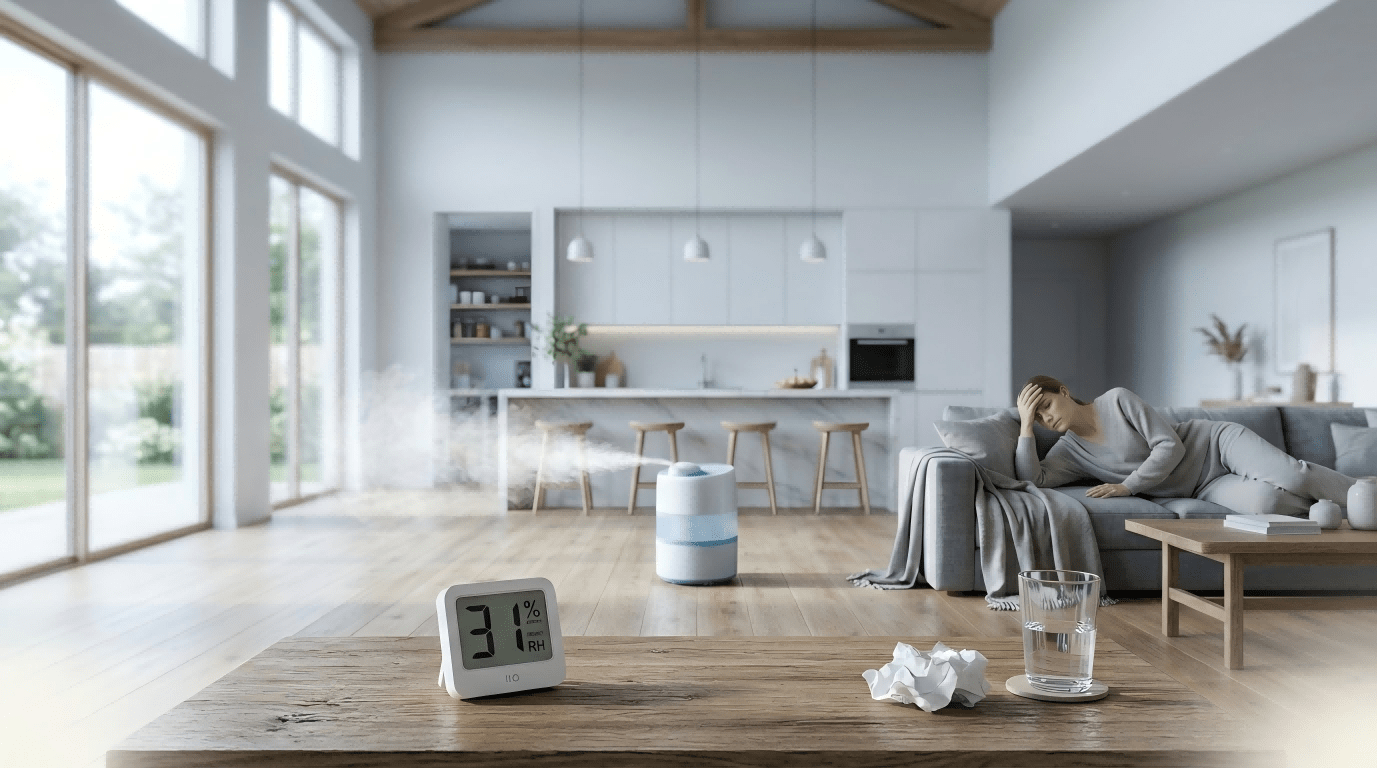

You did everything right. You measured your living room and kitchen. You added them up. You bought a humidifier rated for that square footage — maybe even a little more, just to be safe. You set the target humidity, filled the tank, and waited.
Two hours later: 29% RH. The next morning, the tank is empty and the humidity is at 36%. It never got close to 50%.
You didn't buy the wrong humidifier. You were given a number that was designed to sound reassuring — and that number has almost nothing to do with your actual living room in January.
Rated coverage area is calculated in a sealed lab room under controlled conditions with no heating system, no air exchange, and no open floor plan. Your home is none of those things. Here's how that number is actually derived, why it fails in real homes, and what metric actually predicts whether a humidifier will keep up with your space.
The "Rated Coverage" Number Is Almost Always Wrong
Every humidifier box has a coverage number. 300 sq ft. 500 sq ft. 1,000 sq ft. These numbers are calculated using the AHAM (Association of Home Appliance Manufacturers) testing protocol — a standardized lab procedure designed to create comparable measurements across brands.
The problem isn't the standard. The problem is what the standard assumes.
Fig. 1 — Lab test conditions vs. your real open floor plan. The same humidifier rated at 600 sq ft in a sealed lab room may effectively cover only 300–350 sq ft in your actual heated, open-plan home in January. The difference is real and consistent.
 31% RH after a full night of running. The humidifier isn't broken — it's just undersized for an open floor plan with an active heating system.
The gap between rated and actual coverage isn't a bug — it's a predictable consequence of what the lab test measures versus what your home actually is. And the more open your floor plan, the higher your ceilings, and the harder your heating system runs, the wider that gap becomes.
Why Open Floor Plans Are the Hardest Spaces to Humidify
Three compounding physical factors explain why open floor plans consistently defeat humidifiers that should theoretically be powerful enough to cover them.
Reason 1: Volume, Not Just Area
Humidifier rated coverage is calculated in square feet — a two-dimensional measurement. But humidity fills three-dimensional space. The volume of air your humidifier needs to bring to 50% RH depends on ceiling height as much as floor area.
A room with 10 ft ceilings contains 25% more air than the same room with 8 ft ceilings. A room with 12 ft ceilings — common in modern open-plan condos and townhouses in cities like Toronto, Calgary, and Denver — contains 50% more air. That means a humidifier rated for 600 sq ft at standard 8 ft ceiling height is effectively only rated for 480 sq ft at 10 ft ceilings and 400 sq ft at 12 ft ceilings.
Nobody prints this on the box.
Reason 2: Continuous Air Exchange
A sealed lab room has zero air exchange. Your open floor plan has continuous air exchange — through the open connection to the kitchen, the hallway, the staircase, and the HVAC ductwork itself.
Residential HVAC systems typically cycle air 0.5–1 times per hour. Every cycle brings in fresh dry air from outside (heated and therefore low-RH) and exports some of the humidified air you've just added. In a sealed room, every unit of humidity you add stays. In your open-plan living room, a meaningful fraction of what you add immediately leaves.
This is why running a humidifier in an open floor plan feels like filling a leaky bucket.
Reason 3: Your Heating System Is Actively Working Against You
This is the factor most people don't account for: the humidifier isn't just adding moisture to a static environment. It's in a continuous battle with your forced-air heating system, which is simultaneously removing moisture.
Forced-air heating works by pulling cold outdoor air, heating it rapidly, and circulating it. Cold outdoor air carries almost no moisture. Heated to 70°F, its relative humidity drops dramatically. In Calgary, Edmonton, Denver, or Minneapolis in January, a heating system running continuously can drop indoor RH by 1–2% per hour without any humidification.
That means a humidifier that's theoretically adding humidity isn't just trying to raise RH from 25% to 50% — it's trying to raise it while the heating system is continuously pulling it back down. The net effect is that the machine needs roughly twice the output of what a static calculation would suggest.

Fig. 2 — Humidity diffusion in a typical open-plan living room and kitchen. Moisture escapes continuously to adjacent spaces and is diluted by the HVAC system bringing in dry air. The net output needed to maintain 50% RH in this scenario is 1,000–1,200 ml/h — not the 300–500 ml/h of a standard bedroom unit.
The Number That Actually Matters: Output Rate (ml/h)
Forget the square footage number on the box. The metric that actually predicts whether a humidifier will keep up with your space is output rate — measured in milliliters per hour (ml/h).
Output rate tells you how much water the unit can convert to vapor per hour. That number, compared to the actual moisture demand of your space (which depends on floor area, ceiling height, air exchange rate, and heating system load), tells you whether the machine will keep up or fall behind.
| Space Type | Floor Area | Ceiling Height | Min Output Needed | Typical Unit That Fails |
|---|---|---|---|---|
| Sealed bedroom | 150–200 sq ft | 8 ft | 200–300 ml/h | Standard ultrasonic fine here |
| Master bedroom | 250–350 sq ft | 9 ft | 350–500 ml/h | Most "bedroom" units (150–250 ml/h) |
| Open living room | 400–500 sq ft | 9–10 ft | 600–800 ml/h | Any unit rated "500 sq ft" at 300 ml/h |
| Living + kitchen open plan | 500–700 sq ft | 9–10 ft | 800–1,000 ml/h | Most mid-range units fall short |
| Large open floor plan | 800–1,000 sq ft | 10–12 ft | 1,000–1,200 ml/h | Only high-output units qualify |
For open floor plans with active heating: multiply your floor area by 1.5 to get your "effective area" for humidifier sizing purposes. Then look for a unit with output in ml/h sufficient for that effective area. A 600 sq ft open-plan living and kitchen space should be sized as if it's 900 sq ft — which requires approximately 1,000–1,200 ml/h output to maintain 50% RH through a heated winter.
The Right Way to Shop for a Large-Room Humidifier
- Look for output rate in ml/h — this is on the spec sheet, not always on the front of the box
- For open floor plans, target at least 1,000 ml/h — anything less will fall behind in heated winter conditions
- Check ceiling height — 9 ft or above adds meaningful volume; size up accordingly
- Tank size of 10L or more — smaller tanks require middle-of-the-night refills that interrupt humidification
- Built-in humidistat — lets the unit cycle to maintain a target RH rather than running continuously at full blast
- Filterless design — filters reduce effective output over time as they clog; a filterless steam unit maintains full output
- Buying based on rated sq ft coverage alone — this number is almost always overstated for real home conditions
- Choosing a unit with under 500 ml/h output for any space larger than a closed bedroom
- Ignoring ceiling height when sizing — 10 ft ceilings require 25% more output than 8 ft ceilings
- Running two small units instead of one high-output unit — doubles the maintenance with unpredictable coverage overlap
- Setting target RH above 60% — the unit will never reach it, running continuously and wasting energy
What 1,200 ml/h Actually Looks Like in a Real Home
The Y&O Steam Plus outputs 1,200 ml/h at maximum setting — enough to release approximately 1.2 liters of water vapor into your space every hour. In practical terms, that means:
In a 600 sq ft open-plan living and kitchen space with 9 ft ceilings and a heating system running, the Y&O Steam Plus can raise RH from 20% to 50% in approximately 90–120 minutes, then cycle to maintain that level. A 400 ml/h unit in the same space will take 4–6 hours to reach the same target — if it can reach it at all against the heating system's continuous draw.
The 10L dual-tank design matters for large spaces specifically: at moderate output settings (600–800 ml/h), the unit runs 12–16 hours between refills. At full 1,200 ml/h, approximately 8 hours. For overnight use in an open floor plan — the most demanding scenario — this means no 3am tank emergencies.
Real-world coverage area testing, operation demonstration, and large-space performance assessment for the Y&O Steam Plus
37K+ views — detailed walkthrough of dual-tank design, auto-shutoff, and large-room coverage mechanics (output rate, tank runtime)
Placement Strategy for Open Floor Plans
Even the right humidifier, placed wrong, will underperform. In a sealed bedroom, placement matters less — moisture distributes evenly. In an open floor plan, placement can make a 30–40% difference in effective coverage.
Fig. 3 — Humidifier placement in an open floor plan. Center placement allows moisture to diffuse in all directions, maximizing effective coverage. Corner placement blocks diffusion on two sides and creates dead zones — reducing effective coverage by 40–50% regardless of output rate.

Placement Rules for Maximum Coverage
- Place in the center of the open-plan space — not against a wall, not in a corner
- Keep at least 3 ft clearance from walls on all sides to allow full 360° diffusion
- Floor level is correct — steam rises naturally and distributes upward through the room volume
- Keep interior doors open between connected zones (living room to kitchen) to allow humidity to flow freely
- Close exterior doors and windows — every air leak is a humidity leak
- In multi-level homes, prioritize the main living floor — humidity rises, so upper floors benefit partially
Regional Notes: U.S. and Canada
Not all large rooms are equally hard to humidify. The drier your outdoor climate and the longer your heating season, the more output you need to maintain target humidity.
| Region | City Examples | Heating Season | Output Needed (600 sq ft open plan) |
|---|---|---|---|
| Canadian Prairies | Calgary, Edmonton, Saskatoon | Sept–April (7+ months) | 1,100–1,200 ml/h — most demanding |
| U.S. Southwest | Phoenix, Las Vegas, Denver | Oct–March (5–6 months) | 1,000–1,200 ml/h — very dry baseline |
| U.S. Midwest / Great Plains | Chicago, Minneapolis, Kansas City | Oct–April (6+ months) | 900–1,100 ml/h |
| Ontario / Quebec | Toronto, Ottawa, Montreal | Nov–March (5 months) | 800–1,000 ml/h |
| Pacific Northwest / Coastal BC | Vancouver, Seattle, Portland | Dec–Feb (2–3 months) | 600–800 ml/h — milder and shorter season |

Center placement in a large open-plan space allows steam to diffuse in all directions — maximizing effective coverage from a single high-output unit.
One Unit. 1,200 ml/h. Your Entire Open Floor Plan.
The Y&O Steam Plus was built specifically for the spaces where standard humidifiers give up — open-plan living rooms, connected kitchen spaces, and large floors across North America's hardest heating climates.
See the Y&O Steam Plus →Your Questions Answered
How do I calculate how much output I actually need for my open floor plan?
Start with your floor area in square feet. Multiply by 1.5 to account for open floor plan air exchange and heating system draw. If your ceilings are above 9 ft, add another 15–20%. Then look for a humidifier with an output rate (in ml/h) sufficient to raise and maintain 50% RH in that adjusted effective area. As a practical reference: a 600 sq ft open-plan space with 9 ft ceilings in a heated North American home needs approximately 1,000–1,200 ml/h to maintain 50% RH reliably. For soft-water regions (Pacific Northwest, coastal BC) with shorter heating seasons, the lower end of that range may suffice. For Prairie cities (Calgary, Edmonton) or Southwest U.S. (Phoenix, Denver), target the higher end.
Can one humidifier really cover 1,000 sq ft?
Yes — with conditions. A single high-output steam unit at 1,200 ml/h can maintain 40–50% RH in a 1,000 sq ft open-plan space, but two factors must align: the unit needs to be placed centrally (not in a corner), and the space needs to be reasonably open (not divided by multiple closed doors). In practice, a 1,000 sq ft space with an open floor plan and 9 ft ceilings in a moderately heated home is achievable with the Y&O Steam Plus. The same space in Calgary in January, with 12 ft ceilings and a high-output HVAC system, may require two units or very strategic placement. For a full breakdown of whole-house coverage options: Whole-House Humidifier: HVAC vs Portable Steam →
Why does my humidifier run all night but humidity still won't reach 50%?
Three most likely causes, in order of probability: First, the unit's output rate is simply insufficient for your actual space — a 300–400 ml/h unit in a large open floor plan with heating running will never reach 50% regardless of run time, because the heating system is removing moisture faster than the humidifier adds it. Second, the unit is placed in a corner or against a wall, blocking 50%+ of its diffusion radius. Third, interior doors are open to adjacent spaces, effectively doubling or tripling the volume the unit is trying to humidify. Verify your unit's output rate against the calculator above, reposition it centrally, and close doors to unconditional spaces. If the problem persists, the output rate is the issue. For more on large-room specific humidifier options: Best Humidifier for Large Rooms →
Should I get one large humidifier or two smaller ones for my open floor plan?
One high-output unit almost always beats two smaller ones — for three reasons. First, maintenance: two units means twice the cleaning, twice the descaling, twice the refilling. Second, placement: two units create unpredictable coverage overlap zones and dead zones that are hard to optimize. Third, cost: a quality high-output unit typically costs less than two mid-range units combined, and runs more efficiently. The exception is a genuinely multi-zone home where one floor is separated from another by closed doors and stairs — in that case, one unit per floor is the right approach. For the large-room comparison between Y&O and common alternatives, see: Best Humidifier for Large Rooms →
How does winter heating season affect how much output I need?
Significantly. Your heating system is the single biggest variable in humidifier sizing. A forced-air system running continuously in a Calgary or Denver winter can drop indoor RH by 1–2% per hour. This means the humidifier isn't just trying to raise RH from a low baseline — it's maintaining a constant battle against the heating system's dehumidifying effect. In milder climates (Pacific Northwest, coastal BC) with shorter heating seasons and less aggressive systems, the demand is noticeably lower. The regional table in this article provides specific output recommendations by city. If you're in a hard-water city, the interaction between white dust risk and humidifier type adds another dimension — see: Hard-Water Humidifier Disaster: White Dust & Your Lungs →
Related Reading
Sources & References
- AHAM — Association of Home Appliance Manufacturers — Humidifier Testing Standards
- ASHRAE Standard 55 — Thermal Environmental Conditions for Human Occupancy
- U.S. Environmental Protection Agency — Use and Care of Home Humidifiers
- U.S. Geological Survey — Hardness of Water — Regional Data
- Reddit Community Discussions — r/BuyItForLife · r/Humidifiers
- Y&O — YO-M2 Steam Plus Product Page & User Reviews
- YouTube Independent Reviews — 911Reviews · Muzain Reviews