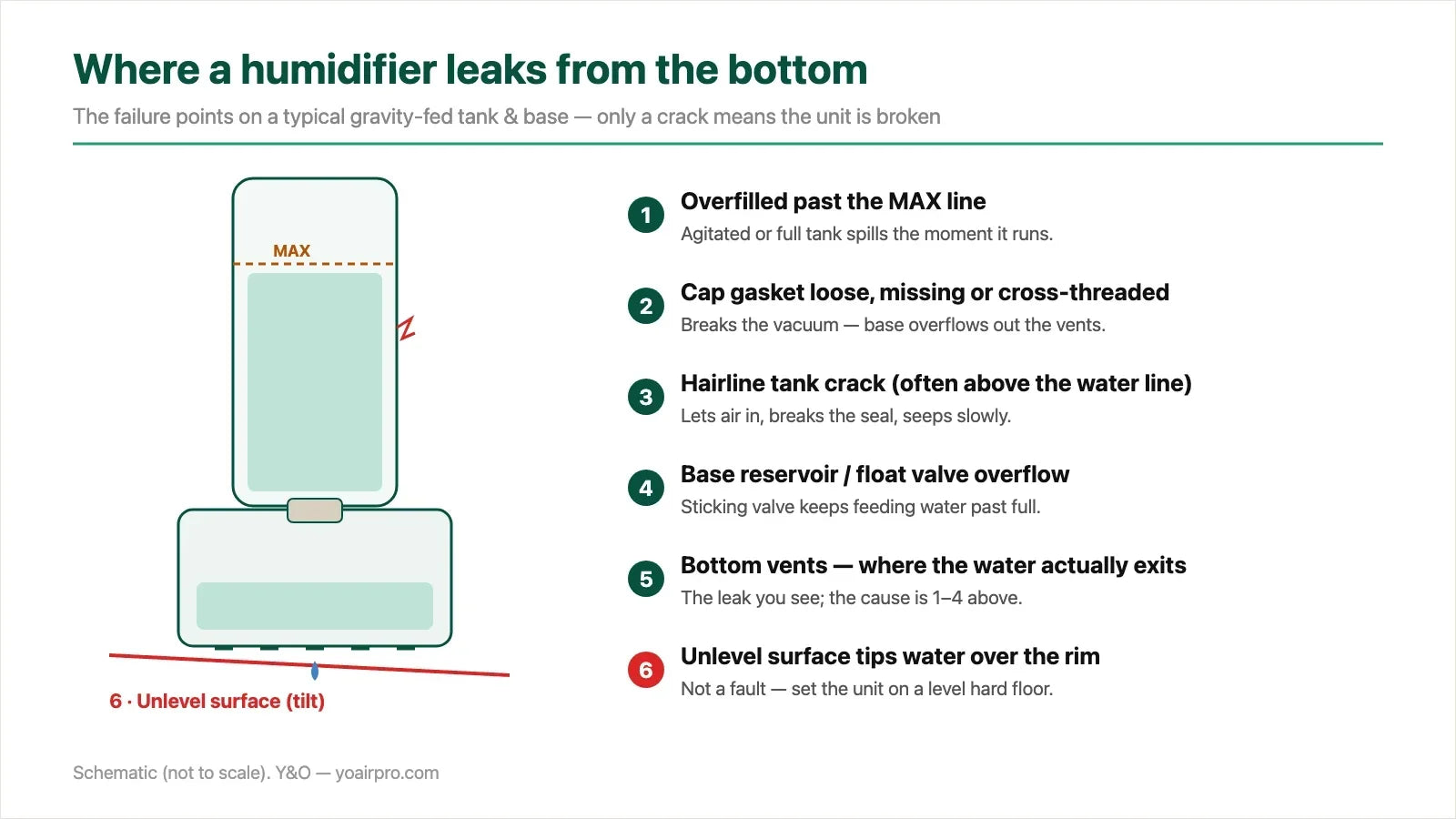

A humidifier leaking from the bottom almost always traces to one of six things, and only one of them means the machine is broken. On a gravity-fed cool-mist unit — the kind of Honeywell, Vicks or Levoit tank you flip onto a base — the most common culprit is the tank cap: a loose, cross-threaded, or missing rubber gasket, often stiffened by mineral crust, breaks the vacuum that holds the water back, so the base reservoir overflows and runs out the bottom vents, a cause Honeywell’s own troubleshooting guide lists first. The other five are overfilling past the max line, a hairline tank crack, an unlevel surface, an ultrasonic unit’s seeping transducer well, and warm mist condensing on a cold floor. Water boils at 212°F, and a sealed-chamber steam design removes the two failure points behind most base leaks — the ultrasonic transducer well and the wet wick tray. Here is how to tell which one you have, in about two minutes, as of 2026.
The 2-minute diagnosis: which of the six is yours
Before you buy a replacement, run down this table — five of the six causes are a fix, not a funeral. The single most useful test is the paper-towel test: fill the tank, stand it on a dry paper towel on a level counter for ten minutes, and see where the first damp ring appears — under the cap points to the seal, at a corner points to a crack, and a puddle away from the unit points to condensation, not a leak at all. The last column is the honest part of a buyer’s question: some leak points are baked into the machine’s design, and switching technology is the only thing that removes them.
| Cause | Where it shows up | 2-minute check | Which design removes this leak point |
|---|---|---|---|
| Overfilled past the MAX line | Spills from the tank collar or base the moment it runs | Empty to the MAX line; agitation from an ultrasonic plate makes a too-full tank spill even level | None — any tank overfills, steam included. Fill to the line. |
| Cap gasket loose, missing or cross-threaded | Base reservoir overflows out the bottom vents | Remove cap; the rubber gasket should lie flat, no tears or mineral crust; re-seat the cap straight | Sealed steam has no flip-tank base float valve to overflow |
| Hairline tank crack (often above the water line) | Slow seep from a corner that worsens over days | Paper-towel test 10 min; a crack lets air in and breaks the seal even if you can’t see it | None — any tank can crack. Replace it; never glue. |
| Unlevel surface (tilt) | One side runs over the rim; uneven base pooling | Set on a hard, level floor; check with a phone level app before blaming the unit | None — a design issue only in that a wide base tolerates tilt better. |
| Ultrasonic transducer-well seepage / clogged drain | Underside of the base, near the vents | Look in the misting well for mineral-clogged drain holes or a degraded seal around the metal plate | Steam & evaporative have no transducer well at all |
| Warm-mist condensation (not a true leak) | Puddle a foot or two away, under the mist stream | Move the unit off cold tile and aim mist upward; if the puddle stops, it was condensation | A steam unit that cools its vapor before it exits sends out a mist closer to room temperature, so there is less of a warm-plume-on-cold-surface gap — though aim and placement matter most |
Read the table as a decision, not a checklist: if your damp ring is under the cap, you have a ninety-second fix; if it is at a seam and returns after you re-seat everything, the tank is cracked and no amount of cleaning will save it. The rest of this guide explains the two mechanisms people find most confusing — the vacuum seal and condensation — and then answers the buyer’s real question: which kind of humidifier is least likely to put you back here next winter.
Why a cap seal or hairline crack floods the base
A gravity-fed cool-mist humidifier is a physics trick. You fill the tank, screw on the cap, and flip it upside down onto the base; the water does not gush out because atmospheric pressure and a small float valve hold it in a standoff, releasing just enough to keep the base reservoir topped up as the unit evaporates it. That entire system depends on one perfect seal at the cap — and the moment air can sneak past it, the standoff collapses and the tank dumps into a base that was never meant to hold a full tank’s worth of water.
This is why two very different-looking problems produce the identical symptom of water under the machine. A cap gasket that fell out during cleaning, hardened with age, or sits cross-threaded lets air in at the cap. A hairline crack — even one above the water line, from dropping the tank or over-tightening it — lets air in at the crack. Either way the fix is the same diagnosis: air is defeating the vacuum, so the base overflows and the water appears at the bottom vents, not at the actual point of failure. Honeywell’s troubleshooting guide makes the same point and adds the rule that matters most: inspect the rubber gasket so it “lie[s] flat without tears, stretching, or mineral crust,” and never seal a cracked tank with household glue or tape — replace the tank or gasket with a part made for that model.
Hard water quietly accelerates the seal failure. Every fill leaves a little calcium and magnesium behind, and that mineral crust builds on the exact rubber gasket that needs to stay soft and flat to seal. In hard-water regions — where US tap water can top 180 mg/L, roughly three times the under-60 mg/L that counts as soft — a gasket that sealed fine in October can be crusted stiff by January, which is why descaling is really leak prevention in disguise. If you are on hard water, our US water-hardness map shows where you stand on that 60-to-180 mg/L scale, and our step-by-step descaling routine keeps the seal clean; running tap versus distilled water changes how fast that crust forms.

Overfill and unlevel surfaces: fixed in a minute
The two most common leaks are also the two least serious, and neither needs a replacement part. Overfilling is the number-one avoidable cause: the MAX line exists because the base needs headroom, and an ultrasonic unit’s vibrating plate will slosh a brim-full tank over the edge even when it is sitting perfectly level. The fix is to empty back to the line and wipe the base dry; the fix is not to run it half-empty forever, just to respect the line the manufacturer printed there.
An unlevel surface is the sneakiest of the six because nothing is broken at all. A soft rug, a warped floorboard, or a wobbly shelf tilts the reservoir a few degrees, and water that would sit safely below the rim now runs over one side. Set the unit on a hard, level floor — not carpet, not a side surface — and confirm it with the level app already on your phone before you conclude the humidifier is faulty. Placing a unit on the floor also keeps a genuine overflow from cascading onto furniture or electronics, which is the more expensive version of this problem.
One myth worth killing: cranking the output does not “push through” a leak, it usually creates one. Running a small unit flat-out in a very dry, 10–15% room means constant refilling and more chances to overfill, and it can tip a room into the kind of localized over-humidity that condenses on cold surfaces. The US EPA recommends keeping indoor relative humidity between 30% and 50%, and a unit sized to the room hits that band without being run at a leak-prone maximum. If you are guessing at size, our output calculator gives the ml/h a given room actually needs.
Condensation vs a real leak — how to tell
Plenty of “my humidifier is leaking” reports are not leaks at all — they are condensation, and the tell is location. A true leak pools directly under or beside the machine. Condensation pools a foot or two away, under the path of the mist, because the water never came from inside the unit — it came out as vapor and turned back to liquid when it met a colder surface. Warm-mist and high-output units cause this most, since a heavy plume aimed low at a cold tile floor or an exterior wall gives that vapor a cold surface to collect on.
The physics is the same dew-point effect the National Weather Service describes: air can only hold so much moisture at a given temperature, and when moist air touches a surface below its dew point, the excess condenses out as liquid water. Fixing condensation is about aim and placement, not parts — raise the unit off the cold floor, angle the mist upward and away from cold walls and windows, and lower the output a notch so the room is not saturated right at the nozzle. This is also where warm-mist steam units differ from each other: some blow hot vapor that condenses readily, while a design that cools the vapor before it leaves the unit puts out a cooler mist, closer to room temperature, to begin with.
Which humidifier design leaks least — honestly
We design and build a portable steam humidifier, so read this section as disclosure, not a verdict. The honest truth is that no humidifier is leak-proof: overfilling, a hairline crack and an unlevel surface can happen to any machine on the market, ours included, so anyone promising a “leak-proof” humidifier is overselling it. What technology does change is whether a machine carries the two design-specific leak points that generate the most bottom-leak complaints.
Ultrasonic units carry a transducer well — a small pool of water in the base around the vibrating plate. If the seal around that plate degrades or the tiny drain holes clog with minerals, water seeps out the underside, and it is the hardest leak for an owner to diagnose because it hides inside the base. Evaporative units carry a wick sitting in a standing-water tray that can overflow and, left damp, is the classic home for the biofilm we cover in do humidifiers cause mold. A sealed-chamber steam design has neither: no transducer well to seep and no wet wick tray to overflow, because it boils water in a closed chamber rather than atomizing or wicking it. Our own machine is filterless for exactly that reason — there is no wick or filter in the water path at all.
Here is our honest ledger, because a buyer deserves the trade-offs, not a sales pitch. A steam unit boils water at 212°F, so it draws more electricity than a cool-mist unit; on hard water it needs descaling more often because heat drives scale onto the element; and a portable covers the rooms you put it in, not a whole house you have to plumb. What you get in return, on the leaking question specifically, is a machine with two fewer places to fail: our Y&O 10L runs two removable 5L tanks you fill to a clear line, boils the water in a sealed chamber, then cools the vapor before it leaves the unit so the mist is cool to the touch and less prone to condensing on your floor. It still needs to be filled to the line and descaled — we will not pretend otherwise — but it removes the transducer well and the wick tray from the equation. If you are weighing the three technologies head to head, steam vs ultrasonic vs evaporative and our humidifier buying guide lay out who each one suits.

Tired of mopping under the humidifier?
Our 10L steam humidifier boils water in a sealed chamber and cools the vapor before it leaves the unit — no transducer well, no wet wick, no filters to buy. Two 5L tanks you fill to a clear line. See whether it fits your space.
See the Y&O Steam Plus 10LFAQ
Why is my humidifier leaking from the bottom?
Almost always one of six things: the tank is overfilled past the MAX line, the cap gasket is loose, missing or cross-threaded, there is a hairline crack in the tank, the unit is on an unlevel surface, an ultrasonic transducer well is seeping, or warm mist is condensing on a cold floor. On gravity-fed cool-mist units the cap seal is the most common cause, because once air gets past the seal the base reservoir overflows and runs out the bottom vents.
How do I know if it's a leak or just condensation?
Look at where the water sits. A true leak pools directly under or beside the machine. Condensation pools a foot or two away, under the path of the mist, because that water left the unit as vapor and turned back to liquid on a colder surface. If moving the unit off a cold floor and aiming the mist upward stops the puddle, it was condensation, not a leak.
Can a hairline crack in the tank cause a bottom leak?
Yes, and it is one of the most confusing causes because the crack can be above the water line and invisible. A gravity-fed tank holds water by vacuum, so any breach that lets air in defeats the seal and the base overflows. The test is to fill the tank, stand it on a dry paper towel for ten minutes, and look for a damp ring. A cracked tank should be replaced, never glued or taped.
Do steam humidifiers leak?
They can, but from fewer places. Overfilling, a cracked tank or an unlevel surface can leak on any machine, steam included. What a sealed-chamber steam design does not have is an ultrasonic transducer well or a wet wick tray, which are the two design-specific leak points behind most bottom leaks on other technologies. A steam unit still needs to be filled to the line and descaled on hard water.
How do I stop my humidifier from leaking?
Work through the fixable causes first: empty to the MAX line, remove and inspect the cap gasket so it lies flat with no mineral crust, re-seat the cap straight, and set the unit on a hard, level floor. Descale regularly so mineral crust does not stiffen the seal. If a paper-towel test still shows a damp ring at a seam after all that, the tank is cracked and needs replacing.
Keep reading
- The humidifier buying guide
- Steam vs ultrasonic vs evaporative
- The filter-free steam humidifier
- Tap water vs distilled: what to use
- How to descale a humidifier
- The US water-hardness & white-dust map
Sources — manufacturer troubleshooting guidance and dew-point physics. All links verified live.