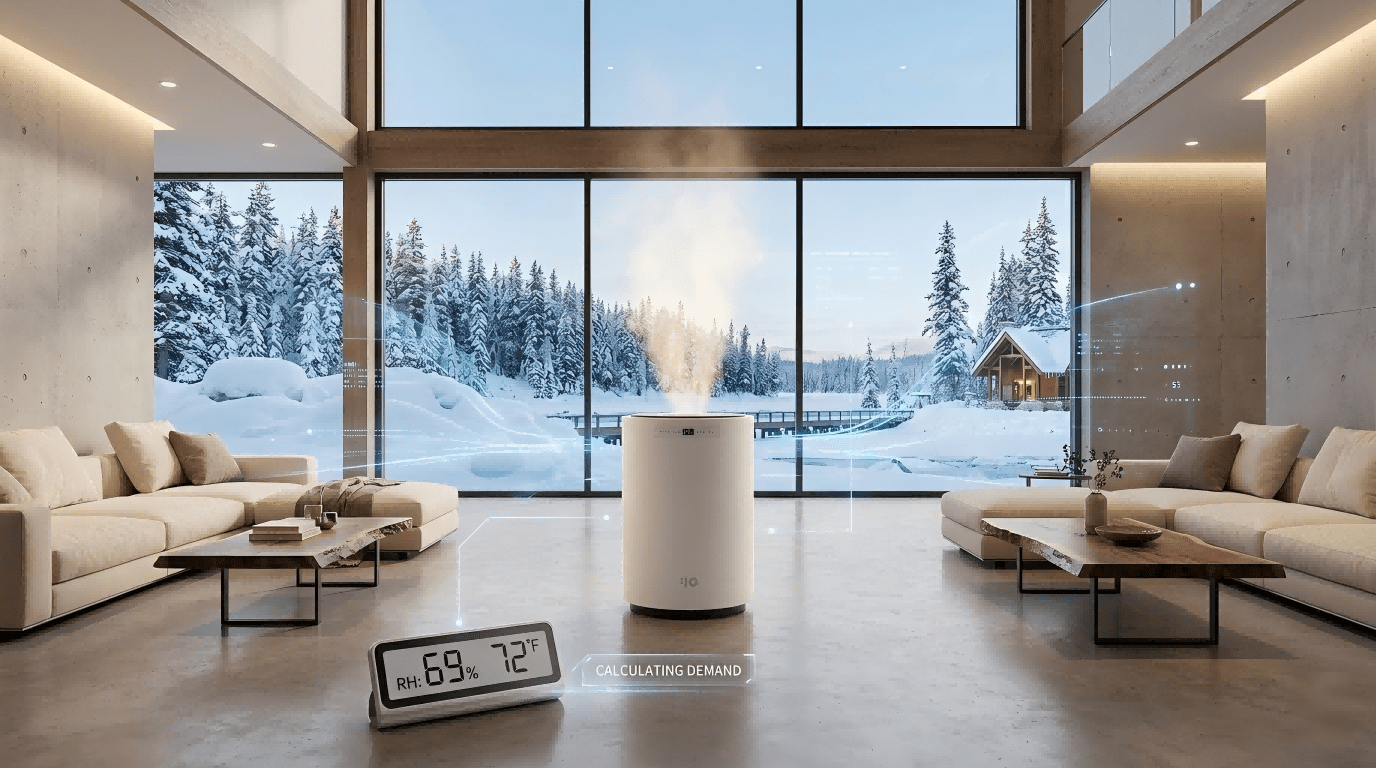

Most people size a humidifier by looking at the rated coverage number on the box. That number is almost always wrong for real North American homes — sometimes by 50% or more.
The correct approach is to calculate the output rate (ml/h) your space actually needs, accounting for ceiling height, floor plan openness, climate zone, and water hardness. This calculator does that in about 30 seconds.
Rated coverage area is a lab number. Output rate (ml/h) is the real metric. Use the calculator below to find exactly what your home requires — then scroll down to understand why each variable matters and how to apply the result.
The Calculator
Why Each Variable Matters
The calculator uses four variables — area, ceiling height, floor plan type, and climate zone. Here's why each one matters and how it affects the result.
Floor Area
Floor area is the starting point, but it's a two-dimensional measurement for a three-dimensional problem. Humidity fills volume, not just area. A 600 sq ft room with 10 ft ceilings contains 25% more air than the same room with 8 ft ceilings — and requires proportionally more output to humidify.
The calculator adjusts automatically for ceiling height. If you're above 9 ft, the output requirement increases meaningfully. Above 11 ft — common in lofts, vaulted living rooms, and some modern townhouses — the increase is significant enough to push you into the next output tier.
Floor Plan Type
Open floor plans are the hardest spaces to humidify because moisture flows freely to adjacent areas — the kitchen, hallway, and staircase all draw humidity away from the unit's immediate zone. A 600 sq ft open-plan living and kitchen space effectively behaves like an 800–900 sq ft closed room for humidification purposes.
The floor plan multipliers used in this calculator:
| Floor Plan Type | Description | Output Multiplier |
|---|---|---|
| Open plan | Kitchen, dining, living connected — no dividing walls or doors | ×1.5 — most demanding |
| Semi-open | Some connected zones, some closed rooms | ×1.2 — moderate adjustment |
| Closed rooms | Doors closed, each room is a separate sealed space | ×1.0 — closest to lab conditions |
For a full explanation of why open floor plans consistently defeat standard-rated humidifiers: Your Humidifier Says It Covers 500 sq ft. Here's Why It Probably Doesn't →
Climate Zone
Climate zone determines both the baseline outdoor humidity your heating system is working against, and how long you'll be running the humidifier each year. The Canadian Prairies and U.S. Upper Midwest represent the most demanding conditions — extreme cold outdoor air, heating seasons lasting 7+ months, and in many cities, very hard water compounding the problem.
For a detailed breakdown of output requirements by North American city and region: Why Dry Air in North American Winters Defeats Most Humidifiers →
Water Hardness
Water hardness affects technology choice more than output quantity. In hard-water cities (Phoenix, Las Vegas, Calgary, Denver), running an ultrasonic humidifier produces mineral aerosol — the white dust that settles on furniture and gets inhaled. For these users, steam is the correct technology regardless of output requirements: it leaves minerals in the tank rather than dispersing them into your air.
The calculator reflects a modest output adjustment for hard water (ultrasonic users in hard-water areas effectively need to oversize to compensate for efficiency losses from mineral buildup), but the technology recommendation is the more important output of this variable.
For the full white dust picture by region: Hard-Water Humidifier Disaster: White Dust & Your Lungs →
How to Apply Your Result
Once you have your output number, the next step is matching it to a unit. Here's what to look for:
- Look for output rate in ml/h on the spec sheet — this is the number that matters, not the rated sq ft coverage on the front of the box
- Your calculated number is a minimum — if you're between tiers, round up rather than down
- For extreme climate zones (Prairies, Upper Midwest), add 10–15% buffer above your calculated minimum — real-world conditions regularly exceed averages
- Verify the unit has a built-in humidistat — without one, you're running manually and will either over- or under-humidify
- Check tank size for overnight runtime — at 1,200 ml/h, a 10L tank runs approximately 8 hours, which covers most overnight periods without refilling
- Verify actual room humidity with a separate hygrometer — built-in sensors on most humidifiers read 5–10% higher than actual room humidity
- Don't rely on rated sq ft coverage — it's measured in a sealed lab room with no heating system and no open floor plan
- Don't size down "just to try it" — an undersized unit running continuously against an active heating system won't reach target humidity regardless of run time
- Don't use an ultrasonic unit in hard-water cities without distilled water — the ongoing distilled water cost often exceeds the price difference to a steam unit within one season
For the decision between one unit and two: How Many Humidifiers Do You Actually Need? →
The Unit That Meets Every Climate Zone's Demand
The Y&O Steam Plus outputs 1,200 ml/h — enough for open floor plans up to 1,000 sq ft in extreme Prairie and Midwest conditions. No filters, no white dust, no distilled water required.
See the Y&O Steam Plus →Your Questions Answered
Why doesn't the calculator use the rated sq ft coverage number?
Rated coverage area is measured under AHAM standard conditions — a sealed room at controlled temperature and starting humidity, with no heating system running and no open floor plan. Your home in January is none of those things. The output rate (ml/h) is a direct physical measurement of how much water vapor the unit releases per hour. When you compare that number to the actual moisture demand of your space — accounting for ceiling height, air exchange, and heating system load — you get a result that actually predicts real-world performance. The sq ft number on the box doesn't.
My result says I need more than 1,200 ml/h. What are my options?
Three options, depending on your home type. First, zone-based portable units — one high-output steam unit per primary living zone (main floor and upper floor separately). This works well for homes up to 2,500 sq ft with clear zone separation by floor. Second, HVAC whole-house humidification — if you have forced-air heating with ductwork, an HVAC-integrated humidifier covers the entire home regardless of floor plan. The installation cost is $600–$1,400, but the ongoing cost is low. Third, focus humidification on your highest-priority zones (bedrooms overnight, main living area during the day) rather than trying to humidify the entire home simultaneously. For the HVAC comparison: Whole-House Humidifier: HVAC vs Portable Steam →
Does the calculator account for altitude?
The climate zone multipliers partially account for altitude through the regional groupings — the Southwest / Rockies zone (which includes Denver at 5,280 ft and Calgary at 3,438 ft) carries a higher multiplier than lower-altitude regions. For precise altitude adjustment: if you're above 3,000 ft, add approximately 15% to your calculated result; above 5,000 ft, add 20%. Air at high altitude holds less moisture at the same temperature due to lower pressure, which means your humidifier is working against lower-capacity air. This effect is real and consistent, and is a primary reason high-altitude users report humidifiers underperforming standard calculations.
I have a finished basement I also want to humidify. How do I factor that in?
Basements should be treated as a separate zone from the main floor. Humidity doesn't travel well against gravity — a main-floor unit's output won't reliably reach basement levels. Add your basement square footage to the calculator as a separate calculation. If the basement result is under 600 ml/h, a secondary mid-range unit may suffice there. If it's over 600 ml/h, a second full-output unit is warranted. Note that finished basements in heating season often have slightly higher humidity than above-grade floors, because basement walls are in contact with ground that holds some moisture — measure actual RH before assuming you need aggressive humidification there.
My result is 800 ml/h but I already own a 400 ml/h unit. Should I buy a second one or replace it?
Replace it rather than supplement it. Two 400 ml/h units don't add up to 800 ml/h of effective coverage in an open space — they create overlapping humidity zones near each unit and dead zones at the edges, plus double the maintenance burden. A single 1,200 ml/h steam unit placed centrally will outperform two 400 ml/h units in almost every large-room scenario, at lower total cost over a heating season (especially if you're in a hard-water city where ultrasonic units require distilled water). For the full one-vs-two analysis: How Many Humidifiers Do You Actually Need? →
Related Reading
Sources & References
- AHAM — Humidifier Testing Standards
- ASHRAE Standard 55 — Thermal Environmental Conditions for Human Occupancy
- U.S. Geological Survey — Hardness of Water — Regional Data
- U.S. Environmental Protection Agency — Use and Care of Home Humidifiers
- Y&O — YO-M2 Steam Plus Product Page