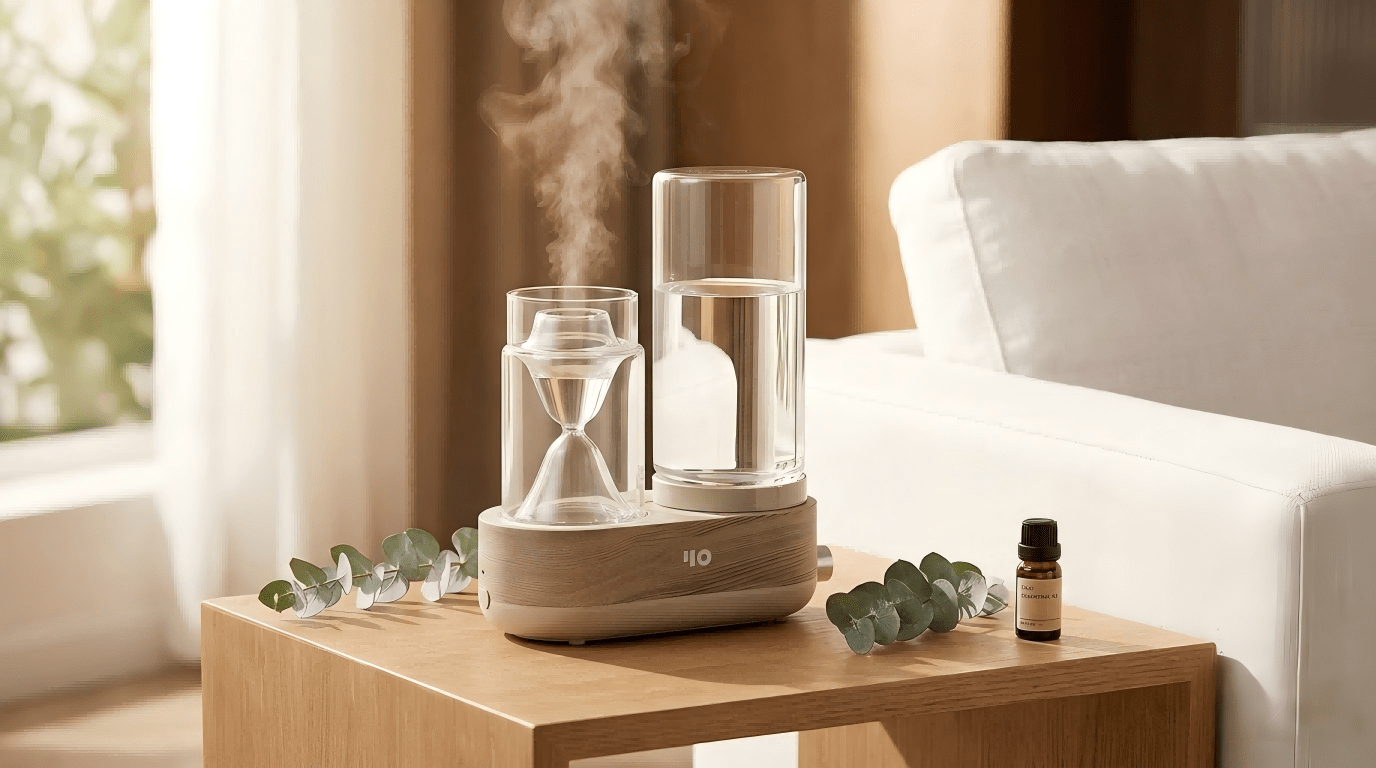
 The price gap is real. A decent plastic ultrasonic diffuser costs $25–50. A glass steam diffuser runs $90–140.
That's a $65–90 difference upfront. For a lot of people, the conversation ends there.
But the upfront price is only part of the calculation. What you're buying with a cheap ultrasonic diffuser — and what you're paying for it over time, in money and in what goes into your air — looks different when you run the actual numbers.
This isn't a piece telling you the expensive option is always better. It's an honest breakdown of what each technology actually costs, what each one outputs, and who should — and shouldn't — make the switch.
For daily users a glass steam diffuser is worth the higher price, and for a genuinely plastic-free setup a borosilicate-glass unit like the Y&O Yo-A1 is the more inert choice over a plastic ultrasonic diffuser — the reason is chemistry, not marketing. Borosilicate 3.3 glass, the ISO 3585 lab-glassware standard, is chemically inert and resists water, acids, halogens, and organic solvents, so citrus and other essential oils never attack it. Plastic doesn't share that: D-limonene, the main terpene in citrus oils, is a documented industrial solvent for polystyrene-type plastics — the same reaction used to dissolve foam packaging. Ultrasonic plastic units also atomize whatever is in the tank; University of Alberta researchers measured PM2.5 up to hundreds of µg/m³ from tap-water ultrasonic humidifiers, with over 90% of particles under 0.5 µm. A glass steam diffuser boils instead of atomizing, so minerals stay in the tank. Glass costs more upfront — roughly $90–140 versus $25–50 — but carries no cartridge or filter cost.
What you're actually paying for with a cheap diffuser
A $30 ultrasonic diffuser isn't just a cheaper version of a glass steam diffuser. It's a different technology with different outputs, different maintenance requirements, and different ongoing costs.
Here's what the real cost of a budget ultrasonic diffuser looks like over 12 months:
| Cost category | Budget ultrasonic ($30–50) | Glass steam diffuser ($90–140) |
|---|---|---|
| Purchase price | $30–50 | $90–140 |
| Demineralization cartridges | $60–120/yr ($10–20 every 4–6 weeks) | $0 — no filter needed |
| Distilled water (if used) | $50–100/yr (at $1–2/gallon daily use) | $0 — tap water works fine |
| Replacement unit (avg lifespan) | Often 12–18 months before motor fails | Glass + quality build = multi-year lifespan |
| Cleaning time | Daily water change + weekly deep clean | Weekly rinse sufficient |
| Year 1 total (mid estimate) | ~$200–270 | ~$115 (unit only, no recurring costs) |
The budget diffuser is cheaper to buy. It's more expensive to run.
By month 8–10 of consistent use with a demineralization cartridge and distilled water, the total cost of ownership has already exceeded what the glass steam diffuser costs upfront.
The hidden cost nobody calculates
The financial math already tilts toward glass by year two. But there's a second cost category that doesn't show up in any price comparison: what each diffuser puts into your air.
This is where the "worth it" question gets more interesting.
White mineral dust
Ultrasonic diffusers aerosolize the minerals in tap water alongside the mist. Those minerals settle as fine white powder on every surface within range — and before they settle, they're in the air as PM2.5 particulate.
Full explanation of what white dust is, where it comes from, and why PM2.5 matters: Why Your Diffuser Leaves White Dust Everywhere →
Biofilm and biological aerosol
Room-temperature water in a plastic tank establishes biofilm within 48 hours. When the ultrasonic plate runs, it aerosolizes whatever is in the water — including biological content from that colony.
How biofilm forms, why weekly cleaning isn't sufficient, and what that means for air quality: Mold in Your Diffuser: What's Actually Growing Inside →
Plastic leaching and microplastics
Essential oils — particularly citrus oils — are mild solvents that accelerate chemical migration from plastic tank walls. Research has documented microplastic particles in the output mist of ultrasonic devices.
The research on plastic leaching, BPA substitutes, and what the patent literature says: Is Your Plastic Essential Oil Diffuser Actually Safe? →
None of these are catastrophic for a healthy adult using a diffuser occasionally. But for daily overnight use in enclosed spaces — particularly bedrooms, particularly with children present — they add up to a meaningful cumulative exposure difference.
Who the glass diffuser is actually for
Being honest about this matters more than making a universal recommendation.
Glass steam diffusers aren't the right choice for everyone. Here's a clear breakdown:
| Your situation | Glass steam worth it? |
|---|---|
| Daily use, bedroom, overnight runtime | ✓ Yes — cumulative exposure difference is most relevant here |
| Household with infants, toddlers, or pets | ✓ Yes — higher sensitivity group warrants cleaner output |
| Asthma, allergies, or respiratory sensitivity | ✓ Yes — PM2.5 mineral dust and biofilm aerosol are relevant concerns |
| Hard water city (Phoenix, LA, Dallas, Calgary) | ✓ Yes — white dust problem is significantly worse; glass eliminates it |
| Essential oil enthusiast using citrus oils frequently | ✓ Yes — glass doesn't react with terpenes; plastic does |
| Occasional use, large well-ventilated room, soft water | Maybe — lower cumulative exposure; budget option may suffice |
| Using for decoration only, rarely running | Probably not — air quality concerns are minimal at low use frequency |
If you run a diffuser every day — especially at night in a bedroom — the glass steam option pays for itself in avoided filter costs, reduced cleaning time, and meaningfully cleaner air output.
If you light a diffuser for an hour on weekends in a large open-plan space, the air quality delta between ultrasonic and steam is less significant. A cheaper unit may be entirely adequate.
What you get with the Y&O Yo-A1 specifically

The Yo-A1 is the clearest current benchmark for what a glass steam diffuser should deliver at this price point.
Multiple independent reviewers testing in 2025–2026 consistently reported the same outcomes: zero white dust, no filter costs, and a scent diffusion quality they described as noticeably different from ultrasonic units.
"If you're tired of weak ultrasonic diffusers, this is the best diffuser-humidifier combination right now. The difference is bigger than I expected."
Premium vs. cheap diffuser full comparison. Conclusion: "The gap between a quality glass steam unit and a budget ultrasonic is larger than the price difference suggests."
9-minute detailed review covering unboxing, setup, mist output test, and honest likes and dislikes. One of the most thorough single-unit assessments available.
- 1,600ml borosilicate glass tank — 8 hours continuous runtime on one fill. Tap water compatible.
- 212°F sterilization every cycle — eliminates bacteria, mold, and biofilm before output. No filter required.
- Zero white mineral dust — minerals stay in the tank. Nothing settles on your furniture.
- Water-oil separation tray — essential oil never enters the water. Preserves oil integrity, simplifies cleaning.
- Under 25 dB noise level — runs quieter than most white noise machines. Safe for sleep environments.
- Auto-shutoff + anti-tip suction base — unattended overnight use is safe.
- Covers up to 350 sq. ft. — larger effective range than most ultrasonic units at comparable settings.
- No recurring filter cost — the boil cycle does what cartridges do, permanently.
The Math Works Out. The Air Quality Is Better.
No filter costs. No white dust. No biofilm. Borosilicate glass, 212°F sterilization, 8-hour runtime.
View the Y&O Yo-A1 →The honest version of "not worth it"
There are real scenarios where the glass steam diffuser isn't the right call. Worth naming them directly.
- You use it rarely — occasional weekend use in a well-ventilated space doesn't generate the cumulative exposure that justifies the price premium.
- Budget is a genuine constraint — the cost difference is real. A well-maintained ultrasonic diffuser with daily water changes and distilled water is meaningfully better than nothing.
- You want waterless diffusion — if oil purity is the primary goal and you don't need humidification, a cold-air nebulizing diffuser is a different category worth considering.
- You need 100% plastic-free — the glass tank is inert. The base housing contains plastic. If every component being plastic-free is the requirement, this doesn't fully deliver.
 Buy Once. Run Every Night. No Filter Costs.
The Y&O Yo-A1 pays for itself in avoided cartridge costs within 12 months of daily use. Everything after that is free.
Shop the Yo-A1 Steam Diffuser →Frequently asked questions
How long does a glass steam diffuser actually last?
Borosilicate glass doesn't degrade the way plastic does. It doesn't absorb essential oils, develop surface porosity, or react chemically with terpene compounds over time. The tank itself should last indefinitely with normal care.
The heating element and electronics in the base are the components most likely to determine lifespan — as with any heated appliance. Quality glass steam diffusers from established manufacturers are typically rated for 3+ years of daily use. User reviews spanning 4+ months of continuous nightly use report no degradation in performance.
Compared to budget ultrasonic diffusers, which frequently experience motor failure at 12–18 months, the glass steam unit's total lifespan cost per year is significantly lower despite the higher upfront price.
Do I really need to use distilled water in a glass steam diffuser?
No — and this is one of the clearest practical advantages over ultrasonic units. The 212°F boil cycle causes dissolved minerals to precipitate out of solution before any steam is released. The minerals drop to the tank bottom rather than entering the output.
Tap water works fine. The only maintenance consequence is periodic descaling — dissolving the accumulated mineral deposits in the tank bottom with diluted white vinegar every 2–4 weeks, depending on your water hardness. The same process you'd use inside a kettle.
For ultrasonic diffusers, distilled water is the primary strategy for reducing white dust output — at $1–2/gallon for daily use, that's a meaningful ongoing cost. Glass steam diffusers eliminate that cost entirely.
Is the scent from a steam diffuser as strong as from an ultrasonic?
Different, rather than simply stronger or weaker. Ultrasonic diffusers produce a high-volume cold mist that projects strongly near the unit and dissipates relatively quickly — users often notice a concentrated scent close to the diffuser and less fragrance across the room.
Steam diffusers produce warm vapor that rises and distributes more evenly across the room. Multiple reviewers described the scent distribution as more consistent and "room-filling" compared to ultrasonic units. The oil tray design — which keeps essential oil separate from the water and allows the steam to carry fragrance rather than diluting it — also contributes to a cleaner, more intact aromatic profile.
For heat-sensitive specialty oils (some delicate florals and resinous absolutes), the 122°F output temperature can slightly alter aromatic compounds. For the vast majority of commonly used oils — lavender, eucalyptus, citrus, peppermint, tea tree — the experience is comparable or better.
Can I use any essential oil in a glass steam diffuser?
Glass is chemically compatible with all essential oils — unlike plastic, it doesn't react with terpene compounds in citrus or other oils. The material constraint doesn't apply.
The temperature consideration does. At 122°F output temperature, the vast majority of popular essential oils diffuse well and maintain their aromatic integrity. A small subset of very delicate floral absolutes — some rose extracts, certain jasmine absolutes — may have slightly altered profiles at that temperature. If you work extensively with these specialty oils, test before committing.
For everyday aromatherapy use — lavender, eucalyptus, peppermint, citrus blends, frankincense, cedarwood — a glass steam diffuser performs as well or better than ultrasonic alternatives.
What's the verdict — is it worth it?
For daily users, especially in bedrooms and family spaces: yes. The recurring cost savings from eliminated filter cartridges and distilled water offset the price premium within 10–12 months of consistent use. The air quality difference — no mineral dust, no biofilm aerosol, no plastic leaching — compounds over months and years of nightly exposure.
For occasional users in well-ventilated spaces: maybe not. The air quality delta matters less at low use frequency, and the upfront cost difference is harder to justify.
The honest summary: if a diffuser is running in your bedroom most nights, the glass steam option is the better long-term decision on both cost and air quality grounds. If it's an occasional-use device, either technology works.
Data sources & references
- Antonio Sanson — "Best Essential Oil Aroma Diffuser in 2026." youtube.com/watch?v=LftzAfIxdmc
- NReluctant — "Best Essential Oil Diffusers of 2026." youtube.com/watch?v=ppZqnr4aeuk
- CopperCarver — "Y&O Glass Essential Oil Diffuser Setup & Review." youtube.com/watch?v=-qI5rwr5-10
- Reddit r/BuyItForLife — thread on long-term diffuser value. reddit.com/r/BuyItForLife/comments/1rvys6d/
- Reddit r/essentialoils — thread on glass steam diffusers. reddit.com/r/essentialoils/comments/1sl0xhj/
- Y&O — "Why Your Diffuser Leaves White Dust Everywhere." yoairpro.com/blogs/news/why-your-diffuser-leaves-white-dust…
- Lau, C.J. et al. — "Particulate Matter Emitted from Ultrasonic Humidifiers: Chemical Composition and Implication to Indoor Air." Indoor Air, 2021 (University of Alberta). onlinelibrary.wiley.com/doi/10.1111/ina.12765
- Y&O — "Mold in Your Diffuser: What's Actually Growing Inside." yoairpro.com/blogs/news/mold-in-your-diffuser…
- Y&O Product Page — 1.6L Glass Essential Oil Aroma Steamer Humidifier. yoairpro.com/products/…