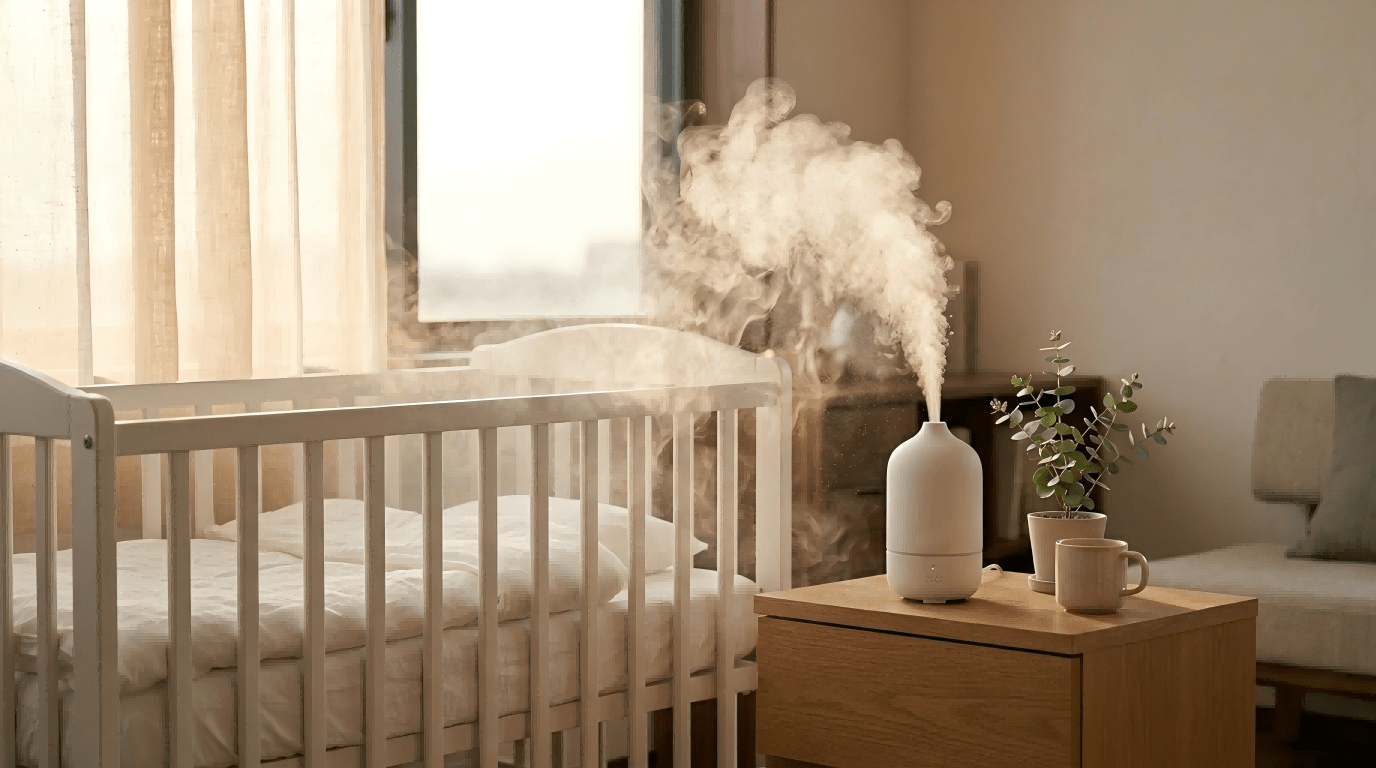

You've thought about every detail in that room.
The mattress material. The paint on the walls. The laundry detergent you switched to. The monitor positioned at the right angle.
But the diffuser running on the dresser — did you think about what's coming out of it?
Most diffusers weren't designed with infants in mind. They were designed for adult living rooms. Putting one in a baby's room without understanding what it actually outputs — mineral particulate, biological aerosol, or warm sterile steam — is a decision worth making deliberately.
Why a baby's room is different from every other room
Infants breathe faster than adults. A newborn takes 30–60 breaths per minute. An adult takes 12–20.
That means a baby in a room with a running diffuser is inhaling whatever the diffuser outputs at 2–3 times the rate an adult would. The same airborne particulate load that an adult filters through a larger respiratory system enters an infant's underdeveloped lungs at a higher relative dose.
Infants also spend more time in one room than anyone else in the household. A baby can sleep 14–17 hours per day in the first months. That's 14–17 hours of continuous exposure to whatever the diffuser is putting into the air — every single day.
The EPA's indoor air quality guidance identifies infants and young children as a high-sensitivity group for indoor air pollutants — specifically because of their higher breathing rate, developing lung tissue, and extended time spent indoors.
None of this means diffusers are categorically unsafe for nurseries. It means the choice of diffuser technology matters more in a baby's room than anywhere else in the house.
The three things coming out of a standard diffuser

Most people think of a diffuser as outputting two things: water vapor and essential oil scent.
Ultrasonic diffusers — the most common type — actually output three things. The third one is the problem.
1. Water vapor and scent
The intended output. Essential oil fragrance carried by aerosolized water droplets. This part works as designed.
2. Mineral particulate (white dust)
Dissolved minerals in tap water — primarily calcium and magnesium — travel through the ultrasonic misting process unchanged. When the water droplets evaporate in the air, the minerals stay behind as fine airborne particles in the PM2.5 size range.
These particles settle as white dust on furniture. Before they settle, they're in the air. In a baby's room, they're in the air your infant is breathing at 30–60 breaths per minute.
For a detailed explanation of how mineral dust forms and what PM2.5 particulate means for respiratory health: Why Your Diffuser Leaves White Dust Everywhere →
3. Biological aerosol (biofilm)
Ultrasonic diffusers hold water at room temperature — 65–75°F. That's the ideal growth range for bacteria and mold spores. Within 48 hours, a biofilm colony establishes on the tank surfaces.
When the ultrasonic plate runs, it aerosolizes whatever is in the water — including fragments of that biofilm colony. In a room where an infant is sleeping, that biological aerosol is entering underdeveloped lung tissue for hours at a time.
For the full science on how biofilm forms and why weekly cleaning isn't enough: Mold in Your Diffuser: What's Actually Growing Inside →
What "non-toxic" actually means for a diffuser
The term gets used loosely. In the diffuser category, it's worth breaking down into specific criteria.
| Safety criterion | Ultrasonic + plastic | Steam + glass |
|---|---|---|
| Mineral dust output | ✗ Minerals aerosolized with every cycle | ✓ Minerals stay in tank — none in output |
| Biological aerosol risk | ✗ Biofilm establishes within 48 hours | ✓ 212°F boil eliminates bacteria every cycle |
| Plastic contact with water | ✗ Water sits in plastic tank at room temp | ✓ Water contacts only borosilicate glass |
| Essential oil purity | Oils diluted directly in water tank | Oils on separate tray — no dilution |
| Noise level | 30–45 dB (fan + vibration) | <25 dB — below whisper level |
| Auto-shutoff | Varies by model | ✓ Runs safely unattended overnight |
| Anti-tip design | Varies by model | ✓ Suction-cup base — stable on any surface |
Truly non-toxic for a baby room means clean on all three vectors: no mineral particulate, no biological aerosol, no plastic water contact. Most ultrasonic diffusers don't pass any of the three.
The question to ask before putting any diffuser in a nursery
It's a simple one: at what temperature does this unit hold its water?
Room temperature water — 65–75°F — is a biological incubator. Anything that holds water at that temperature for hours at a time creates conditions for microbial growth.
Every ultrasonic diffuser holds water at room temperature. That's not a design flaw — it's how the vibration mechanism works. The water has to be at ambient temperature for the ultrasonic plate to function.
Steam diffusers answer that question differently. The water is boiled — every cycle, before any output is produced. At 212°F, bacteria don't grow. They die.
A diffuser running in a baby's room overnight is running for 8–10 consecutive hours. In an ultrasonic unit, that's 8–10 hours of continuous biological aerosol exposure in a closed room where an infant is breathing 30–60 times per minute. The cumulative inhalation dose over weeks and months of nightly use adds up significantly.
32,000+ views. The most-shared short video on why cool-mist devices in family spaces deserve more scrutiny than they typically get.
Specifically notes auto-shutoff and sterile steam output as reasons the unit is appropriate for households with infants and pets.
"Most people don't think about what their diffuser is made of. In a baby's room, that decision matters more than anywhere else."
What a genuinely safe nursery diffuser looks like

The Y&O Yo-A1 was built around the principles that matter most in a family environment: sterile output, inert materials, and safety features that make unattended overnight use genuinely reliable.
Every cycle starts with a 212°F boil. Bacteria and mold spores don't survive it. The steam that exits the unit has passed through a complete sterilization process — the same principle used to sterilize baby bottles and surgical equipment.
The 1,600ml borosilicate glass tank means water never contacts plastic at any point in the process. Glass is chemically inert — it doesn't leach, doesn't absorb, and doesn't provide the surface texture that biofilm needs to anchor.
- 212°F sterilization every cycle — bacteria and mold eliminated before any steam reaches the room.
- Zero mineral dust output — minerals precipitate during boiling and stay in the tank. None enter the mist.
- Borosilicate glass water tank — no plastic water contact at any point in the process.
- Under 25 dB noise level — quieter than a whisper. Safe for sleeping infants.
- Auto-shutoff when tank runs dry — won't run unattended without water.
- Anti-tip suction-cup base — stable on dresser surfaces, won't tip if bumped.
- 8-hour continuous runtime — runs a full night on one fill without interruption.
- Water-oil separation tray — essential oil never enters the water. Output is sterile steam carrying fragrance, not oil-contaminated mist.
Sterile Steam. Glass Tank. Safe for Your Baby's Room.
212°F sterilization every cycle · Zero mineral dust · Under 25 dB · 8-hour runtime · Auto-shutoff
View the Y&O Yo-A1 →A few things to know before you decide
- Essential oils in infant rooms require caution regardless of diffuser type — many pediatricians recommend avoiding concentrated essential oils around babies under 3 months, and using only gentle, age-appropriate oils for older infants. The diffuser technology matters; so does what you put in it. Always confirm with your pediatrician.
- The base housing contains plastic — "glass diffuser" refers to the water tank. The base unit includes plastic housing. The water-contact surface is glass — which is where material choice matters for infant safety.
- Scale accumulates over time — the boiling process precipitates minerals into the tank bottom. Periodic vinegar cleaning (every 2–4 weeks) dissolves it. Less frequent than ultrasonic biofilm maintenance, but not zero.
- Output is warm steam, not cool mist — the steam is cooled to 122°F before output, not scalding. But place the unit on a dresser or shelf out of reach, not on the floor where a crawling infant could contact it directly.

Eight Hours of Clean Air While Your Baby Sleeps
No mineral dust. No biofilm. No plastic water contact. Just sterile steam from borosilicate glass — running quietly through the night.
Shop the Yo-A1 Steam Diffuser →Frequently asked questions
Is it safe to use essential oils in a baby's room at all?
This depends significantly on the infant's age and the specific oils used. Many pediatricians recommend avoiding essential oils entirely for babies under 3 months, as their respiratory systems are still developing and their skin is highly permeable.
For older infants, gentle oils like lavender and chamomile are more commonly considered appropriate — but at lower concentrations and shorter diffusion periods than you might use in an adult space. Eucalyptus, peppermint, and tea tree are generally not recommended for young children due to their potency.
The diffuser technology question and the essential oil question are separate decisions. A steam diffuser with a glass tank addresses the mechanical and biological safety concerns. What you put in the oil tray is a conversation to have with your pediatrician.
See the medical notice at the end of this article.
How far should a diffuser be from a baby's crib?
A general guideline is at least 3–6 feet from the crib — enough distance for the steam or mist to disperse into the room air before reaching the infant's immediate breathing zone. Positioning on a dresser or shelf at a height above crib level allows the output to diffuse naturally across the room.
For a steam diffuser operating at 122°F output temperature, keeping it out of direct reach is also a physical safety consideration — particularly once infants become mobile. A dresser or shelf is appropriate; the floor is not.
Does the steam from a steam diffuser pose a burn risk in a baby's room?
The Y&O Yo-A1 cools its output to 122°F before release — warm to the touch, but not scalding at typical diffusion distances. At 3–6 feet from the unit, the steam disperses significantly before reaching any surface.
The relevant precaution is placement: keep the unit on a stable elevated surface (dresser, shelf) that a crawling or walking child cannot reach. The anti-tip suction base adds stability, but positioning out of reach is the primary safety measure.
How often should I clean the diffuser if it's running in a baby's room nightly?
For a steam diffuser: a weekly rinse of the glass tank and a wipe of the oil tray is typically sufficient. The 212°F boil cycle eliminates bacterial growth each run, so biofilm doesn't accumulate the way it does in an ultrasonic unit.
The main maintenance task is scale removal — mineral deposits from the boiling process, dissolved with diluted white vinegar every 2–4 weeks. The transparent glass tank makes it easy to see when cleaning is needed.
For an ultrasonic diffuser in a baby's room: daily water changes and weekly deep cleaning are the minimum recommended by most manufacturers. Whether that schedule is practical to maintain consistently is a personal assessment.
My pediatrician said no diffuser in the baby's room. What should I do?
Follow your pediatrician's guidance. This article provides information about diffuser technology differences — it doesn't override clinical advice specific to your child.
If you want to revisit the conversation with your doctor, the relevant questions to ask are: what specific concerns does the recommendation address (particulate, essential oils, humidity levels, biological contamination)? Does the recommendation apply equally to a steam diffuser with a glass tank and 212°F sterilization cycle, or was it based on cool-mist ultrasonic devices specifically?
Those distinctions may or may not change the recommendation. Your pediatrician's answer is the right one for your situation.
Data sources & references
- U.S. Environmental Protection Agency — Indoor Air Quality: Sensitive Populations. epa.gov/indoor-air-quality-iaq
- U.S. Environmental Protection Agency — Particulate Matter (PM2.5). epa.gov/pm-pollution
- CDC — NIOSH Indoor Environmental Quality. cdc.gov/niosh/topics/indoorenv
- ASHRAE — Indoor Air Quality Standards. ashrae.org
- Non-Toxic Dad — "The Wrong Humidifier Can Be TOXIC!" youtube.com/watch?v=sdjsRDdcGS8
- GoTechGeek — Y&O Glass Essential Oil Diffuser Review. youtube.com/watch?v=1zv48sr6aAU
- The Nutmeg Home — "What Kind of Diffuser Is Best?" youtube.com/watch?v=CdlD08m6kKQ
- Reddit r/nontoxic — thread on diffuser safety for families. reddit.com/r/nontoxic/comments/1s3ww02/
- Y&O — "Why Your Diffuser Leaves White Dust Everywhere." yoairpro.com/blogs/news/why-your-diffuser-leaves-white-dust…
- Y&O — "Mold in Your Diffuser: What's Actually Growing Inside." yoairpro.com/blogs/news/mold-in-your-diffuser…
- Y&O Product Page — 1.6L Glass Essential Oil Aroma Steamer Humidifier. yoairpro.com/products/…