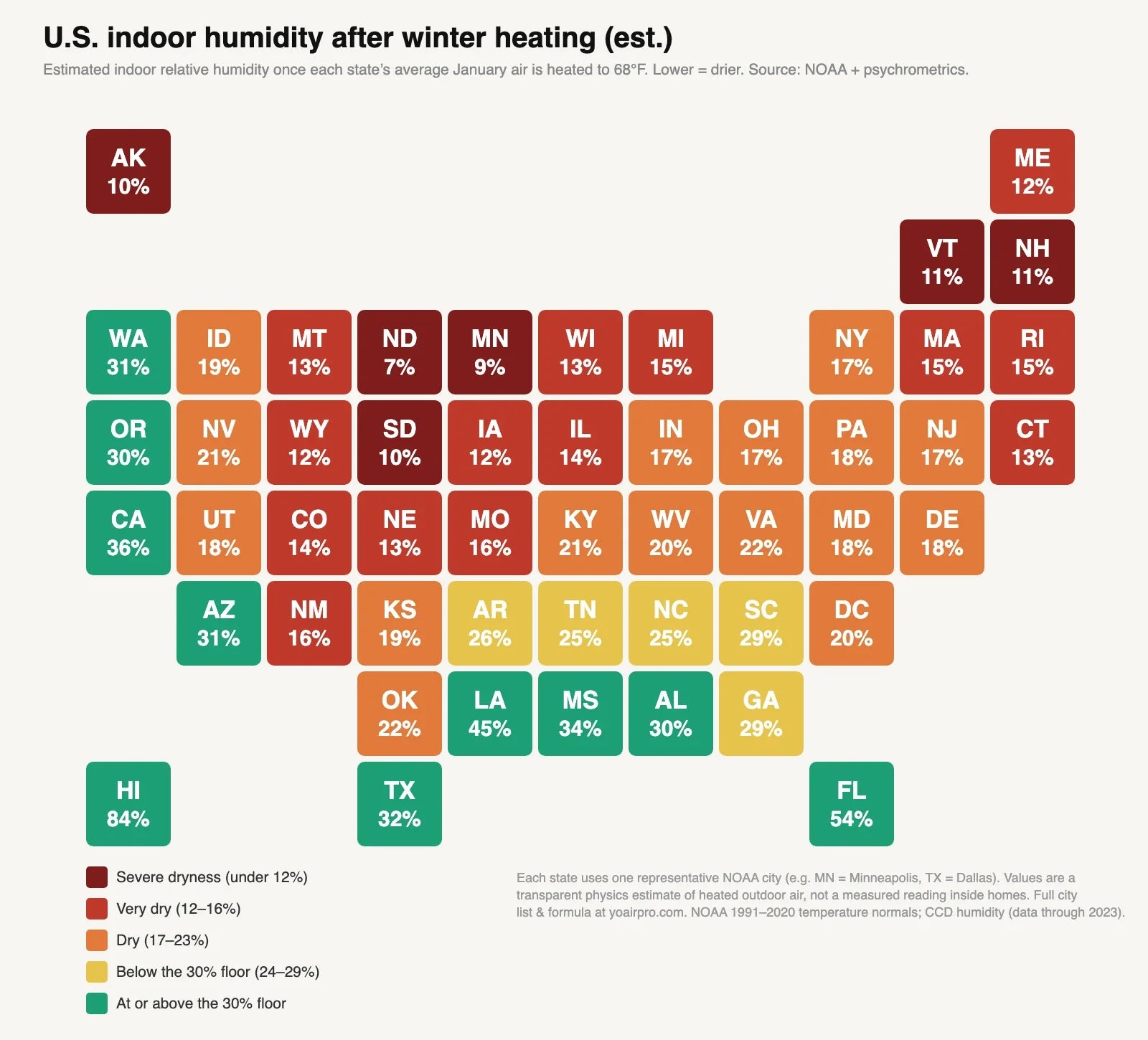

Using NOAA’s 1991–2020 temperature normals and morning/afternoon humidity data, this map estimates how dry indoor air gets in every US state once winter outdoor air is drawn in and heated to a normal 68°F. North Dakota (Fargo) lands the driest at about 7% indoor relative humidity, with Minnesota, South Dakota, Vermont and New Hampshire in single digits or low teens; 41 of the 50 states and DC fall below the 30% floor that the US EPA calls the low end of its recommended range (ideally 30–50%). Only the deep South, Texas and the Pacific coast — where homes barely run the furnace — stay at or above 30% as of 2026. These are transparent physics estimates of heated outdoor air, not measured readings inside homes; every input and the formula are shown below so you can recalculate any state yourself.
The full table: all 50 states and DC, indoor humidity after the heat comes on
The table ranks every US state and DC by our estimate of the indoor relative humidity a home is left with after the average January day’s outdoor air is heated to 68°F. Each state is represented by one major NOAA city (named in the row), using that city’s January mean temperature and its January morning/afternoon outdoor humidity. Not one state north of the Sun Belt clears the EPA’s 30–50% ideal range once the furnace is running, and the coldest — the Dakotas, Minnesota, northern New England — sit around a desert-like 7–12%.
| Rank | State — NOAA city | Avg Jan air | Outdoor RH | Est. indoor RH at 68°F |
|---|---|---|---|---|
| 1 | ND — Fargo | 9.2°F | 74% | ~7% |
| 2 | MN — Minneapolis | 16.2°F | 72% | ~9% |
| 3 | AK — Anchorage | 16.9°F | 74% | ~10% |
| 4 | SD — Sioux Falls | 17.9°F | 73% | ~10% |
| 5 | VT — Burlington | 20.9°F | 69% | ~11% |
| 6 | NH — Concord | 22.3°F | 67% | ~11% |
| 7 | WY — Cheyenne | 29.2°F | 53% | ~12% |
| 8 | ME — Portland | 24.0°F | 67% | ~12% |
| 9 | IA — Des Moines | 22.3°F | 73% | ~12% |
| 10 | MT — Billings | 27.0°F | 61% | ~13% |
| 11 | WI — Milwaukee | 24.0°F | 72% | ~13% |
| 12 | NE — Omaha | 24.4°F | 72% | ~13% |
| 13 | CT — Hartford | 27.1°F | 65% | ~13% |
| 14 | CO — Denver | 32.1°F | 54% | ~14% |
| 15 | IL — Chicago | 25.2°F | 73% | ~14% |
| 16 | MI — Detroit | 25.8°F | 74% | ~15% |
| 17 | MA — Boston | 29.9°F | 64% | ~15% |
| 18 | RI — Providence | 30.2°F | 64% | ~15% |
| 19 | MO — Kansas City | 29.0°F | 71% | ~16% |
| 20 | NM — Albuquerque | 37.4°F | 51% | ~16% |
| 21 | IN — Indianapolis | 28.5°F | 76% | ~17% |
| 22 | NY — Islip | 31.9°F | 66% | ~17% |
| 23 | OH — Columbus | 29.6°F | 73% | ~17% |
| 24 | NJ — Newark | 32.8°F | 64% | ~17% |
| 25 | PA — Philadelphia | 33.7°F | 66% | ~18% |
| 26 | MD — Baltimore | 34.3°F | 64% | ~18% |
| 27 | DE — Wilmington | 33.5°F | 67% | ~18% |
| 28 | UT — Salt Lake City | 31.4°F | 74% | ~18% |
| 29 | KS — Wichita | 33.2°F | 70% | ~19% |
| 30 | ID — Boise | 32.2°F | 74% | ~19% |
| 31 | DC — Washington | 37.5°F | 63% | ~20% |
| 32 | WV — Charleston | 35.0°F | 70% | ~20% |
| 33 | KY — Louisville | 35.7°F | 71% | ~21% |
| 34 | NV — Las Vegas | 49.5°F | 42% | ~21% |
| 35 | VA — Richmond | 38.3°F | 66% | ~22% |
| 36 | OK — Oklahoma City | 38.2°F | 68% | ~22% |
| 37 | TN — Nashville | 39.6°F | 72% | ~25% |
| 38 | NC — Charlotte | 42.1°F | 66% | ~25% |
| 39 | AR — Little Rock | 40.7°F | 70% | ~26% |
| 40 | GA — Atlanta | 44.8°F | 68% | ~29% |
| 41 | SC — Columbia | 45.7°F | 67% | ~29% |
| 42 | AL — Birmingham | 44.7°F | 70% | ~30% |
| 43 | OR — Portland | 41.9°F | 80% | ~30% |
| 44 | AZ — Phoenix | 56.8°F | 46% | ~31% |
| 45 | WA — Seattle | 42.8°F | 80% | ~31% |
| 46 | TX — Dallas | 47.8°F | 67% | ~32% |
| 47 | MS — Jackson | 47.0°F | 74% | ~34% |
| 48 | CA — Los Angeles | 58.4°F | 50% | ~36% |
| 49 | LA — New Orleans | 54.3°F | 74% | ~45% |
| 50 | FL — Orlando | 60.6°F | 71% | ~54% |
| 51 | HI — Honolulu | 73.6°F | 70% | ~84% |
Two results are worth calling out because they cut against reputation. Denver, famous as one of the driest cities to live in, lands mid-pack at about 14% — drier than most, but not the driest — because its sunny winter days are milder than a Great Lakes city’s, so the air it heats starts warmer. Meanwhile Seattle, which nobody pictures as arid, only just clears 30% once the heat is on. The lesson of the whole table is that winter indoor dryness tracks how cold your outdoor air is, not how humid your region’s reputation is. If your state isn’t the one you live in — Texas covers El Paso and Houston alike — use the row whose January temperature is closest to yours; the physics is identical everywhere.
Why heating cold air makes it this dry
Air holds moisture as invisible vapor, and warm air can hold far more of it than cold air. On a 20°F January morning, even outdoor air sitting at 75% relative humidity is carrying only a trace of actual water, because 20°F air physically cannot hold much. When your furnace pulls that air in and warms it to 68°F, it adds zero moisture — it only raises the air’s capacity, so the same trace of water now has to fill a much larger tank, and the relative humidity collapses.
That collapse is the last column of the table. Take Minneapolis: average January air near 16°F, warmed to a living-room 68°F, ends up around 9% relative humidity — drier indoors than a Phoenix afternoon is outdoors. It isn’t that northern air is unusually parched to begin with; it’s that heating cold air acts like a dehumidifier you run all winter without noticing. This is also why a dry-climate reputation doesn’t decide a winter indoor ranking: the driver is the temperature you heat the air through, and the physics is spelled out plainly by the National Weather Service. We walk through the same effect from the homeowner’s side in why winter dry air defeats most humidifiers.
How we calculated it — and what it doesn’t claim
A data map is only as good as its inputs, so here is exactly how each number was built, with nothing hidden. Every temperature and outdoor-humidity figure is a real NOAA value; the indoor percentage is a transparent psychrometric estimate, not a measured reading in anyone’s living room.
- Outdoor temperature (input, sourced): each state’s representative city January mean from the NOAA NCEI 1991–2020 Normal Daily Mean Temperature table.
- Outdoor humidity (input, sourced): the average of that city’s January morning and afternoon relative humidity from the NOAA NCEI Comparative Climatic Data humidity table (data through 2023). Using the real per-city outdoor humidity — rather than assuming one national figure — is what makes this a per-state result.
- The physics (standard, disclosed): heating a parcel of air at constant pressure conserves its water vapor, so indoor RH = outdoor RH × es(Toutdoor) / es(68°F). We compute the saturation vapor pressure es with the WMO Magnus formula, es(T) = 6.112 · exp(17.62T / (243.12+T)) hPa, and use an indoor setting of 68°F (es = 23.33 hPa).
The single assumption that matters is that the furnace adds no moisture and the air’s water content is conserved on the way in — a worst-case “dry-out” baseline that ignores the moisture a real home adds from cooking, showers, plants and people. So read each figure as a solid baseline index, not a lab measurement: your own home can read a few points higher if it’s tightly sealed and full of moisture sources, or even lower if you keep the thermostat above 68°F, since a warmer room pushes relative humidity down further still. Because the inputs are public and the formula is standard, anyone can reproduce or update it — the per-city worksheet is published alongside this map.
What your state’s number means at home
Below about 30%, dry air stops being an abstraction and starts showing up around the house. At the 7–15% many northern states hit, the everyday signs are the ones people rarely connect to humidity: skin that feels tight and flaky, chapped lips, a dry nose and throat that’s worst first thing in the morning, static shocks off every doorknob, and hair that won’t sit right. None of it is dangerous; it’s a low-grade daily nuisance that runs for months. We field these questions every heating season, and they come overwhelmingly from customers in the cold-winter states at the top of this table — the same people who tell us their home felt fine in October and bone-dry the week the furnace kicked on.
Your house feels it too, and here the damage can be permanent. Wood is hygroscopic — it surrenders moisture to dry air and shrinks — so a long stretch below 30% is what opens gaps between hardwood boards, cracks trim and furniture, and knocks acoustic instruments out of tune. We cover those cases in humidifiers for hardwood floors and keeping a guitar room at the right humidity, and your houseplants struggle in the same air. Winter dryness is one problem that hits your comfort, your belongings and your home’s finishes at the same time, which is why the states in red on the map are worth acting on rather than tolerating.
What actually raises the number
The fix is to put moisture back into the air the heat keeps stripping out — with a humidifier sized to the space you actually live in. The common mistake isn’t picking the wrong technology; it’s buying something far too small for a house sitting at 10–15%, so it runs all day and never moves the reading. Before buying anything, our output calculator tells you the capacity a given room actually needs, and how many humidifiers you really need pushes back on covering every room in the house.
We design and build a portable steam humidifier, so read the rest as disclosure. Our honest case for steam in air this dry: it boils water in a sealed chamber and then cools the vapor before it leaves the unit, so it puts out clean moisture with no white mineral dust the way an ultrasonic unit does, and it doesn’t depend on ductwork the way a built-in whole-house system does. The trade-offs are just as real and we’d rather you hear them from us: a portable covers the rooms you put it in, not the whole house; you refill it by hand; boiling water draws more electricity than a cool-mist unit; and hard water means you’ll descale it more often than a non-heated machine. If you’re weighing options, steam vs ultrasonic vs evaporative lays out who each one suits.
Live in one of the states in red?
Our 10L steam humidifier is built for exactly these conditions — big output for a dry, heated home, pure steam with no white dust, and no filters to buy. See whether it fits your space.
See the Y&O Steam Plus 10L
FAQ
Which US state has the driest indoor air in winter?
By this estimate, North Dakota. Once average January air in Fargo (about 9 degrees Fahrenheit outdoors) is heated to 68 degrees indoors, relative humidity falls to roughly 7 percent. Minnesota, South Dakota, Vermont and New Hampshire are close behind in the single digits and low teens, because the colder the outdoor air, the lower indoor humidity ends up once heating is running.
What is a good indoor humidity level in winter?
The US EPA recommends keeping indoor relative humidity below 60 percent and ideally between 30 and 50 percent. Many heated homes in northern states sit far below that in winter, in the 10 to 20 percent range, which is why dry skin, static shocks and cracking wood are so common during the heating season.
Is this map a measurement of humidity inside homes?
No. It is a transparent physics estimate, not a measured reading. It takes each state's average January outdoor temperature and humidity from NOAA and calculates what the relative humidity would be if that air were heated to 68 degrees with no moisture added. A real home reads a little higher when it is well sealed and full of moisture sources like cooking and showers, or lower when the thermostat is set above 68 degrees.
Why is my house so dry in winter even in a humid state?
Because cold outdoor air holds very little moisture, and your heating system warms it without adding any back. Warming air raises how much moisture it could hold, so the small amount actually present fills a bigger capacity and the relative humidity drops. That is why even states with humid reputations, like Washington or Michigan, still see dry indoor air once the furnace runs.
Does a humidifier fix low winter humidity?
Yes, that is what it is for. A humidifier adds moisture back into air that heating has dried out. The key is sizing it to the space, because a unit that is too small for a house at 10 to 15 percent humidity will run constantly without raising the reading much. Steam units add the benefit of a clean vapor with no white mineral dust.
Keep reading
- Why winter dry air defeats most humidifiers
- The heating-season humidity guide
- The hardest tap water in America
- The US water-hardness & white-dust map
- Humidifier output calculator
- Steam vs ultrasonic vs evaporative
Sources — temperature and humidity normals from NOAA NCEI; humidity guidance from the US EPA and NOAA NWS. All links verified live.
- NOAA NCEI — U.S. Climate Normals (1991–2020)
- NOAA NCEI — Normal Daily Mean Temperature table (January)
- NOAA NCEI — Comparative Climatic Data (relative humidity)
- NOAA NCEI — CCD morning/afternoon relative humidity table (data through 2023)
- NOAA National Weather Service — Relative Humidity and Dew Point
- US EPA — Mold Course, Chapter 2 (indoor RH ideally 30–50%)