
If every winter your home turns into a minefield of doorknob zaps, clingy laundry, and hair that stands on end, the cause isn’t the carpet or your shoes — it’s the dry air. Static electricity is a symptom of low humidity: when the air is dry it acts as an insulator and lets charge pile up on your body, and when it’s humid a thin film of moisture on every surface quietly drains that charge away before it can build into a shock. That’s why static arrives with the heating season and disappears in summer. The single most effective fix is to raise the humidity back into the normal 30–50% range — here’s the science, the numbers, and every practical way to stop the shocks.
The short answer
Winter static is caused by dry indoor air, and the most effective fix is to raise your humidity back to about 30–50%. Static-control standards from the electronics industry, where a stray spark can destroy a chip, converge on the same number: keep relative humidity at roughly 40–60% and static stops being a problem; let it fall below about 30% and charge starts building fast (KEYENCE). A heated winter home routinely sits at 15–25%, well inside the shock zone. The tricks — dryer sheets, touching metal, natural fibers — help at the margins, but the root cause is the moisture missing from your air.
Why static gets so bad in winter
It comes down to two things stacking up. Cold winter air holds far less moisture than warm air to begin with, and then your heating system warms that already-dry air, which drops its relative humidity even lower (Northeastern University). The result is indoor air that’s bone dry — often drier than a desert — for months at a time, exactly when you’re shuffling around in socks and sweaters.
Dry air matters because it’s an electrical insulator. When you walk across a carpet, friction strips electrons off one surface and onto another, leaving your body with a net charge. In humid air, a microscopically thin layer of water vapor coats every surface, including your skin, and that film is just conductive enough to bleed the charge away continuously, so it never gets a chance to accumulate (DESCO). In dry air there’s no such film, the charge has nowhere to go, and it keeps climbing until you touch a doorknob and it all lets go at once.
The humidity–static numbers
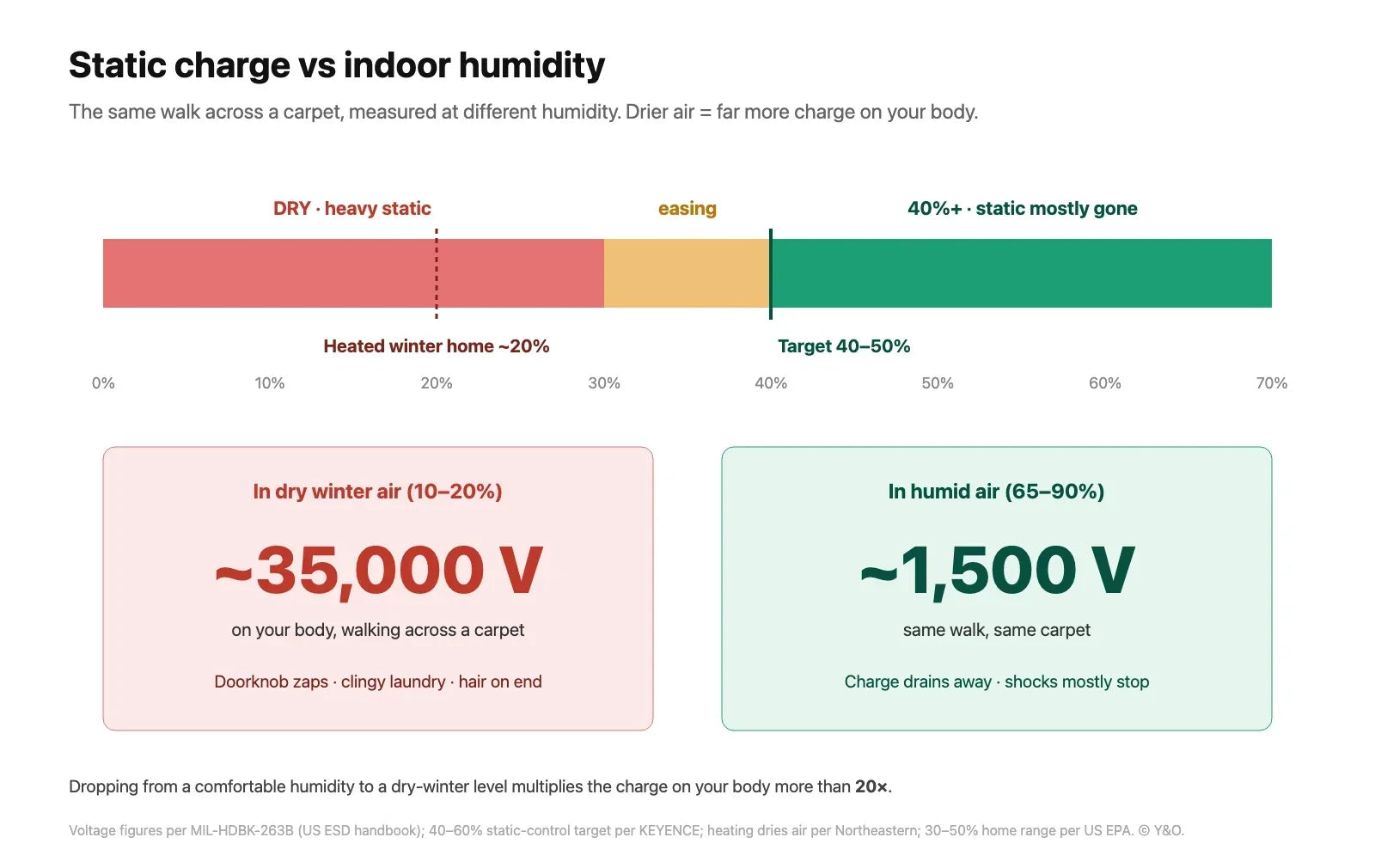
The relationship is dramatic, and it’s been measured. Walking across a carpeted floor, a person builds only about 1,500 volts of static in humid air (around 65–90% relative humidity) — but in dry winter air (10–20%), that same walk builds around 35,000 volts (MIL-HDBK-263B). That’s not a typo: dropping the humidity from a comfortable level to a dry-winter level multiplies the charge your body carries more than twenty-fold.
You don’t feel a shock until the voltage is high enough to jump the gap to a grounded object — a few thousand volts for a noticeable zap. In humid air you rarely get there; in dry winter air you’re building tens of thousands of volts with every crossing of the room, which is why the same house that never shocks you in July zaps you constantly in January. The chart above lays that out: the charge on your body far higher in dry air than in humid.
The threshold: ~40% and the shocks stop
Here’s the useful part. You don’t need tropical humidity to kill static — you need to clear roughly 40%. The electronics industry, which spends real money keeping static under control, targets about 40–60% relative humidity in sensitive areas, and treats anything below 30% as the zone where charge builds rapidly and discharges unpredictably (KEYENCE). That lines up neatly with the 30–50% range the EPA recommends for a comfortable, healthy home for other reasons entirely.
So the target is simple: get your rooms up into the 40–50% band and the shocks mostly vanish — comfortably below the ~50–60% ceiling where you’d start inviting condensation or mold. The problem is that a heated winter home, left alone, sits far below that at 15–25%, which we mapped city by city in the driest winter indoor air data. Closing that gap is the whole job.
How to actually stop the static
There are two kinds of fixes: the ones that treat the room, and the ones that treat the symptom. Both have a place.
Treat the room (fixes the cause):
- Raise the humidity to 40–50%. This is the one fix that addresses why static is happening at all, and it works on every shock in the house at once — laundry, hair, doorknobs, and electronics. A humidifier sized to the space is the direct route; measure with a hygrometer so you actually reach the band rather than guess.
- Add moisture where you can. Houseplants, drying laundry indoors, and leaving the bathroom door open after a shower all nudge humidity up a little — helpful, but rarely enough on their own to lift a whole dry house into the 40s.
Treat the symptom (helps at the margins):
- Moisturize your skin. Dry skin holds more charge; lotion makes your body a little less of a static generator.
- Choose natural fibers. Cotton and wool generate and hold less static than synthetics like polyester and nylon, in both clothing and bedding.
- Use dryer sheets and fabric softener, which leave an anti-static coating on laundry so it clings less.
- Discharge yourself deliberately. Touch a metal doorframe or key to a grounded object before you reach for electronics or another person, so the charge leaks off gently instead of as a zap.
- Go easy on rubber-soled shoes on carpet, which are especially good at building charge as you walk.
The symptom fixes are worth doing, but notice they’re all local and temporary — a lotion here, a dryer sheet there. None of them changes the fact that the air itself is dry, which is why the shocks keep coming back until the humidity does.

Why humidity is the durable fix
Everything on the symptom list is a patch on one shock at a time; raising the humidity removes the condition that creates all of them. Get a room into the 40–50% band and the laundry stops clinging, your hair lies down, the doorknob stops biting, and your electronics are safer — all from the same change, because you’ve restored the thin conductive film of moisture that lets charge drain away instead of building up.
For a bedroom or an office, a portable unit is enough; for a large or very dry space, you want the output to actually move the whole room’s humidity rather than just the air right around the machine, which is where a higher-output unit like a steam humidifier earns its place. And because winter dryness does more than shock you — it also dries skin and airways — getting the humidity right fixes several problems at once, as we cover in why your skin feels dry indoors and the heating-season checklist.
Stop the winter shocks at the source
The Y&O Steam Plus is a high-output 10L steam humidifier — enough to lift a whole room back into the 40–50% range where static, dry skin, and dry air all ease off at once.
See the Y&O Steam Plus 10LFAQ
Why is there so much static in my house in winter?
Because winter air is dry. Cold air holds little moisture, and heating dries it further, so indoor humidity often falls to 15 to 25%. Dry air is an electrical insulator, so the charge you build walking around has no way to drain off and keeps climbing until it discharges as a shock. Raising humidity back to 30 to 50% is the direct fix.
What humidity level stops static electricity?
Roughly 40% and above. Static-control standards target about 40 to 60% relative humidity, and treat below 30% as the zone where charge builds quickly. Getting your rooms into the 40 to 50% band stops most static while staying below the level where condensation or mold become a concern.
Does a humidifier get rid of static electricity?
Yes, when it raises the room into the 40 to 50% range. Adding moisture restores a thin conductive film on surfaces that lets static charge drain away instead of building up, which stops shocks on laundry, hair, doorknobs, and electronics at once. It is the one fix that addresses the cause rather than each symptom.
How much does dry air increase static?
A lot. Measurements show a person builds only about 1,500 volts walking across a carpet in humid air (about 65 to 90% relative humidity), but about 35,000 volts doing the same thing in dry winter air (10 to 20%). Dropping from a comfortable humidity to a dry-winter level multiplies the charge more than twentyfold, which is why the same house shocks you constantly in winter and never in summer.
What are quick ways to reduce static without a humidifier?
Moisturize your skin, wear cotton and wool instead of synthetics, use dryer sheets on laundry, and touch a metal doorframe before reaching for electronics so the charge leaks off gently. These help at the margins, but they treat one shock at a time and do not change the dry air that causes them.
Keep reading
- The US cities with the driest winter indoor air
- Why your skin feels dry indoors in winter
- The heating-season humidity checklist
- How to check your hygrometer with salt
Sources — static-control and humidity guidance. Verified live.
- MIL-HDBK-263B — US ESD Control Handbook, Typical Electrostatic Voltages table (walking across carpet ~35,000 V at 10–20% RH vs ~1,500 V at 65–90% RH)
- KEYENCE — How Humidity Affects Static Electricity (40–60% RH static-control target; below 30% charge builds rapidly)
- Northeastern University — How to Get Rid of Static This Winter (why heating dries the air)
- DESCO — Static Control and Relative Humidity (the conductive moisture film)
- US EPA — Mold and Health (30–50% indoor humidity)