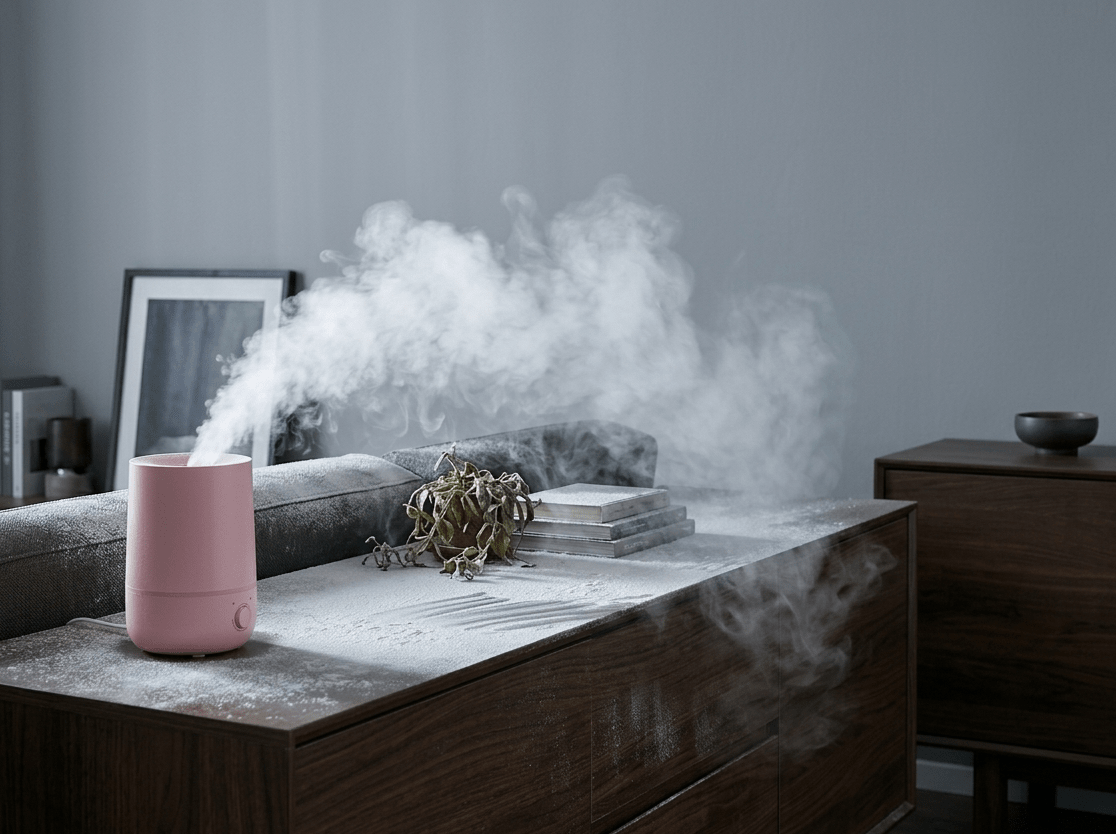

It's February. The heat has been running for three months straight and you finally bought a humidifier. Smart move. Except now there's a fine white film on your TV screen. On your Kindle. On the dark wood shelf above your desk. You've wiped it off twice this week. It comes right back.
That's not dust. That's not condensation. That's calcium and magnesium pulled straight out of your tap water — atomized by your ultrasonic humidifier and released into your living room, hour after hour, night after night.
If you're in Phoenix, Las Vegas, Denver, Calgary, Dallas, or most of inland Ontario, your tap water likely carries 200–800 mg/L of dissolved minerals. Every hour your cool-mist humidifier runs, it's converting those minerals into breathable aerosol particles. Here's what that actually means for your air quality — and how to stop it.
That White Powder on Your Furniture Isn't Dust

Ultrasonic humidifiers work by vibrating a small piezoelectric disc at roughly 1.7 MHz — fast enough to shatter the surface tension of water into a fine aerosol mist.
The problem is that water doesn't get to choose what it carries. Tap water contains dissolved calcium, magnesium, and trace minerals. When the disc atomizes the water, it atomizes everything in it. The H₂O molecules evaporate quickly once they're in the air. The mineral particles don't. They stay airborne as PM10 and PM2.5 — the same particle-size categories that air quality monitors track and that health agencies regulate.
According to the U.S. Geological Survey, approximately 85% of U.S. homes receive hard or very hard water — with concentrations in some regions exceeding 1,000 mg/L. That's nearly ten times the threshold for "hard" water classification.
To put that in perspective: a glass of water from a Phoenix tap carries roughly as much dissolved mineral content as a glass of lightly salted water. Run a humidifier on that water for eight hours while you sleep, and those minerals are going somewhere. Most of them end up in your air — and then in your lungs.
How Big Is the Hard-Water Problem?
Hard water isn't an edge case. It's the default for most of North America. Soft-water pockets — parts of the Pacific Northwest, coastal New England — are the exception. If you're in the Midwest, Southwest, Great Plains, or most of Canada south of the Shield, your tap water is actively working against you every time you run an ultrasonic humidifier.
The math is uncomfortable: higher water hardness → more minerals per liter → more airborne mineral particles per hour of humidifier use. A humidifier running 8 hours overnight at 1L/hr in Phoenix-hardness water is atomizing hundreds of milligrams of mineral content into your bedroom air every single night of winter.
What's Actually Floating in Your Air
The diagram below shows the fundamental difference in how ultrasonic and steam technology handle dissolved minerals — and why it matters for everything downstream.
Fig. 1 — Mineral fate in ultrasonic vs. steam humidifiers. Boiling physically separates minerals from water vapor — what leaves a steam humidifier is, by definition, mineral-free.

The independent testing organization RTINGS has documented measurable PM value increases in rooms running ultrasonic humidifiers with hard tap water. The harder the water, the more pronounced the effect. What you see as white residue on surfaces is the heavy fraction that settled — the lighter fraction is still circulating in the air your family breathes.
PM2.5 particles are small enough to penetrate deep into lung tissue. Chronic exposure is flagged by the EPA as a meaningful indoor air quality concern. While a single humidifier won't replicate outdoor pollution levels, 7–9 hours of overnight bedroom exposure across a six-month heating season adds up — especially for anyone with rhinitis, asthma, or sensitive airways.
What the Community Is Saying
Community discussions in Reddit r/BuyItForLife and r/Humidifiers paint a remarkably consistent picture. White dust complaints rank among the highest-frequency issues reported by ultrasonic humidifier owners — nearly always correlated with users in hard-water cities.
Independent reviewers have tested these dynamics head-on. A selection of relevant third-party evaluations:
Side-by-side comparison of steam vs. ultrasonic technology, with real-world health implication analysis for each method
Technology-route analysis covering when steam clearly outperforms ultrasonic — especially in hard-water homes
Comprehensive comparison with a dedicated maintenance chapter — covers white dust, filter mold, and real cleaning burden
Honest trade-off breakdown including steam's advantages in hard water and honest notes on energy consumption
Technology Showdown: What Actually Works in Hard Water
Three mainstream humidifier technologies handle the hard-water problem very differently. No sugarcoating here — this is the actual picture:
| Feature | Ultrasonic Cool Mist | Evaporative | Steam (Y&O) |
|---|---|---|---|
| White dust risk | High — all minerals go airborne | Low — minerals stay in filter | None — minerals stay in tank |
| Water type needed | Distilled recommended ($1–2/gal) | Tap water fine | Tap water fine |
| Pathogen risk | High — stagnant water dispersed | Medium — wet filter molds | Minimal — 212°F kills pathogens |
| Daily maintenance | Full scrub required daily | Filter swap every 1–2 weeks | Weekly descale, no filter |
| Ongoing costs | Distilled water + possible filters | Replacement filters add up fast | None — zero consumables |
| Energy use | Low (~25–50W) | Low (~40–80W) | Higher (~800–1,250W, cycles on/off) |
| Best for hard-water homes? | No — avoid without distilled water | Acceptable | Yes — purpose-built for it |
Red Flags: Is Your Current Setup Making Things Worse?

- White residue appearing on TV screens, bookshelves, or furniture within 3–5 days of use
- The residue returns immediately after wiping — it's mineral deposit, not surface grime
- Your humidifier manual says "use distilled water for best results" — that's a white-dust admission
- You can see a visible cool mist cloud (that cloud = unfiltered, unboiled water particles)
- You live in the Southwest, Midwest, Great Plains, or inland Canada — all high-hardness zones
- Rhinitis or allergy symptoms worsen in winter despite using a humidifier
Green Flags: What a Clean Solution Looks Like
- Water reaches 212°F (100°C) before output — mineral separation happens at the boiling stage
- Output cools to ~122°F (50°C) through dual air channels — warm but not scalding
- Works normally with tap water — no distilled water required, no ongoing cost
- No filter to replace — and no filter to grow mold inside
- Zero white residue on surfaces after weeks of continuous use
- Mineral deposits collect visibly at the tank bottom — rinsed out during your weekly clean
How Steam Solves This at the Physics Level
The mechanism here is simple enough to be bulletproof. When water reaches its boiling point, H₂O molecules gain enough kinetic energy to escape as vapor. Dissolved calcium and magnesium ions don't. They're non-volatile — they remain in the liquid phase and eventually precipitate as scale at the bottom of the heating chamber.
This isn't a filter that can get clogged or bypassed. It's a physical phase change. By definition, only water vapor crosses the liquid-to-gas boundary at standard pressure. What exits a steam humidifier is mineral-free — not as a feature claim, but as a consequence of thermodynamics.
Steam humidifiers exploit the same principle as distillation — boiling separates dissolved solids from water. A still collects the condensed vapor; a steam humidifier releases it into the room. Either way, what leaves the boiling chamber is chemically pure water vapor. The minerals are left behind in the tank, visible as white scale, and rinsed out on cleaning day.
This mineral elimination is closely linked to pathogen elimination — which is the core argument explored in our full guide: Why 100% sterile output is the #1 standard for any humidifier →
The Y&O Steam Plus: Designed for Hard-Water North America
The Y&O Steam Plus (YO-M2) heats water to 212°F (100°C), then routes steam through a high/low-pressure dual channel system that cools output to 122°F (50°C) before it leaves the unit. You get the full mineral-elimination benefit of boiling with an output temperature that's comfortable in any room, including bedrooms and nurseries.
With a 10L dual-tank design (two removable 5L tanks), maximum output of 1,200ml/hr, and coverage up to 1,000 sq. ft., it's built for the scale of a real hard-water home — not a lab test. Independent reviewer Muzain Reviews (37K+ views) walked through the dual-tank design and auto-shutoff mechanics in detail.
Verified purchaser feedback on the yoairpro.com product page is consistent: users in hard-water regions — including Canada's heating-season winters — report zero white residue after switching from ultrasonic models, with open-plan living and kitchen spaces holding stable at 50–53% RH throughout the coldest months.
The Honest Caveats — What Steam Doesn't Fix
Steam humidifiers solve the white dust problem completely. They don't solve every problem. Here's what's worth knowing before you buy.
Because minerals stay in the tank rather than going into your air, they accumulate as limescale on the heating element. This is exactly what you want — but it does mean regular descaling. For the Y&O Steam Plus, the process is straightforward: add 20g citric acid (or white vinegar), run a brief heating cycle, soak for 20–30 minutes, rinse. The recommended frequency is every 2–3 weeks in moderate hard water; weekly in high-hardness regions. Not complicated, but it's a real maintenance task — don't skip it.
Energy use is the other honest conversation. A steam humidifier runs at ~800–1,250W while heating water. A comparable ultrasonic unit runs at 25–50W. That's a real difference. Steam units cycle (heat to temp, pause, reheat) rather than running continuously, so the real-world delta is smaller than the nameplate wattage suggests — but it isn't zero.
If you're in a genuinely soft-water area (parts of the Pacific Northwest or New England), an evaporative humidifier may deliver acceptable performance at lower energy cost. Steam is the clear winner specifically in hard-water regions — which covers the vast majority of the U.S. and Canada.

Stop Breathing Mineralized Air This Winter
The Y&O Steam Plus eliminates white dust at the physics level — no distilled water, no filters, no weekly surface wiping. Built for hard-water homes across North America.
See the Y&O Steam Plus →Your Questions Answered
Is white dust from a humidifier actually dangerous to breathe?
The measured answer: it depends on exposure level and individual sensitivity. Mineral aerosol from hard-water ultrasonic humidifiers consists of calcium and magnesium particles in the PM2.5–PM10 range. At typical room concentrations, this is unlikely to cause acute harm in healthy adults. For individuals with asthma, rhinitis, or other respiratory sensitivities, any added particulate burden in bedroom air is a meaningful concern — particularly when that bedroom exposure runs 7–9 hours a night across a six-month heating season. The EPA's indoor air quality guidance recognizes chronic low-level particle exposure as a cumulative risk worth addressing.
Can I just use distilled water in my ultrasonic humidifier?
Yes — distilled water eliminates white dust in ultrasonic humidifiers, since it contains virtually no dissolved minerals to atomize. The trade-off is cost and logistics. Distilled water typically runs $1–2 per gallon at grocery stores. For a humidifier using 1–2L per hour, that adds up quickly through a heating season. A steam humidifier that works correctly with tap water generally represents better long-term value for most households — especially in hard-water regions where the distilled water requirement is ongoing and non-negotiable.
How do I know if my local water is hard enough to cause this?
Your municipal water utility is legally required to publish annual water quality reports — search "[your city] water quality report" and look for "hardness" or "total dissolved solids (TDS)." Anything above 120 mg/L (7 grains per gallon) is classified as hard. Phoenix averages 250–400 mg/L; Las Vegas runs higher. If you already see white scale on your kettle interior or shower glass door, your water is definitely hard enough to cause white dust from an ultrasonic humidifier. The USGS also maintains a national overview of water hardness by region.
Why does the steam output feel warm — is that safe?
The Y&O Steam Plus heats water to 212°F internally but routes steam through dual pressure channels that cool it to approximately 122°F (50°C) before it exits the unit — comparable to the warmth of a hot shower. At that temperature and at normal room distances, you won't be burned. The unit should still sit on a stable surface out of direct reach, as with any appliance that runs warm. The practical upside: warm output raises room humidity more rapidly than cool mist, and the gentle warmth has a noticeable effect on perceived comfort during cold winter nights.
How often does a steam humidifier actually need descaling?
It depends on your water hardness and how many hours per day you run the unit. In moderately hard water (120–250 mg/L) with daily overnight use, every 2–3 weeks is reasonable. In very hard water (400+ mg/L) or with heavy use, weekly descaling may be needed. The practical signal: reduced steam output means scale has built up on the heating element. The Y&O Steam Plus descaling process takes about 30–40 minutes of active soak time (citric acid or white vinegar + water, heat cycle, soak, rinse). It's a real task — but mineral deposits that go into the tank are the controlled outcome. Mineral deposits that go into your lungs are the alternative.
Related Reading
Sources & References
- U.S. Geological Survey — Hardness of Water
- U.S. Environmental Protection Agency — Use and Care of Home Humidifiers
- ASHRAE Standard 55 — Thermal Environmental Conditions for Human Occupancy (recommends 30–60% RH)
- World Health Organization — WHO Guidelines for Indoor Air Quality: Dampness and Mould
- RTINGS — Independent Humidifier Tests and Reviews
- Reddit Community Discussions — r/BuyItForLife · r/Humidifiers
- Y&O — YO-M2 Steam Plus Product Page · Why Y&O
- YouTube Independent Reviews — Antonio Sanson · GoTechGeek · Muzain Reviews · Computer Tech & More