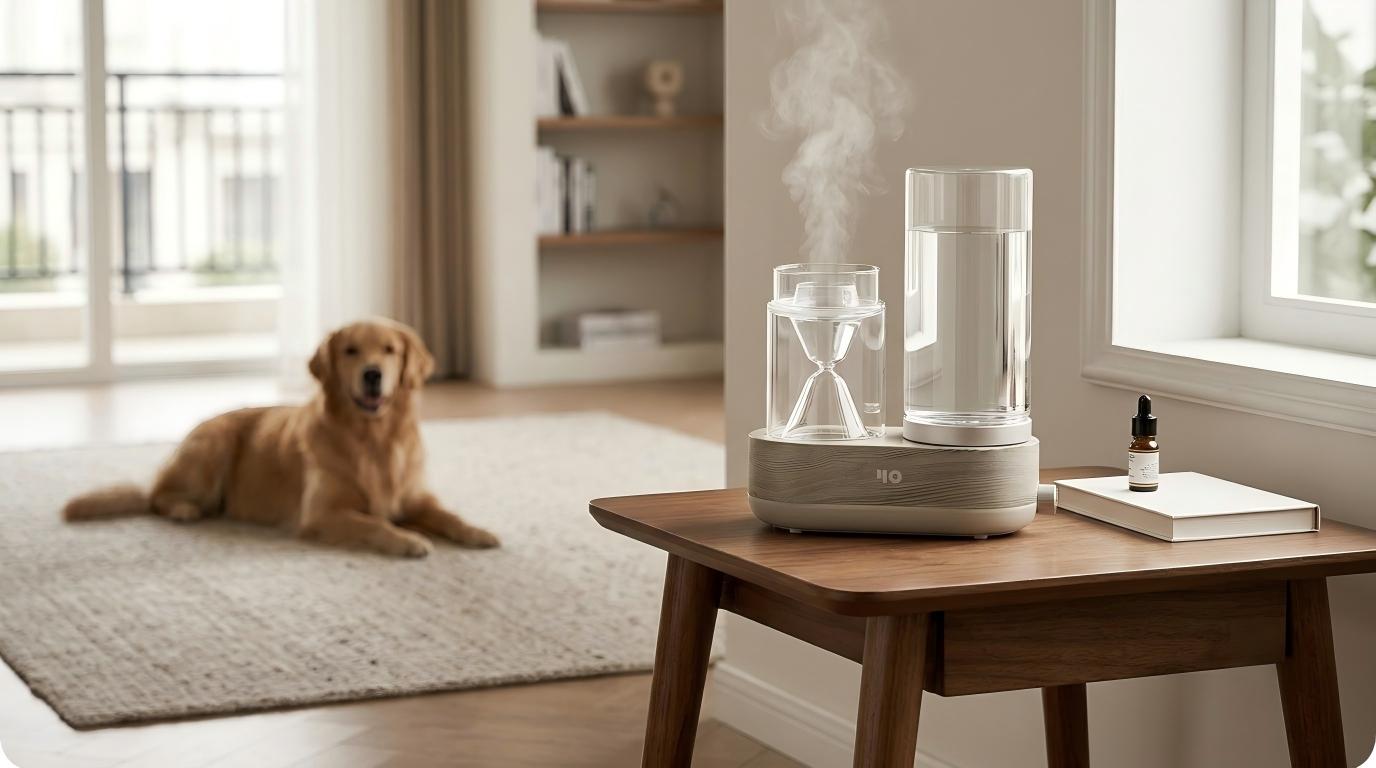

You love your diffuser. You also love your dog or cat. And at some point, you've probably wondered whether those two things can coexist safely in the same house.
The honest answer: it depends on what you're diffusing, how you're using it, and — less obviously — what your diffuser is made of.
There's a lot of conflicting information out there on this topic. Some sources say essential oils are fine around pets. Others say they're dangerous. The truth sits in the middle, and the details matter.
Diffusing essential oils in a home with pets isn't automatically unsafe — but it does require more consideration than diffusing in a pet-free home. The oil you choose, the concentration, the ventilation, and your pet's ability to leave the room are all variables that change the risk profile significantly.
Why Pets Are More Sensitive to Essential Oils Than We Are
A dog's sense of smell is estimated to be 10,000 to 100,000 times more acute than a human's. A cat's is roughly 14 times stronger than ours. What registers as a pleasant, subtle scent to you may be overwhelming — and potentially irritating — to an animal sharing the same air.
But sensitivity isn't just about smell intensity. The deeper issue is metabolic. Cats in particular lack a liver enzyme called glucuronyl transferase that humans use to process many aromatic compounds. This means certain substances that humans metabolize and excrete relatively quickly can accumulate to toxic levels in cats even from low-level exposure over time.
The ASPCA specifically advises against using essential oil diffusers in homes with pet birds. Birds have highly sensitive respiratory tracts and may develop serious problems from airborne aromatic compounds that dogs and cats can tolerate at low concentrations. If you have birds, consult your veterinarian before diffusing anything in shared spaces.
The Three Ways Pets Are Exposed — and Which One Matters Most
When people ask about diffuser safety for pets, they're usually thinking about inhalation. But there are actually three routes of exposure, and they carry very different risk levels.
Ingestion is the highest-risk route by far. If a pet licks spilled essential oil, chews a diffuser reservoir, or grooms oil droplets off their fur, the concentration they're exposed to is vastly higher than anything inhaled from the air. This is particularly relevant for cats, who groom themselves extensively — oil mist that settles on fur can be ingested during self-cleaning.
Skin contact is the second-highest risk. Concentrated essential oils on a pet's skin or paws can cause irritation, sensitization, and absorption into the bloodstream. Never apply undiluted essential oils to a pet.
Inhalation via diffusion — the route most relevant to this discussion — is the lowest-risk exposure method when used correctly. According to the ASPCA Animal Poison Control Center, using an oil diffuser for a short time period in a secured area that your dog or cat cannot access is not likely to be an issue. The key words: short time, secured area, cannot access.
The ASPCA Animal Poison Control Center's position is that brief diffuser use in a space pets cannot access is generally lower risk — but direct application, ingestion, or prolonged exposure in enclosed spaces without an exit option raises the risk significantly. Always consult your veterinarian for guidance specific to your pet.
Essential Oils Most Commonly Flagged as Risky for Pets
The oils that appear most consistently on veterinary and ASPCA watch lists share common chemical characteristics — phenols, ketones, and monoterpenes that cats especially cannot metabolize efficiently.
| Essential Oil | Risk for Dogs | Risk for Cats | Primary Concern |
|---|---|---|---|
| Tea Tree (Melaleuca) | High | High | Neurological symptoms even at low doses; ASPCA flagged |
| Pennyroyal | High | High | Liver failure risk in dogs; strongly avoid |
| Wintergreen | High | High | Contains methyl salicylate — similar to aspirin; toxic to both |
| Citrus oils (lemon, orange, grapefruit) | Moderate | High | Cats lack enzyme to break down citrus compounds |
| Peppermint | Moderate | High | Respiratory irritant; cats particularly sensitive |
| Cinnamon | Moderate | High | Mucosal irritant; strong sensitizer |
| Clove | Moderate | High | High eugenol content; liver stress in cats |
| Pine / Spruce | Moderate | High | Terpene compounds; cats metabolize poorly |
Oils Generally Considered Lower-Risk Around Dogs
The following oils appear most frequently on lower-risk lists for dogs when used at low concentrations with proper ventilation and the ability for the pet to leave the room. This list does not apply equally to cats — cats require more caution with almost all oils.
No essential oil is universally safe for all pets. Individual animals vary in sensitivity, age, breed, and health status. The lists below reflect general guidance from veterinary and aromatherapy sources — they are not a substitute for advice from your veterinarian about your specific pet.
| Essential Oil | Dogs | Cats | Notes |
|---|---|---|---|
| Lavender | Lower risk | Use with caution | Most widely referenced as lower-risk; low concentration, good ventilation |
| Roman Chamomile | Lower risk | Use with caution | Gentle; avoid German chamomile which has higher risk profile |
| Frankincense | Lower risk | Use with caution | Generally considered lower-risk for dogs in diffusion |
| Cedarwood (Atlas) | Lower risk | Use with caution | Atlas cedarwood; avoid Texas or Virginia cedarwood (different chemistry) |

Practical Rules for Diffusing in a Home with Pets
- Give your pet an exit — never diffuse in a room your pet cannot leave; they should always be able to move to a different area
- Keep sessions short — 20–30 minutes maximum; brief exposure in a ventilated space is very different from continuous diffusion in a sealed room
- Use fewer drops — 1–2 drops maximum when pets are present, not the usual 3–5
- Ventilate — open a window or door to prevent concentration build-up
- Watch for warning signs — coughing, sneezing, watery eyes, drooling, lethargy, or difficulty breathing; stop immediately if any appear
- Place the diffuser out of reach — pets are curious; a knocked-over diffuser with pooled oil is a far greater risk than airborne vapor
- Consult your vet — especially before using any oil around a young, elderly, or health-compromised pet
- Don't use tea tree, pennyroyal, wintergreen, or citrus oils in any space shared with cats
- Don't diffuse in a sealed room with no air circulation while pets are present
- Don't apply any essential oil directly to a pet's skin or fur without veterinary guidance
- Don't assume "natural" means "safe for pets" — concentration and species-specific metabolism are what matter
- Don't diffuse anything around birds — their respiratory tracts are far more sensitive than dogs or cats
Why the Diffuser Itself Is Part of the Pet Safety Equation
Most pet safety guides focus entirely on which oils to avoid. They skip a variable that matters just as much in a pet household: what else is the diffuser putting into the air besides the oil you chose?
Ultrasonic diffusers that use plastic reservoirs introduce two additional elements into the air: mineral aerosol from hard tap water (white dust) and, over time, trace VOCs from oil-plastic contact degrading the reservoir surface. In a pet-free household, these are low-level background concerns. In a household where a cat or dog is breathing that air continuously — often at floor level, closer to where particles settle — they become more relevant.
The white dust issue is particularly worth considering for pets. Mineral aerosol from hard tap water settles on surfaces, fur, and bedding. A cat that grooms itself regularly may be ingesting not just aromatic compounds but also mineral particulate that has settled on its coat from an ultrasonic diffuser running in the same room.
In a pet household, the oil you choose is only one variable. Mineral aerosol from ultrasonic diffusers and plastic-derived VOCs from oil-reservoir contact are uninvited additions to the air your pets breathe. A glass steam diffuser produces only what you put in — aromatic steam, nothing else.
Control What Goes Into the Air — Especially for Your Pets
The Yo-A1 uses borosilicate glass throughout — no plastic contact, no mineral mist, 100°C sterilization. What enters the air is only the oil you chose, carried in clean steam.
Meet the Yo-A1 →Why a Glass Steam Diffuser Is a More Considered Choice for Pet Households
When you're thinking carefully about what enters the air your pets breathe, the device matters as much as the oil.
The Yo-A1's 1,600ml borosilicate glass reservoir means essential oils never contact plastic at any point. No oil-plastic degradation, no trace compounds entering the steam over time. What you put in is what comes out — nothing added by the materials themselves.
Because it produces pure steam rather than atomized water droplets, there's no mineral carry-over from tap water. No white dust settling on surfaces, fur, or pet bedding. For a cat that grooms itself throughout the day, this removes one source of potential incidental ingestion entirely.
The 100°C sterilization means the reservoir is clean at the start of every session — no biofilm accumulating between uses in standing water. And the auto shut-off means sessions end when you set them to, not when you remember to turn it off — relevant when the goal is brief, controlled diffusion rather than continuous exposure.
None of this changes the need to choose oils carefully and follow the practical rules above — those remain the most important factors in a pet household. But when you've done that work, the device you use should add as few unintended variables to the air as possible. That's what a glass steam unit offers.

Clean Steam. Glass. No Mineral Mist. No Plastic Contact.
When you're being thoughtful about what your pets breathe, the Yo-A1 gives you one less variable to worry about. Borosilicate glass · 100°C sterilization · pure steam output · auto shut-off.
Shop the Yo-A1 →Frequently Asked Questions
Is it safe to use an essential oil diffuser around dogs and cats?
It can be, with the right conditions. The ASPCA Animal Poison Control Center notes that brief diffuser use in a space pets can exit is generally lower-risk than direct application or ingestion. The key variables are: which oil you use, how long you run the diffuser, whether the room is ventilated, and whether your pet can leave the area. Cats require more caution than dogs due to a metabolic difference that makes them less able to process many aromatic compounds. Always consult your veterinarian before introducing essential oils into a home with pets.
Which essential oils are toxic to cats?
Cats are particularly sensitive because they lack a liver enzyme needed to metabolize many aromatic compounds. Oils consistently flagged as high-risk for cats include: tea tree (melaleuca), pennyroyal, wintergreen, all citrus oils (lemon, orange, grapefruit, bergamot), peppermint, cinnamon, clove, and pine or spruce oils. This list is not exhaustive. When in doubt about any oil around your cat, consult your veterinarian before use.
Can I diffuse lavender around my dog or cat?
Lavender is the oil most frequently cited by veterinary and aromatherapy sources as lower-risk for diffusion in pet households — particularly for dogs. For cats, it appears on lower-risk lists more often than most oils, but cats' metabolic sensitivity means caution is still warranted: low concentration, short sessions, good ventilation, and the ability to leave the room. Monitor your pet for any signs of discomfort (sneezing, lethargy, drooling) and stop immediately if any appear. Confirm with your veterinarian before regular use around any pet.
What are the signs that essential oils are affecting my pet?
Warning signs that a pet is being negatively affected by diffused oils include: coughing, sneezing, or wheezing; watery or red eyes; drooling more than usual; signs of lethargy or unusual stillness; pawing at the face or nose; difficulty breathing or labored respiration; vomiting; or unsteady movement. If you notice any of these, turn off the diffuser immediately, move your pet to fresh air, and contact your veterinarian. If symptoms are severe, contact the ASPCA Animal Poison Control Center (888-426-4435) or an emergency veterinary clinic.
Is a glass diffuser safer for pets than a plastic one?
From an air quality standpoint, yes — for two reasons specific to pet households. First, glass reservoirs don't degrade with essential oil contact, so there are no plastic-derived compounds entering the steam over time. Second, steam-based glass diffusers don't produce mineral aerosol from hard tap water — the white dust that settles on surfaces, fur, and bedding. For cats that groom themselves regularly, reducing incidental ingestion of mineral particulate from surfaces is a meaningful consideration. The oil selection and usage rules remain the most important factors, but the device materials are a relevant part of the full picture.
Can I diffuse essential oils if I have pet birds?
The ASPCA specifically advises against using essential oil diffusers in homes with pet birds. Birds have highly sensitive respiratory tracts — far more sensitive than dogs or cats — and aromatic compounds that dogs and cats may tolerate at low concentrations can cause serious respiratory distress in birds. If you have birds, consult your veterinarian before diffusing any essential oil in shared living spaces.
References
- ASPCA — The Essentials of Essential Oils Around Pets: aspca.org
- Chewy — Dogs and Essential Oil Diffusers: Safety Tips: chewy.com
- PetPlace — How Dangerous Are Essential Oils for Pets: petplace.com
- U.S. EPA — Indoor Air Quality: epa.gov/indoor-air-quality-iaq
- USGS — Water Hardness: usgs.gov
- Justia Patents — Steam Diffusion Patent 11052167: patents.justia.com/patent/11052167