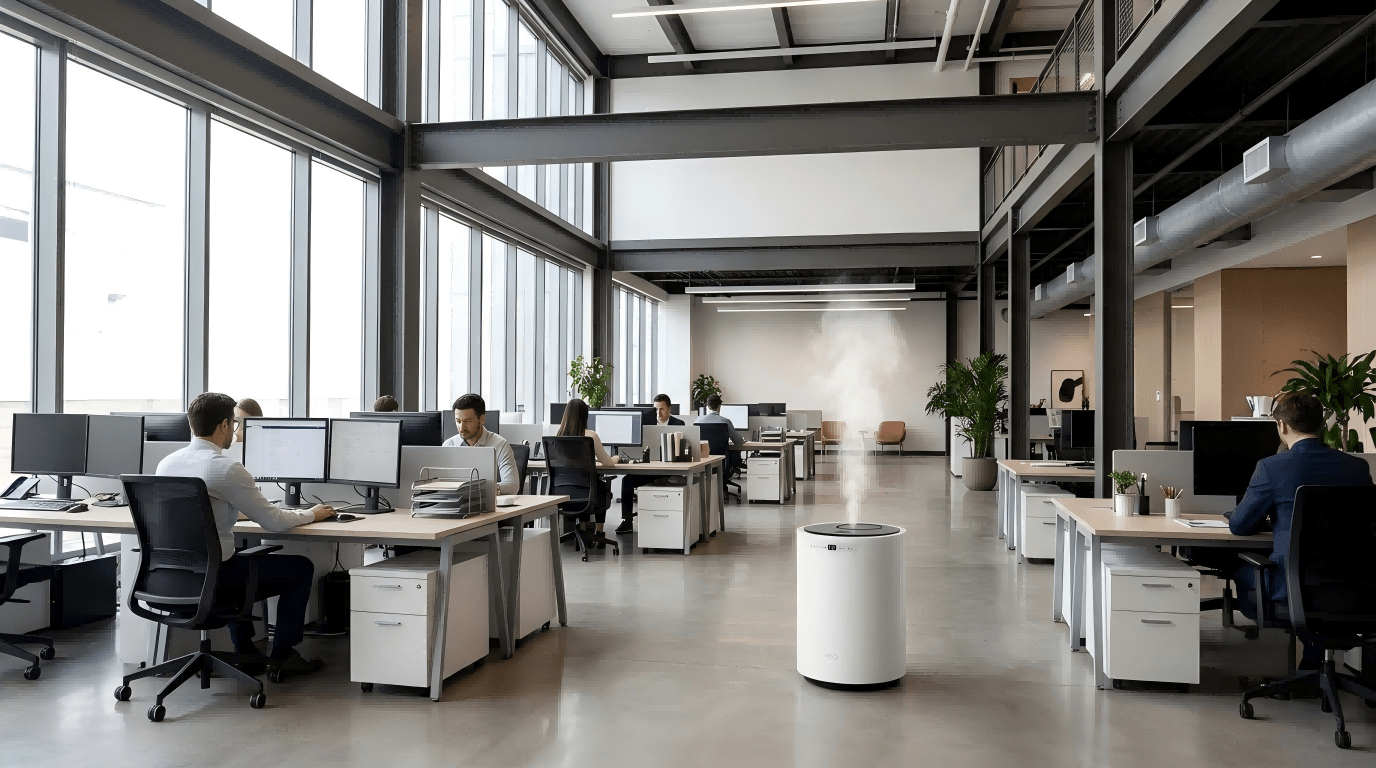

Most humidifier content is written for bedrooms. The unit gets placed on a nightstand, runs for eight hours, and the door stays closed. The math is manageable.
Large spaces and commercial environments don't work that way. Open floor plans, high ceilings, HVAC systems running continuously, people moving in and out — every one of these factors increases moisture demand beyond what standard residential humidifiers are designed to handle. Most fail quietly: the unit runs, the display shows adequate humidity, and the actual room air stays dry.
This guide covers why large spaces and commercial environments require a fundamentally different approach to humidification — the output calculations that actually work, the biological safety requirements that matter more when people spend hours in a shared space, and the technology choice that makes continuous commercial-grade use viable.
Why Home Humidifiers Fail in Large Spaces
The failure mode is predictable. A humidifier rated for 500 sq ft gets placed in a 600 sq ft open-plan office. The display reads 45% RH. The air feels dry. People are still congested. Nothing seems to work.
The reason is that residential humidifier coverage ratings are calculated under ideal conditions that commercial environments never provide: a sealed room, standard 8-foot ceilings, minimal air exchange, and no foot traffic. Remove any one of those conditions and the effective coverage drops significantly. Remove all of them and the unit is delivering perhaps 30–40% of its rated coverage.
| Factor | Residential Baseline | Commercial / Large Space Reality | Impact on Humidity |
|---|---|---|---|
| Ceiling height | 8 ft standard | 10–14 ft common in commercial spaces | 25–75% more air volume to humidify |
| Air exchange rate | Low in closed bedroom | High — HVAC, doors opening, ventilation systems | Constant moisture removal from room air |
| Open floor plan | Closed room — humidity stays | Open — humidity disperses through adjacent spaces | Effective coverage area dramatically reduced |
| Occupancy | 1–2 people | Multiple people — body heat raises temperature, affects RH | Higher output required to maintain target RH |
| Operating hours | 8 hours overnight | 8–12 hours continuous daytime use | Tank capacity and output consistency critical |
The result is that a commercial or large-space humidification requirement is typically 2–3x the output of what the room's square footage would suggest in residential terms. This isn't a product quality issue — it's a physics issue that residential product ratings don't account for.
Square footage coverage claims on humidifier packaging are calculated under conditions that commercial spaces never replicate. The number that actually predicts performance is output rate in ml/h — how much moisture the unit can add to the air per hour under real operating conditions. For large spaces, this is the only metric worth comparing. For the full explanation: Why Humidifier Coverage Claims Are Almost Always Wrong →
Output Requirements by Space Type
The starting point for any large-space humidification calculation is cubic feet of air, not square feet of floor. Ceiling height multiplies the volume significantly — and volume is what the humidifier actually has to work with.
| Space Type | Typical Dimensions | Ceiling Height | Required Output (ml/h) | Notes |
|---|---|---|---|---|
| Private office | 150–250 sq ft | 9–10 ft | 300–500 ml/h | Door closed — more contained |
| Open-plan office zone | 400–800 sq ft | 10–12 ft | 700–1,000 ml/h | HVAC and air exchange demand upper range |
| Classroom / daycare room | 600–900 sq ft | 9–11 ft | 800–1,200 ml/h | High occupancy and ventilation requirements |
| Yoga / fitness studio | 800–1,500 sq ft | 12–16 ft | 1,000–1,200+ ml/h | High ceilings and body heat significantly increase demand |
| Home studio / large living room | 400–700 sq ft | 9–12 ft | 600–900 ml/h | Open floor plan — moisture disperses laterally |
| Reception / waiting area | 300–600 sq ft | 10–14 ft | 500–900 ml/h | High foot traffic and door openings increase demand |
These figures assume heating season conditions — outdoor temperatures below 40°F and furnace or HVAC running continuously. In milder conditions, required output is lower. In extreme cold (below 0°F), required output may be 20–30% higher than the ranges above.
The practical implication: for most commercial spaces and large open-plan environments, a single unit outputting 1,200 ml/h — the maximum output of the YO-M2 — is the minimum viable specification. Units with lower output rates will underperform regardless of their rated coverage claims.

Biological Safety in Shared Spaces
In a home bedroom, the person most affected by a contaminated humidifier tank is the person who set it up. In a commercial or shared space, it's everyone who works, studies, or exercises there — often for 8 hours a day, 5 days a week.
Cool-mist and ultrasonic humidifiers in commercial settings present a biological risk that scales with occupancy and operating hours. A tank that develops bacterial or mold growth from inadequate cleaning doesn't just affect one sleeper overnight — it continuously aerosolizes into the shared air of an office, classroom, or studio for the full operating day.
Commercial settings also rarely have a dedicated person responsible for daily humidifier tank maintenance. In a home, the unit owner has a direct incentive to keep it clean. In an office or classroom, the humidifier is shared infrastructure — and shared infrastructure rarely gets the daily attention that cool-mist units biologically require.
Steam humidifiers address this by design. The boiling process substantially reduces biological contamination risk during operation, regardless of whether the tank was cleaned yesterday or last week. For a unit running in a space where 10 people breathe the output for 8 hours a day, this is not a secondary consideration.
In hard-water cities — Phoenix, Las Vegas, Denver, Dallas, Salt Lake City — ultrasonic and cool-mist humidifiers aerosolize mineral particulate into shared air continuously. In a home, this affects one or two people. In a classroom or office, it affects everyone present for the full operating day. Steam humidifiers leave minerals in the tank. For commercial use in hard-water markets, this is a practical air quality requirement, not a preference. Full analysis: Hard Water & White Dust: What's Actually in Your Air →
Why Steam Is the Right Technology for Commercial Use
The technology decision for commercial humidification comes down to three requirements that residential product comparisons underweight: output consistency under sustained load, biological safety in shared-use contexts, and maintenance realism in environments without dedicated facilities staff.
Output Consistency
Cool-mist evaporative units are subject to diminishing returns as room humidity rises — the closer room RH gets to target, the slower evaporation becomes, and the lower the effective output. In a large space where the unit is working hard to raise RH from 20% to 45%, this means output drops exactly when demand is highest.
Steam humidifiers maintain consistent output regardless of room humidity level. A unit rated at 1,200 ml/h delivers close to that rate whether room RH is 20% or 45%. For commercial spaces where the goal is reaching and maintaining a target range, this consistency matters significantly.
Biological Safety at Scale
As covered above, the biological risk of cool-mist units multiplies with occupancy and operating hours. Steam's boiling process substantially reduces this risk during operation — which is why steam technology is the standard in medical, hospitality, and food service humidification contexts where shared-air biological safety is a formal requirement.
Maintenance Realism
A cool-mist humidifier in a commercial setting requires daily tank cleaning to remain biologically safe. In practice, this means whoever is responsible for the space — an office manager, a teacher, a studio owner — needs to empty, dry, and refill the tank every day. This is rarely sustained consistently in commercial environments.
Steam humidifiers substantially reduce this maintenance burden. The boiling process handles biological contamination during operation. The tank still requires periodic cleaning — but the consequence of missing a cleaning cycle is mineral accumulation, not aerosolized bacteria in shared air. For commercial operators, this is a meaningful operational difference.
Placement for Large Spaces and Commercial Environments
Placement in large spaces requires thinking about zone coverage rather than single-point output. One unit — even at 1,200 ml/h — cannot uniformly humidify an entire open floor plan. The goal is to place units where output diffuses through the highest-occupancy areas.
- Place against a wall in a central location relative to the zone you're humidifying
- Avoid placement directly under or adjacent to HVAC vents — forced air disperses humidity before it can raise room RH
- In open-plan spaces, treat each 800–1,000 sq ft zone as a separate unit requirement
- Position at least 6–8 feet from the nearest workstation or occupied area
- Ensure output rises and disperses — not aimed horizontally at desk or breathing level
- Route power cords along walls and behind furniture in high-traffic areas
- Use a standalone hygrometer at occupant height to verify RH — not the humidifier's built-in sensor
For spaces over 1,000 sq ft, a single unit at 1,200 ml/h is likely to maintain 40–45% RH in the immediate zone but fall short across the full space. Two units positioned at opposite ends of the space is more effective than one unit at maximum output in the center.
The Y&O Steam Plus — Built for Continuous Large-Space Use
1,200 ml/h output · 10L dual tank · No filter · Steam sterilization · Zero white dust · Auto shut-off · 8–12h continuous operation per fill
See the YO-M2 Steam Plus →Your Questions Answered
How many humidifiers does a large open-plan office need?
Treat each 800–1,000 sq ft zone as requiring its own unit, assuming 10–12 ft ceilings and standard HVAC operation. A 2,000 sq ft open-plan floor with 12-ft ceilings and active ventilation realistically requires two units each outputting 1,000–1,200 ml/h to maintain 40–50% RH through heating season. Placing a single unit in the center and expecting it to cover the full floor will consistently underperform — humidity disperses through open spaces and is continuously removed by HVAC systems. Use standalone hygrometers at multiple points in the space to verify actual RH distribution, not just the reading near the unit. Full sizing guidance: How Many Humidifiers Does a Large Space Actually Need? →
Is a humidifier necessary in an office or commercial space?
In North American heating season — October through March — indoor RH in a commercial space without humidification typically falls to 20–30%. At these levels, occupants experience dry nasal passages, increased susceptibility to airborne pathogens, dry skin, and eye irritation. ASHRAE Standard 55 recommends 30–60% RH for thermal comfort and occupant health in commercial spaces. Beyond occupant comfort, low humidity in offices increases static electricity (a practical concern around electronics), and in spaces with wood flooring or musical instruments, causes structural damage over time. For spaces running heating 8+ hours daily through winter, active humidification is standard practice in building management.
What type of humidifier is best for a classroom or daycare?
For classrooms and daycare environments, biological safety is the primary requirement — because the unit runs all day in a space with children who have developing immune systems and high respiratory virus exposure. Cool-mist and ultrasonic units require daily cleaning to prevent bacterial and mold growth in standing water; this is rarely maintained consistently in educational settings where facility staff have multiple responsibilities. Steam humidifiers substantially reduce biological contamination risk through the boiling process, making them more appropriate for environments where maintenance consistency cannot be guaranteed and where the output is shared by 20–30 children for 6–8 hours daily. Full classroom-specific guidance: Humidifier for Classroom and Daycare →
How do I know if my commercial humidifier is actually working?
The humidifier's built-in RH sensor is almost never an accurate measure of room humidity — it reads the air near the unit, which is always higher than the ambient room level. Place standalone hygrometers at occupant height in two or three locations across the space: one near the unit, one at the far end of the zone, and one at a typical workstation. The occupant-level reading at the far end of the zone is the number that matters. If it's consistently below 40%, you either need higher output, better placement, or an additional unit. Many commercial operators discover their humidifier has been running for months while the far end of the office stayed at 25–30% RH — because they were only checking the display on the unit.
Can I use a residential humidifier in a commercial space?
It depends on the space size and operating hours. A residential unit with 800–1,200 ml/h output can effectively humidify a private office or small studio (150–300 sq ft, door closed) that operates standard business hours. For open-plan spaces, classrooms, or any space over 400 sq ft with active HVAC, residential units typically fall short — not because of quality, but because they're not designed for the air exchange rates and operating hours of commercial environments. The 10L tank capacity of the YO-M2 is specifically relevant here: most smaller residential units require refilling every 4–6 hours, which interrupts daytime commercial operation. A 10L tank at moderate output runs 8–12 hours continuously — covering a full commercial operating day without a refill interruption.
Related Reading
Sources & References
- ASHRAE Standard 55 — Thermal Environmental Conditions for Human Occupancy
- ASHRAE Standard 62.1 — Ventilation and Acceptable Indoor Air Quality in Commercial Buildings
- U.S. Environmental Protection Agency — Indoor Air Quality in Commercial Buildings
- U.S. Environmental Protection Agency — Use and Care of Home Humidifiers
- NOAA — U.S. Climate Data
- U.S. Geological Survey — Hardness of Water — Regional Data
- Y&O — YO-M2 Steam Plus Product Page