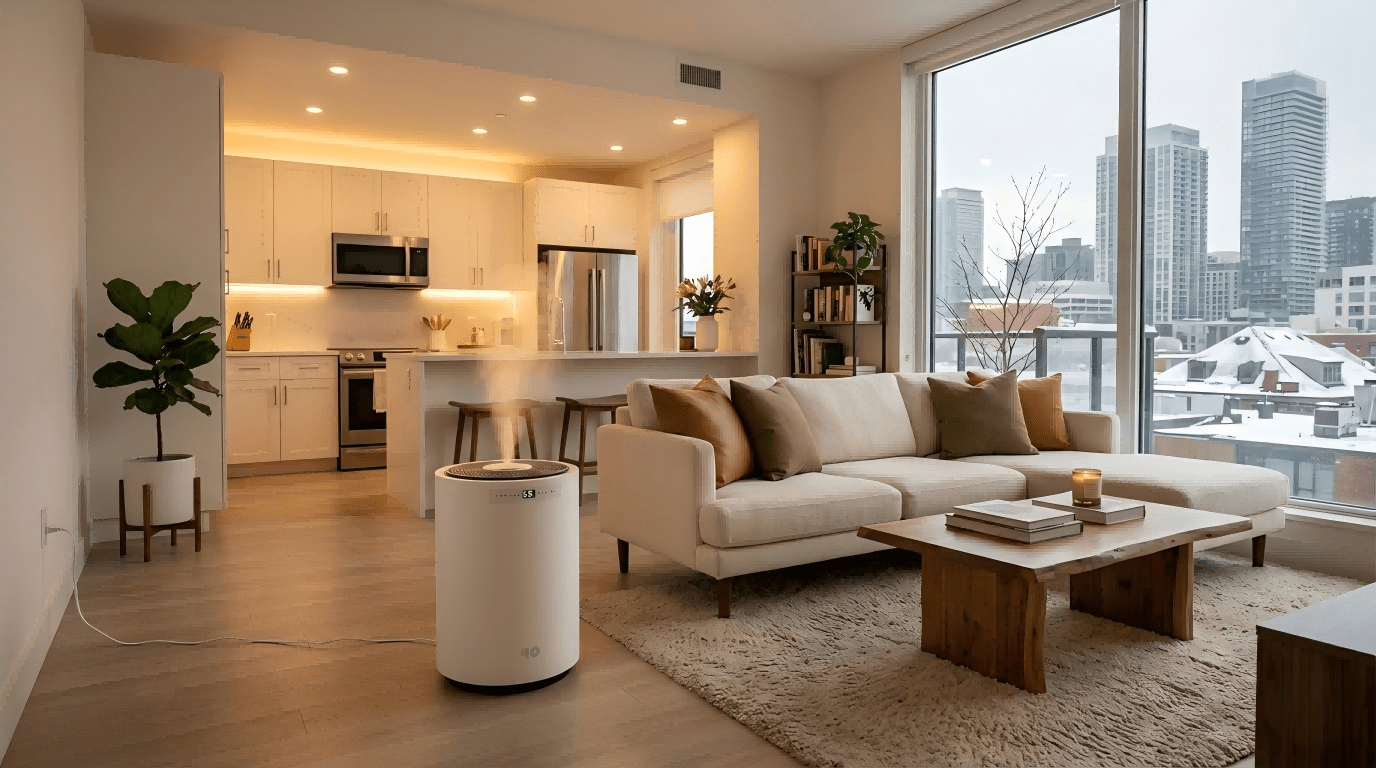

Apartments seem like they should be easy to humidify. Smaller space, less demand, simpler problem. In practice, apartment dwellers run into a specific set of problems that house owners don't — and most humidifier guides are written for houses.
Baseboard heat and radiant systems that dry air differently than forced-air furnaces. White dust settling on electronics in a space where everything is close together. Ultrasonic mist concentrating in a small room instead of dispersing. Noise from a humidifier that matters more when your bedroom is ten feet from your living room.
The rules for humidifying an apartment are genuinely different from humidifying a house. Not dramatically — but enough that the standard advice often leads apartment dwellers to buy the wrong type, place it wrong, or set it wrong. This guide covers what's actually different and what actually works.
Why Apartments Are a Different Humidification Challenge
Three factors make apartment humidification different from house humidification — and understanding them changes which product and approach you should use.
Factor 1: Heating Systems Are Different
Most apartment buildings — particularly older ones in cities like Chicago, New York, Toronto, and Boston — use radiant heat: steam radiators, hot water baseboard heaters, or radiant floor systems. These systems heat differently from the forced-air furnaces common in single-family homes, and they affect indoor humidity differently.
Forced-air furnaces pull outdoor air in, heat it, and circulate it continuously — this is what causes the dramatic humidity drops that Prairie and Midwest house dwellers experience. Radiant systems heat surfaces rather than air, and don't circulate outdoor air in the same way. The result: radiant-heated apartments often don't get as extremely dry as forced-air houses, but they still get dry enough to cause discomfort — typically settling at 25–35% RH in winter rather than the 15–20% common in forced-air homes.
This matters for sizing: if you're in a radiant-heated apartment, you typically need less output than a similarly-sized forced-air house. The 1,000–1,200 ml/h output required for a large open-plan house is usually overkill for an apartment — 400–700 ml/h is more appropriate for most apartment scenarios.
Factor 2: Small Spaces Concentrate Problems
In a house, an ultrasonic humidifier's white dust disperses across a large volume of air and settles across a large surface area. In a 600 sq ft apartment, that same mineral aerosol concentrates in a small space — settling visibly on your TV, laptop, books, and every other surface within a few feet of the unit.
The same applies to biological aerosols. An ultrasonic humidifier with a neglected tank in a small apartment bedroom creates a high-concentration exposure environment that a house user wouldn't experience — the sealed, small room amplifies the effect of whatever comes out of the unit overnight.
For a full breakdown of white dust risk: Hard-Water Humidifier Disaster: White Dust & Your Lungs →
Factor 3: Noise and Size Matter More
In a house, a humidifier in the living room is separated from the bedroom by walls and distance. In a studio or one-bedroom apartment, there's often no separation at all — the unit that runs in the living room is also the unit you sleep near. Noise level matters more, and physical footprint matters more.
Steam humidifiers produce a low boiling-water sound that most users describe as comparable to a white noise machine at low settings — acceptable for most apartment environments. Ultrasonic units are nearly silent but produce the white dust and biological aerosol issues described above. Evaporative units vary widely in noise level depending on fan speed.
Fig. 1 — Apartment vs house humidification: the key differences. Apartments typically need less output but are more sensitive to white dust concentration, noise, and biological aerosol effects in enclosed spaces.
Which Humidifier Type Works Best for Apartments
The right choice depends on your specific apartment situation. Here's how the three main types perform in apartment environments:
| Type | Apartment Suitability | Main Concern | Best For |
|---|---|---|---|
| Ultrasonic | Poor in hard-water cities | White dust concentrates on electronics; biological aerosol in small sealed rooms | Soft-water cities only, with daily cleaning |
| Evaporative | Moderate | Fan noise; wick maintenance; can't use in very small rooms without over-humidifying | Moderate-sized apartments with good airflow |
| Steam | Best overall for apartments | Low boiling sound at low settings; slightly higher electricity use | Any apartment, any water hardness, overnight bedroom use |
Steam is the recommended choice for apartment use specifically because the white dust problem — manageable in a house — becomes a daily nuisance in a small space. In a 500 sq ft apartment with hard city water, an ultrasonic humidifier will coat your laptop, TV, and furniture in visible white mineral residue within days. Steam eliminates this entirely.
For a complete technology comparison: Steam vs Ultrasonic vs Evaporative: Which Is Worth It? →
Sizing for an Apartment
Most apartment guides oversize humidifiers by applying house-based calculations to apartment spaces. Here's a more accurate apartment-specific reference:
| Apartment Type | Typical Area | Heating Type | Output Needed |
|---|---|---|---|
| Studio | 300–500 sq ft | Radiant / baseboard | 300–500 ml/h |
| 1-bedroom | 500–750 sq ft | Radiant / baseboard | 400–650 ml/h |
| 2-bedroom | 750–1,100 sq ft | Radiant / baseboard | 600–900 ml/h |
| 1-bedroom with forced air | 500–750 sq ft | Forced-air (newer buildings) | 600–800 ml/h |
| 2-bedroom with forced air | 750–1,100 sq ft | Forced-air (newer buildings) | 800–1,100 ml/h |
Radiators (cast iron or steel units on walls) and baseboard heaters (low metal units along walls) = radiant heat. Vents in the floor, ceiling, or walls with air blowing through = forced air. If your building was built before 1980, radiant is likely. Newer buildings in colder climates increasingly use forced air. Not sure? Check your lease or ask building management — it affects sizing meaningfully.
Placement in an Apartment
Apartment placement has specific constraints that house placement doesn't. Here are the rules that actually apply:
Fig. 2 — Apartment humidifier placement. Option A (living area, central) covers the whole apartment with door open — the best choice for most units. Option B (bedroom) is suitable if sleep quality is the primary concern and the living area doesn't need daytime coverage.
Placement Rules for Apartments
- Place in the living area centrally with bedroom door open — this covers the whole apartment from one unit, including the bedroom
- Keep at least 2–3 ft from walls, furniture, and electronics — in a small space, proximity matters more than in a house
- If using for sleep primarily, place in the bedroom 3–5 ft from the bed head — close enough to affect breathing zone, far enough to diffuse
- Keep away from electronics — in a small apartment, the distance between your humidifier and your TV or laptop matters; steam is safe but don't direct output at devices
- Avoid placing near windows — cold window surfaces can cause condensation on the glass, which can lead to mold on window frames over time
- Don't place in the kitchen — cooking already adds moisture; the combination can push RH above 60% and promote mold
- Don't place directly beside the bed — oversaturates the immediate breathing zone
- Don't run at maximum output in a studio apartment — in a small sealed space, you can overshoot 60% RH quickly; use a humidistat and set a target of 45–50%
- Don't use an ultrasonic unit near electronics — in an apartment, your TV, laptop, and speakers are always nearby; white dust settles on them within days
The Over-Humidification Risk in Apartments
This is the apartment-specific problem that house guides don't warn about: in a small sealed space, it's genuinely easy to overshoot your target humidity and push above 60% RH — the threshold where dust mite populations and mold activity increase significantly.
In a 400 sq ft studio with a 1,200 ml/h unit running at full output, you can hit 70% RH in under an hour. This is too much — it encourages condensation on cold surfaces (windows, exterior walls), promotes mold growth in corners and on window frames, and can increase dust mite allergen load in bedding.
The solution is straightforward: use a humidistat to set a target of 45–50% RH, and use a separate hygrometer to verify the actual reading. A unit that cycles automatically to maintain a target is far safer in apartment use than one you run manually.
If you notice condensation forming on your windows regularly, your indoor humidity is too high — even if the humidifier's built-in sensor reads within range. Window condensation is the visible sign that surface temperatures are being hit. Reduce target RH by 5–10% and monitor. Persistent condensation on exterior walls or in corners warrants a conversation with building management about ventilation.
What Apartment Renters Are Saying
 In a compact apartment bedroom, placement at 3–5 ft from the bed allows steam to diffuse before reaching your breathing zone — without over-saturating the immediate area in a small sealed room.
Clean Steam. Quiet Operation. No White Dust.
The Y&O Steam Plus works in any apartment, with any tap water, without coating your electronics in mineral residue. The built-in humidistat maintains your target RH automatically — no over-humidification risk.
See the Y&O Steam Plus →Your Questions Answered
Can I use a humidifier in an apartment without damaging anything?
Yes — with two conditions. First, use a steam humidifier rather than ultrasonic in hard-water cities (which covers most major North American cities) to avoid white dust settling on electronics and furniture. Second, use a humidistat to set a target of 45–50% RH and don't exceed it — over-humidification in a small sealed space can cause condensation on windows and exterior walls, which can lead to mold. A correctly sized steam unit with automatic humidistat control is safe for apartment use and won't damage walls, furniture, or electronics.
My apartment has baseboard heaters. Do I still need a humidifier?
Probably yes, but you may need less than you think. Baseboard and radiant heating systems don't circulate outdoor air the way forced-air furnaces do, so they don't cause the dramatic humidity drops common in Prairie and Midwest houses. However, they still allow dry outdoor air to infiltrate through gaps and ventilation, and they raise air temperature without adding moisture — which lowers relative humidity. A baseboard-heated apartment in winter typically settles at 25–35% RH without humidification, which is below the 40% threshold for comfortable nasal function. A modest 400–600 ml/h unit is usually sufficient — you don't need the 1,200 ml/h required for a forced-air house.
Will a humidifier cause mold in my apartment?
Not if used correctly. Mold risk from humidifiers comes from two sources: over-humidification (pushing RH above 60%, which creates conditions for mold on cold surfaces) and a dirty humidifier tank dispersing mold spores. Both are preventable. Set your target at 45–50% RH, monitor with a hygrometer, and if you see condensation on windows regularly, reduce your target. Use a steam humidifier to eliminate the dirty-tank biological aerosol risk. If your apartment already has ventilation or moisture issues (common in older buildings), address those with building management — a humidifier won't cause mold in a well-ventilated apartment used correctly, but it can accelerate existing moisture problems. For more on mold risk from humidifiers: Is Your Humidifier Making You Sick? →
What's the right humidity level for an apartment in winter?
The same as any indoor space: 40–60% RH per ASHRAE Standard 55. For apartment use specifically, targeting 45–50% gives you comfortable conditions while maintaining a meaningful buffer below 60% — important in a small space where it's easier to overshoot. If your windows regularly show condensation at 50%, reduce to 45%. In very cold climates (Prairie Canada, Upper Midwest), window condensation can occur at lower RH levels due to extreme temperature differentials — in these cases, 40–45% may be the practical ceiling. For the full humidity science: The 40–60% Humidity Rule →
I live in a studio apartment. Is one humidifier enough?
Yes — one correctly sized unit is always enough for a studio. A studio apartment is, by definition, a single open space. One unit placed centrally covers the entire area without the diffusion problems of a house floor plan. For most studios (300–500 sq ft) with radiant heat, a 300–500 ml/h unit is appropriate. For a studio with forced-air heat in a cold climate, 500–700 ml/h. The main risk in a studio is over-humidification rather than under-coverage — use a humidistat and monitor with a hygrometer. For help calculating your specific output need: Humidifier Output Calculator →
Related Reading
Sources & References
- ASHRAE Standard 55 — Thermal Environmental Conditions for Human Occupancy
- U.S. Environmental Protection Agency — Use and Care of Home Humidifiers
- U.S. Geological Survey — Hardness of Water — Regional Data
- Reddit Community Discussions — r/Apartmentliving · r/Humidifiers
- Y&O — YO-M2 Steam Plus Product Page