
Every major parenting resource says the same thing: use cool mist for newborns, never steam. The American Academy of Pediatrics says it. WebMD says it. Healthline says it.
The reason they give is burn risk. And they're not wrong — older steam vaporizers released near-boiling vapor that could genuinely scald a baby. But that guidance was written for a different generation of technology, and it hasn't been updated to reflect what modern steam humidifiers actually do.
This article covers what the burn risk concern is actually based on, how modern steam humidifiers differ from the vaporizers that earned that reputation, and why the more important safety question for a newborn nursery isn't about burn risk at all — it's about what's growing in your tank.
Where the “No Steam for Newborns” Advice Comes From
The AAP recommendation against steam humidifiers in children's rooms dates to an era when the dominant technology was the steam vaporizer: a simple device that boiled water in an open reservoir and released steam directly into the air at temperatures close to 212°F (100°C).
Those devices were genuinely dangerous near infants. If a baby was placed too close, or if an older child knocked one over, the boiling water and near-scalding steam posed a real burn risk. The AAP recommendation was appropriate for that technology.
The AAP recommends cool-mist humidifiers for children's rooms specifically because of burn risk from hot steam and the risk of boiling water being knocked over. It does not address modern steam humidifiers designed with cold-water storage tanks and separate sealed heating chambers — a fundamentally different architecture from the open-reservoir vaporizers that prompted the original guidance.
How the YO-M2 Solves the Original Burn Risk
The technology that earned steam humidifiers their reputation for being unsafe in nurseries no longer represents what modern steam humidifiers are. The YO-M2 was engineered specifically around the two failure points that made older vaporizers dangerous near infants — and the design choices are worth understanding in detail.
Solution 1: Cold-Water Reservoir, Not a Boiling Tank
Older steam vaporizers heated the entire water reservoir to a boil. That meant a large open volume of near-212°F water sat inside the unit during operation — the source of the tip-over scalding risk that drove the original AAP recommendation.
The YO-M2 separates storage from heating. The 10L water reservoir remains at room temperature throughout the entire operating cycle. Water is never stored hot. There is no large container of boiling water inside the unit that can be knocked over, leaked, or spilled onto a child.
Solution 2: Sealed Heating Chamber with Temperature Control
Heating happens in a separate, sealed chamber — physically isolated from the storage tank. The chamber processes only a small volume of water at a time, generating steam continuously rather than holding a large boiling reserve.
A built-in temperature control system governs output through the full cycle. By the time steam exits the unit, it has cooled to approximately 122°F (50°C) — warm like a hot shower, not scalding like a kettle. The sterilization that makes steam biologically superior happens at boiling temperature inside the sealed chamber; the output that enters your nursery air is already at a safe contact temperature.
The original AAP concern was that a child could tip over a unit and be scalded by a large volume of boiling water, or get burned by direct contact with near-boiling steam output. The YO-M2 architecture addresses both: there is no boiling water inside the unit at any time (only a small volume in the sealed heating chamber), and output temperature is controlled to a non-scalding 122°F before any mist leaves the device.
This is what separates a modern steam humidifier from a steam vaporizer. The technology category is the same; the engineering is not. A unit designed around cold-tank storage and temperature-controlled output is not the device the AAP recommendation was written about.
The Safety Question No One Is Asking
While parents are focused on the burn risk question — which modern steam humidifiers have largely resolved — the more significant safety issue with newborn humidification is going largely undiscussed.
Cool-mist and ultrasonic humidifiers, which are universally recommended as the “safe” choice, create a serious biological risk when used continuously in a warm nursery. Standing water at room temperature, in a tank that isn't emptied and dried daily, becomes a growth environment for mold and bacteria within 24–48 hours.
When a cool-mist humidifier runs overnight in a nursery, it aerosolizes whatever is in that tank — including bacteria, mold spores, and in hard-water cities, breathable mineral particulate. That mist enters the air a newborn breathes for 8–10 hours every night.
A steam humidifier boils the water before releasing anything. Pathogens are killed at the source. Minerals stay in the tank. The mist that reaches the room is clean by design — not by how recently the tank was cleaned.
For a newborn whose immune system is still developing, that distinction is not minor.

Placement: The Rule That Makes Steam Safe in Any Nursery
The burn risk concern with steam humidifiers, while less significant with modern technology, is not zero. The correct response is proper placement — not avoiding the technology altogether.
The rule is straightforward: keep the humidifier at least 4–6 feet from the crib, positioned against a wall away from the sleeping area, with output aimed toward the center of the room — not directed at the crib.
| Placement Rule | Why It Matters |
|---|---|
| 4–6 feet from crib minimum | Steam diffuses and cools as it disperses — at this distance, output temperature reaching the crib is ambient room temperature |
| Floor placement, away from crib | Position against a wall at least 4–6 feet from the crib — steam rises naturally and disperses into room air before reaching the sleeping area |
| Output aimed toward room center | Distributes humidity evenly rather than concentrating mist directly toward sleep surface or bedding |
| Not against exterior walls | Cold wall surfaces can cause condensation; damp walls in a nursery create mold risk over a heating season |
| Cord managed and out of reach | Relevant as baby develops mobility — cord management is a nursery safety baseline regardless of humidifier type |
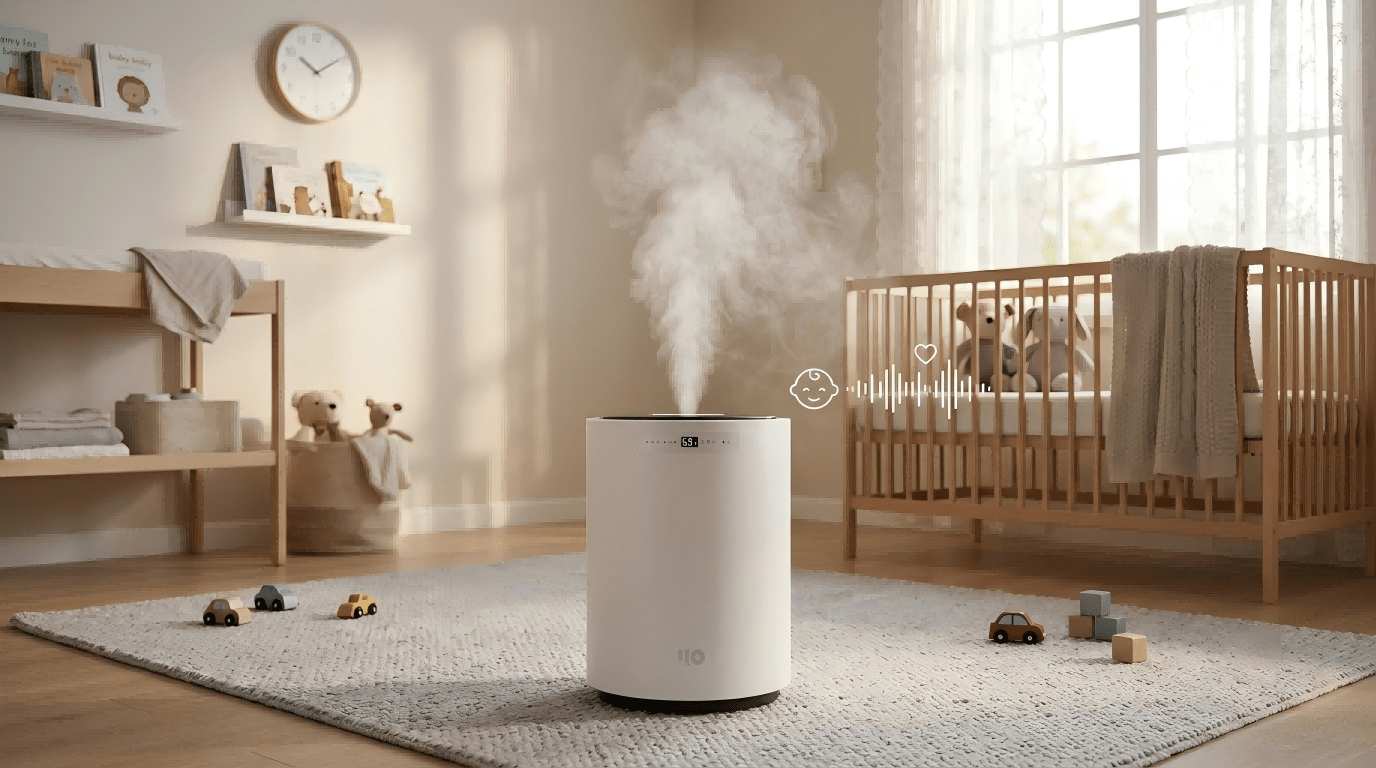
A steam humidifier placed on the floor 5 feet from a crib, against a wall, aimed toward the center of the room, poses no realistic burn risk to a newborn. Steam rises and cools to room temperature well before it reaches the crib. What it delivers — all night, every night — is biologically clean humidity.
What About the White Dust Problem?
Parents in hard-water cities — Phoenix, Las Vegas, Denver, Dallas, Salt Lake City — face an additional concern with cool-mist and ultrasonic humidifiers that rarely gets mentioned in the newborn safety discussion.
Ultrasonic units aerosolize water directly, which means they also aerosolize dissolved minerals. In hard-water markets, this produces the fine white dust that settles on every nursery surface — the crib rail, the changing table, the mobile. That dust is mineral particulate small enough to be inhaled.
A newborn breathing mineral particulate from an ultrasonic humidifier running all night is not a theoretical risk. The evidence on ultrasonic white dust and respiratory health is clear enough that this should be part of any honest nursery humidifier discussion — and it almost never is.
Steam humidifiers boil the water. Minerals stay in the tank. Zero white dust enters the nursery air. For a newborn in a hard-water city, this is not a secondary consideration.
Phoenix, Las Vegas, Denver, Dallas, and Salt Lake City all have tap water with mineral hardness high enough to produce visible white dust from ultrasonic humidifiers within days of use. In a nursery where a unit runs 8–10 hours a night, that particulate accumulates on every surface. If you're in a hard-water city and considering a cool-mist humidifier for your newborn's room, use distilled water — or switch to steam and eliminate the problem entirely.
The Honest Comparison: Steam vs. Cool-Mist for Newborns
| Factor | Cool-Mist / Ultrasonic | Modern Steam |
|---|---|---|
| Burn risk | None | Minimal with proper placement (4–6 ft from crib) |
| Bacterial contamination | High — standing water grows bacteria within 24–48h without daily cleaning | None — boiling kills pathogens before release |
| Mold risk | High in warm nursery with continuous use | None — no standing water at room temperature |
| White dust (hard water) | Yes — minerals aerosolized into nursery air | None — minerals stay in tank |
| Filter requirement | Most require filter or wick replacement | No filter required |
| Water type required | Distilled recommended to reduce mineral dust | Tap water fine — minerals neutralized by boiling |
| AAP recommendation | Preferred (burn risk basis) | Not addressed for modern units with cooling systems |
The trade-off is clear: cool-mist eliminates burn risk but introduces biological and mineral risks that are significant in a continuously-running newborn nursery context. Modern steam eliminates biological and mineral risks but requires proper placement to address burn risk — which proper placement does address.

The Y&O Steam Plus — Designed for Continuous Nursery Use
Boils to 212°F · Cools to 122°F before release · No filter · Zero white dust · 10L dual tank · Auto shut-off
See the YO-M2 Steam Plus →Your Questions Answered
The AAP says to use cool mist for babies. Should I ignore that?
No — but understand what the AAP recommendation is actually based on. The AAP recommends cool-mist to avoid burn risk from hot steam, which was a genuine concern with older steam vaporizers that released near-boiling vapor. Modern steam humidifiers with internal cooling systems reduce output to approximately 122°F before release — a temperature that doesn't pose a realistic scalding risk to a newborn in a crib 4–6 feet away. The AAP guidance hasn't been updated to address this technology. If you use a modern steam humidifier with correct placement, the burn risk the AAP is concerned about is effectively mitigated.
How far does a steam humidifier need to be from the crib to be safe?
At least 4–6 feet, positioned against a wall away from the crib, with output aimed toward the center of the room rather than directly at the sleeping area. Steam rises naturally and cools as it disperses — at 4–6 feet, the mist reaching crib level is at room temperature, indistinguishable from ambient air. Make sure the cord is managed and routed along the wall, out of reach as the baby develops mobility in the months ahead.
Can I use tap water in a steam humidifier in the nursery?
Yes — and this is one of steam's practical advantages for nursery use. Because the water is boiled, minerals don't get aerosolized into the air. Cool-mist and ultrasonic humidifiers require distilled water in hard-water areas to prevent white mineral dust from entering the nursery air. With a steam humidifier, tap water is fine — minerals accumulate in the tank rather than being dispersed into the room your newborn breathes.
How often does a steam humidifier need to be cleaned compared to cool mist?
Less frequently — and this matters in a newborn context where daily cleaning is rarely realistic. Cool-mist and ultrasonic humidifiers require daily tank emptying and drying to prevent bacterial and mold growth in standing water. Missing a day or two creates a contamination risk in the unit that then gets aerosolized into nursery air. Steam humidifiers boil the water, which prevents biological contamination during use. The tank still needs periodic cleaning, but the consequence of missing a cleaning cycle is mineral buildup in the tank — not bacterial growth being dispersed into your newborn's room.
Does a steam humidifier work as well as cool mist for newborn congestion?
Yes — humidification effectiveness at maintaining room RH is equivalent between steam and cool-mist technologies. Both raise indoor relative humidity by adding moisture to the air; the method of generation doesn't affect the humidity level achieved in the room. Where steam has an advantage for newborn congestion specifically is output consistency: high-output steam units maintain target RH more reliably in cold, dry heating-season conditions than most cool-mist units rated for similar coverage, because output rate in ml/h determines how much humidity the unit can add against a furnace running all night. For more on baby congestion and humidifiers: Humidifier for Baby Congestion →
What humidity level should I maintain in a newborn's room?
40–50% RH is the target — the same range recommended for adults and the same across all infant and toddler stages. Below 30%, nasal passages dry out and the newborn's already-limited respiratory defenses are further compromised. Above 60%, mold and dust mite activity increases. Always verify with a standalone hygrometer placed at crib height — built-in humidifier sensors typically overread by 5–10%, and you want to measure the air your baby actually breathes, not the air near the unit.
Related Reading
Sources & References
- American Academy of Pediatrics — Humidifiers and Vaporizers for Children
- Children's Hospital Colorado — Humidifier Safety
- WebMD — Safe Humidifier and Vaporizer Use for Babies
- Healthline — Humidifier for Baby: What You Need to Know
- Omega Pediatrics — Newborn Risks of Using a Cool Mist Humidifier
- U.S. Environmental Protection Agency — Use and Care of Home Humidifiers
- Reddit Community Discussions — r/beyondthebump · r/Humidifiers
- Y&O — YO-M2 Steam Plus Product Page