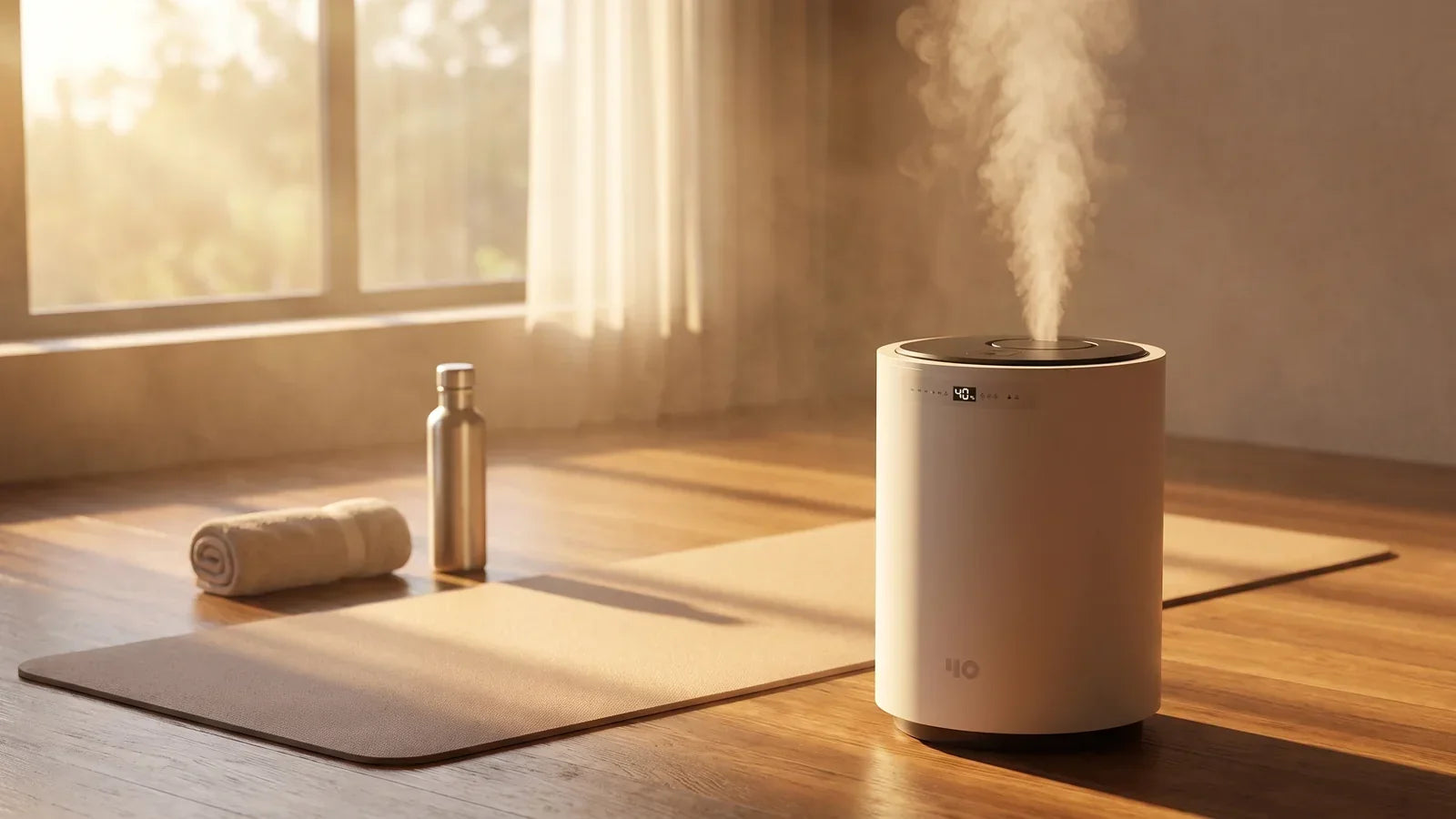

A hot yoga room lives or dies on two numbers: temperature and humidity. Heaters are the easy part. Holding the moisture is where most at-home setups fall apart — the room heats up, the air dries out, and your practice turns into breathing sandpaper. This guide is about the second number.
- Quick answer: which humidifier and what settings
- Hot yoga temperature & humidity targets (with a comparison table)
- Why a steam humidifier fits a hot room — the physics
- Sizing it: room size, output, and the dome/tent case
- Home hot yoga room setup: a quick checklist
- Want scent during practice? Read this first
- The honest trade-offs (before you buy)
- FAQ
Quick Answer: Which Humidifier for Hot Yoga at Home
If you're building a hot yoga space at home, use a high-output steam (warm-mist) humidifier and aim for roughly 95–100°F with about 40% relative humidity — the low end of the hot-yoga range, not the 105°F Bikram maximum. Bikram studios run 105°F at ~40% RH, a heat index of 121–149°F (ThermoPro). The physics most guides skip: heating a room drives its relative humidity down, because warm air holds far more moisture — so a hot room actively pushes you toward dry, throat-scratching air. A steam or warm-mist unit fits because it adds moisture without spraying the cold droplets and mineral "white dust" that ultrasonic misters leave on your mat and skin. As a sizing floor from Y&O's own VaporFlow-26 testing, budget about 300 ml/h of output per 250 sq ft; a small, well-sealed room is easier and cheaper to heat (Yoga Design Lab). This is a home guide — it is not studio-grade equipment advice.
Most "hot yoga at home" articles tell you to "add a humidifier" and move on. That's the part worth slowing down on, because the humidifier is the piece people get wrong. A hot yoga room is one of the few home spaces where you are heating and humidifying at the same time, and the two work against each other. Get the machine wrong and you either can't hold the humidity, or you coat your mat in white mineral dust every session.
We build and stress-test high-output steam humidifiers, so we'll be upfront about where they fit and where they don't. Studios that want humidity piped into a ducted HVAC system use industrial electrode steam units — that's a different category, and we'll point you to it. This guide is for the person turning a spare bedroom, garage corner, or a yoga dome into a home hot yoga room.
Hot Yoga Temperature and Humidity: What to Actually Target
Hot yoga isn't one temperature. It's a family of styles, each with its own heat and humidity. The classic Bikram sequence runs the hottest; power and core styles sit lower. Knowing your style's numbers is what tells you how hard your humidifier has to work. Here's the range, style by style, with sources you can check.
| Practice / setting | Room temp | Humidity (RH) | Source |
|---|---|---|---|
| At-home sweet spot (our pick) | 95–100°F | ~40% | Low end of the range, chosen for at-home safety (see note below) |
| Bikram (classic) | 105°F | 40% (some raise to 60%) | Feels like 121–149°F — ThermoPro |
| Moksha / Modo | 103°F | 40–60%* | Temp: ThermoPro |
| CorePower | 93–98°F | 40–60%* | Temp: ThermoPro |
| Baptiste Power Vinyasa | 90–95°F | 40–60%* | Gentler entry point — temp: ThermoPro |
| General hot yoga range | 95–105°F | 40–60% | Crunch |
| Home safety ceiling | Don't exceed 105°F | — | 105°F ceiling per Crunch; without professional ventilation, stay at the low end — our take |
* ThermoPro specifies the temperature for these styles; the 40–60% figure is the general hot yoga humidity band per Crunch, not a per-style number.
Our take: at home, start at 95–100°F and about 40% RH, not the 105°F Bikram ceiling. A commercial studio has purpose-built ventilation and staff monitoring the room; your spare bedroom doesn't. The lower end of the range still gives you the warm, pliable-muscle feel of hot yoga with more margin for error on airflow. You can always nudge up once you've practiced in the space and trust your setup.
One number worth internalizing: 40% RH is a floor, not a nicety. As the room climbs toward 100°F, relative humidity naturally collapses — the same water in the air reads as a much lower percentage when the air is hot. That's why a heater alone gives you a dry, harsh room, and why the humidifier is doing real work the entire session, not just topping off.
Why a Steam Humidifier Fits a Hot Room — the Physics
There are three humidifier technologies you'll see recommended, and only one of them is a clean fit for a room you're deliberately heating. Let's reason from how each actually works, not from marketing.
Ultrasonic (cool mist) is the wrong tool for a hot room, for two concrete reasons. First, it sprays a cool, dense fog of water droplets — you're pushing cool moisture into a room you're paying to keep at 100°F, and the droplets tend to fall and settle near the machine rather than spreading. Second, ultrasonic units atomize whatever is dissolved in the water, so with typical tap water they scatter mineral "white dust" onto surfaces — in a yoga room, that means your mat, your skin, and the floor you're pressing your face into. That's not a fit.
Evaporative (wick) units are gentler but fight the environment: a hot, dry room drives hard against the wick, output sags as the wick mineralizes, and you're back to buying and swapping filters. Steam is the technology that shares the same job as your heater instead of fighting it — it warms and moistens at once, and because it boils the water it leaves minerals behind in the tank rather than throwing them into the air. No white dust on the mat, no wick to replace.
Here's the honest nuance we won't hide: our steam humidifier is not a space heater, and it shouldn't be your heat source. The Y&O Steam Plus (model YO-M2) boils water in a sealed chamber to 212°F (100°C) to sterilize it, then cools the vapor before it leaves the unit so the mist is warm-to-cool to the touch rather than scalding steam. That design choice is about burn safety, especially around kids and pets — but it also means the machine contributes some warmth without doing the heavy lifting on temperature. You still need a dedicated heater to reach 95–105°F; the humidifier's job is to hold ~40% RH while that heater tries to dry the room out.
No portable humidifier "makes" a room hot yoga-ready on its own. You need a heater for temperature and a humidifier for moisture. The steam unit's advantage is that it doesn't cool the room or coat it in mineral dust the way a cool-mist ultrasonic does — not that it replaces the heater.
Sizing It: Room Size, Output, and the Dome/Tent Case
The number that decides coverage is hourly output (ml/h), not tank size. A big tank just means fewer refills; it does nothing to push moisture across the room. In Y&O's in-house VaporFlow-26 testing, our rule of thumb is roughly 300 ml/h of output for every 250 sq ft of open floor to hold a target humidity band. A 10 L dual-tank unit like the YO-M2 tops out at 1,200 ml/h, which is far more headroom than a small practice room needs — and that headroom matters here for a specific reason.

Our 300 ml/h-per-250-sq-ft figure comes from testing at 70°F room temperature. A hot yoga room at 95–105°F sheds relative humidity faster, so treat that figure as a floor, not a measured hot-yoga throughput. We have not yet run the VaporFlow protocol at 100°F, so the exact ml/h needed to hold 40% RH in a heated room is [to be confirmed] — we won't invent a number we haven't measured. The practical takeaway holds: buy more output headroom than a same-size unheated room would need.
For most home setups — a spare bedroom, a garage corner, or a sectioned-off basement — you're working with roughly 100–200 sq ft. On paper that's a small load. But because the heat is constantly wringing humidity out of the air, you want a unit that can run continuously without gasping, which is exactly where a 10 L dual-tank machine earns its place: the two independent 5 L tanks mean you can refill one side without stopping the session.
The hot yoga dome or tent
A growing number of home practitioners use a hot yoga dome or tent — a zippered, insulated enclosure that traps heat and humidity in a much smaller volume. A dome is the easiest space to humidify because it's small and sealed, but it's also the easiest to over-saturate. In an enclosure of a few dozen cubic feet, a full 1,200 ml/h blast will blow past 40% RH fast. Run the unit on a low setting, and — more than anywhere else — watch a hygrometer, because a sealed dome gives you very little air exchange to buffer mistakes. The upside: a dome reaches temperature quickly and keeps your heating bill sane.
Home Hot Yoga Room Setup: a Quick Checklist
Recreating a studio at home isn't complicated, but the order and the details matter. Here's the setup we'd tell a friend to build, front to back.
- Pick a small, well-sealed room. Smaller volume reaches temperature faster and costs less to run (Yoga Design Lab). A spare bedroom beats an open basement.
- Heat first, humidify second. A space heater sets the temperature; the humidifier holds the moisture. They are two jobs, two machines.
- Put a hygrometer down at mat level, not up on a wall or ledge. You breathe near the floor. Aim for ~40% RH and no more than 105°F. A cheap digital thermo-hygrometer is the single most useful $15 you'll spend.
- Start the humidifier 15–20 minutes before you begin, so the room is at target when you step on the mat — not climbing to it during your first sun salutation.
- Plan for ventilation between sessions. Crack a window and let the room dry out afterward. A room held warm and moist and then sealed up is exactly the condition you don't want lingering (more on this in the trade-offs below).
For the deeper "what size machine for what space" math — output rate versus floor area, with our full test data — see our guide to sizing a humidifier by room and output. If you're actually building out a commercial studio rather than a home room, that's a different spec entirely; start with our large-space and commercial humidification guide instead of this page.
Want Scent During Practice? Read This First
A lot of studios diffuse a light scent — eucalyptus, lavender — and it's a reasonable thing to want at home. Do not put essential oils in your main steam humidifier. Oils clog and damage the heating element and void the warranty; that's true of the YO-M2 and of most humidifiers, not a quirk of ours. The tank is for water.
If you want fragrance, use a machine built for it. Y&O makes a separate Steam Aroma glass diffuser designed to run essential oils safely — humidity from one machine, scent from another. Keep the jobs separate and both machines last longer.
The Honest Trade-offs (Before You Buy)
We sell steam humidifiers, so here's where we tell you the parts a sales page skips. A steam unit is the right tool for a home hot yoga room, but it isn't free of downsides.
- It uses real electricity. Boiling water takes power — a steam unit this size draws on the order of 1,250 W on a US 120 V circuit. Running it alongside a space heater in a hot yoga room means two energy-hungry appliances at once. Budget for it.
- You need ventilation. A warm, ~40% RH room is comfortable to practice in, but sealing it up warm and damp afterward invites problems. Air the room out after each session.
- Hard water means descaling. Because steam leaves minerals in the tank, you'll descale periodically — for the YO-M2, that's about 20 g of citric acid in water, heated 10–15 minutes, then soaked 20–30 minutes and rinsed. It's simple, but it's a recurring chore that cool-mist owners don't fully escape either.
- It is not studio-grade equipment. A portable 10 L unit is built for a home room, not a 40-person Bikram studio piped into ducted HVAC. Commercial studios use industrial electrode/resistive steam humidifiers integrated into the building's air system (Condair). If that's your project, buy that class of machine, not this one.
Where we land: for practicing hot yoga in a spare room, garage, or dome at home, a high-output steam humidifier held at ~40% RH is the cleanest fit — no white dust, no wicks, and it works with your heat instead of against it. Match it with a heater and a hygrometer, keep it at the low end of the temperature range, and air the room out afterward.
Building a home hot yoga room?
The Y&O Steam Plus (YO-M2) is a filter-free, no-white-dust 10 L steam humidifier with dual tanks for continuous running — the moisture half of your setup.
Frequently Asked Questions
What humidity should a home hot yoga room be?
Aim for about 40% relative humidity. Classic Bikram runs 105°F at ~40% RH, with some studios raising humidity toward 60% (ThermoPro). At home we recommend holding the low end — roughly 40% — and measuring it with a hygrometer at mat level, because a hot room's relative humidity drops fast as the temperature climbs.
What temperature is hot yoga at home?
Hot yoga generally runs 95–105°F depending on style (Crunch): Bikram at 105°F, Moksha/Modo at 103°F, CorePower at 93–98°F, and Baptiste Power Vinyasa at 90–95°F (ThermoPro). At home, without professional ventilation, start at the low end — 95–100°F — and don't exceed 105°F.
Can I use an ultrasonic (cool mist) humidifier for hot yoga?
It's a poor fit. Ultrasonic units spray cool droplets into a room you're trying to keep hot, and with tap water they scatter mineral "white dust" onto your mat, skin, and floor. A steam or warm-mist unit adds moisture without cooling the room or leaving mineral residue.
Does the humidifier heat the hot yoga room?
No — not on its own. The Y&O YO-M2 boils water to 212°F to sterilize it, then cools the vapor before it exits for burn safety, so it adds only modest warmth. You still need a dedicated space heater to reach 95–105°F; the humidifier's job is to hold humidity while the heater dries the air out.
What size humidifier do I need for a home hot yoga room?
Most home setups are 100–200 sq ft. As a floor, budget roughly 300 ml/h of output per 250 sq ft (from Y&O's VaporFlow-26 testing at 70°F); a heated room sheds humidity faster, so buy extra headroom. A 10 L dual-tank steam unit at up to 1,200 ml/h has ample capacity and lets you refill one tank without stopping practice.
Disclosures & Disclaimer
Transparency note: This article features the Y&O Steam Plus (model YO-M2), a product from our brand line. Our recommendations are based on internal testing and product specifications, and we flag the trade-offs honestly.
General note: This guide covers the practice environment — temperature, humidity, and equipment. It is not medical, fitness, or safety advice for hot yoga itself. Practice within your own limits, stay hydrated, and consult a qualified instructor or physician about whether heated exercise is appropriate for you.
Crunch — The Perfect Heat: What Temperature Is Best for Hot Yoga?
ThermoPro — Best Temperature and Humidity for Hot Yoga
Yoga Design Lab — How to Build a Hot Yoga Room for Home Practice
Condair — Humidification for Yoga Studios