Does the air in your bedroom feel so dry that you wake up with a scratchy throat? Or maybe your basement has that persistent musty smell no matter how much you clean it? You're not alone—and the good news is that fixing these problems is easier than you think.
This guide cuts through the confusion between humidifiers and dehumidifiers. I'll help you figure out what's actually happening in your home and which device will solve your problem—so you're not stuck with something that just collects dust.
The Simple Difference: What Each Device Actually Does
Let's start with the basics. Here's what you need to know:
|
Feature |
Humidifier |
Dehumidifier |
|
What it does |
Adds moisture to air |
Takes moisture out of air |
|
When you need it |
Air feels too dry,winter months |
Air feels too damp,summer months |
|
Best humidity level |
Below 40% |
Above 60% |
|
Problems it fixes |
Dry skin, static shocks, stuffy nose |
Mold, musty smells, dampness |
|
Main types |
Ultrasonic, evaporative, steam |
Compressor, desiccant |
A humidifier adds moisture when air is too dry; a dehumidifier removes moisture when air is too damp.

How to Tell What Your Home Needs
Before you buy anything, you need to know what's actually going on with your air. Here's how to figure it out.
The Comfort Zone: What's the Right Humidity Level?
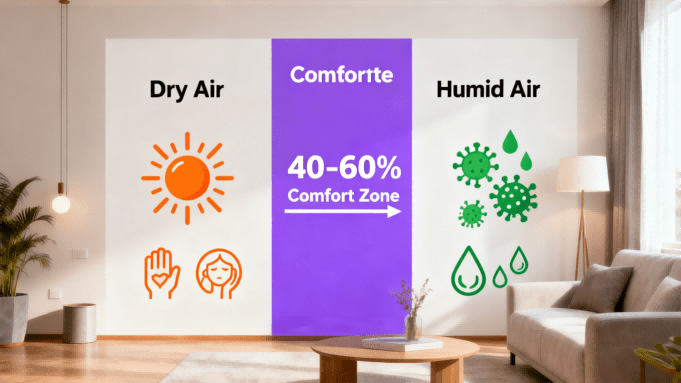
Lead experts like A.V. Arundel and T.D. Sterling have found that indoor humidity should stay between 40-60%. Below 40%, you start having health issues. Above 60%, mold can grow.
How to Check Your Home's Humidity
Get yourself a humidity meter (called a hygrometer). Here's what to do:
● Check different rooms. Your bedroom might read completely different from your basement. Don't assume they're all the same.
● Measure for a few days. Humidity changes throughout the day, so take readings at different times to get a real picture of what's happening.
● Do this BEFORE you buy anything. You might be surprised at what you find. Maybe your air isn't as dry as you thought, or your basement is more humid than you realized.
How to Know If Something's Wrong
Sometimes you don't need a meter to know something's off. Your home will give you clues.
Signs the air is too dry:
● You're getting shocked by static electricity constantly
● Your wood furniture is cracking or splitting
● Your skin, lips, and throat feel dry all the time
Signs the air is too damp:
● Your windows are fogging up with condensation
● There's a musty odor you can't get rid of
● You're seeing mold spots appear on walls or ceilings
● Your allergies are acting up more than normal
When Should You Use a Humidifier?
You need a humidifier when your air is too dry. This typically happens in four situations:
● Winter months. Heating systems are notorious for drying out indoor air. If you run your furnace regularly, you're probably dealing with dry air.
● Dry climates. Live in a desert area or somewhere with naturally low humidity? A humidifier can make your home much more comfortable.
● Health reasons. Dry air makes breathing problems worse and can dry out your sinuses, making you more susceptible to infections.
● Protecting your belongings. Wood furniture and musical instruments need some moisture in the air. Too-dry air can cause them to crack or warp.
When Should You Use a Dehumidifier?
You need a dehumidifier when you have too much moisture in your air. Here's when that typically happens:
● Basements. This is the most common reason people buy dehumidifiers. Basements naturally collect moisture, especially in North America.
● Summer. Warm, humid weather means more moisture in your home.
● Coastal areas. Ocean air brings moisture year-round.
● After water problems. If you've had flooding or leaks, a dehumidifier helps dry things out and prevents mold.
● High-moisture rooms. Laundry rooms and bathrooms create a lot of moisture.

Which Type of Humidifier Should You Get?
Before you pick a type, think about what matters most to you: Is it health and cleanliness? Low maintenance? Or keeping things quiet? Here's what you need to know about each:
The Three Main Types
1. Ultrasonic Humidifiers
These vibrate water into a fine mist. They're very quiet and use less electricity. The mist feels cool. But here's the catch: if you use tap water, you'll get white dust all over your furniture (from minerals in the water). And if you don't clean it every few days, it can spread bacteria.
Best for: Bedrooms where you need quiet, if you're willing to use distilled water and clean it often.
2. Evaporative Humidifiers
A fan blows air through a wet filter. They won't over-humidify your room, and there's no white dust. But they're noisier than ultrasonic types, and you'll need to clean the tank and wick every 1-3 days, plus replace the filter monthly.
Best for: People who don't mind some noise and regular filter changes.
3. Steam Humidifiers (Boiling Water Type)
Steam humidifiers boil the water, which kills bacteria, so you can use regular tap water without worry. You won't have to deal with frequent cleaning; just plan to descale the hard mineral buildup in the tank every one to two weeks. The downside? They use more electricity and make your room slightly warmer. Also, keep them away from kids—the steam is hot.
Best for: People who prioritize health, want to avoid frequent maintenance, and don't mind higher energy costs.
We tested popular models to see how loud they actually are and how fast they work. Here's what we found:
|
Humidifier Type |
Tested Model Example |
Test Room Size |
Initial RH% → Target RH% (Time) |
Measured Noise (Low Setting) |
|
Ultrasonic |
Levoit Classic 300S |
150 Sq. Ft. Bedroom |
35% to 50% (in 2~ hours) |
30dB(Whisper) |
|
Evaporative |
Honeywell HCM-350 |
300 Sq. Ft. Living Area |
35% to 50% (in 4~hours) |
42dB(Whisper) |
|
Steam |
Y&O Plus |
150 Sq. Ft. Bedroom |
35% to 50% (in ~3 hours) |
35dB(Whisper) |
Key Takeaways from the Data:
● Noise vs. Type: The Ultrasonic model truly lives up to its "quiet" claim, making it the clear choice for light sleepers. The Evaporative model's fan noise (42 dB) is significantly more noticeable, confirming the need for users to accept a white-noise element.
● Speed vs. Efficiency: Ultrasonic and Steam units were significantly faster at raising humidity. However, in our tests, the Evaporative model's self-regulating nature ensured we never surpassed the 60% RH safety threshold, which is a major convenience advantage.
Which One Should You Choose?
● If you prioritize maximum hygiene and purity: Go with the Steam (Warm Mist) type (but beware of the high energy consumption).
● If you prioritize quiet operation and low energy bills: The Ultrasonic model is your best bet (but you'll need to use costly distilled water or tolerate the "white dust").
● If you prioritize balanced energy use and self-regulating moisture: The Evaporative type is the most suitable (but you must factor in high maintenance costs).
How to Choose the Right Product Specifications?
Once you know which type you want, you need to figure out what size works for your room. We focus on the humidifier's capacity, measured in "Gallons Per Day" (GPD), which is typically calculated based on the area the humidifier needs to cover. The specific calculation method is shown in the table below:
|
Room Area (Sq. Ft.) |
Suggested Min. Capacity (GPD) |
Suggested Capacity (L/Day) |
Typical Application Scenario |
|
< 300 |
1-2 GPD |
3.8-7.6 L/Day |
Small bedroom, nursery, or office |
|
300 - 500 |
3 GPD |
11.4 L/Day |
Master bedroom, mid-sized living room |
|
500 - 800 |
4-5 GPD |
15.1-18.9 L/Day |
Large open rooms, apartment living area |
|
800 - 1,500 |
6-8 GPD |
22.7-30.3 L/Day |
Open-plan living spaces, entire apartment floor |
|
Whole House |
10+ GPD |
37.9+ L/Day |
Townhouse or large single-family home (Requires a central system or multiple units) |
Which Type of Dehumidifier Should You Get?
When picking a dehumidifier, you need to think about three things: the temperature where you'll use it, how much it'll cost to run, and how loud it is.
Based on the Energy Factor (EF) and capacity tests from ENERGY STAR, alongside the Standard and Low-Temperature performance data from AHRI, we have organized the product comparison below:
|
Feature |
Compressor (Refrigerant) Dehumidifier |
Desiccant Dehumidifier |
|
Working Principle |
Condensation. Cools air via a refrigerant coil to condense moisture into water droplets. |
Adsorption. Uses a desiccant wheel to absorb moisture, then uses a heater to release and condense the water. |
|
Optimal Temp. Range |
Warm Environments: >60℉(~16℃) |
Cold Environments:<60℉(~16℃) |
|
Low-Temp. Performance (<60℉) |
Poor/Unstable. Coils freeze up. The unit must stop dehumidifying to run energy-intensive defrost cycles, severely dropping efficiency. |
Excellent/Stable. Performance is largely unaffected by temperature; it can run reliably even near freezing. |
|
Energy Efficiency |
High. Achieves high Energy Factor (EF) in warm conditions and often qualifies for ENERGY STAR certification. |
Low. Requires continuous power to run the electric heater for regeneration, consuming more power overall. |
|
Effect on Room Temp. |
Minimal temperature change. |
Significant Warming. Releases heat from the regeneration process, which can raise the room temperature by ~ 5-10℉. |
|
Weight & Noise |
Heavy and Loud. Contains a heavy compressor; noise is typically a constant, noticeable hum. |
Lightweight and Quiet(er). No compressor; noise is mainly fan/heater sound, but often less intrusive than the compressor's noise. |
|
Typical Use Case |
Humid summer basements, laundry rooms, main living areas. |
Unheated crawl spaces, cold winter basements, garages, RVs, and boats. |
In summary, the key takeaway from the authoritative testing is this: If you need efficiency in warm spaces, go with the Compressor. If you need something that works reliably in cold spaces, go with a desiccant model.
Which Specs Do You Need?
Once you've picked your type, you need to figure out what capacity you need based on your room size and current humidity level. The specific match-up is detailed in the table below.
|
Room Area (Sq. Ft.) |
Starting Humidity Range (RH) |
Suggested Minimum Capacity (Pints/Day) |
Typical Application Scenario & Risk |
|
< 500 |
60% - 70% |
10 – 14 Pints |
Damp closets, small storage rooms. Mold begins to form. |
|
< 500 |
70% and Above |
18 – 25 Pints |
Small rooms with severe poor ventilation or minor leaks. Rapid mold growth. |
|
500 - 1,000 |
60% - 70% |
18 – 25 Pints |
Moderately damp basements or open living areas. Requires continuous control. |
|
500 - 1,000 |
70% and Above |
30 – 35 Pints |
Heavily leaking or extremely poor ventilated basements. Requires high-intensity dehumidification. |
|
1,000 - 1,500 |
60% - 70% |
35 – 40 Pints |
Large damp areas or during continuously high-humidity seasons. |
|
1,000 - 1,500 |
70% and Above |
40 – 50 Pints |
Very large damp basements or post-water damage areas. |

Your Simple Action Plan
Step 1: Figure Out What's Going On
● Buy a humidity meter and check different rooms for a few days
● Know your baseline: Are you usually above 60%, below 40%, or just right?
● In winter, check outdoor temperature—it affects how much humidity is safe indoors
Step 2: Pick the Right Device
If your humidity is too LOW (below 40%), you need a humidifier:
● Health is priority #1: Get a steam type
● Need it quiet: Get ultrasonic (but use distilled water)
● On a budget: Get evaporative (just change filters monthly)
If your humidity is too HIGH (above 60%), you need a dehumidifier:
● Warm space (above 65°F): Get a compressor type
● Cold space (below 60°F): Get a desiccant type
● For basements: Set up a drain hose so you don't empty buckets
The bottom line? Measure your humidity first, understand what temperature your device will operate in, and choose based on those two factors. You'll save money and actually solve your problem instead of just buying a device that sits in the corner not doing much.
Which One Do You Actually Need? Let's Wrap This Up
The difference between humidifiers and dehumidifiers is simple—one adds moisture, one takes it away. But which one do you actually need? Let your humidity meter decide. Once you know your numbers, picking the right device is easy, and your home will feel better within days. No more guessing, just real solutions that work.
Important Note
Quick disclaimer: This guide is for educational purposes only and shouldn't be used to diagnose, treat, or prevent any medical condition. If you or a family member have asthma, COPD, a compromised immune system, or other health conditions, consult your doctor or pulmonologist before making changes to your home's humidity. This isn't a replacement for professional medical advice.