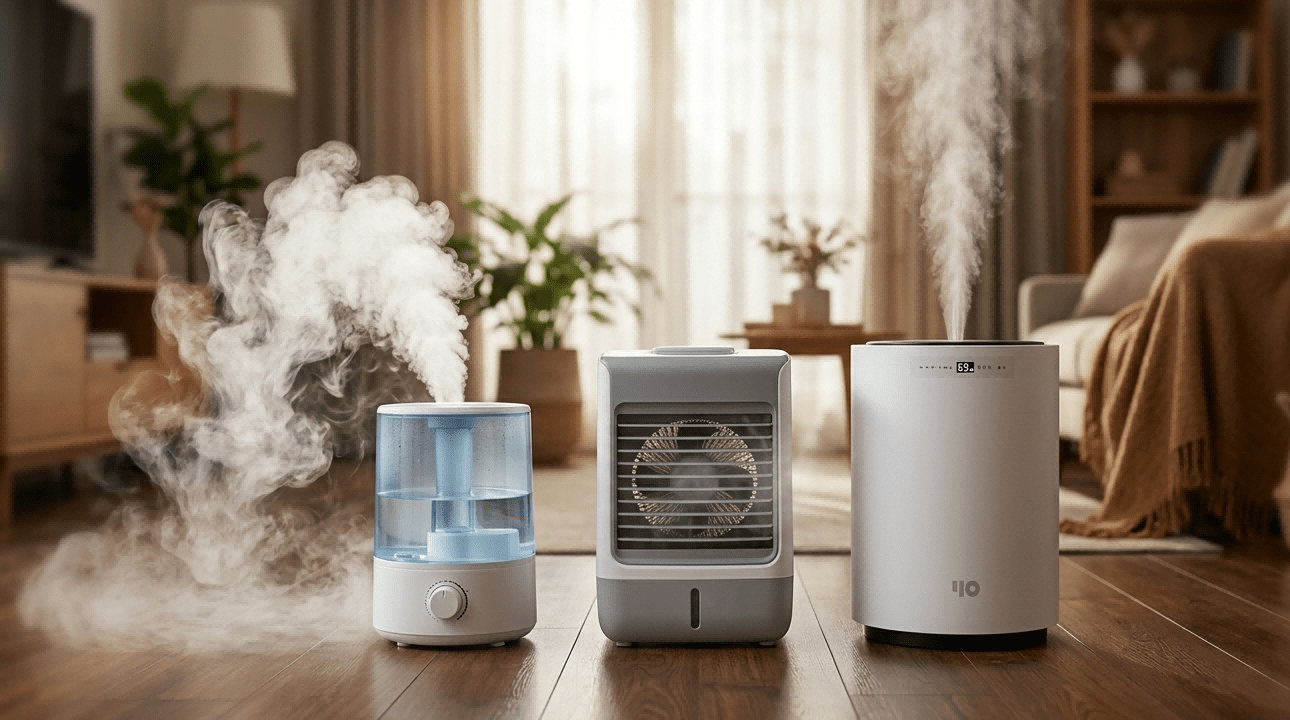

Sie haben bereits entschieden, dass Sie einen Luftbefeuchter brauchen. Gut. Der schwierigere Teil – herauszufinden, ob Ihre Winter in Calgary tatsächlich Ihre Nebenhöhlen ruinieren oder ob das Phoenixer Leitungswasser Ihre Luftqualität verschlechtert – ist bereits geklärt.
Jetzt stehen Sie vor drei völlig unterschiedlichen Technologien mit verdächtig ähnlichen Preisschildern, und die technischen Datenblätter helfen nicht weiter. Ultraschall. Verdunstend. Dampf. Alle sagen, sie „fügen trockener Luft Feuchtigkeit hinzu“. Darüber hinaus haben sie fast nichts gemeinsam.
Dies ist keine Bewertung spezifischer Modelle. Es ist ein direkter Vergleich von drei grundlegend unterschiedlichen Ansätzen zur Luftbefeuchtung – was jeder einzelne mit Ihrem Wasser, Ihrer Luft, Ihrem Geldbeutel und Ihrem Wartungsplan über eine gesamte Heizperiode hinweg anstellt. Wir werden auch die Frage beantworten, die niemand sonst stellt: Wenn Sie bereits einen Ultraschallbefeuchter besitzen, ist ein Wechsel zu Dampf finanziell sinnvoll?
Wie jede Technologie mit Ihrem Wasser umgeht
Das Wichtigste, was Sie über Luftbefeuchter verstehen müssen, ist dies: Sie fügen Ihrer Luft nicht einfach nur Wasserdampf hinzu. Sie verarbeiten Wasser auf Weisen, die sehr unterschiedliche Auswirkungen darauf haben, was in Ihre Lungen gelangt.
So funktioniert jede Technologie tatsächlich – ohne Marketing-Sprech.
Abb. 1 – Was mit gelösten Mineralien bei jedem Technologietyp passiert. Nur Dampf trennt Mineralien durch einen physikalischen Phasenwechsel vom Wasserdampf – die anderen beiden verlassen sich auf mechanische oder biologische Filtration, mit sehr unterschiedlichen Ergebnissen.
Die wichtigste Erkenntnis aus diesem Diagramm: Ultraschall ist die einzige Technologie, die Mineralien absichtlich in die Luft abgibt. Die anderen beiden halten Mineralien aus der Luft fern – aber durch sehr unterschiedliche Mechanismen, mit sehr unterschiedlichen Wartungsfolgen.
Der 8-Faktoren-Vergleich

Hier ist das vollständige Bild, ehrlich bewertet nach jeder Dimension, die für echte Haushalte in den USA und Kanada wirklich wichtig ist.
| Faktor | Ultraschall | Verdunstend | Dampf (Y&O) |
|---|---|---|---|
| Risiko für weißen Staub | Hoch – alle Leitungswassermineralien gelangen in die Luft | Kein Risiko – Mineralien bleiben im Docht | Kein Risiko – Mineralien bleiben im Tank |
| Pathogenabgabe | Hoch – stagniertes Wasser wird aerosolisiert | Mittel – feuchter Docht kann schimmeln | Minimal – 100°C tötet Pathogene ab |
| Städte mit hartem Wasser (Phoenix, Calgary, Denver) | Vermeiden – weißer Staub stark | Akzeptabel mit Dochtwechsel | Spezifisch dafür gebaut – Leitungswasser in Ordnung |
| Wöchentlicher Wartungsaufwand | Tägliche Tankreinigung erforderlich | Wöchentliche Reinigung + monatlicher Dochtwechsel | Wöchentliches Spülen + monatliche Entkalkung |
| Jährliche Verbrauchskosten | 180–360 $/Jahr destilliertes Wasser | 40–80 $/Jahr Dochtfilter | 0 $ – keine Filter, kein destilliertes Wasser |
| Geräuschpegel | Nahezu geräuschlos (~25–30 dB) | Lüftergeräusch (~38–45 dB) | Sieden + leiser Lüfter (~40–48 dB, leiser Modus ruhiger) |
| Energieverbrauch | Niedrig (~25–50W) | Niedrig (~40–80W) | Höher (~800–1.250W, schaltet ein/aus) |
| Abdeckung großer Räume (90 qm) | Schwierig – Tröpfchen setzen sich in Gerätenähe ab | Mäßig bei Hochleistungsmodellen | Effektiv – Dampf steigt auf und verbreitet sich |
Dampfbefeuchter laufen auf ihrer niedrigsten Einstellung am leisesten – vergleichbar mit einem Weißrausch-Gerät. Auf hoher Stufe erzeugt das kochende Wasser ein sanftes Gurgeln, das manche Benutzer beruhigend finden und andere störend. Wenn absolute Stille Ihre Priorität ist, gewinnt Ultraschall. Wenn Sie in einem großen offenen Haus leben, wo das Gerät über 6 Meter entfernt steht, ist der Geräuschpegel von Dampf kein Problem. Für detaillierte Anweisungen zur Wasserart pro Luftbefeuchter siehe unseren Begleitartikel: Kann man Leitungswasser in einem Luftbefeuchter verwenden?
Die realen Kosten über eine Heizperiode
Der Aufkleberpreis ist die falsche Zahl, die man betrachten sollte. Die wichtige Entscheidung sind die Gesamtkosten über eine 6-monatige Heizperiode – Hardware, Verbrauchsmaterialien und Strom zusammen.
Hier ist, was ein typischer Haushalt in Toronto, Calgary oder Chicago tatsächlich ausgibt, vorausgesetzt, ein Gerät läuft 8 Stunden pro Nacht:

Annahmen: 80–120 $ Hardwarekosten, 6-monatige Saison, 8 Std./Nacht. Ultraschall: 25 Gallonen/Monat destilliertes Wasser zu 1,50 $/Gallone. Verdunstend: 2 Dochtwechsel zu je 15–20 $. Dampf: Strom zu durchschnittlich 0,14 $/kWh (USA) bei einem intermittierenden Betriebszyklus von ~35 %.
Das Ergebnis überrascht die meisten Menschen. Ultraschall ist die teuerste Option über eine Heizperiode – mit erheblichem Abstand – speziell aufgrund der fortlaufenden Kosten für destilliertes Wasser. Verdunstung ist insgesamt am günstigsten. Dampf liegt in der Mitte.
Das gilt aber nur für Städte mit hartem Wasser. In Regionen mit weichem Wasser – Küstenregionen von Britisch-Kolumbien, Teile des pazifischen Nordwestens, Neuengland – können Ultraschallbenutzer oft auf destilliertes Wasser verzichten, was die Rechnung erheblich verschiebt.
Wenn Sie bereits einen Ultraschallbefeuchter besitzen – sollten Sie wechseln?
Dies ist die Frage, die niemand sonst direkt beantwortet. Hier ist die ehrliche Rechnung.
Wenn Sie 25–30 $ pro Monat für destilliertes Wasser ausgeben und in einer Stadt mit hartem Wasser wie Phoenix, Las Vegas, Calgary oder Denver leben, werden Sie die Kosten für einen Dampfbefeuchter innerhalb einer Heizperiode allein durch Wassereinsparungen wieder hereinholen. Danach sind Sie jedes Jahr im Plus.
- Sie haben innerhalb weniger Tage nach dem Betrieb Ihres Luftbefeuchters weiße Rückstände auf Möbeln oder Elektronik bemerkt.
- Sie kaufen regelmäßig destilliertes Wasser und ärgern sich über die Kosten.
- Jemand in Ihrem Haushalt leidet an Rhinitis, Asthma oder Atemwegsempfindlichkeiten.
- Ihr Luftbefeuchter muss mehr als einmal pro Woche gereinigt werden, um geruchsfrei zu bleiben.
- Sie leben in Phoenix, Las Vegas, Calgary, Denver, Dallas oder in den meisten Teilen des US-amerikanischen Mittleren Westens oder der Prärieprovinzen.
Wenn zwei oder mehr dieser Punkte zutreffen, ist ein Wechsel finanziell und gesundheitlich sinnvoll. Wenn keiner zutrifft – Sie sich in einem Gebiet mit weichem Wasser befinden und sorgfältig reinigen – funktioniert Ihr aktueller Ultraschallbefeuchter möglicherweise einwandfrei.
Dampfgeräte ziehen in der Spitze 800–1.250 W – ungefähr so viel wie ein Haartrockner. Sie schalten sich jedoch ein und aus, um die Zielfeuchtigkeit aufrechtzuerhalten, anstatt kontinuierlich zu laufen, sodass der tatsächliche Verbrauch näher bei 35–40 % der Spitzenleistung liegt. Bei durchschnittlichen US-Strompreisen (0,14 $/kWh) kostet eine 6-monatige Saison etwa 50–75 $ an zusätzlichem Strom. Das ist echtes Geld, wird aber durch null Filter- oder destillierte Wasserkosten ausgeglichen. In Provinzen wie Ontario oder Alberta mit variablen Strompreisen kann sich die Rechnung leicht verschieben – es lohnt sich, dies zu berücksichtigen, wenn Ihre Stromrechnung bereits hoch ist.
Welche Technologie ist die richtige für Ihr Zuhause?
Nutzen Sie diesen Entscheidungsbaum, um Ihre Antwort in weniger als 60 Sekunden zu finden.
Abb. 2 – Nutzen Sie diesen Entscheidungsbaum, um Ihren empfohlenen Luftbefeuchtertyp zu finden. Die beiden häufigsten Ergebnisse für Haushalte mit hartem Wasser in den USA und Kanada sind Dampf oder Dampf/Verdunstung.
Regionaler Leitfaden: USA & Kanada

Die Wasserhärte variiert stark je nach Region. Hier ist, wie man es geografisch betrachtet:
| Region | Wasserhärte | Empfohlener Typ | Wichtigster Grund |
|---|---|---|---|
| Phoenix, Las Vegas, Tucson | Sehr hart (300–800 mg/L) | Dampf | Weißer Staub ist bei Ultraschall stark; Verdampfungsdochte verstopfen schnell |
| Calgary, Edmonton, Saskatoon | Hart (200–400 mg/L) | Dampf | Grundwasser der Prärie und Kommunalwasser sind hart; lange Heizperioden |
| Denver, Dallas, Houston | Hart (150–350 mg/L) | Dampf | Hartes Wasser + trockene Winter machen Dampf zur klaren praktischen Wahl |
| Chicago, Toronto, Minneapolis | Mäßig (100–200 mg/L) | Dampf oder Verdunstend | Beide funktionieren; Dampf punktet bei Gesundheit und Wartung; Verdunstung beim Preis |
| Vancouver, Seattle, Portland | Weich (<80 mg/L) | Jeder Typ | Weiches, aus Bergen stammendes Wasser; Ultraschall funktioniert hier gut mit Leitungswasser |
| Küstenregion Neuengland (Boston, Halifax) | Weich–Mäßig | Verdunstend oder Dampf | Mäßige Härte; beide Ansätze sind je nach Prioritäten vernünftig |
Sie sind sich bei Ihrer Stadt nicht sicher? Ihr städtisches Wasserversorgungsunternehmen ist gesetzlich verpflichtet, jährliche Wasserqualitätsberichte zu veröffentlichen – suchen Sie nach „[Ihre Stadt] Wasserqualitätsbericht“ und achten Sie auf „Härte“ oder „Gesamt der gelösten Feststoffe (TDS)“. Über 120 mg/L wird von der US Geological Survey als hart eingestuft.
Was echte Benutzer sagen
Community-Diskussionen auf Reddit r/BuyItForLife, r/Humidifiers und r/Calgary zeigen durchweg dasselbe Wechselmuster in Regionen mit hartem Wasser.
Unabhängige Prüfer haben alle drei Technologie-Typen direkt getestet. Eine Auswahl relevanter Drittanbieter-Bewertungen:
Technologie-Aufschlüsselung, die zeigt, wann Dampf Ultraschall deutlich übertrifft – besonders in nordamerikanischen Haushalten mit hartem Wasser
Praktischer Vergleich von Dampf vs. Ultraschall mit Analyse der gesundheitlichen Auswirkungen für jede Technologie
Umfassender Test inklusive eines speziellen Wartungskapitels – behandelt weißen Staub, Filterschimmel und den tatsächlichen Reinigungsaufwand über alle Typen hinweg
Die ehrlichen Kompromisse – Was Dampf nicht behebt
Dampf gewinnt bei Hygiene, Leistung bei hartem Wasser und langfristigen Kosten. Er gewinnt nicht bei allem. Hier erfahren Sie, was Sie vor Ihrer Entscheidung wissen sollten.
- Der Energieverbrauch ist real – 800–1.250 W Spitzenleistung, obwohl das Takten den tatsächlichen Verbrauch auf ca. 35–40 % davon reduziert
- Entkalken ist in Gebieten mit hartem Wasser monatlich erforderlich – der Vorgang ist einfach, aber eine echte Aufgabe
- Nicht kompatibel mit ätherischen Ölen – das Heizelement verstopft und funktioniert nicht mehr
- Die Ausgangstemperatur von 50 °C (122 °F) bedeutet, dass er außerhalb der direkten Reichweite kleiner Kinder platziert werden sollte
- In Regionen mit sehr weichem Wasser ist der Vorteil von weißem Staub gegenüber Verdampfern weniger signifikant
Für Haushalte in Regionen mit weichem Wasser, in denen Geräuschempfindlichkeit oberste Priorität hat – Pazifischer Nordwesten, Küste von BC, maritimes Kanada – könnte ein Verdampfungsbefeuchter tatsächlich die bessere Wahl sein. Verdampfungsmodelle sind die kostengünstigste Option, wenn das Wasser bereits weich ist, und sie erzeugen keinen weißen Staub.
Das vollständige Argument für die Sterilisation – warum eine Ausgabe von 212 °F über die bloße Mineralientrennung hinaus wichtig ist – wird ausführlich in unserem Hauptartikel behandelt: Warum 100 % steril der #1 Standard für Luftbefeuchter ist →
Der Y&O Steam Plus hat keinen Filter, der jemals ausgetauscht werden müsste. Mineralien, die einen Verdampfungswirbel verstopfen oder in einem Ultraschallgerät in die Luft gelangen würden, sammeln sich einfach am Tankboden als sichtbare Ablagerungen und werden dann am Reinigungstag ausgespült. Eine detaillierte Aufschlüsselung der Wartung mit und ohne Filter im Laufe der Zeit finden Sie unter: Filterfreier Dampfbefeuchter: Vorteile und Wartung →

Bereit, keine Filter mehr zu ersetzen und destilliertes Wasser zu kaufen?
Der Y&O Steam Plus funktioniert mit Leitungswasser in jeder US-amerikanischen oder kanadischen Stadt – hartes Wasser, weiches Wasser, spielt keine Rolle. Keine Filter. Kein destilliertes Wasser. Kein weißer Staub.
Den Y&O Steam Plus ansehen →Ihre Fragen beantwortet
Ist ein Dampfbefeuchter sicher für Babys und Kleinkinder?
Der Dampfausstoß eines Y&O-Geräts liegt bei ca. 50 °C (122 °F) – warm, aber bei typischen Raumabständen nicht kochend heiß. Die praktische Vorsichtsmaßnahme ist die Platzierung: Stellen Sie das Gerät auf eine stabile Oberfläche, wo ein Kleinkind es nicht umkippen oder den Auslass erreichen kann. Für Kinderzimmer bevorzugen viele Eltern Verdampfungsbefeuchter wegen ihrer kühlen Ausgabe, während andere Dampf wegen seiner überlegenen Keimeliminierung und des fehlenden weißen Staubs wählen. Beide sind bei korrekter Platzierung eine vernünftige Wahl für ein Kinderzimmer. Der größere Risikofaktor bei jedem Luftbefeuchter im Babyzimmer ist der weiße Mineralstaub von Ultraschallmodellen – ein Risiko, das Dampf vollständig beseitigt.
Verbraucht ein Dampfbefeuchter deutlich mehr Strom als Ultraschall- oder Verdampfungsgeräte?
Auf dem Papier ja – Dampfbefeuchter verbrauchen 800–1.250 W gegenüber 25–80 W bei den anderen Typen. In der Praxis schalten sich Dampfgeräte ein und aus, um die Zielfeuchtigkeit aufrechtzuerhalten, anstatt kontinuierlich zu laufen, wodurch der reale Verbrauch auf etwa 35–40 % der Spitzenleistung sinkt. Bei durchschnittlichen US-Strompreisen (0,14 $/kWh) erhöht der Betrieb eines Dampfbefeuchters 8 Stunden pro Nacht für eine 6-monatige Heizperiode Ihre Stromrechnung um etwa 50–75 $. Im gleichen Zeitraum geben Ultraschall-Nutzer mit hartem Wasser typischerweise 180–360 $ für destilliertes Wasser aus. Endergebnis: Dampf ist in Städten mit hartem Wasser insgesamt günstiger, trotz der höheren Wattleistung.
Kann ich in allen drei Luftbefeuchtertypen Leitungswasser verwenden?
Kurze Antwort: Ja für Dampf- und Verdampfungsgeräte, dringend nicht empfohlen für Ultraschallgeräte in Gebieten mit hartem Wasser. Ultraschallgeräte zerstäuben alles im Wasser – einschließlich Mineralien – direkt in Ihre Luft. In Regionen mit weichem Wasser (Vancouver, Seattle, Küste Neuenglands) ist dies ein geringfügiges Problem. In Städten mit hartem Wasser wie Phoenix, Calgary oder Denver erzeugt dies erheblichen weißen Staub und messbare PM-Anstiege in Innenräumen. Dampf- und Verdampfungsgeräte verarbeiten Leitungswasser beide, ohne Mineralien in die Luft zu schleudern. Eine detaillierte Aufschlüsselung nach Wassertyp und Luftbefeuchtertechnologie finden Sie unter: Können Sie Leitungswasser in einem Luftbefeuchter verwenden? →
Welcher Luftbefeuchtertyp ist am leisesten?
Ultraschall ist der klare Gewinner in puncto Geräuschentwicklung – die Piezoscheibe arbeitet oberhalb des menschlichen Hörbereichs, und das einzige Geräusch ist ein sehr leiser Lüfter. Verdampfungsmodelle erzeugen ein leises, aber hörbares Lüftersummen (~38–45 dB), vergleichbar mit einer ruhigen Büroumgebung. Dampfgeräte erzeugen eine Kombination aus sanften Kochgeräuschen und geringer Lüfterleistung – am lautesten von den dreien bei hohen Einstellungen, aber merklich leiser im niedrigen oder Schlafmodus. Unabhängige Tests von Rezensenten, darunter Your Review Channel, ergaben, dass das Geräuschniveau von Dampf im niedrigen Modus für die meisten Schlafenden akzeptabel ist, obwohl extrem leichte Schläfer die nahezu geräuschlose Ultraschallfunktion bevorzugen könnten.
Wie lange hält jeder Typ typischerweise, bevor er ersetzt werden muss?
Bei richtiger Wartung können alle drei Typen 5–10 Jahre halten. Der praktische Unterschied in der Lebensdauer ergibt sich aus Verschleißteilen: Die Piezoscheiben von Ultraschallgeräten können sich verschlechtern, wenn sie mit hartem Leitungswasser ohne Entkalkung betrieben werden, und Schimmelschäden durch unzureichende Reinigung können Kunststoffkomponenten beeinträchtigen. Lüfter und Dochtgehäuse von Verdampfungsgeräten sind im Allgemeinen haltbar, aber die Dochte selbst sind Verbrauchsmaterial (alle 4–8 Wochen auszutauschen). Der Hauptverschleißpunkt von Dampfgeräten ist das Heizelement – Kalkablagerungen sind der Hauptfehlergrund, weshalb eine monatliche Entkalkung wichtig ist. Ein gut gewarteter Dampfbefeuchter mit regelmäßiger Entkalkung hat keinen inhärenten mechanischen Grund, über viele Jahre auszufallen.
Verwandte Artikel
Quellen & Referenzen
- U.S. Geological Survey — Wasserhärte
- U.S. Environmental Protection Agency — Verwendung und Pflege von Luftbefeuchtern für den Haushalt
- ASHRAE Standard 55 — Thermische Umweltbedingungen für die menschliche Belegung
- Virginia Tech — Luftbefeuchter und Raumluftqualität (Prof. Andrea Dietrich, 2025)
- RTINGS — White Dust Research: Einfluss des Wassertyps auf PM-Werte
- Reddit Community Discussions — r/BuyItForLife · r/Humidifiers · r/Calgary
- Y&O — YO-M2 Steam Plus Produktseite
- YouTube Independent Reviews — GoTechGeek · Antonio Sanson · Computer Tech & More