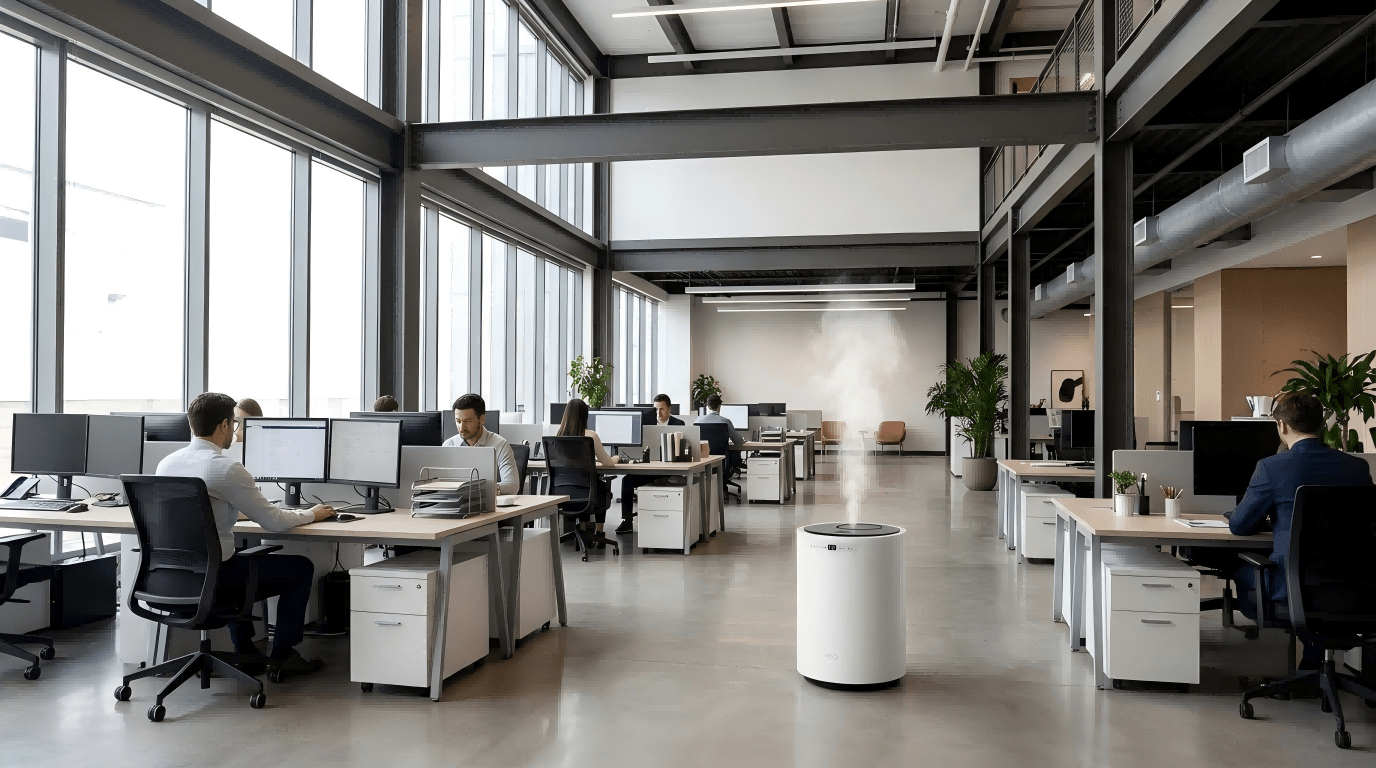

Die meisten Inhalte zu Luftbefeuchtern sind für Schlafzimmer geschrieben. Das Gerät wird auf einem Nachttisch platziert, läuft acht Stunden lang und die Tür bleibt geschlossen. Die Berechnung ist überschaubar.
Große Räume und gewerbliche Umgebungen funktionieren nicht so. Offene Grundrisse, hohe Decken, ständig laufende HVAC-Systeme, ein- und ausgehende Personen – jeder dieser Faktoren erhöht den Feuchtigkeitsbedarf über das hinaus, wofür Standard-Luftbefeuchter für den Haushalt ausgelegt sind. Die meisten versagen stillschweigend: Das Gerät läuft, das Display zeigt eine ausreichende Luftfeuchtigkeit an und die tatsächliche Raumluft bleibt trocken.
Dieser Leitfaden behandelt, warum große Räume und gewerbliche Umgebungen einen grundlegend anderen Ansatz zur Befeuchtung erfordern – die tatsächlich funktionierenden Leistungsberechnungen, die biologischen Sicherheitsanforderungen, die wichtiger sind, wenn Menschen stundenlang in einem gemeinsam genutzten Raum verbringen, und die Technologiewahl, die einen kontinuierlichen gewerblichen Einsatz ermöglicht.
Warum Luftbefeuchter für den Haushalt in großen Räumen versagen
Der Fehlerfall ist vorhersehbar. Ein Luftbefeuchter, der für 45 Quadratmeter ausgelegt ist, wird in einem 55 Quadratmeter großen Großraumbüro aufgestellt. Das Display zeigt 45 % relative Luftfeuchtigkeit an. Die Luft fühlt sich trocken an. Die Menschen sind immer noch verstopft. Nichts scheint zu funktionieren.
Der Grund dafür ist, dass die Reichweitenangaben von Luftbefeuchtern für den Haushalt unter idealen Bedingungen berechnet werden, die gewerbliche Umgebungen niemals bieten: ein versiegelter Raum, Standarddeckenhöhe von 2,40 Metern, minimaler Luftaustausch und kein Personenverkehr. Wird eine dieser Bedingungen entfernt, sinkt die effektive Reichweite erheblich. Werden alle entfernt, liefert das Gerät vielleicht 30–40 % seiner angegebenen Reichweite.
| Faktor | Referenzwert für den Haushalt | Realität im Gewerbe / großer Raum | Auswirkungen auf die Luftfeuchtigkeit |
|---|---|---|---|
| Deckenhöhe | 2,40 m Standard | 3–4,30 m üblich in Gewerberäumen | 25–75 % mehr Luftvolumen zu befeuchten |
| Luftaustauschrate | Niedrig in geschlossenem Schlafzimmer | Hoch – HVAC, sich öffnende Türen, Belüftungssysteme | Kontinuierliche Feuchtigkeitsentfernung aus der Raumluft |
| Offener Grundriss | Geschlossener Raum – Feuchtigkeit bleibt erhalten | Offen – Feuchtigkeit verteilt sich in angrenzenden Räumen | Effektiver Abdeckungsbereich dramatisch reduziert |
| Belegung | 1–2 Personen | Mehrere Personen – Körperwärme erhöht die Temperatur, beeinflusst die relative Luftfeuchtigkeit | Höhere Leistung erforderlich, um die Ziel-RH aufrechtzuerhalten |
| Betriebsstunden | 8 Stunden über Nacht | 8–12 Stunden kontinuierlicher Tagesbetrieb | Tankkapazität und Ausgabekonsistenz entscheidend |
Das Ergebnis ist, dass der Befeuchtungsbedarf für gewerbliche oder große Räume typischerweise das Zwei- bis Dreifache der Leistung dessen beträgt, was die Quadratmeterzahl des Raumes in Wohnräumen vermuten lassen würde. Dies ist kein Problem der Produktqualität – es ist ein Physikproblem, das die Produktbewertungen für den Haushalt nicht berücksichtigen.
Die Angaben zur Abdeckungsfläche von Luftbefeuchtern auf der Verpackung werden unter Bedingungen berechnet, die in gewerblichen Räumen niemals repliziert werden. Die Zahl, die tatsächlich die Leistung vorhersagt, ist die Ausgabeleistung in ml/h – wie viel Feuchtigkeit das Gerät pro Stunde unter realen Betriebsbedingungen der Luft hinzufügen kann. Für große Räume ist dies die einzige Kennzahl, die einen Vergleich wert ist. Für die vollständige Erklärung: Warum Angaben zur Luftbefeuchterabdeckung fast immer falsch sind →
Leistungsanforderungen nach Raumtyp
Der Ausgangspunkt für jede Berechnung der Befeuchtung großer Räume ist das Luftvolumen in Kubikmetern, nicht die Grundfläche in Quadratmetern. Die Deckenhöhe multipliziert das Volumen erheblich – und mit dem Volumen muss der Luftbefeuchter tatsächlich arbeiten.
| Raumtyp | Typische Abmessungen | Deckenhöhe | Benötigte Leistung (ml/h) | Anmerkungen |
|---|---|---|---|---|
| Privates Büro | 14–23 qm | 2,7–3 m | 300–500 ml/h | Tür geschlossen – besser isoliert |
| Großraumbüro-Zone | 37–74 qm | 3–3,7 m | 700–1.000 ml/h | HVAC- und Luftaustauschanforderungen im oberen Bereich |
| Klassenzimmer / Kindertagesstätte | 56–84 qm | 2,7–3,4 m | 800–1.200 ml/h | Hohe Belegung und Belüftungsanforderungen |
| Yoga- / Fitnessstudio | 74–140 qm | 3,7–4,9 m | 1.000–1.200+ ml/h | Hohe Decken und Körperwärme erhöhen den Bedarf erheblich |
| Heimstudio / großes Wohnzimmer | 37–65 qm | 2,7–3,7 m | 600–900 ml/h | Offener Grundriss – Feuchtigkeit verteilt sich seitlich |
| Empfangs- / Wartebereich | 28–56 qm | 3–4,3 m | 500–900 ml/h | Hoher Fußgängerverkehr und sich öffnende Türen erhöhen den Bedarf |
Diese Zahlen gehen von Heizperiodenbedingungen aus – Außentemperaturen unter 4°C und kontinuierlich laufende Heizung oder HVAC-Anlage. Unter milderen Bedingungen ist die benötigte Leistung geringer. Bei extremer Kälte (unter -18°C) kann die benötigte Leistung 20–30 % höher sein als die oben genannten Bereiche.
Die praktische Implikation: Für die meisten gewerblichen Räume und große offene Umgebungen ist ein einzelnes Gerät mit einer Leistung von 1.200 ml/h – die maximale Leistung des YO-M2 – die minimal realisierbare Spezifikation. Geräte mit geringerer Leistung werden unabhängig von ihren angegebenen Reichweitenangaben eine schlechtere Leistung erbringen.

Biologische Sicherheit in gemeinsam genutzten Räumen
In einem Schlafzimmer ist die Person, die am stärksten von einem kontaminierten Luftbefeuchtertank betroffen ist, die Person, die ihn aufgestellt hat. In einem gewerblichen oder gemeinsam genutzten Raum sind es alle, die dort arbeiten, lernen oder trainieren – oft 8 Stunden am Tag, 5 Tage die Woche.
Kaltnebel- und Ultraschallbefeuchter in gewerblichen Umgebungen stellen ein biologisches Risiko dar, das mit der Belegungszahl und den Betriebsstunden skaliert. Ein Tank, der durch unzureichende Reinigung Bakterien- oder Schimmelpilzwachstum entwickelt, betrifft nicht nur einen Schlafenden über Nacht – er versprüht kontinuierlich Aerosole in die gemeinsame Luft eines Büros, Klassenzimmers oder Studios während des gesamten Betriebstages.
Gewerbliche Umgebungen haben auch selten eine dedizierte Person, die für die tägliche Wartung des Luftbefeuchtertanks zuständig ist. In einem Haushalt hat der Gerätebesitzer einen direkten Anreiz, ihn sauber zu halten. In einem Büro oder Klassenzimmer ist der Luftbefeuchter eine gemeinsam genutzte Infrastruktur – und gemeinsam genutzte Infrastruktur erhält selten die tägliche Aufmerksamkeit, die Kaltnebelgeräte biologisch erfordern.
Dampfbefeuchter lösen dieses Problem durch ihr Design. Der Kochvorgang reduziert das biologische Kontaminationsrisiko während des Betriebs erheblich, unabhängig davon, ob der Tank gestern oder letzte Woche gereinigt wurde. Für ein Gerät, das in einem Raum läuft, in dem 10 Personen 8 Stunden am Tag die Abluft atmen, ist dies keine zweitrangige Überlegung.
In Städten mit hartem Wasser – Phoenix, Las Vegas, Denver, Dallas, Salt Lake City – zerstäuben Ultraschall- und Kaltnebelbefeuchter kontinuierlich Mineralpartikel in die Raumluft. In einem Haushalt betrifft dies ein oder zwei Personen. In einem Klassenzimmer oder Büro betrifft es alle Anwesenden den gesamten Betriebstag lang. Dampfbefeuchter hinterlassen Mineralien im Tank. Für den gewerblichen Einsatz in Märkten mit hartem Wasser ist dies eine praktische Anforderung an die Luftqualität, keine Präferenz. Vollständige Analyse: Hartes Wasser & weißer Staub: Was wirklich in Ihrer Luft ist →
Warum Dampf die richtige Technologie für den gewerblichen Einsatz ist
Die Technologieentscheidung für die gewerbliche Befeuchtung beruht auf drei Anforderungen, die bei Vergleichen mit Produkten für den Haushalt zu gering bewertet werden: Ausgabekonsistenz unter Dauerlast, biologische Sicherheit in gemeinsam genutzten Kontexten und Wartungsrealismus in Umgebungen ohne dediziertes Personal.
Konsistenz der Ausgabe
Kaltnebel-Verdunstungsgeräte unterliegen abnehmenden Erträgen, wenn die Raumfeuchtigkeit ansteigt – je näher die relative Luftfeuchtigkeit des Raumes am Zielwert liegt, desto langsamer wird die Verdunstung und desto geringer ist die effektive Leistung. In einem großen Raum, in dem das Gerät hart arbeitet, um die relative Luftfeuchtigkeit von 20 % auf 45 % zu erhöhen, bedeutet dies, dass die Leistung genau dann sinkt, wenn der Bedarf am höchsten ist.
Dampfbefeuchter halten die Leistung unabhängig vom Raumfeuchtigkeitsniveau konstant. Ein Gerät mit einer Leistung von 1.200 ml/h liefert diesen Wert annähernd, egal ob die Raumfeuchtigkeit 20 % oder 45 % beträgt. Für gewerbliche Räume, in denen das Ziel darin besteht, einen Zielbereich zu erreichen und aufrechtzuerhalten, ist diese Konsistenz von großer Bedeutung.
Biologische Sicherheit im großen Maßstab
Wie oben beschrieben, vervielfacht sich das biologische Risiko von Kaltnebelgeräten mit der Belegung und den Betriebsstunden. Der Siedeprozess von Dampf reduziert dieses Risiko während des Betriebs erheblich – weshalb die Dampftechnologie der Standard in medizinischen, Gastgewerbe- und Lebensmittelbefeuchtungskontexten ist, in denen die biologische Sicherheit der gemeinsamen Luft eine formelle Anforderung ist.
Realistische Wartung
Ein Kaltnebelbefeuchter in einer gewerblichen Umgebung erfordert eine tägliche Tankreinigung, um biologisch sicher zu bleiben. In der Praxis bedeutet dies, dass jeder, der für den Raum verantwortlich ist – ein Büroleiter, ein Lehrer, ein Studiobesitzer –, den Tank täglich leeren, trocknen und nachfüllen muss. Dies wird in gewerblichen Umgebungen selten konsequent eingehalten.
Dampfbefeuchter reduzieren diesen Wartungsaufwand erheblich. Der Kochvorgang bewältigt die biologische Kontamination während des Betriebs. Der Tank muss immer noch regelmäßig gereinigt werden – aber die Folge eines verpassten Reinigungszyklus ist die Ansammlung von Mineralien, nicht die Aerosolisierung von Bakterien in der gemeinsamen Luft. Für gewerbliche Betreiber ist dies ein bedeutender operativer Unterschied.
Platzierung für große Räume und gewerbliche Umgebungen
Die Platzierung in großen Räumen erfordert ein Zonenkonzept anstelle einer punktuellen Ausgabe. Eine Einheit – selbst bei 1.200 ml/h – kann nicht einen gesamten offenen Grundriss gleichmäßig befeuchten. Ziel ist es, Einheiten dort zu platzieren, wo die Ausgabe durch die am stärksten frequentierten Bereiche diffundiert.
- Platzieren Sie es an einer Wand an einem zentralen Ort relativ zur Zone, die Sie befeuchten möchten.
- Vermeiden Sie die Platzierung direkt unter oder neben HLK-Belüftungsöffnungen – erzwungene Luft verteilt die Feuchtigkeit, bevor sie die Raum-RH erhöhen kann.
- In offenen Räumen behandeln Sie jede Zone von 74–93 Quadratmetern als separaten Einheitenbedarf.
- Positionieren Sie es mindestens 1,80–2,40 Meter von der nächsten Arbeitsstation oder dem besetzten Bereich entfernt.
- Stellen Sie sicher, dass die Ausgabe nach oben steigt und sich verteilt – nicht horizontal auf Schreibtisch- oder Atemhöhe gerichtet ist.
- Verlegen Sie Stromkabel entlang von Wänden und hinter Möbeln in stark frequentierten Bereichen.
- Verwenden Sie ein eigenständiges Hygrometer auf Augenhöhe der Bewohner, um die RH zu überprüfen – nicht den eingebauten Sensor des Luftbefeuchters.
Für Räume über 93 Quadratmeter wird eine einzelne Einheit mit 1.200 ml/h wahrscheinlich 40–45 % relative Luftfeuchtigkeit in der unmittelbaren Zone aufrechterhalten, aber im gesamten Raum zu kurz kommen. Zwei Einheiten, die an gegenüberliegenden Enden des Raums positioniert sind, sind effektiver als eine Einheit mit maximaler Leistung in der Mitte.
Der Y&O Steam Plus – Gebaut für den kontinuierlichen Einsatz in großen Räumen
1.200 ml/h Leistung · 10L Doppeltank · Kein Filter · Dampfsterilisation · Kein weißer Staub · Automatische Abschaltung · 8–12h Dauerbetrieb pro Füllung
Siehe YO-M2 Steam Plus →Ihre Fragen beantwortet
Wie viele Luftbefeuchter benötigt ein großes Großraumbüro?
Behandeln Sie jede Zone von 74–93 Quadratmetern als eine Einheit, vorausgesetzt, die Deckenhöhe beträgt 3–3,7 Meter und die HLK-Anlage wird standardmäßig betrieben. Eine offene Etage von 186 Quadratmetern mit 3,7 Meter hohen Decken und aktiver Belüftung benötigt realistisch zwei Einheiten, die jeweils 1.000–1.200 ml/h abgeben, um während der Heizperiode eine relative Luftfeuchtigkeit von 40–50 % aufrechtzuerhalten. Eine einzelne Einheit in der Mitte zu platzieren und zu erwarten, dass sie die gesamte Etage abdeckt, wird durchweg zu einer Unterleistung führen – die Feuchtigkeit verteilt sich in offenen Räumen und wird kontinuierlich durch HLK-Systeme entfernt. Verwenden Sie an mehreren Stellen im Raum eigenständige Hygrometer auf Augenhöhe der Bewohner, um die tatsächliche Verteilung der relativen Luftfeuchtigkeit zu überprüfen, nicht nur die Anzeige in der Nähe des Geräts. Vollständige Größenrichtlinien: Wie viele Luftbefeuchter benötigt ein großer Raum tatsächlich? →
Ist ein Luftbefeuchter in einem Büro oder Geschäftsraum notwendig?
In der nordamerikanischen Heizperiode – Oktober bis März – sinkt die relative Luftfeuchtigkeit in Innenräumen eines Gewerberaums ohne Befeuchtung typischerweise auf 20–30 %. Bei diesen Werten leiden die Bewohner unter trockenen Nasenschleimhäuten, erhöhter Anfälligkeit für luftgetragene Krankheitserreger, trockener Haut und Augenreizungen. ASHRAE Standard 55 empfiehlt eine relative Luftfeuchtigkeit von 30–60 % für thermischen Komfort und die Gesundheit der Bewohner in Gewerberäumen. Neben dem Komfort der Bewohner erhöht niedrige Luftfeuchtigkeit in Büros die statische Elektrizität (ein praktisches Problem bei Elektronik) und verursacht in Räumen mit Holzböden oder Musikinstrumenten im Laufe der Zeit strukturelle Schäden. Für Räume, in denen im Winter täglich 8 Stunden oder länger geheizt wird, ist eine aktive Befeuchtung Standard in der Gebäudeverwaltung.
Welche Art von Luftbefeuchter ist am besten für Klassenzimmer oder Kindertagesstätten geeignet?
Für Klassenzimmer und Kindertagesstätten ist biologische Sicherheit die wichtigste Anforderung – denn das Gerät läuft den ganzen Tag in einem Raum mit Kindern, die sich in der Entwicklung befindliche Immunsysteme und eine hohe Exposition gegenüber Atemwegsviren haben. Kaltnebel- und Ultraschallgeräte erfordern eine tägliche Reinigung, um Bakterien- und Schimmelwachstum in stehendem Wasser zu verhindern; dies wird in Bildungseinrichtungen, in denen das Personal mehrere Aufgaben hat, selten konsequent eingehalten. Dampfbefeuchter reduzieren das Risiko biologischer Kontamination durch den Kochprozess erheblich, wodurch sie besser für Umgebungen geeignet sind, in denen die Wartungskonsistenz nicht garantiert werden kann und in denen die Leistung täglich von 20–30 Kindern für 6–8 Stunden genutzt wird. Vollständige, klassenzimmerspezifische Anleitung: Luftbefeuchter für Klassenzimmer und Kindertagesstätten →
Woher weiß ich, ob mein gewerblicher Luftbefeuchter tatsächlich funktioniert?
Der eingebaute RH-Sensor des Luftbefeuchters ist fast nie ein genaues Maß für die Raumluftfeuchtigkeit – er misst die Luft in der Nähe des Geräts, die immer höher ist als das Umgebungsniveau im Raum. Platzieren Sie unabhängige Hygrometer auf Augenhöhe der Bewohner an zwei oder drei Stellen im Raum: eines in der Nähe des Geräts, eines am entgegengesetzten Ende des Bereichs und eines an einem typischen Arbeitsplatz. Der Wert auf Augenhöhe am entgegengesetzten Ende des Bereichs ist der entscheidende Wert. Wenn er konstant unter 40 % liegt, benötigen Sie entweder eine höhere Leistung, eine bessere Platzierung oder ein zusätzliches Gerät. Viele kommerzielle Betreiber stellen fest, dass ihr Luftbefeuchter monatelang lief, während das entgegengesetzte Ende des Büros bei 25–30 % RH blieb – weil sie nur die Anzeige am Gerät überprüften.
Kann ich einen Luftbefeuchter für den Haushalt in einem gewerblichen Raum verwenden?
Das hängt von der Raumgröße und den Betriebszeiten ab. Ein Haushaltsgerät mit 800–1.200 ml/h Leistung kann ein privates Büro oder ein kleines Studio (150–300 qm, Tür geschlossen) während der üblichen Geschäftszeiten effektiv befeuchten. Für offene Räume, Klassenzimmer oder jeden Raum über 400 qm mit aktiver Klimaanlage sind Haushaltsgeräte in der Regel nicht ausreichend – nicht wegen der Qualität, sondern weil sie nicht für die Luftwechselraten und Betriebszeiten kommerzieller Umgebungen ausgelegt sind. Die 10-Liter-Tankkapazität des YO-M2 ist hier besonders relevant: Die meisten kleineren Haushaltsgeräte müssen alle 4–6 Stunden nachgefüllt werden, was den Tagesbetrieb in gewerblichen Umgebungen unterbricht. Ein 10-Liter-Tank bei moderater Leistung läuft 8–12 Stunden ununterbrochen – und deckt so einen vollen kommerziellen Betriebstag ohne Nachfüllunterbrechung ab.
Ähnliche Artikel
Quellen & Referenzen
- ASHRAE Standard 55 — Thermal Environmental Conditions for Human Occupancy
- ASHRAE Standard 62.1 — Ventilation and Acceptable Indoor Air Quality in Commercial Buildings
- U.S. Environmental Protection Agency — Indoor Air Quality in Commercial Buildings
- U.S. Environmental Protection Agency — Use and Care of Home Humidifiers
- NOAA — U.S. Climate Data
- U.S. Geological Survey — Hardness of Water — Regional Data
- Y&O — YO-M2 Steam Plus Produktseite