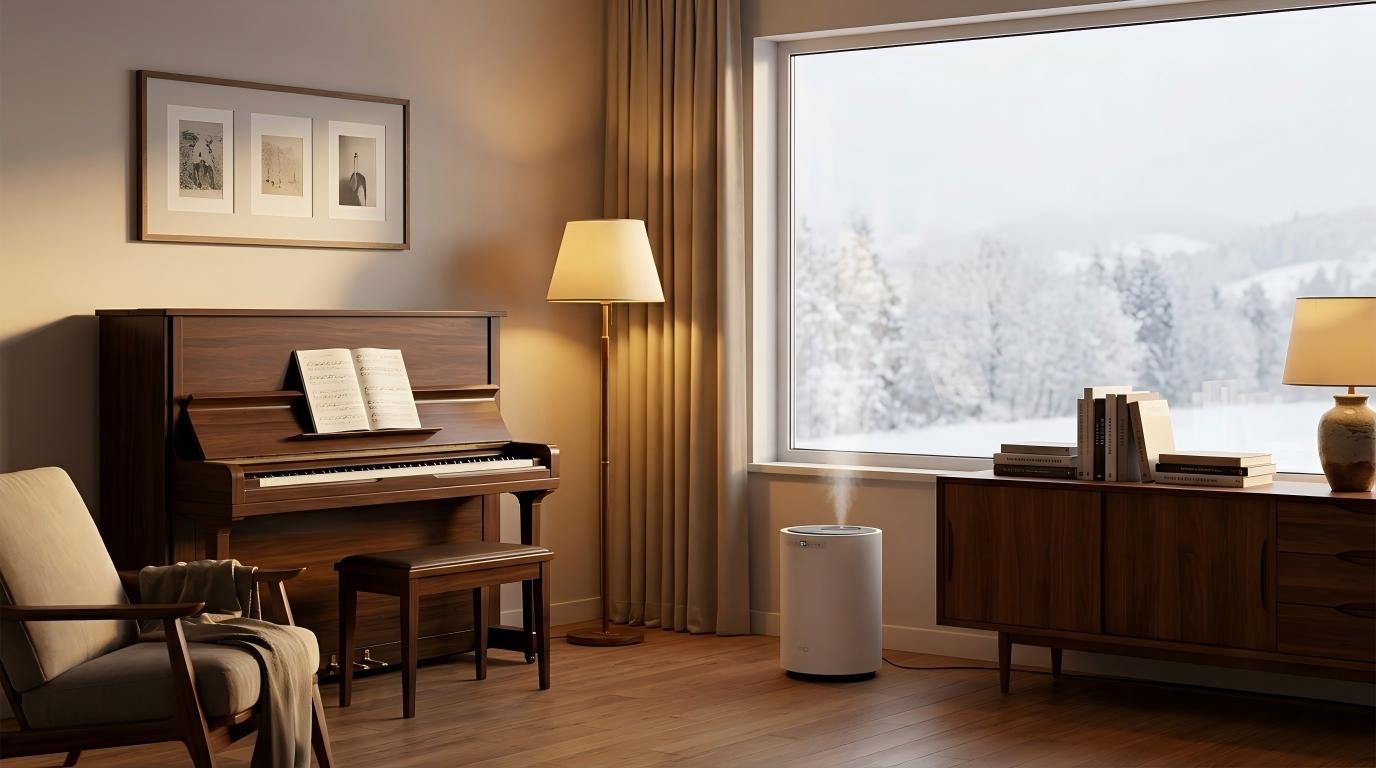

Sie haben echtes Geld für dieses Zuhause ausgegeben. Die breiten Eichendielen. Das Ledersofa. Das Mid-Century-Sideboard aus Walnussholz. Vielleicht ein Klavier, das seit zwei Generationen in der Familie ist, oder Kunstwerke, die Sie von einer wichtigen Reise mitgebracht haben.
Jeden Winter, von November bis März, wirkt etwas Unsichtbares gegen all diese Dinge. Es ist nicht der Gebrauch. Es ist nicht das Alter. Es ist die Luft.
Trockene Winterluft entzieht Holz, Leder, Papier und allen anderen natürlichen Materialien in Ihrem Zuhause Feuchtigkeit – was zu Rissen, Verformungen, Sprödheit und Oberflächenschäden führt, die die meisten Hausbesitzer fälschlicherweise für normale Abnutzung halten. Was die meisten Menschen nicht wissen, ist, dass der Ultraschall-Luftbefeuchter, den sie zur Behebung des Problems gekauft haben, die Dinge auf eine andere Weise oft noch schlimmer macht – indem er dieselben Oberflächen mit einer feinen Schicht Mineralstaub überzieht, die nahezu unmöglich zu entfernen ist. Dieser Leitfaden erklärt, was diesen Winter tatsächlich in Ihrem Zuhause passiert und wie eine richtige Lösung aussieht.
Die vier Dinge, die trockene Luft gerade beschädigt
Wenn die Luftfeuchtigkeit in Innenräumen unter 30 % relativer Luftfeuchtigkeit fällt – was in einem beheizten nordamerikanischen Haus von Dezember bis Februar normal ist – wird die Luft aktiv „hungrig“ nach Feuchtigkeit. Sie entzieht Wasser, wo immer es verfügbar ist, und natürliche Materialien geben es bereitwillig ab.
Parkettböden und Holzmöbel
Holz ist, was Ingenieure als hygroskopisches Material bezeichnen – es tauscht Feuchtigkeit mit der umgebenden Luft aus, dehnt sich bei Feuchtigkeit aus und zieht sich bei Trockenheit zusammen. Dies ist kein Mangel. Es ist die grundlegende Natur des Materials.
In einer Heizperiode, die die relative Luftfeuchtigkeit in Innenräumen monatelang unter 30 % hält, wird diese Kontraktion sichtbar. Parkettdielen schrumpfen, und es entstehen Spalten zwischen ihnen. Massivholzmöbel entwickeln Haarrisse entlang der Maserung, meist an Verbindungsstellen und Plattenkanten, wo sich die Spannung konzentriert. Furnier beginnt sich an den Ecken zu lösen. Nichts davon ist im gewöhnlichen Sinne reparierbar – man kann es füllen und neu lackieren, aber das Holz hat sich bereits bewegt.
Ledermöbel und -waren
Leder ist im Wesentlichen konservierte Tierhaut und benötigt eingeschlossene Feuchtigkeit in der Faserstruktur, um geschmeidig zu bleiben. Wenn die umgebende Luft diese Feuchtigkeit schneller entzieht, als natürliche Öle sie ersetzen können, fühlt sich die Oberfläche zunächst trocken, dann hart an und reißt schließlich – normalerweise zuerst an den am stärksten beanspruchten Stellen wie Armlehnen und Sitzkissen.
Eine Pflegebehandlung behandelt die Oberfläche. Sie stellt die Faserstruktur nicht wieder her, sobald die innere Feuchtigkeit entwichen ist. Leder, das mehrere trockene Winter ohne ausreichende Raumluftfeuchtigkeit erlebt hat, altert messbar schneller als Leder, das in einer stabilen Umgebung aufbewahrt wird.
Musikinstrumente
Instrumentenbauer arbeiten mit Toleranzen im Bruchteil eines Millimeters, und jede dieser Dimensionen setzt einen bestimmten Feuchtigkeitsbereich voraus. Gitarrenkorpusse reißen an der Decke, wenn die innere Feuchtigkeit unter das Maß fällt, für das die Verstrebung gebaut wurde. Klavierresonanzböden entwickeln Haarrisse und verlieren an akustischer Klarheit. Hölzerne Blasinstrumente reißen zwischen den Tonlöchern.
Der Instrumentenbauer-Standard liegt bei 45–55 % relativer Luftfeuchtigkeit, und das ist keine Präferenz – es ist der Bereich, in dem das Instrument weiterhin das Objekt ist, zu dem es gebaut wurde.
Kunstwerke, Bücher und Papiersammlungen
Papier besteht hauptsächlich aus Zellulosefasern und Wasser, und das Wasser leistet strukturelle Arbeit. Wenn die Umgebungsfeuchtigkeit über längere Zeit unter 35 % bleibt, wird Papier brüchig. Buchrücken reißen am Falz. Kunstwerke auf Papier entwickeln das, was Restauratoren als "Wellenbildung" bezeichnen – eine irreversible dimensionale Verformung. Öl- und Acrylfarbschichten auf Leinwand können Mikro-Risse im Farbfilm entwickeln, wenn die Leinwand darunter schrumpft.
Museen halten eine relative Luftfeuchtigkeit von 40–60 % nicht, weil es für Besucher angenehm ist – sondern weil es der Bereich ist, in dem die Sammlung nicht mehr aktiv verfällt.

Warum dies in modernen nordamerikanischen Häusern schlimmer ist
Zwei Designentscheidungen im modernen nordamerikanischen Haus machen Trockenluftschäden erheblich schlimmer als noch vor einer Generation.
Zentrale Warmluftheizungen saugen kalte Außenluft an, erwärmen sie und zirkulieren sie kontinuierlich. Kalte Außenluft enthält sehr wenig Feuchtigkeit – oft weniger als 1 Gramm Wasser pro Kilogramm Luft an einem Wintertag. Wenn diese Luft ohne Feuchtigkeitszufuhr auf Innentemperatur erwärmt wird, sinkt die relative Luftfeuchtigkeit drastisch. Ein Haus, das draußen mit 40 % relativer Luftfeuchtigkeit beginnt, wird sich innerhalb weniger Tage nach dem Einschalten der Heizung bei 15–20 % relativer Luftfeuchtigkeit im Inneren einpendeln.
Moderne Gebäudehüllen verschlimmern dies. Dichte Bauweise, hochisolierte Dämmung und dampfdichte Fenster tun genau das, wofür sie konzipiert wurden – aber sie verhindern auch den natürlichen Feuchtigkeitsaustausch, den ältere, undichtere Häuser hatten. Das Ergebnis ist ein Haus, das die Wärme gut hält und Feuchtigkeit schlecht.
Die vollständige Klimaphysik, warum die Heizperiode die meisten Luftbefeuchter besiegt: Warum trockene Luft in nordamerikanischen Wintern die meisten Luftbefeuchter besiegt – und was wirklich funktioniert →
Die Lösung, die Sie gekauft haben, schadet wahrscheinlich auch
Das ist der Teil, über den fast niemand ehrlich spricht.
Sie haben die trockene Luft bemerkt. Sie sind zu Amazon gegangen und haben einen gut bewerteten Ultraschall-Luftbefeuchter gekauft. Er läuft leise im Wohnzimmer, und das Hygrometer zeigt jetzt gesündere 40 % an. Problem gelöst.
Doch nach ein paar Wochen bemerken Sie ein feines weißes Pulver auf dem Couchtisch. Dann auf dem Fernsehbildschirm. Dann in den Klaviertasten. Dann stumpf es die Oberfläche des Walnuss-Sideboards ab, das Sie eigentlich schützen wollten.
Ultraschall-Luftbefeuchter zerstäuben Leitungswasser direkt in die Luft. Alle im Wasser gelösten Mineralien – Kalzium, Magnesium, Kieselsäure, Eisen – gelangen als feine Partikel in die Luft. Wenn sie sich absetzen, tun sie dies auf allem, und sie lassen sich nicht einfach abwischen.
Der mineralische Rückstand ist chemisch mit den Oberflächen verbunden, auf denen er landet. Auf Glas und Kunststoff ist es ein Schleier, den man mit Mühe wegpolieren kann. Bei Holz dringt er in offene Poren und Oberflächen ein. Auf Leder setzt er sich in die natürliche Maserung und dunkelt mit der Zeit nach. Auf Instrumentenoberflächen und Kunstwerken ist es die Art von Verunreinigung, die ein Restaurator professionell behandeln muss – vorausgesetzt, sie kann überhaupt behandelt werden.
Die wahren Kosten von weißem Staub – nach Oberfläche
| Oberfläche | Was passiert mit Ultraschall-Weißstaub | Wiederherstellbar? |
|---|---|---|
| Elektronik (Fernseher, Laptops, Bildschirme) | Feiner Schleier auf Displays; Partikel gelangen in Lautsprechergitter und Lüftungsschlitze | Teilweise – regelmäßige, sorgfältige Reinigung hilft, aber der Verschleiß sammelt sich an |
| Dunkle Holzmöbel | Sichtbarer weißer Film, der jede horizontale Oberfläche hervorhebt, besonders bei flachem Lichteinfall | Kurzfristig abwischbar; langfristig in die Oberfläche eingebettet |
| Klavier- und Instrumentenoberflächen | Setzt sich zwischen Tasten, auf Saiten, in Steg- und Verstrebungsaussparungen ab | Erfordert professionelle Reinigung; kann die Stimmstabilität beeinträchtigen |
| Leder | Zieht in die Oberflächenporen ein, dunkelt mit der Zeit nach, resistent gegen Pflegebehandlungen | Weitgehend dauerhaft |
| Gerahmte Kunst und Papier | Setzt sich auf Rahmenoberflächen ab; wandert durch Rahmenlücken auf das Kunstwerk selbst | Eingriff auf Konservator-Ebene erforderlich |
| HLK und Luftqualität | Partikel liegen im PM2,5-Bereich – klein genug, um in die Lunge zu gelangen | Luftqualität erholt sich, wenn die Quelle entfernt wird |
Die vollständige Biologie und Chemie dessen, was Ultraschallgeräte tatsächlich freisetzen: Die Katastrophe mit dem Hartwasser-Luftbefeuchter: Weißer Staub und Luftqualität →
Der Museumsstandard – und warum er für Ihr Zuhause gilt
Das Metropolitan Museum of Art hält seine Galerien bei 45–55 % relativer Luftfeuchtigkeit. Die Library of Congress tut dasselbe. Steinway liefert Klaviere mit Feuchtigkeitskontroll-Sets, die auf denselben Bereich kalibriert sind. Jeder große Instrumentenhersteller gibt in seinen Pflegeanleitungen 40–60 % relative Luftfeuchtigkeit an.
Keine dieser Institutionen hat diesen Bereich aus Gründen des menschlichen Komforts gewählt – sie haben ihn gewählt, weil es der Bereich ist, in dem natürliche Materialien aufhören, aktiv zu verfallen. Unter 35 % reißen und schrumpfen sie. Über 65 % schwellen sie an und bilden Schimmel. Dazwischen halten sie.
Ihr Zuhause ist kein Museum, aber die Physik weiß das nicht. Dasselbe Holz, Leder, Papier und dieselbe Leinwand reagieren auf dieselben Bedingungen auf die gleiche Weise. Der Grund, warum der Museumsstandard existiert, ist derselbe Grund, warum Sie ihm wahrscheinlich näher sein sollten.
Warum 40–60 % relative Luftfeuchtigkeit der tatsächliche biologische und materielle Sweet Spot ist: Die 40–60 % Feuchtigkeitsregel →
Was ein Zuhause tatsächlich durch die Heizperiode schützt
Eine Befeuchtungslösung, die den Inhalt Ihres Zuhauses wirklich schützt, muss gleichzeitig drei Kriterien erfüllen. Die meisten tragbaren Luftbefeuchter auf dem Markt erfüllen bestenfalls ein oder zwei davon.
Test 1 – Leistung, die das Ziel tatsächlich halten kann
Die angegebenen Abdeckungsbereiche auf Luftbefeuchterkartons sind fast immer übertrieben. Ein Gerät, das als „bis zu 500 sq ft“ (ca. 46 m²) gekennzeichnet ist, wird normalerweise bei 55°F (ca. 13°C) Außentemperatur und 40 % anfänglicher Luftfeuchtigkeit berechnet – Bedingungen, die in einer echten Januar-Heizperiode nicht existieren. In der Praxis erfordert die Aufrechterhaltung von 45 % relativer Luftfeuchtigkeit in einem 600 sq ft (ca. 56 m²) großen Wohnzimmer während einer starken Kältewelle eine kontinuierliche Leistung von 1.000–1.200 ml/h, und die meisten tragbaren Luftbefeuchter liefern davon höchstens ein Drittel.
Die Leistungsberechnung, warum die meisten Geräte im tatsächlichen Raum versagen: Warum „500 sq ft“ Abdeckung fast nie 500 sq ft bedeutet →
Test 2 – Kein weißer Staub
Jeder Luftbefeuchter, der Leitungswasser in den Raum zerstäubt – ob Ultraschall oder Kaltnebel – trägt mineralische Partikel zu jeder Oberfläche im Raum bei. Für ein Zuhause, das Sie schützen möchten, ist das ein No-Go. Die einzigen Technologien, die dies vollständig vermeiden, sind Dampf (Mineralien verbleiben in der Heizkammer) und Verdunstung (Mineralien verbleiben im Docht, den Sie dann entsorgen).
Test 3 – Nachhaltiger Dauerbetrieb
Die Heizperiode dauert über 5 Monate, und der Luftbefeuchter muss die meiste Zeit davon laufen. Das bedeutet geringen täglichen Wartungsaufwand, hohe Tankkapazität für eine vernünftige Nachfüllfrequenz und ein System, das nicht über Monate des harten Einsatzes stillschweigend an Leistung verliert.
Dochtbasierte Verdunstungsgeräte sammeln Mineralien an und verlieren stetig an Leistung. Ultraschallgeräte erfordern eine tägliche Tankreinigung, um biologisch sicher zu bleiben. Dampf ist die Technologie, die am wenigsten von kontinuierlichen, winterlangen Betriebszyklen betroffen ist.
Leistung ≥ 1.000 ml/h, um das Ziel unter realen Bedingungen zu halten. Keine Mineralstoffemission – kein weißer Staub. Dauerbetrieb ohne tägliche Wartung. Jeder Luftbefeuchter, der einen dieser drei Tests nicht besteht, schützt das Haus nicht; er maskiert das Symptom, während er anderswo Schaden anrichtet.

Gebaut, um das zu schützen, was Sie tatsächlich besitzen
1.200 ml/h Dampfleistung halten 45 % relative Luftfeuchtigkeit unter echten Winterbedingungen. Mineralien bleiben in der versiegelten Heizkammer – kein weißer Staub auf Holz, Leder, Kunst oder Instrumenten. Entwickelt für die 5-monatige Heizperiode, nicht für ein Demo-Wochenende.
Siehe den Y&O Steam Plus →Ihre Fragen beantwortet
Schädigt trockene Raumluft meine Holzböden wirklich, oder ist das übertrieben?
Es ist real, und die meisten Hersteller von Holzböden verlangen explizit von Hausbesitzern, eine relative Luftfeuchtigkeit von 35–55 % als Bedingung für die Garantie aufrechtzuerhalten. Unterhalb dieses Bereichs wird das Schrumpfen als Spalten zwischen den Dielen sichtbar – meist zuerst im Januar oder Februar in nördlichen Klimazonen. Der Schaden ist im gewöhnlichen Sinne nicht reversibel: Wenn Holz ausreichend geschrumpft ist, um eine Lücke zu öffnen, schließt sich die Lücke in feuchten Jahreszeiten teilweise, kehrt aber nie vollständig in den Zustand vom Installationstag zurück. Eine konstante relative Luftfeuchtigkeit von 40–50 % während der Heizperiode verhindert, dass sich jedes Jahr neue Schäden ansammeln.
Wird ein Luftbefeuchter meine Holzböden beschädigen, wenn ich ihn falsch benutze?
Ein direkter Wasserschaden durch einen ordnungsgemäß funktionierenden Luftbefeuchter ist unwahrscheinlich – die Feuchtigkeitsabgabe erfolgt in Form von Dampf, nicht als Sprühnebel, und verteilt sich in der Raumluft. Die beiden eigentlichen Risiken sind: Überbefeuchtung (konstanter Betrieb über 60 % relativer Luftfeuchtigkeit, was Kondensation an kalten Oberflächen und Schwellen von Holz verursachen kann) und Tanklecks (was ein mechanisches Versagen ist, kein Designproblem). Das Aufstellen des Geräts auf einer harten Oberfläche statt direkt auf Holzböden, die Verwendung eines Hygrostaten zur Begrenzung auf 50–55 % relative Luftfeuchtigkeit und ein Abstand von mindestens einigen Metern zu Holzmöbeln eliminieren das praktische Risiko. Ultraschallgeräte bergen ein anderes Risiko – die Ablagerung von weißem Staub auf Bodenoberflächen –, das Dampf- und Verdunstungsgeräte vollständig vermeiden.
Welche Luftfeuchtigkeit streben Museen und Instrumentenbauer tatsächlich an?
Das Metropolitan Museum of Art hält seine Galerien bei 45–55 % relativer Luftfeuchtigkeit. Die Library of Congress verwendet denselben Bereich. Steinway, Martin, Taylor und jeder andere große Instrumentenhersteller geben in ihren Pflegeanleitungen 40–60 % relative Luftfeuchtigkeit an, wobei 45–55 % als ideal für die Lagerung gelten. Der Bereich ist nicht willkürlich – es ist die empirisch ermittelte Zone, in der natürliche Materialien (Holz, Leder, Papier, Leinwand, Elfenbein, Knochen) ihre dimensionale Stabilität bewahren, ohne Austrocknung oder biologisches Wachstum zu beschleunigen. Ein Zuhause, das während der Heizperiode denselben Bereich von 45–55 % anstrebt, wendet denselben Standard auf dieselben Materialien an.
Mein Luftbefeuchter läuft, aber ich sehe weißen Staub auf allem – was ist da los?
Der Luftbefeuchter tut seinen Dienst – aber es ist ein Ultraschallgerät (oder Kaltnebelgerät), und es zerstäubt den Mineralgehalt Ihres Leitungswassers zusammen mit dem Wasserdampf direkt in den Raum. Der weiße Staub besteht aus Kalzium, Magnesium und anderen gelösten Mineralien, die jetzt als feine Partikel in der Luft sind und sich auf jeder horizontalen Oberfläche absetzen. Destilliertes Wasser beseitigt das Problem, ist aber für den täglichen Gebrauch in einem großen Gerät unpraktisch. Die dauerhafte Lösung besteht darin, auf eine Technologie umzusteigen, die Leitungswasser nicht zerstäubt: Dampfbefeuchter kochen das Wasser und lassen Mineralien in der Heizkammer zurück, und Verdunstungsgeräte fangen Mineralien im Docht auf. Vollständiger Technologievergleich: Dampf vs. Ultraschall vs. Verdunstung →
Brauche ich einen Ganzhausbefeuchter, um mein Zuhause zu schützen, oder funktioniert auch ein tragbarer?
Ein tragbarer Luftbefeuchter kann für die meisten Haushalte gut funktionieren, vorausgesetzt, die Leistung ist ehrlich auf den Raum abgestimmt. Ein leistungsstarkes Dampfgerät (1.000+ ml/h) in einem offenen Wohnbereich kann bei normaler Luftzirkulation über etwa 75-110 m² eine relative Luftfeuchtigkeit von 45 % aufrechterhalten – genug, um die Hauptwohnbereiche zu schützen, in denen sich Holzböden, Möbel und Kunst befinden. Für Häuser über etwa 230 m² oder mit vielen geschlossenen Türen zwischen den Zonen ist entweder ein Ganzhaus-HLK-Luftbefeuchter oder zwei tragbare Geräte realistischer. Der vollständige Vergleich zwischen tragbaren und HLK-Geräten: Ganzhausbefeuchter: HLK vs. tragbarer Dampf →
Weiterführende Literatur
Quellen & Referenzen
- ASHRAE Standard 55 — Thermische Umgebungsbedingungen für die menschliche Besiedlung
- Smithsonian Museum Conservation Institute — Umweltrichtlinien für Sammlungen
- Library of Congress Preservation Directorate — Temperatur- und Feuchtigkeitsrichtlinien
- National Wood Flooring Association — Standards für die Installation und Pflege von Holzböden
- U.S. Environmental Protection Agency — Verwendung und Pflege von Luftbefeuchtern für Haushalte
- Reddit Community Discussions — r/homeowners · r/Humidifiers
- Y&O — YO-M2 Dampf Plus Produktseite