
You switched to clean beauty products. You stopped microwaving in plastic. You checked your water bottle for BPA.
But there's a device running in your home right now — possibly in your bedroom, possibly all night — that almost nobody thinks to check.
Most essential oil diffusers have plastic water tanks. That plastic is in contact with water, with essential oils, and in some cases with heat. The question of what that combination releases into the air is worth asking directly.
The microplastics research is still developing. But the material science around plastic and water contact is well established. Here's what we actually know — and what a straightforward material switch eliminates entirely.
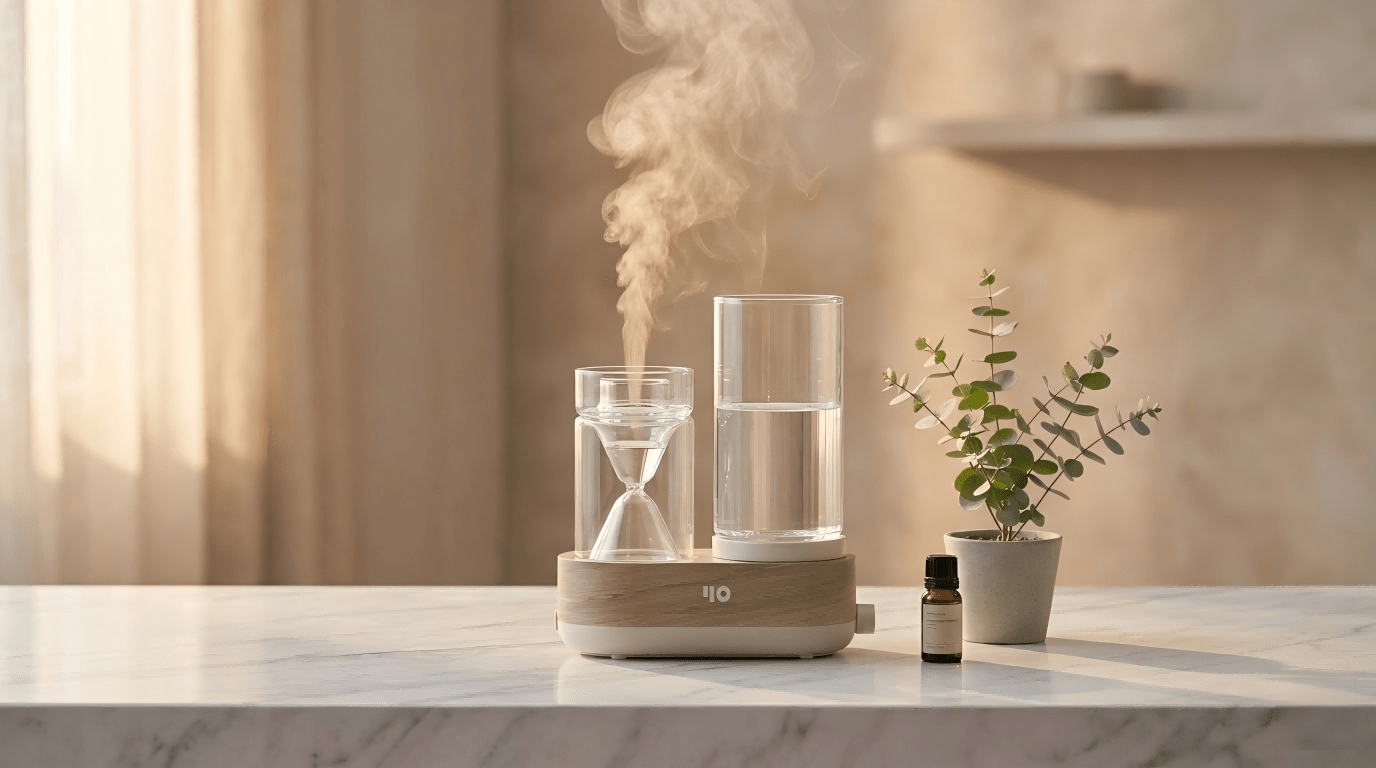
Plastic essential oil diffuser tanks are usually molded from ABS or PP plastic, and neither material is chemically inert. Plastic polymers carry additives — plasticizers, stabilizers, and in older or lower-grade plastics, BPA — that aren't bonded to the polymer and can migrate into the water they contact. Essential oils accelerate this: citrus oils are high in limonene, a mild solvent that speeds plasticizer migration from plastic surfaces. This isn't only theoretical — a 2021 study in Environment International documented plastic particles in the output mist of tested ultrasonic humidifiers, and a granted U.S. patent (No. 11,052,167) for glass-tank diffusers states that conventional PP and ABS tanks make the mist carry plastic odor. Borosilicate glass sidesteps all of it — no additives, no bisphenols, no microplastic shedding under essential-oil contact. That's why the Y&O Yo-A1 uses a borosilicate glass tank for every surface the water and oil actually touch.
What microplastics are and how they get into the air
Microplastics are plastic particles under 5mm in size — many far smaller, in the nanoplastic range below 1 micrometer.
They enter the environment through degradation of larger plastic items, through synthetic textiles, through packaging, and increasingly, through the devices we run continuously in enclosed spaces.
The research on airborne microplastics has accelerated significantly in the last five years. A 2022 study published in Environmental Health journal found microplastic particles in human lung tissue samples — confirming that airborne microplastics are inhaled and deposited in lung tissue, not just filtered out by the upper airway.
The WHO's assessment on microplastics notes that while the full health implications are still being studied, the precautionary principle applies — particularly for vulnerable populations and chronic exposure scenarios.
A device running continuously in a bedroom for 8 hours a night is a chronic exposure scenario.
The specific concern with plastic diffuser tanks
 There are two distinct mechanisms worth understanding for plastic diffusers specifically.
Mechanism 1 — Chemical leaching
Plastic polymers aren't inert. They contain chemical additives — plasticizers like phthalates, stabilizers, antioxidants, and in older or lower-grade plastics, BPA. These additives aren't chemically bound to the polymer matrix; they can migrate out of the plastic into the water it contacts.
The migration rate increases with three factors: temperature, contact time, and chemical stress from solvents. Essential oils — particularly citrus oils, which contain limonene and other terpenes — are mild solvents. They accelerate plasticizer migration from plastic surfaces.
Most ultrasonic diffusers mix essential oil directly into the plastic water tank. That's simultaneous solvent exposure (from the oil) and prolonged water contact at the same surface — the conditions that maximize chemical migration from plastic into the liquid, which then gets aerosolized into the room.
Mechanism 2 — Physical microplastic release
Plastic surfaces degrade over time. Ultrasonic vibration — 1.7 million cycles per second against a plastic tank interior — creates mechanical stress on that surface continuously. Cleaning with brushes or abrasive cloths adds further surface wear.
As plastic degrades, it sheds microparticles. In a water-contact scenario with continuous mechanical agitation, some of those particles enter the water and are subsequently aerosolized by the ultrasonic plate.
This is not theoretical. A 2021 study in Environment International documented microplastic release from ultrasonic humidifiers specifically — finding plastic particles in the output mist of tested units.
What the patent literature says about plastic diffuser design
The concern about plastic diffuser tanks isn't new to manufacturers. It shows up directly in patent literature.
A patent filing (No. 11,052,167) for glass-tank diffuser technology explicitly states the design rationale: conventional diffuser water tanks made from PP or ABS plastic result in mist carrying plastic odor, and the prolonged contact between essential oil-water mixtures and plastic may produce harmful substances affecting human health.
That's a manufacturer acknowledging the plastic contact problem in a legal document — not a third-party claim.
Plastic material risk is one of three concerns with standard ultrasonic diffusers. The other two: mineral dust → and biofilm contamination →
Plastic types matter — but none are fully inert
Not all plastics are equal in leaching risk. Here's how common diffuser tank materials compare:
| Material | Common use | Leaching risk | Essential oil compatibility |
|---|---|---|---|
| ABS plastic | Most budget diffusers | High — contains additives, degrades with citrus oils | Poor — citrus, pine, eucalyptus cause degradation |
| PP plastic | Mid-range diffusers | Moderate — food-safe grade still contains additives | Moderate — still reactive with strong terpene oils |
| BPA-free plastic | Marketed as "safer" | Moderate — BPA replaced with BPS/BPF, similar concerns | Still plastic — solvent reaction remains |
| Borosilicate glass | Laboratory / premium diffusers | None — chemically inert, no additives to migrate | Compatible with all essential oils — no reaction |
| Stainless steel | Some waterless diffusers | Minimal — food-grade steel is largely inert | Good — compatible with most oils |
The "BPA-free" label deserves particular attention. BPA (bisphenol A) was removed from many plastics following regulatory pressure. It was replaced primarily with BPS (bisphenol S) and BPF (bisphenol F). Research published in Environmental Health Perspectives suggests BPS and BPF have similar hormonal activity to BPA — meaning "BPA-free" doesn't necessarily mean "bisphenol-free" or "leaching-free."
Glass sidesteps the entire bisphenol conversation. It contains no polymer additives. It doesn't leach into water regardless of temperature, contact time, or the oils involved.
Why this matters more in a diffuser than other plastic items
You probably use plastic in dozens of ways daily. Why does a diffuser warrant specific attention?
Three compounding factors make diffuser plastic exposure different from most plastic contact:
Aerosolization. A plastic water bottle leaches chemicals into the water you drink. That's an ingestion route. A diffuser aerosolizes whatever is in its water — creating an inhalation route. Inhaled particles and chemicals reach lung tissue directly, bypassing the digestive system's filtering mechanisms.
Chronic duration. Running a diffuser 8 hours overnight, 7 nights a week, produces a cumulative inhalation exposure that exceeds most other plastic contact scenarios in daily life.
Essential oil amplification. The solvents in essential oils — terpenes, particularly in citrus oils — accelerate plasticizer migration from plastic surfaces. The more concentrated and frequent the oil use, the higher the potential chemical release from plastic tank walls.
A plastic ultrasonic diffuser running in a closed bedroom overnight combines all three factors: aerosolization into a confined space, 8+ hours of chronic exposure during sleep, and essential oil solvent contact with the plastic tank. For families with infants, this exposure is happening in rooms where people with the highest breathing rates and least developed respiratory systems are sleeping. See also: Non-Toxic Diffuser for Baby Room →
"Most people don't think about what their diffuser is made of. Glass doesn't react with essential oils. Plastic does — and that reaction goes into the mist."
Full comparison of premium vs. budget diffusers — material safety is identified as the primary differentiator, not price or design.
32,000+ views. The most-shared video on why device material selection matters for indoor air quality in family homes.
Why borosilicate glass eliminates the concern entirely
 Borosilicate glass is the material used in laboratory beakers, pharmaceutical vials, and high-end cookware. It was chosen for those applications for the same reason it matters in a diffuser: it's chemically inert.
No polymer additives. No plasticizers. No bisphenols. No surface degradation from mechanical agitation or chemical stress. No microplastic shedding. Nothing to migrate into the water regardless of temperature, contact time, or the essential oils involved.
It doesn't just reduce the microplastic and leaching concern — it removes it from the equation entirely.
- Zero chemical additives — borosilicate glass contains no plasticizers, bisphenols, or stabilizers to migrate into water.
- No microplastic shedding — glass doesn't shed particles under mechanical stress or with essential oil contact.
- Compatible with all essential oils — citrus, pine, eucalyptus, and terpene-heavy oils don't degrade glass. They degrade plastic.
- No flavor or scent absorption — glass doesn't absorb essential oil residue between uses. No cross-contamination between different oils.
- Thermally stable — borosilicate glass handles thermal cycling without stress fracturing or surface degradation.
- Transparent — tank state is visible at all times. No guessing about water quality or residue buildup.
The Y&O Yo-A1 pairs borosilicate glass with steam diffusion — meaning water is boiled at 212°F before output. That adds a sterilization benefit on top of the material safety benefit: no biofilm, no mineral dust, no plastic. Just sterile steam from an inert glass tank.
No Plastic. No Microplastics. No Compromise.
Borosilicate glass water tank · 212°F sterilization · Zero mineral dust · 8-hour runtime
View the Y&O Yo-A1 →Being honest about what we don't know yet
The microplastics research is moving fast but remains incomplete. A few honest caveats:
- Diffuser-specific microplastic studies are limited — the 2021 Environment International study on ultrasonic humidifiers is one of very few. The research base is growing but not yet comprehensive for this specific device category.
- Long-term health effects of inhaled microplastics are still being studied — we know microplastics reach lung tissue. The clinical health implications of chronic low-level exposure are not yet fully characterized.
- Y&O's base unit contains plastic — the water tank is borosilicate glass. The base housing and electronics unit contains plastic components. The water never contacts the plastic base, but the unit is not 100% plastic-free as a whole product.
- "BPA-free" glass claims require verification — borosilicate glass is genuinely inert, but always verify the glass grade. Not all "glass" diffusers use borosilicate — some use lower-grade glass with surface coatings.
The precautionary case for glass over plastic in a device running overnight in enclosed spaces is strong, even while the long-term research continues to develop. You don't need complete certainty about downstream health effects to make a reasonable material preference choice.

Glass Where It Matters. Steam That's Sterile.
The water only ever touches borosilicate glass. No plastic contact, no leaching, no microplastic shedding — ever.
Shop the Yo-A1 Steam Diffuser →Frequently asked questions
Do all plastic diffusers release microplastics?
The honest answer is: we don't have comprehensive testing data for every diffuser model. What we know from materials science is that plastic surfaces degrade over time under mechanical stress and chemical contact, and that ultrasonic vibration provides continuous mechanical stress to the tank interior.
The 2021 Environment International study documented microplastic particles in the output mist of tested ultrasonic humidifiers. Whether every plastic diffuser releases measurable microplastics under all conditions is not established. That there's a plausible mechanism for it to occur — and that it has been documented in at least one peer-reviewed study — is established.
Is "BPA-free" plastic actually safer?
Probably not significantly. BPA (bisphenol A) was removed from many consumer plastics after research linked it to hormonal disruption. It was primarily replaced with BPS (bisphenol S) and BPF (bisphenol F).
Research published in Environmental Health Perspectives found that BPS and BPF show similar estrogenic activity to BPA in cell studies. The "BPA-free" label addresses one specific chemical while potentially substituting another with similar properties. It does not indicate that a plastic is free of all bisphenols, plasticizers, or leachable additives.
For a device running in an enclosed space overnight, "BPA-free plastic" is a marketing improvement, not a material safety solution.
Does the Y&O diffuser have any plastic components?
Yes. The water tank is borosilicate glass — the surface that contacts water and essential oils. The base unit housing the heating element and electronics uses plastic components.
The water never contacts the plastic base. The relevant question for leaching and microplastic concerns is what material the water actually touches — which is glass. But if your goal is a 100% plastic-free device, the Yo-A1 doesn't fully deliver that.
This is worth knowing going in, and we think transparency on this point matters more than glossing over it.
Are citrus essential oils really harder on plastic tanks?
Yes — this is well-established materials chemistry. Citrus oils are high in limonene and other monoterpene compounds, which are mild solvents. They can accelerate the degradation of plastic surfaces, particularly ABS and lower-grade PP.
You may have noticed this yourself: a plastic diffuser that has been used regularly with citrus oils often develops a slightly tacky surface, discoloration, or visible degradation of the tank interior over months of use. That surface change indicates chemical interaction between the oil and the plastic — which is the same process that can release plasticizers and microparticles into the water and mist.
Glass is not affected by limonene or any other essential oil component. The tank surface remains unchanged regardless of oil type or duration of use.
What's the safest essential oil diffuser option overall?
Based on material safety, biological output, and particulate concerns, the ranking looks like this:
1. Steam diffuser with borosilicate glass tank — eliminates plastic contact, microplastic risk, mineral dust, and biofilm in a single technology choice. The Y&O Yo-A1 is the clearest current example.
2. Waterless cold-air diffuser with glass or stainless steel — no water contact at all eliminates biofilm and mineral dust. Material depends on the specific model.
3. Ultrasonic with borosilicate glass tank — if glass is present, plastic contact is eliminated, but biofilm and mineral dust concerns remain.
4. Ultrasonic with BPA-free plastic, distilled water — reduces but doesn't eliminate the mineral dust issue; doesn't address plastic leaching or biofilm.
5. Ultrasonic with standard plastic, tap water — the most common setup, and the one that accumulates the most compounding concerns.
Data sources & references
- Jenner L.C. et al. — "Detection of microplastics in human lung tissue." Environmental Health, 2022. nature.com/articles/s41370-022-00461-y
- World Health Organization — Microplastics in drinking water. who.int/news-room/fact-sheets
- Liao C., Kannan K. — "BPS and BPF: Similar hormonal activity to BPA." Environmental Health Perspectives, 2014. ncbi.nlm.nih.gov/pmc/articles/PMC5359417/
- Li L. et al. — "Microplastics in ultrasonic humidifier output mist." Environment International, 2021. sciencedirect.com
- Justia Patents — Patent No. 11,052,167 (Glass aromatherapy diffuser). patents.justia.com/patent/11052167
- The Nutmeg Home — "What Kind of Diffuser Is Best?" youtube.com/watch?v=CdlD08m6kKQ
- NReluctant — "Best Essential Oil Diffusers of 2026." youtube.com/watch?v=ppZqnr4aeuk
- Non-Toxic Dad — "The Wrong Humidifier Can Be TOXIC!" youtube.com/watch?v=sdjsRDdcGS8
- Reddit r/nontoxic — thread on plastic diffuser concerns. reddit.com/r/nontoxic/comments/1s3ww02/
- Y&O Product Page — 1.6L Glass Essential Oil Aroma Steamer Humidifier. yoairpro.com/products/…