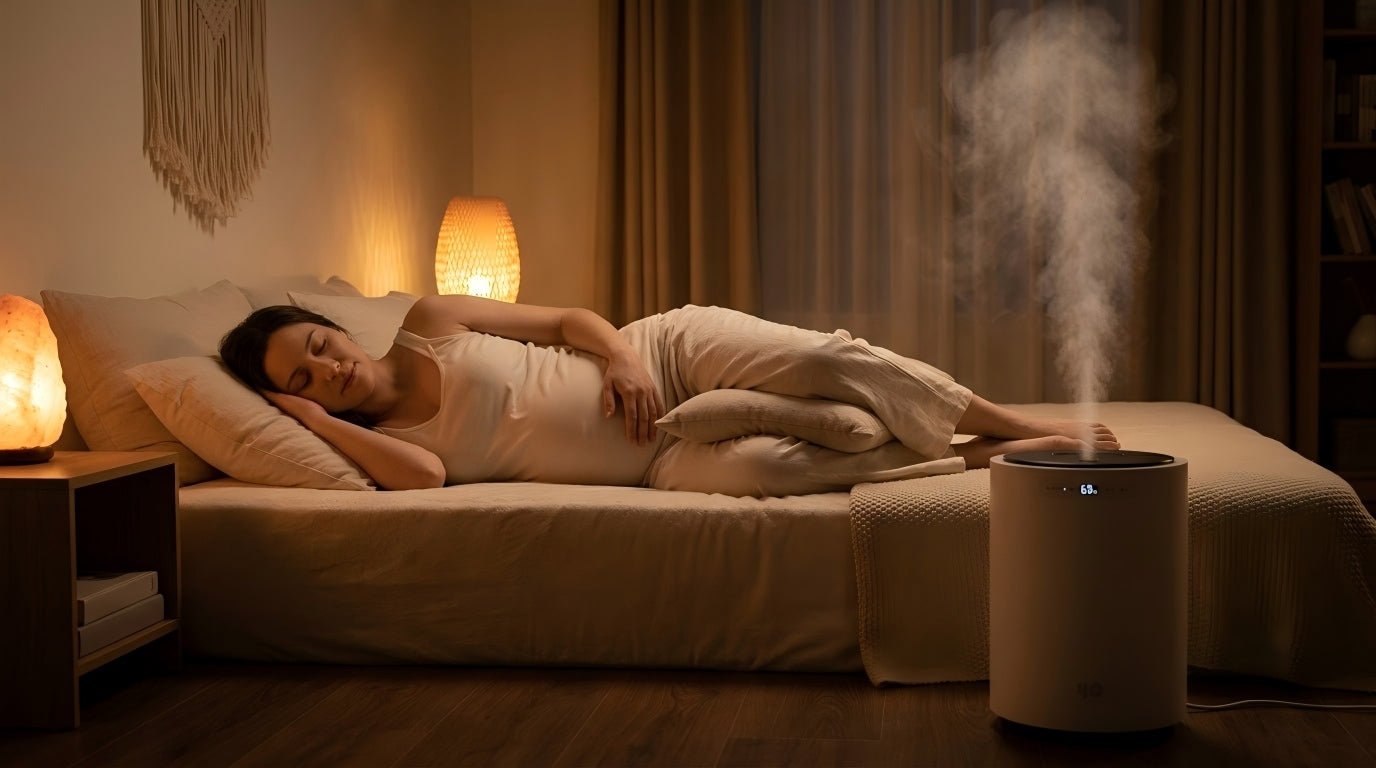

At some point in your second or third trimester, you'll find yourself lying awake at 3 a.m., unable to breathe through your nose, wondering if this is a cold or just pregnancy. Most of the time, it's just pregnancy.
Pregnancy rhinitis — nasal congestion caused entirely by hormonal changes, not illness — affects up to 30% of pregnant women. It's not dangerous, but it disrupts sleep, amplifies fatigue, and gets worse in dry air. It also can't be treated with most decongestants, which are not recommended during pregnancy.
This guide covers what a humidifier actually does during pregnancy, which trimester benefits most, what technology is genuinely safe versus what standard advice gets wrong, and the one category of additive that no pregnant woman should put in a humidifier tank.
What Dry Air Does to a Pregnant Body
Pregnancy amplifies the body's sensitivity to air quality in ways that are easy to overlook. Blood volume increases by up to 50% over the course of pregnancy, nasal blood vessels engorge, and the immune system modulates to protect the fetus — all of which make the respiratory system more reactive to environmental conditions than it would be otherwise.
Dry air below 30% RH — the norm in a heated North American home in winter without humidification — creates four specific problems that compound each other during pregnancy.
| Condition | How Dry Air Makes It Worse | When It Peaks |
|---|---|---|
| Pregnancy rhinitis | Nasal passages already swollen from hormones — dry air thickens mucus and increases congestion severity | Second trimester |
| Nosebleeds | Increased nasal blood vessel fragility + dry air = more frequent and harder-to-stop bleeds | Any trimester |
| Skin dryness & itching | Stretching skin loses moisture faster; dry air accelerates transepidermal water loss | Third trimester |
| Sleep disruption | Congestion forces mouth-breathing; dry throat causes waking; already-fragile third-trimester sleep gets worse | Third trimester |
None of these are serious medical conditions on their own. But compounded across a third trimester when sleep is already difficult, they significantly affect quality of life — and all of them are meaningfully reduced by maintaining 40–50% indoor RH.
Is a Humidifier Safe During Pregnancy?
Yes — with the right technology, the right water, and without essential oils unless your OB-GYN has specifically approved them.
The American Pregnancy Association lists humidifiers as a safe home remedy for pregnancy congestion. Most OB-GYNs recommend them as a drug-free alternative to decongestants that aren't safe during pregnancy. The consensus is clear: humidification is safe throughout all three trimesters.
What matters is the details — because two common humidifier practices create genuine risks during pregnancy that most guidance doesn't address clearly.
Risk 1: Biological Contamination in Cool-Mist Tanks
Cool-mist and ultrasonic humidifiers require daily cleaning to prevent bacterial and mold growth in standing water. At room temperature, a tank that isn't emptied and dried daily becomes a contamination source within 24–48 hours — and whatever grows in the tank gets aerosolized into the air you breathe.
During pregnancy, when the immune system is operating in a modified state to protect the fetus, inhaling aerosolized bacteria from a contaminated humidifier tank is not a theoretical risk. It's the same principle that makes moldy humidifiers a documented health risk — amplified by the immune modulation of pregnancy.
Steam humidifiers eliminate this risk entirely. The boiling process kills pathogens before any mist is released. The output that enters your breathing zone is sterile by design — not dependent on whether you cleaned the tank yesterday.
Risk 2: Essential Oils
Several essential oils commonly used in humidifiers and diffusers are contraindicated during pregnancy. Rosemary, clary sage, and cinnamon bark are among those associated with uterine stimulation. Peppermint and eucalyptus are generally considered acceptable in small amounts but are still not formally recommended without physician approval.
The standard guidance is unambiguous: do not add any essential oil to a humidifier during pregnancy without explicit OB-GYN approval. Plain water only.
Rosemary, clary sage, cinnamon bark, thyme, and oregano are among the oils associated with uterine contractions or increased pregnancy risk. Some are marketed for diffuser use without any pregnancy warning on the label. If you currently use a humidifier as an essential oil diffuser, stop adding oils until you've confirmed each one is safe with your OB-GYN. Plain water only.

Which Trimester Benefits Most
A humidifier is useful throughout pregnancy, but the benefit is not uniform across all three trimesters.
First Trimester
Pregnancy rhinitis typically begins developing in the first trimester as hormone levels rise, but symptoms are usually milder at this stage. The most relevant benefit in T1 is prevention: starting humidification before rhinitis peaks keeps nasal passages moist and reduces the severity of congestion that develops later. If you're entering pregnancy during heating season, starting in the first trimester is the right call.
Second Trimester
Pregnancy rhinitis peaks in the second trimester. Estrogen and progesterone levels are at their highest relative to first-trimester fluctuations, and the effect on nasal blood vessels is most pronounced. This is when the difference between a humidified and unhumidified bedroom is most noticeable — and when the inability to use standard decongestants makes non-pharmacological relief most important.
Third Trimester
The third trimester is when humidity's impact on sleep quality becomes critical. Sleep is already compromised by physical discomfort, frequent waking, and positional limitations. Nasal congestion that forces mouth-breathing, dry throat that causes additional waking, and skin itching from stretching and dryness all layer on top of those baseline challenges.
Running a humidifier overnight in the bedroom from month 6 through birth is one of the highest-return, lowest-effort interventions available for third-trimester sleep quality. It requires no medication, has no side effects, and addresses multiple symptoms simultaneously.
Steam vs. Cool-Mist During Pregnancy: The Honest Answer
Standard pregnancy guidance recommends cool-mist humidifiers, citing burn risk from steam. This is the same guidance covered in detail in the newborn safety article — and the same technology gap applies.
The burn risk concern was valid for older steam vaporizers that released near-boiling vapor. The YO-M2 uses a cold-water storage tank that remains at room temperature throughout operation, with a separate sealed heating chamber that generates steam and cools it to approximately 122°F before release. There is no large volume of boiling water in the unit. Output temperature is controlled. The burn risk that drove the standard recommendation does not apply to this architecture.
What does apply — and what standard guidance consistently underweights for pregnant women — is the biological risk of cool-mist units. A pregnant woman running an ultrasonic humidifier in her bedroom every night without daily cleaning is introducing aerosolized bacteria into the air she breathes during sleep. Steam eliminates that risk by boiling the water before release.
| Factor | Cool-Mist / Ultrasonic | YO-M2 Steam |
|---|---|---|
| Burn risk | None | None — cold storage tank; output cooled to 122°F |
| Bacterial contamination | High without daily cleaning — significant during pregnancy immune modulation | None — boiling kills pathogens before release |
| White mineral dust | Yes in hard-water cities — inhaled particulate during pregnancy | None — minerals remain in tank |
| Maintenance burden | Daily cleaning required to remain safe | Periodic — boiling prevents biological contamination during use |
| Water type required | Distilled recommended in hard-water areas | Tap water fine — minerals stay in tank |
For a pregnant woman who will run a humidifier overnight for months — from heating season through the postpartum period — the biological safety profile of steam is meaningfully superior, and the burn risk that standard guidance cites has been addressed by design.
The Y&O Steam Plus — Safe Throughout Pregnancy and Beyond
Cold-water tank · Sealed heating chamber · 122°F output · No filter · Zero white dust · 10L dual tank · 1,200 ml/h
See the YO-M2 Steam Plus →Your Questions Answered
Is it safe to use a humidifier in all three trimesters?
Yes. The American Pregnancy Association lists humidifiers as a safe, drug-free home remedy for pregnancy congestion throughout all three trimesters. The key variables are technology choice, water type, and essential oil avoidance. A steam humidifier that sterilizes water through boiling eliminates the biological contamination risk that makes cool-mist units a concern when the immune system is modulated. Keep RH between 40–50%, use plain water only, and confirm any essential oil use with your OB-GYN before adding anything to the tank.
Can I use essential oils in my humidifier while pregnant?
Not without explicit OB-GYN approval for each specific oil. Several essential oils commonly marketed for diffuser use are associated with uterine stimulation during pregnancy — including rosemary, clary sage, cinnamon bark, thyme, and oregano. Others like peppermint and eucalyptus are not formally contraindicated but are also not recommended without physician guidance. The safest approach throughout pregnancy is plain water only. Do not assume an oil is safe because it is natural, popular, or sold without a pregnancy warning label.
Cool mist or warm mist — which is better during pregnancy?
Standard guidance recommends cool-mist to avoid burn risk from steam — guidance that was written for older steam vaporizers that released near-boiling vapor. Modern steam humidifiers with cold-water storage tanks and temperature-controlled output (approximately 122°F) do not present the same burn risk. The more relevant comparison for a pregnant woman running a humidifier overnight for months is biological safety: cool-mist units require daily cleaning to prevent bacterial contamination, while steam humidifiers sterilize water through boiling before release. If daily cleaning is reliably maintained, a cool-mist unit can be used safely. If it isn't, steam is the safer choice.
Will a humidifier actually help with pregnancy congestion?
Yes — if the congestion is rhinitis-related, which it usually is. Pregnancy rhinitis is caused by hormonal swelling of nasal blood vessels, and dry air significantly worsens its severity by thickening mucus and drying the nasal lining. Maintaining 40–50% RH doesn't eliminate rhinitis — it's driven by hormones, not humidity — but it consistently reduces symptom severity and the frequency of nighttime mouth-breathing. Most OB-GYNs recommend humidification as the first-line, drug-free intervention for pregnancy rhinitis precisely because the alternatives (decongestants) aren't safe during pregnancy.
Where should I place a humidifier in the bedroom during pregnancy?
On the floor against a wall, 4–6 feet from the bed, with output aimed toward the center of the room rather than directly at your face. The goal is to raise the overall RH of the room, not to direct mist at close range. Placing it too close to the bed can create damp bedding or a micro-environment of excessive humidity that's uncomfortable and increases surface mold risk over time. Measure actual RH with a standalone hygrometer — most humidifiers' built-in sensors overread by 5–10%, and you want to know the actual humidity level in the space you're sleeping in.
Can I keep using the same humidifier after the baby arrives?
Yes — the same unit used during pregnancy can go directly into the nursery, with a placement adjustment. Move it to the floor against a wall at least 4–6 feet from the crib, aimed toward the center of the room. The biological safety considerations are the same or more important for a newborn than for a pregnant woman: a steam humidifier that sterilizes water through boiling is appropriate for continuous overnight nursery use. The transition from pregnancy bedroom to newborn nursery is one of the practical advantages of choosing the right technology from the start. Full nursery guidance: Is a Steam Humidifier Safe for Newborns? →
Related Reading
Sources & References
- American Pregnancy Association — Pregnancy Rhinitis
- American College of Obstetricians and Gynecologists — Skin Conditions During Pregnancy
- Mayo Clinic — Nonallergic Rhinitis
- National Center for Biotechnology Information — Rhinitis in Pregnancy
- U.S. Environmental Protection Agency — Use and Care of Home Humidifiers
- ASHRAE Standard 55 — Thermal Environmental Conditions for Human Occupancy
- Reddit Community Discussions — r/BabyBumps · r/pregnant
- Y&O — YO-M2 Steam Plus Product Page