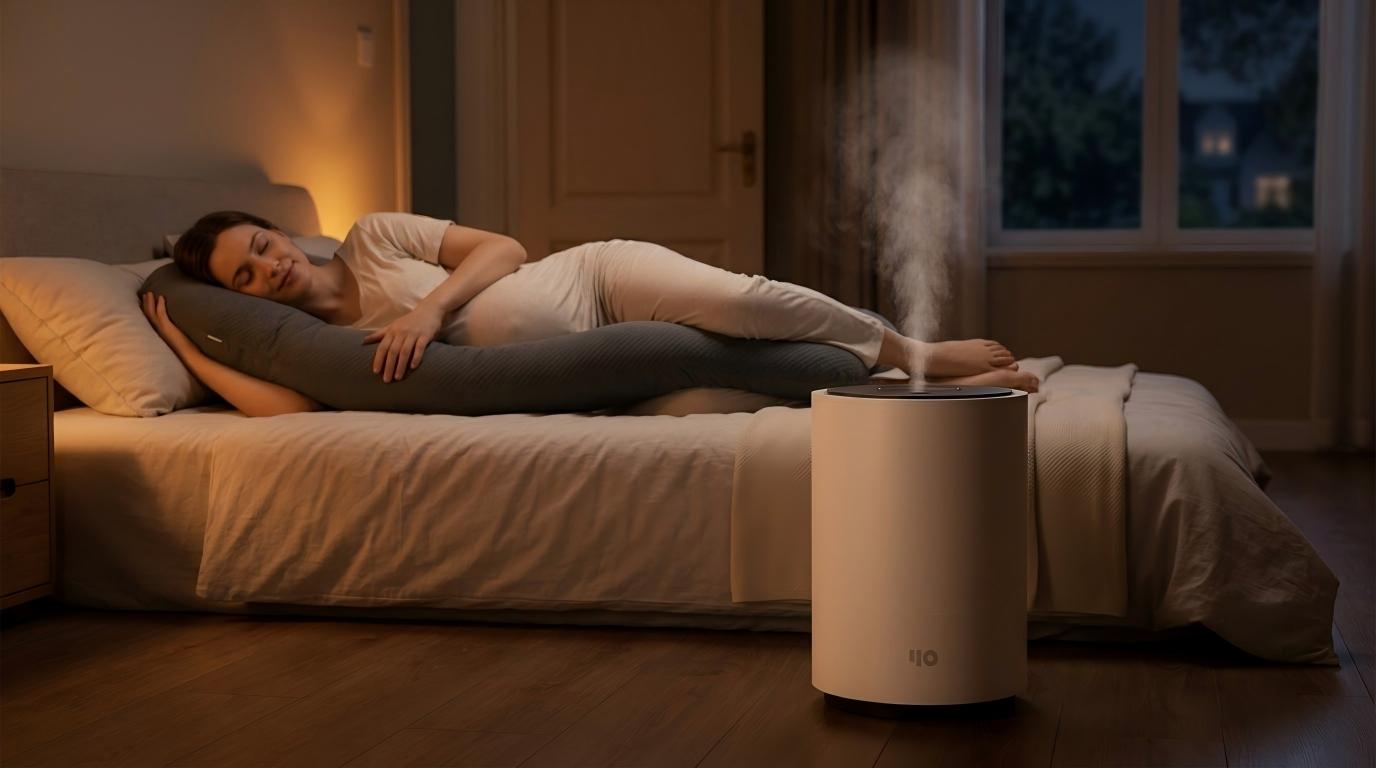

The moment you find out you're pregnant, the list of things to get right feels endless. Air quality rarely makes the top ten. It probably should.
Dry air affects pregnancy comfort, newborn respiratory health, infant sleep, and a child's developing immune system — continuously, invisibly, across every stage of early life. Most parents only start thinking about humidity when their newborn wakes up congested for the third night in a row.
This guide maps the full journey: what humidity does at each stage from pregnancy through toddlerhood, what the research actually says, and what to set up — and when — so you're never playing catch-up with your child's air.
Why Air Humidity Matters More Than Most Parents Know
Indoor relative humidity (RH) is the percentage of moisture in the air relative to the maximum it can hold at that temperature. The number sounds technical. The effects are not.
Below 30% RH, nasal mucous membranes dry out and lose their ability to trap airborne pathogens. At 20% — typical in a heated North American home in January without humidification — that protective layer is essentially gone. For a pregnant woman whose immune system is already modulated, or a newborn whose respiratory system is still developing, that's not a minor inconvenience.
The same condition — low indoor humidity — shows up differently at every stage of early life. During pregnancy it's congestion and sleep disruption. In a newborn it's rattling breathing and skin dryness. In an infant it's nighttime waking and vulnerability to respiratory illness. In a toddler it's the foundation of a winter that either goes smoothly or doesn't.
Understanding the full arc lets you stay ahead of each stage rather than reacting to it.
Stage 1 — Pregnancy (First Trimester Through Birth)
Pregnancy changes everything about how the body interacts with air. Blood volume increases by up to 50%, nasal blood vessels swell, and the immune system operates in a modified state to protect the fetus. The result is that dry air — merely uncomfortable for most adults — becomes a meaningful health factor for pregnant women.
Pregnancy Rhinitis
Up to 30% of pregnant women develop pregnancy rhinitis: persistent nasal congestion unrelated to allergies or illness, caused entirely by hormonal changes that swell the nasal lining. Dry air doesn't cause it, but it significantly worsens it.
Maintaining 40–50% RH keeps nasal passages adequately moist, reduces the severity of congestion, and avoids the cycle of mouth-breathing that disrupts sleep and compounds fatigue in the third trimester.
Skin, Sleep, and Nosebleeds
Pregnancy already stresses the skin barrier through hormonal shifts. Dry air accelerates transepidermal water loss, worsening itching and tightness that are already common complaints. Nosebleeds — more frequent during pregnancy due to increased nasal blood vessel fragility — occur significantly less often when RH is maintained above 40%.
Sleep quality in the third trimester is compromised enough without adding dry-throat waking and nocturnal congestion. A humidifier running overnight in the bedroom is one of the lowest-effort, highest-return interventions available in months 6–9.
The standard recommendation is cool-mist during pregnancy due to burn risk concerns from older steam units. Modern steam humidifiers cool output to approximately 122°F (50°C) before release — warm, not scalding — while the boiling process eliminates the bacterial contamination risk that makes cool-mist units a concern when the immune system is modulated. Full pregnancy-specific guidance: Humidifier During Pregnancy: What's Safe, What Helps →

Stage 2 — Newborn (0–3 Months)
A newborn's respiratory system is completing its transition from the fluid-filled environment of the womb to breathing air. The nasal passages are tiny — a small amount of mucus creates congestion that, in a baby who can't blow their nose or breathe through their mouth effectively, means audible rattling, feeding difficulty, and disrupted sleep.
Dry air in the first weeks of life makes all of this worse. It thickens mucus, dries the nasal lining, and stresses skin that is still developing its own moisture barrier. None of these effects are severe in isolation — but combined, in a home running heated air through winter, they create the conditions for a genuinely difficult early period.
The Steam Safety Question
Most parenting sources recommend against steam humidifiers for newborns, citing burn risk. This guidance was accurate for older vaporizers that released near-boiling steam. Modern steam humidifiers cool output to 122°F before release — warm like a shower, not scalding like a kettle.
The more relevant concern for newborn rooms is biological cleanliness. Cool-mist and ultrasonic units running continuously in a warm nursery create ideal conditions for mold and bacterial growth in standing water — and those organisms get aerosolized into the air a newborn breathes. Steam humidifiers kill pathogens through boiling before any mist is released, which is why the technology is increasingly the right choice for nurseries where continuous overnight operation is the norm.
For a complete breakdown: What Is the Safest Humidifier for Baby? →
Keep any humidifier at least 4–6 feet from the crib. You want moisture distributed through the room, not directed at the baby's face or onto bedding. Damp bedding in a newborn's sleep environment creates both mold risk and unsafe sleep conditions. Elevate the unit on a dresser and aim output toward the center of the room.
Stage 3 — Infant (3–12 Months)
By three months, a baby's respiratory system is more robust — but their immune system is still immature and their exposure to the outside world is increasing. This is the stage when congestion from dry air starts intersecting with actual illness, and parents find it harder to distinguish between the two.
Proper humidification in the infant bedroom does two things: it reduces the frequency of dry-air congestion that mimics illness, and it maintains the nasal mucous membrane function that is the first line of defense against actual pathogens.
Sleep and Humidity
Infant sleep is already fragile. Nasal congestion is one of the most common causes of nighttime waking in the 3–12 month window — and unlike an adult, an infant cannot shift to mouth-breathing to compensate. Maintaining 40–50% RH in the bedroom is one of the few evidence-backed, zero-side-effect interventions for improving infant sleep continuity in dry-air environments.
Skin Conditions
Eczema onset is common in the first year. While humidity is not the primary driver of atopic dermatitis, sustained low-RH environments are a known aggravating factor — they accelerate transepidermal water loss and compromise the skin barrier. Families with a history of eczema should treat consistent bedroom humidification as non-optional through the first winter.

Stage 4 — Toddler (1–3 Years)
By toddlerhood, the acute vulnerability of the newborn period has passed — but the immune system is still developing, and the first years of daycare or preschool bring sustained pathogen exposure that makes respiratory health a year-round concern.
Dry heating-season air remains the background condition that determines how resilient a toddler's respiratory defenses are. A child whose nasal passages are consistently well-hydrated filters pathogens more effectively than one breathing 20% RH air for seven months a year.
Toddlerhood also introduces the practical challenge of a mobile, curious child capable of interacting with a humidifier. Stable placement, cord management, and the biological safety of what's being aerosolized all become more important — and a unit requiring daily tank scrubbing to stay safe is not compatible with the reality of toddler-stage parenting.
The Full-Stage Humidity Reference Table
| Stage | Target RH | Primary Concerns | Key Notes |
|---|---|---|---|
| Pregnancy (T1–T2) | 40–50% | Pregnancy rhinitis, nosebleeds, skin dryness | Bedroom priority; run overnight |
| Pregnancy (T3) | 40–50% | Sleep disruption, congestion peaks, fatigue | Most impactful window during pregnancy |
| Newborn (0–3 mo) | 40–50% | Nasal congestion, skin barrier, feeding comfort | 4–6 ft from crib; steam preferred for biological safety |
| Infant (3–12 mo) | 40–50% | Sleep continuity, immune defense, eczema risk | Continuous overnight use; separate hygrometer required |
| Toddler (1–3 yr) | 40–50% | Recurring respiratory illness, pathogen exposure | Stable placement; low-maintenance technology |
| All stages — cold climates | 35–40% | Window condensation risk at higher RH | Adjust down during peak cold snaps only |
Why Steam Is the Right Technology Across Every Stage
The humidifier technology question gets asked differently at each stage — is it safe during pregnancy, is it safe near a newborn, does it help with infant congestion — but the underlying answer is the same at every point.
The two problems that make other technologies problematic are amplified when a humidifier runs continuously in a bedroom for months at a time, which is exactly what responsible humidification across pregnancy and the early years requires.
Cool-mist and ultrasonic units aerosolize whatever is in the tank — including minerals from hard water that become breathable white dust, and bacteria or mold that grow in standing water within 24–48 hours of continuous operation. Both are directly inhaled by the person the humidifier is meant to protect.
Steam humidifiers boil the water before releasing it. Minerals stay in the tank. Pathogens are killed before any mist reaches the air. The output that enters your bedroom during pregnancy, your newborn's nursery overnight, or your toddler's room through a seven-month heating season — is clean by design, not by how recently you cleaned the tank.
For the full technology comparison: Steam vs. Ultrasonic vs. Evaporative: Which Is Worth It in 2026 →
The Y&O Steam Plus — Safe Across Every Stage
Boils to 212°F · Cools to 122°F before release · 1,200 ml/h · 10L dual tank · No filter · Zero white dust
See the YO-M2 Steam Plus →Your Questions Answered
Is it safe to run a humidifier throughout my entire pregnancy?
Yes — with the right technology and proper RH management. The American Pregnancy Association lists humidifiers as a safe home remedy for pregnancy congestion. The key variables are keeping RH between 40–50% with a standalone hygrometer, choosing a unit that sterilizes water through boiling or requires daily cleaning, and avoiding essential oil additives without OB-GYN approval. Full guidance: Humidifier During Pregnancy →
Can I use the same humidifier from pregnancy in my newborn's room?
Yes, if it's the right technology. A steam humidifier used during pregnancy is appropriate for the nursery — the biological safety profile is the same or better for a newborn. The adjustment is placement: move it to a dresser 4–6 feet from the crib, aimed toward the center of the room. A cool-mist or ultrasonic unit should not go into a newborn's room without a thorough clean and a commitment to the daily maintenance the unit requires to stay biologically safe.
What's the right humidity level for a baby's room?
40–50% RH across all infant and toddler stages. Below 30% is too dry: nasal passage protection and skin barrier function are both compromised. Above 60%, mold and dust mite activity increases. In very cold climates, accept 35–40% during peak cold snaps to avoid window condensation. Always measure with a standalone hygrometer at crib height — built-in humidifier sensors typically overread by 5–10%.
My baby keeps waking up congested. Will a humidifier actually help?
If room RH is below 40%, yes — often significantly. Infant nasal congestion is frequently dry-air congestion rather than illness-related, and the two are easy to confuse because symptoms are identical. Check room RH first. If it's consistently below 40% during heating season, overnight humidification is one of the most direct available interventions. If RH is already in range and congestion persists, the cause is more likely viral. More detail: Humidifier for Baby Congestion →
Can one humidifier cover the whole home, including the nursery?
No — for a nursery with the door closed during sleep, which is standard safe-sleep practice, you need a dedicated unit in that room. Humidity does not travel effectively through closed doors. One high-output unit can cover an open-plan living area, but the bedroom where your baby sleeps needs its own humidification running overnight. Coverage planning guidance: How Many Humidifiers Does a Large Home Actually Need? →
Related Reading
Sources & References
- American Pregnancy Association — Pregnancy Rhinitis
- American Academy of Pediatrics — Safe Sleep Recommendations
- ASHRAE Standard 55 — Thermal Environmental Conditions for Human Occupancy
- U.S. Environmental Protection Agency — Use and Care of Home Humidifiers
- Mayo Clinic — Nonallergic Rhinitis
- National Eczema Association — Atopic Dermatitis and Environmental Triggers
- Reddit Community Discussions — r/beyondthebump · r/Humidifiers
- Y&O — YO-M2 Steam Plus Product Page