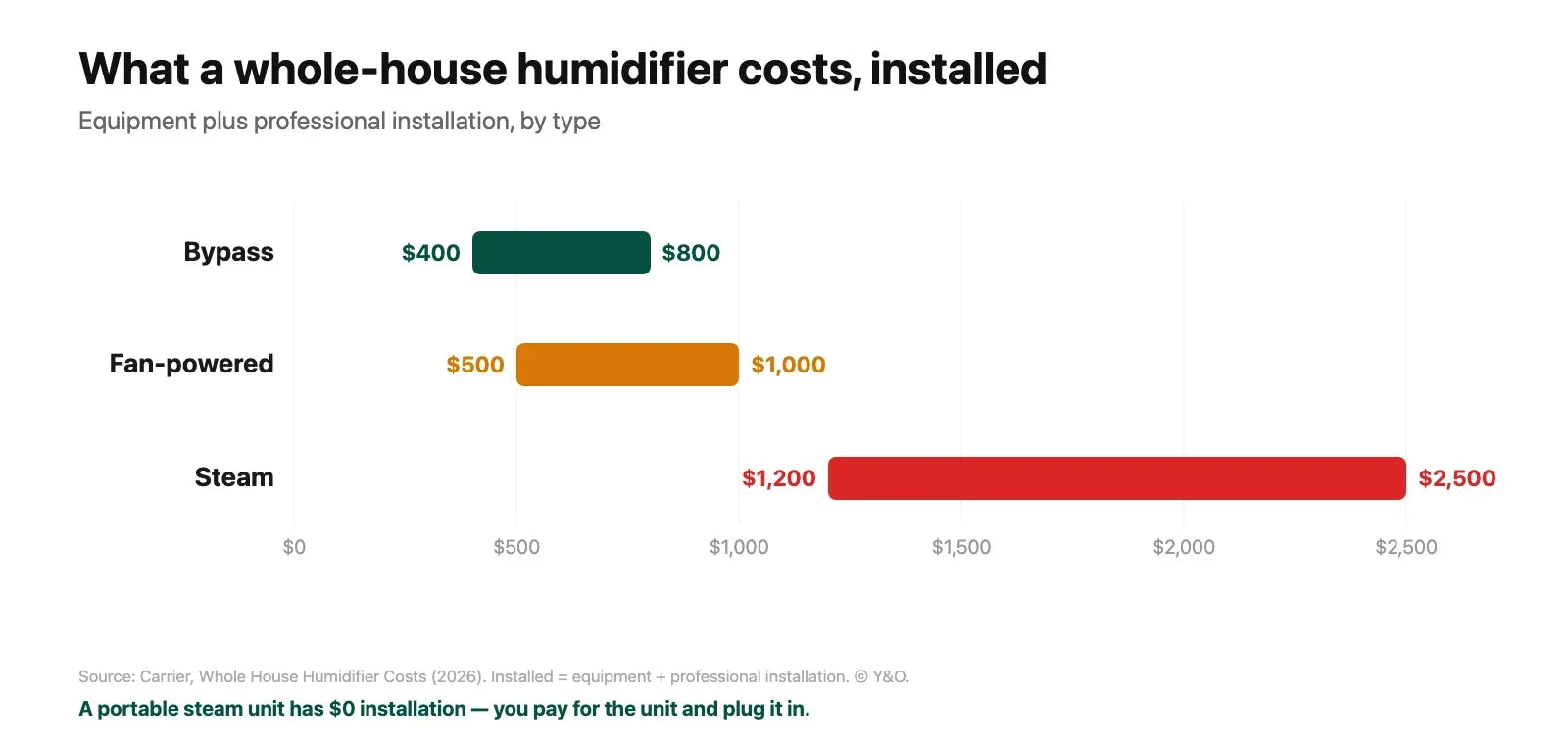

A whole-house humidifier isn’t a single price — it’s an appliance plus a plumbing-and-ductwork installation, and the type you pick swings the total by thousands. Installed, a whole-house humidifier runs roughly $400 to $2,500: bypass units are cheapest at $400–$800, fan-powered land at $500–$1,000, and steam units run $1,200–$2,500 — and that’s before the water, electricity, and yearly maintenance it quietly adds every heating season. Here’s the full breakdown — upfront and ongoing — plus how it compares to a portable steam unit that costs nothing to install.
The short answer
The number you actually pay depends almost entirely on which of the three types you install. Using Carrier’s 2026 cost figures, here’s the installed range — equipment plus professional installation:
| Type | Installed cost | What you get |
|---|---|---|
| Bypass (flow-through) | $400–$800 | Cheapest and simplest; lower output; only humidifies while the furnace runs |
| Fan-powered (flow-through) | $500–$1,000 | Built-in fan, more output, works without the furnace running |
| Steam (in-duct) | $1,200–$2,500 | Highest output and control; highest to buy and to run |
So the headline is a spread, not a single price: a basic bypass can be a few hundred dollars installed, while a steam system approaches the cost of a small HVAC repair. Bryant puts the typical all-in range a little tighter at $400–$1,200, which fits: most homes land in the bypass-to-fan-powered band, and only steam pushes toward the top. If you’re still deciding which type fits, our guide to how a furnace humidifier works and the three types lays out the trade-offs behind these prices.
What drives the price
Two homes can get the same unit and pay very different totals, because the equipment is only part of the bill. Installation labor is the swing factor — it can run $400 to $1,500 on its own (Bryant), and can account for up to half the total project cost (Carrier), since the installer has to cut into your ductwork, tap a water line, mount a humidistat, and sometimes run a drain.
The things that push you toward the high end are all about your house, not the humidifier: a furnace in a tight or awkward spot, no nearby water line, a steam unit’s heavier electrical needs, and regional labor rates. The single biggest lever is the type you choose — going from a bypass to a steam unit can more than triple the installed cost before labor differences even enter the picture. That’s why the “average” price is so wide: a $450 bypass and a $2,400 steam system are both “a whole-house humidifier.”
The ongoing costs nobody quotes
The install price is the part everyone sees. The running costs are the part that surprises people, and they come in three forms. The good news: electricity is cheap — bypass and fan-powered units cost just pennies a day to run because they lean on the furnace blower (Bryant). A steam unit uses meaningfully more, because it boils water.
The less obvious cost is water. The flow-through types deliberately rinse water over their pad to keep mineral scale from clogging it, and that rinse goes down the drain — often 3 to 14 gallons wasted for every gallon that actually reaches your air — the flow-through waste we detail in how a furnace humidifier works, and documented by the trade press (ACHR News). Over a season that adds up, and it’s invisible because it happens at the drain line. Then there’s upkeep: both Carrier and Bryant recommend replacing the water panel each heating season, so budget for an annual pad on top of the sticker price. None of these are huge on their own, but together they mean the sticker price isn’t the finish line — a whole-house unit costs a little every year you own it. The upkeep itself, and what happens when you skip it, is the subject of whether whole-house humidifiers grow mold.
Is it worth it?
For the right home, yes. If you want to bring an entire large house up to humidity at once, you’re staying put long enough to earn back the installation, and you don’t mind the seasonal upkeep, a whole-house system does something no plug-in can — it treats every room through the ducts. That’s a real benefit, and for a big, dry, single-family home it can be the right call.
But it’s a narrower group than the price guides imply. Most people don’t actually need every room humidified — they need the rooms they live and sleep in to stop being dry, which we make the case for in how many humidifiers you really need. If you’re only trying to fix a bedroom and a living room, spending $1,500 installed on a system that treats the whole house — including rooms you don’t use — is paying for coverage you won’t feel.
The portable comparison
We build a portable steam humidifier, so read this as disclosure — but the cost math is straightforward. A portable unit has a $0 installation line: you pay for the unit, plug it in, and pour in water — no ductwork, no water line, no drain, no annual pad, and no service call. It also can’t waste water down a drain, because there isn’t one. Against a $1,200–$2,500 installed steam system, a portable is a fraction of the upfront cost and carries almost none of the recurring bill.
The honest trade-offs are real, and they’re the flip side of that savings. A portable treats the rooms you put it in rather than the whole house, you refill it by hand, and boiling water uses more electricity than a cool-mist unit. In a hard-water area you’ll also want to descale it periodically, though a steam unit sidesteps the white-dust problem that plagues other technologies — the comparison we lay out in steam vs ultrasonic vs evaporative. If you want the two approaches weighed head to head, whole-house vs portable steam is the direct comparison.
Want whole-house output without the whole-house bill?
Our 10L steam humidifier delivers big output for a dry home — no installation, no ductwork, no drain waste, and no white dust. See whether it fits the rooms you actually use.
See the Y&O Steam Plus 10L
FAQ
How much does a whole-house humidifier cost installed?
Installed, a whole-house humidifier typically runs about $400 to $2,500, depending on the type. Using Carrier's 2026 figures, bypass units cost $400 to $800 installed, fan-powered units $500 to $1,000, and steam units $1,200 to $2,500. Installation labor alone can be $400 to $1,500, often close to half the total.
Which whole-house humidifier is cheapest?
A bypass humidifier is the cheapest, at roughly $400 to $800 installed. It has no fan and uses the furnace blower to move air through a wet pad, which keeps both the equipment and the running cost low, but it has the lowest output and only works while the furnace is heating.
How much does a whole-house humidifier cost to run?
Electricity is cheap for bypass and fan-powered units, often just pennies a day, because they rely on the furnace blower; a steam unit uses more because it boils water. The bigger ongoing costs are the water that flow-through units rinse down the drain, and replacing the water panel each heating season.
Are whole-house humidifiers worth the money?
They are worth it if you want to humidify an entire large home, plan to stay long enough to earn back the installation, and accept the seasonal upkeep. If you only need a bedroom and living room comfortable, a portable unit costs far less and treats the rooms you actually use, at the cost of covering rooms rather than the whole house.
Is a portable humidifier cheaper than a whole-house one?
Yes, both upfront and over time. A portable unit has no installation cost, no ductwork or plumbing, no drain waste, and no annual water panel or service call, so it costs a fraction of a $1,200 to $2,500 installed steam system. The trade-off is that it covers the rooms you place it in rather than the whole house and needs refilling by hand.
Keep reading
- How a furnace humidifier works + the 3 types
- Whole-house humidifier problems
- Do whole-house humidifiers cause mold?
- Whole-house vs portable steam
- How many humidifiers do you really need?
- Steam vs ultrasonic vs evaporative
Sources — 2026 cost figures from the HVAC makers. Verified live.