
Published May 25, 2026 · Last updated August 18, 2026
You have a large home. The humidity won't come up. Your instinct says: buy another humidifier.
It's a reasonable instinct. More output, more coverage. Two machines where one failed. Logical.
Except in most cases, it's the wrong answer. And buying a second humidifier doesn't just fail to solve the problem — it doubles your maintenance, doubles your energy bill, and creates coverage problems that a single well-chosen unit wouldn't have.
The question isn't how many humidifiers you need. The question is whether the one you have was ever capable of doing the job in the first place. Here's the framework that answers that — and the specific scenarios where a second unit actually makes sense.
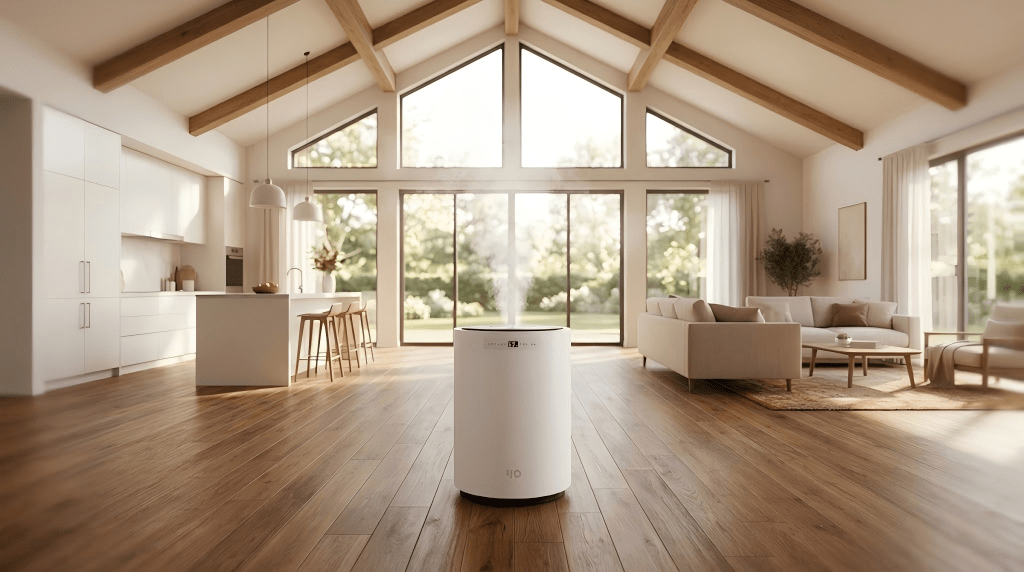
For most homes the answer is one, not two: a single high-output steam unit like the Y&O Steam Plus (model YO-M2, 1,200 ml/h) covers an open floor plan up to 1,000 sq ft (about 93 m²) on its own — more moisture per hour than two typical 400 ml/h units combined (800 ml/h). Size by output rate, not by unit count: budget roughly 300 ml/h of output for every 250 sq ft of open floor, then confirm the result with a hygrometer. Target 40–60% relative humidity (Arundel et al., 1986). You only need a second unit when the air volumes are genuinely separated — an upper floor behind a closed staircase, or a home above ~1,500 sq ft with closed-door zones. If a correctly sized, centrally placed unit still can't hold target humidity, the fix is placement or output — not another machine.
| Home type & layout | Floor area | How many humidifiers | Why |
|---|---|---|---|
| Studio / one-room apartment | Up to 500 sq ft | 1 unit (800–1,200 ml/h) | One mid-to-high-output unit is more than enough for a single enclosed room. |
| Open-plan apartment or condo | 500–900 sq ft | 1 high-output unit (1,200 ml/h) | One Y&O Steam Plus, placed centrally, covers this comfortably. |
| Townhouse / single open main floor | 900–1,000 sq ft | 1 high-output unit (1,200 ml/h) | At the upper edge of one Steam Plus (rated to 1,000 sq ft) — still one unit. |
| Two-storey home, closed staircase | 1,000–1,500 sq ft across floors | 2 units — one per floor | Humidity won't reliably cross a closed stair door; give each floor its own unit. |
| Large detached / multi-zone home | 1,500–2,500+ sq ft | 2+ units by zone (or HVAC) | Beyond ~1,200 sq ft of closed space, one unit can't reach every zone regardless of output. |
Unit counts assume a Y&O Steam Plus (YO-M2) rated at 1,200 ml/h and up to 1,000 sq ft of open floor. Our sizing rule of ~300 ml/h per 250 sq ft is derived from Y&O in-house testing and should be confirmed on-site with a hygrometer, since ceiling height, air changes and how well-sealed the space is all shift real coverage.
Why a Second Humidifier Usually Isn't the Answer
When humidity won't reach target in a large space, the instinct to add a second unit assumes the first unit is working correctly and just needs help. In most cases, that assumption is wrong.
The real issue is almost always one of three things: the original unit's output rate is insufficient for the space, its placement is blocking diffusion, or the heating system load wasn't accounted for. None of these problems are solved by adding a second undersized unit.
Fig. 1 — Two 400 ml/h units vs one 1,200 ml/h unit. The single high-output unit delivers 50% more moisture per hour, requires half the maintenance, and produces better coverage through 360° diffusion from a central position. The only scenario where two units win is when the space genuinely exceeds single-unit capacity.

Two small humidifiers also create a placement problem that's easy to underestimate. When two units run simultaneously in the same open space, their humidity zones overlap near each unit and leave dead zones at the far edges of the room. The sensors on each unit read the humidity in their immediate vicinity — which is higher than the room average — and cycle off prematurely. The result is uneven coverage and false readings.
The Decision Framework: One or Two?
The answer depends on four variables. Work through them in order.
Step 1 — What Is Your Space Actually?
Floor area alone doesn't tell the full story. You need to account for ceiling height, floor plan openness, and how many zones you actually need to humidify simultaneously.
| Home Type | Effective Coverage Need | Verdict |
|---|---|---|
|
Apartment / condo, open plan 600–900 sq ft, 8–10 ft ceilings |
800–1,000 ml/h | One high-output unit — comfortably sufficient |
|
Townhouse, main floor only 700–1,000 sq ft open plan |
1,000–1,200 ml/h | One unit at 1,200 ml/h — at the upper edge but manageable |
|
Two-storey home, main floor priority 1,000–1,500 sq ft total |
Main floor: 1,000–1,200 ml/h Upper floor: 400–600 ml/h |
One per floor — but upper floor may be optional if doors stay open |
|
Large detached home 1,500–2,500 sq ft |
1,200+ ml/h per zone | Two units — one per primary living zone |
|
Very large home / multi-zone 2,500+ sq ft |
Multiple zones | Consider HVAC integration — see: HVAC vs Portable Steam → |
Step 2 — Is Your Current Unit Actually Capable?
Before buying anything — a second unit or a replacement — check your current unit's output rate. This number is in the spec sheet, not always on the front of the box.
- Output rate under 500 ml/h — this unit was never designed for large rooms, adding a second one won't fix the core problem
- No built-in humidistat — the unit can't maintain target RH automatically, which means it either runs too long or shuts off too early
- Tank under 6L — constant refilling interrupts humidification; you're losing output continuity every few hours
- Ultrasonic type in a hard-water city — white dust problem is compounded by adding a second unit
If any of the above apply, the right move is replacing the unit — not supplementing it. A single 1,200 ml/h steam humidifier will outperform two 400 ml/h ultrasonic units in almost every large-room scenario. For the full breakdown of why output rate is the only number that matters: Your Humidifier Says It Covers 500 sq ft. Here's Why It Probably Doesn't →
Step 3 — Is Your Placement Correct?
A correctly placed high-output unit covers significantly more area than the same unit in a corner. Before concluding you need more units, verify placement.
- Unit is placed centrally in the open-plan space — not against a wall or in a corner
- At least 3 ft clearance from walls on all sides
- Interior doors between connected zones are open during operation
- Exterior doors and windows are closed — every air leak reduces effective coverage
- Unit is on the floor, not elevated — steam rises naturally and distributes upward
Step 4 — What Does the Math Say?
Use this quick calculation before buying anything:
Step 1: Measure your open-plan floor area in sq ft.
Step 2: Multiply by 1.5 (open floor plan adjustment).
Step 3: If ceiling height is above 9 ft, multiply again by 1.2.
Step 4: If you're in Calgary, Denver, Phoenix, or another very dry city, multiply by 1.1.
Result: This is your "effective coverage need" in sq ft. Match it to a unit with sufficient ml/h output.
Example: 600 sq ft open plan × 1.5 = 900 × 1.2 (10 ft ceilings) = 1,080 × 1.1 (Calgary) = 1,188 → one 1,200 ml/h unit is the answer, not two smaller units.
When Two Units Actually Make Sense
There are specific scenarios where two units genuinely outperform one. They're less common than most people assume — but they're real.
Fig. 2 — The two scenarios. Open floor plans up to ~1,000 sq ft are single-unit territory. Multi-level homes with closed doors between floors are the primary case for two units — one per floor, not two in the same space.

The Legitimate Two-Unit Scenarios
- Two separate floors with closed staircases — humidity from the main floor won't reliably reach upper bedrooms through a closed staircase door. One unit per floor is the right answer here.
- Home over 1,500 sq ft with multiple closed zones — once you're above ~1,200 sq ft of genuinely closed space, one unit can't physically cover it regardless of output rate. Zone-based approach is correct.
- Basement + main floor both needing coverage — humidity doesn't travel well against gravity. A basement unit and a main-floor unit serve genuinely separate air volumes.
- Primary bedroom isolated from main living space — if your master bedroom is at the far end of a long corridor with a closed door, a dedicated bedroom unit makes sense even if the main space is covered.
Running two units in the same open-plan space because one unit "isn't keeping up" is almost never the right answer. If a 1,200 ml/h unit isn't maintaining 50% RH in a 600–800 sq ft open floor plan, the problem is almost certainly placement (corner vs. center), heating system load (higher than expected), or a mechanical issue with the unit — not insufficient unit count. Fix the root cause before adding hardware.
The Real Cost Comparison: One vs Two
Most people don't think through the full cost of running two units over a heating season. Here's the complete picture for a 6-month winter in a typical U.S. or Canadian home:
| Cost Category | Two 400 ml/h Units | One 1,200 ml/h Steam Unit |
|---|---|---|
| Hardware purchase | $120–$200 (×2 = $240–$400) | $180–$280 (single unit) |
| Distilled water (if ultrasonic, hard water) | $180–$360/season (×2 units) | $0 — tap water works fine |
| Filter replacement | $40–$80/season (if evaporative) | $0 — no filters |
| Electricity | ~$20–$40/season (×2 low-wattage units) | ~$50–$75/season (higher wattage, cycles on/off) |
| Time cost (cleaning, refilling) | Double — two tanks, two descaling sessions | Single tank, single monthly descale |
| Total first-season cost (ultrasonic, hard water) | ~$500–$800 | ~$230–$355 |
The math consistently favors one high-output steam unit over two smaller units — often by a significant margin, especially in hard-water cities where the distilled water cost for two ultrasonic units adds up fast.
What Real Users Discovered

One Unit That Actually Does the Job.
The Y&O Steam Plus delivers 1,200 ml/h — enough for open floor plans up to 1,000 sq ft. One tank to fill. One unit to descale. No second machine required.
See the Y&O Steam Plus →Your Questions Answered
Is one humidifier enough for a 1,000 sq ft open floor plan?
Yes — with conditions. A single 1,200 ml/h steam unit placed centrally can maintain 40–50% RH in a 1,000 sq ft open floor plan during a North American heating season. The key variables are ceiling height (9 ft or below works well; above 10 ft adds meaningful volume), heating system load (Prairie cities like Calgary require more output than milder climates), and placement (center, not corner). If these conditions are met, one unit is the right answer — not two. For the full coverage calculation: Your Humidifier Says It Covers 500 sq ft. Here's Why It Probably Doesn't →
Do I need a humidifier on every floor of my house?
Not necessarily. Humidity rises — so a main-floor unit will provide partial benefit to upper floors through open staircases. Whether the upper floor benefit is sufficient depends on how open the staircase is and how far bedrooms are from it. A practical test: run your main-floor unit for a week and measure bedroom RH with a separate hygrometer. If bedrooms are staying at 40%+ consistently, you don't need a second unit. If they're consistently below 35%, a dedicated bedroom or upper-floor unit is warranted. For most two-storey homes in moderate climates, one main-floor unit is sufficient unless bedrooms are isolated by closed doors at the top of the stairs.
My humidifier runs all night and humidity still won't reach 50%. Do I need a second one?
Almost certainly not. If a humidifier runs continuously and can't reach target humidity, the most likely causes are: insufficient output rate for the space (under 800 ml/h for large open plans), incorrect placement (corner instead of center), heating system removing moisture faster than the unit adds it, or the unit being physically unable to reach the target (e.g., a 300 ml/h unit in a 600 sq ft heated space). A second unit of the same type won't fix any of these. The right answer is usually upgrading to a higher-output unit and repositioning it centrally. For diagnosis: Best Humidifier for Large Rooms →
Is it better to run two smaller humidifiers or one large one?
One large unit almost always wins for open floor plans — for three reasons. First, total output: one 1,200 ml/h unit delivers 50% more moisture than two 400 ml/h units, at lower or comparable total cost. Second, coverage quality: a single central unit diffuses humidity evenly in all directions; two units create overlap zones near each unit and dead zones at the edges. Third, maintenance: two units mean double the cleaning, refilling, and descaling. The exception is genuinely separated spaces (different floors, closed-door zones) where one unit physically can't reach both areas — in that case, one per zone is correct. For the full cost comparison: see the table above in this article.
How do I know if my home is too big for one humidifier?
Use this quick test: run a single 1,200 ml/h unit centrally placed for 5–7 days and measure RH with a separate hygrometer (not the unit's built-in sensor) at the farthest point from the unit. If that far corner is consistently reaching 40%+ RH, you're within single-unit territory. If it's consistently below 35% despite correct placement and heating season adjustments, your space likely exceeds 1,000 sq ft effective coverage and a second unit is genuinely warranted. For homes over 1,500 sq ft with multiple closed zones, two units or HVAC integration is the appropriate solution. For the HVAC comparison: Whole-House Humidifier: HVAC vs Portable Steam →
How many humidifiers do I need for a 2,000 sq ft house?
Plan on two units for a 2,000 sq ft house — one per primary zone — rather than one oversized machine. A single Y&O Steam Plus is rated at 1,200 ml/h and up to about 1,000 sq ft of open floor, so 2,000 sq ft, especially spread across two levels or behind closed doors, is more than one unit can physically hold. Put one high-output unit in the main open living and kitchen area, and a second on the upper floor or in an isolated primary bedroom. Size each by output — roughly 300 ml/h per 250 sq ft of open floor — and confirm with a hygrometer at the farthest corner. Only a genuinely open, single-level 2,000 sq ft space could stretch to one unit covering the core zone while the perimeter runs drier.
Related Reading
Disclosure: We sell steam humidifiers, including the Y&O Steam Plus. Where we have a preference between one unit and two, we say so — including when a second unit is genuinely worth buying.
Sources & References
- AHAM — Humidifier Testing Standards
- ASHRAE Standard 55 — Thermal Environmental Conditions for Human Occupancy
- U.S. Environmental Protection Agency — Use and Care of Home Humidifiers
- Reddit Community Discussions — r/BuyItForLife · r/Humidifiers
- Y&O — YO-M2 Steam Plus Product Page