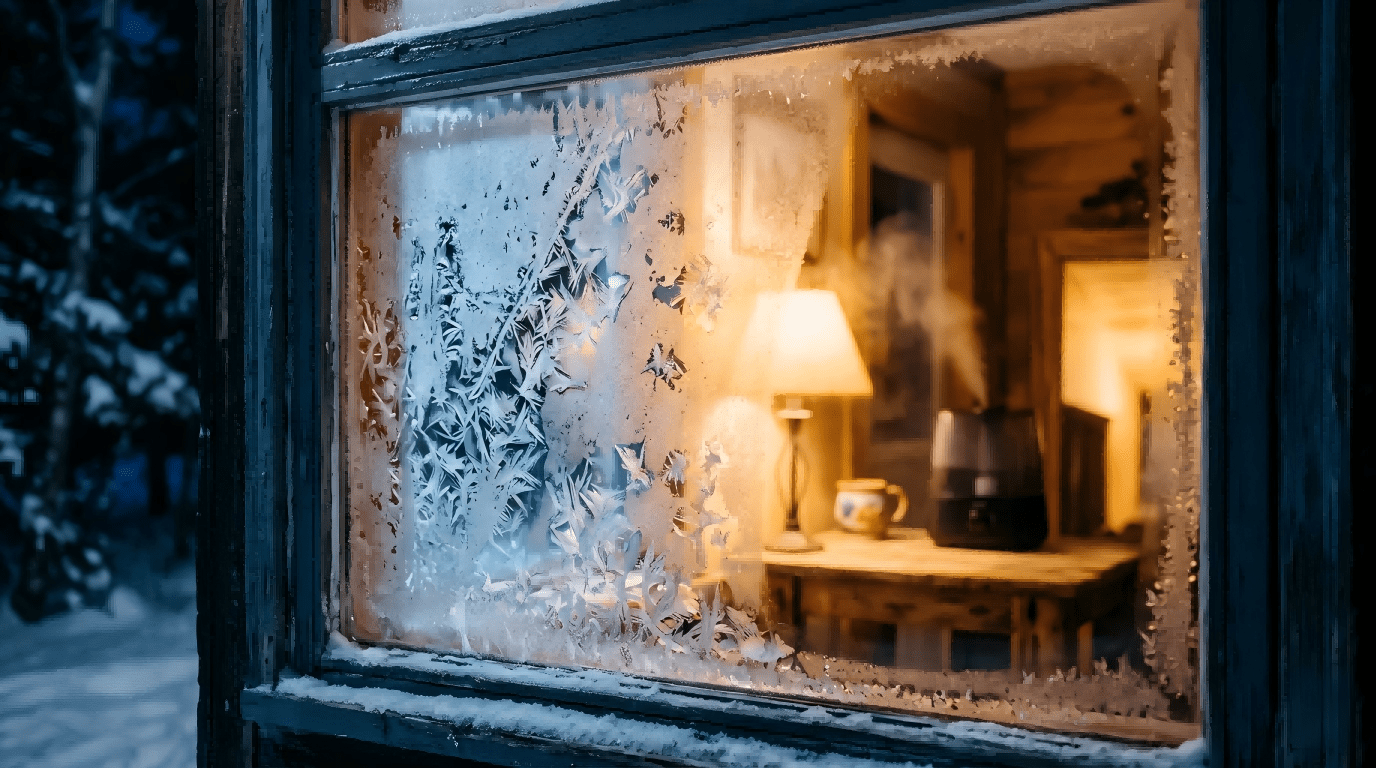

You set the humidifier. You fill the tank. You wake up and the hygrometer still reads 22%.
The unit ran all night. The tank is half empty. But the humidity barely moved.
This isn't a defective humidifier. It's a physics problem — and it's specific to North American winter conditions that most humidifier manufacturers design around in a lab, not in a real home in January.
North American winters create some of the most demanding indoor humidification conditions on the planet. Between extreme cold outdoor air, long heating seasons, high-altitude dry climates, and hard water, most humidifiers are fighting a battle they were never sized to win. Here's why — and what output you actually need to keep up.
Why North American Winters Are Uniquely Brutal for Indoor Humidity
The problem starts outside. Cold air physically holds less moisture than warm air. When outdoor temperatures drop to 14°F (-10°C) — common across the U.S. Midwest and Canadian Prairies from November through March — the outdoor air is nearly devoid of moisture.
That dry outdoor air gets pulled into your home through gaps, ventilation, and door openings. Your heating system warms it to 70°F — but warming it doesn't add moisture. It just makes the same tiny amount of water vapor fill a larger volume of air, dropping relative humidity dramatically.
Fig. 1 — North American humidifier demand by climate zone. The Canadian Prairies and U.S. Upper Midwest require the highest output — combining extreme cold temperatures, long heating seasons, and high water hardness. The Pacific Coast requires the least, with milder temperatures and shorter heating seasons.

The Four Factors That Make North American Winters Uniquely Demanding
Factor 1 — Extreme Cold Outdoor Air
The colder the outdoor air, the less moisture it holds. At 32°F (0°C), air can hold about 5g of water per kilogram. At 14°F (-10°C), it holds less than 2g. At -4°F (-20°C) — a typical Prairie winter night — it holds under 1g.
Every time that ultra-dry air enters your home and gets heated to 70°F, your indoor humidity drops. The more extreme the outdoor cold, the faster your humidity falls — and the harder your humidifier has to work just to maintain a baseline.
Factor 2 — Long Heating Seasons
North American heating seasons vary dramatically by region — and that variation directly affects total humidification demand:
| Region | Typical Heating Season | Months of High Demand | Output Needed |
|---|---|---|---|
|
Canadian Prairies Calgary, Edmonton, Saskatoon |
Sept – April | 7–8 months | 1,100–1,200 ml/h |
|
U.S. Upper Midwest Minneapolis, Chicago, Detroit |
Oct – April | 6–7 months | 1,000–1,200 ml/h |
|
U.S. Southwest / Rockies Denver, Phoenix, Las Vegas |
Oct – March | 5–6 months | 1,000–1,200 ml/h* |
|
Ontario / Quebec Toronto, Ottawa, Montreal |
Nov – March | 4–5 months | 800–1,000 ml/h |
|
U.S. Northeast Boston, New York, Philadelphia |
Nov – March | 4–5 months | 700–900 ml/h |
|
Pacific Coast Vancouver, Seattle, Portland |
Dec – Feb | 2–3 months | 500–700 ml/h |
*Southwest demand is shorter in duration but extreme in intensity — very dry baseline humidity plus hard water makes the peak heating months very demanding despite the shorter season.

Factor 3 — Hard Water Doubles the Problem
Most of the highest-demand regions for humidification are also hard-water regions. This creates a compounding problem for ultrasonic humidifier users: the drier the climate, the more you need to run your humidifier — and the more mineral aerosol gets dispersed into your already-stressed indoor air.
In Phoenix, Las Vegas, Calgary, and Denver — all extreme-demand humidification cities — tap water hardness regularly exceeds 300–500 mg/L. Running an ultrasonic humidifier continuously in these cities during peak heating season creates measurable indoor PM increases from mineral dispersal, on top of the dry air problem you were trying to solve.
For a detailed breakdown of white dust risk by region: Hard-Water Humidifier Disaster: White Dust & Your Lungs →
Factor 4 — High Altitude Adds Another Dimension
Denver sits at 5,280 ft. Calgary at 3,438 ft. Salt Lake City at 4,226 ft. At altitude, air pressure is lower — and lower pressure means air holds less moisture at the same temperature. High-altitude cities face a compounding humidity challenge: already-dry cold air arrives at lower pressure, gets heated, and produces even lower relative humidity than the same process would at sea level.
This is why residents of Denver and Calgary frequently report that humidifiers "can't keep up" even when sized correctly by standard calculations. Standard sizing doesn't account for altitude effects on moisture capacity.
If you live above 3,000 ft elevation, add 15–20% to your calculated output requirement. A 600 sq ft open floor plan in Denver needs approximately 1,100–1,200 ml/h — not the 800–900 ml/h a standard sizing calculator would suggest. The altitude effect is real and consistent, and is a primary reason high-altitude Prairie and Rockies residents report chronic humidity problems despite running high-capacity units.
Why Most Humidifiers Are Designed for Average Conditions
Humidifier output ratings are tested under AHAM standard conditions — a sealed room at controlled temperature and starting humidity. These conditions don't include a heating system running continuously, outdoor air at -4°F being drawn in every time a door opens, or hard water producing mineral buildup on the heating element.
A unit rated for 600 sq ft under AHAM conditions may effectively cover 300–400 sq ft in a Calgary living room in January. The gap isn't a flaw in the product — it's a flaw in assuming lab conditions translate to real winter performance.
For a detailed explanation of why rated coverage numbers consistently mislead buyers: Your Humidifier Says It Covers 500 sq ft. Here's Why It Probably Doesn't →
The Output Rate You Actually Need by Climate Zone
Use this as your baseline. These numbers assume a 600 sq ft open floor plan with 9 ft ceilings and an active forced-air heating system:
Fig. 2 — Required humidifier output (ml/h) by North American climate zone for a 600 sq ft open floor plan with active heating. The Y&O Steam Plus at 1,200 ml/h meets the demand of every zone, including the most extreme Prairie and Upper Midwest conditions.
What Actually Works: Matching Technology to Climate
In moderate climates with soft water and short heating seasons — Pacific Northwest, coastal BC — almost any reasonably-sized humidifier can keep up. The physics aren't particularly demanding.
In extreme-demand zones — Canadian Prairies, U.S. Upper Midwest, high-altitude Southwest — the combination of extreme cold, long heating seasons, hard water, and sometimes altitude creates conditions that eliminate most options:
- Ultrasonic humidifiers in hard-water regions — mineral aerosol compounds the air quality problem you're trying to solve
- Any unit under 800 ml/h for open floor plans — will run continuously without reaching target RH against active heating
- Units without a humidistat — can't maintain a target; either over-humidifies or under-delivers
- Small tank units (under 6L) — require constant refilling, interrupting humidification continuity
- Steam humidifier at 1,000–1,200 ml/h — handles hard water without mineral dispersal, maintains output without filter degradation
- 10L dual-tank design — runs overnight and through the day without refill interruptions in peak heating conditions
- Built-in humidistat — cycles to maintain target RH rather than running at full output continuously
- Central placement in open floor plan — allows full 360° diffusion rather than concentrating output in one zone
- Separate hygrometer to verify actual room RH — built-in sensors often read 5–10% higher than actual
For a complete technology comparison across all three humidifier types: Steam vs Ultrasonic vs Evaporative: Which Is Actually Worth It? →
The Hard Water + Dry Climate Combination
The worst-case scenario for humidifier performance is the combination of extreme dry air demand and hard water. This describes Phoenix, Las Vegas, Denver, Calgary, and Edmonton — cities where residents need maximum humidifier output AND where the most common humidifier type (ultrasonic) creates the worst air quality outcomes.
Steam technology resolves both problems simultaneously: the boiling mechanism eliminates mineral dispersal regardless of water hardness, while the 1,200 ml/h output handles the high-demand conditions of extreme cold and long heating seasons. It's the reason steam humidifiers have seen disproportionate adoption in Prairie Canada and the U.S. Southwest compared to milder regions.

Built for North American Winters. All of Them.
The Y&O Steam Plus delivers 1,200 ml/h with no filters, no white dust, and no distilled water requirement — designed for the hardest humidification conditions in North America, from Prairie winters to Southwest dry seasons.
See the Y&O Steam Plus →Your Questions Answered
Why is my humidifier struggling more this winter than last year?
Three most likely causes: First, limescale buildup on the heating element or ultrasonic disc reduces output efficiency over time — a unit that delivered full output when new may now be producing 70–80% of its rated output after a season of hard-water use. Descaling restores performance. Second, weather conditions vary year to year — a colder than average winter with longer periods of extreme cold creates higher humidification demand than a mild winter. Third, if you've changed anything about your living space (new furniture arrangement blocking diffusion, a door now left open to an adjacent room), effective coverage may have decreased. For cleaning guidance: How to Clean a Humidifier: Descale & Sanitize →
How much more output do I need in Calgary vs Toronto?
Roughly 25–40% more. Toronto's heating season runs approximately 4–5 months with average January lows around 14°F (-10°C). Calgary's runs 7–8 months with average January lows around -4°F (-20°C) and significantly harder water. For the same 600 sq ft open floor plan, Toronto requires approximately 800–900 ml/h while Calgary requires 1,100–1,200 ml/h. Calgary also has the altitude factor (3,438 ft vs Toronto's 249 ft) which adds additional demand. If you're moving from a milder Canadian city to the Prairies, plan to size up significantly — what worked in Toronto will consistently underperform in Calgary.
Does altitude really affect how much humidifier output I need?
Yes — measurably. At higher altitude, air pressure is lower, which means air holds less moisture at the same temperature. A home at 5,000 ft elevation (Denver, Colorado Springs) experiences approximately 15–20% lower air moisture capacity than a home at sea level at the same temperature and relative humidity. This means your humidifier is working against lower-capacity air, and standard sea-level sizing calculations will consistently underestimate what you need. If you're above 3,000 ft, add 15% to your calculated output requirement. If you're above 5,000 ft, add 20%. This adjustment is in addition to the standard open-floor-plan multiplier.
Should I run my humidifier differently in extreme cold vs mild winter days?
Yes — and a humidistat handles this automatically. On extreme cold days (outdoor temps below 14°F/-10°C), your humidifier will need to run longer cycles to maintain target RH because dry outdoor air infiltration is higher. On milder days (above freezing), the same unit may reach target RH relatively quickly and cycle off. A built-in humidistat adjusts automatically — set your target at 45–50% and let it respond to conditions. If you're using a unit without a humidistat, be aware that you may need to manually run it more aggressively during cold snaps. For the full humidity target guide: The 40–60% Humidity Rule →
Is there a point where one humidifier just isn't enough — no matter the output?
Yes — in very large homes over 1,500 sq ft with multiple closed zones, or in multi-level homes where floors are separated by closed staircases. A single 1,200 ml/h unit handles open floor plans up to approximately 1,000 sq ft even in extreme Prairie conditions. Beyond that, zone-based placement (one unit per primary living zone) becomes necessary — not because of climate, but because of physical distance and closed doors preventing diffusion. For the full decision framework: How Many Humidifiers Do You Actually Need? →
Related Reading
Sources & References
- ASHRAE Standard 55 — Thermal Environmental Conditions for Human Occupancy
- AHAM — Humidifier Testing Standards
- U.S. Geological Survey — Hardness of Water — Regional Data
- U.S. Environmental Protection Agency — Use and Care of Home Humidifiers
- Environment and Climate Change Canada — Canadian Climate Normals
- NOAA — U.S. Climate Data
- Reddit Community Discussions — r/Calgary · r/Denver · r/Humidifiers
- Y&O — YO-M2 Steam Plus Product Page