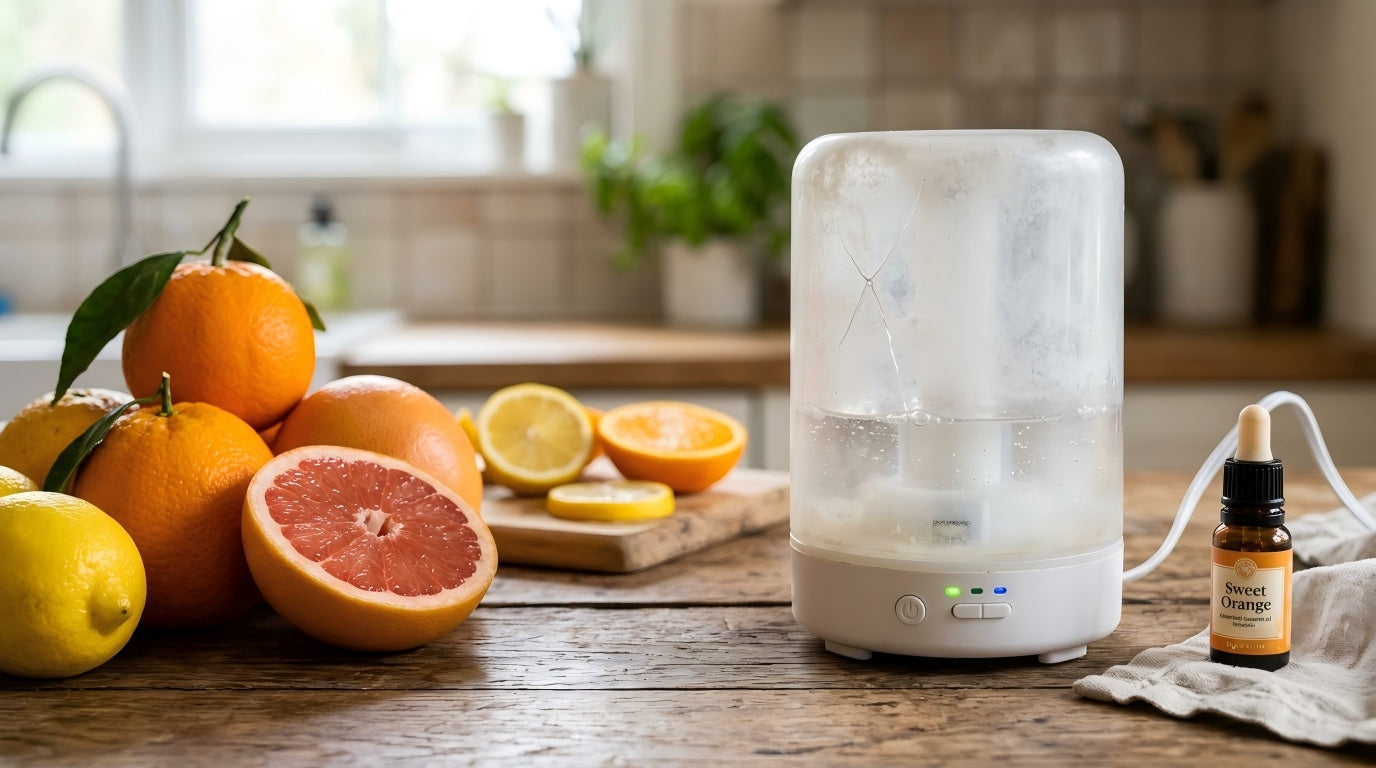

You bought a bottle of sweet orange oil last month. The diffuser worked perfectly the first week.
Now the tank looks cloudy. The mist output feels weaker. There's a sticky ring where the water sits, and one of the plastic clips has a hairline crack you don't remember seeing.
You didn't do anything wrong. The damage is chemistry.
Citrus essential oils contain 60–97% d-limonene — the same compound the industrial cleaning industry uses as a solvent to dissolve grease, paint, and adhesives from plastic surfaces. On a plastic diffuser tank, that compound is doing exactly what it's designed to do.
What d-Limonene Actually Is (And Why It Attacks Plastic)
D-limonene is a natural terpene concentrated in the peel of citrus fruits. It's what gives orange, lemon, and grapefruit oils their bright, clean scent.
It's also one of the most widely used bio-based industrial solvents on the market. It replaces petroleum-based degreasers because it's effective at dissolving oils, resins, and — critically — certain plastics.
The mechanism is simple. Terpenes are lipophilic (they bond with oil-based molecules), and most consumer plastics are made from long chains of hydrocarbons. When d-limonene contacts the surface, it slips between those polymer chains and softens the material.
Given enough time, it does more than soften. It dissolves.
Why "food-safe" plastic isn't the same as "solvent-safe" plastic. Polypropylene (PP) and polyethylene (PE) can safely contain orange juice — the pulp and juice have low d-limonene concentration in a water-based matrix. Pure essential oil is 60–97% d-limonene by volume. That's a 100–200× concentration difference. Consumer plastic ratings don't cover this exposure.
The Specific Plastics That Fail Fastest
Not all plastics degrade at the same rate. Common diffuser materials, ranked from most to least vulnerable:
| Material | Where It's Used in Diffusers | Vulnerability to Citrus Oils |
|---|---|---|
| Polystyrene (PS) | Cheap unit housings, decorative shells | Severe — visible damage in weeks |
| ABS | Structural housings, buttons | High — clouding, cracking |
| Polycarbonate (PC) | Clear tanks marketed as "premium plastic" | High — crazing, stress cracks |
| Polypropylene (PP) | Water tanks, seals | Moderate — swelling, softening over months |
| PETG | Some clear water reservoirs | Moderate to high — depends on additives |
| Silicone | Gaskets, O-rings | Low — but swells and loses seal integrity |
| Borosilicate glass | Premium tanks | None — chemically inert to terpenes |
The uncomfortable part: most manufacturers don't disclose which polymer they use. A "premium plastic tank" label tells you nothing about how it will respond to a citrus oil.
The Warning Signs on Your Diffuser Right Now
Damage from d-limonene doesn't happen overnight. It accumulates. If you've been using citrus oils regularly, check for these signs:
- Cloudy or hazy tank walls that don't clean off with vinegar or dish soap. This is surface-level polymer degradation, not residue.
- A sticky, oily film around the waterline that returns within hours of cleaning. The plastic is leaching softened polymer back into the water.
- Fine crazing (a network of tiny surface cracks) around threaded joints and stress points where the tank meets fittings.
- Yellowing or brown discoloration, particularly in tanks that were originally clear.
- Weaker mist output even after cleaning. Softened polymer can partially block ultrasonic membranes.
- A change in scent quality — a plastic or "off" note mixed into what should be pure citrus. That's dissolved plastic aerosolizing with the mist.
Timeline most users report: visible clouding in 2–4 months of daily citrus use. Structural cracks in 6–12 months. The unit typically stops working entirely between months 10 and 18.
Which Essential Oils Are the Worst Offenders (Ranked)
The damage is proportional to d-limonene content. Here's what independent gas chromatography analyses of common oils have found:
| Essential Oil | Typical d-Limonene Content | Risk Level |
|---|---|---|
| Sweet Orange | 85–97% | Highest |
| Grapefruit | 85–95% | Highest |
| Lime (distilled) | 50–75% | High |
| Lemon | 60–70% | High |
| Bergamot | 30–45% | Moderate |
| Mandarin | 65–75% | High |
| Tea Tree | 1–3% (different terpene profile — high terpinen-4-ol) | Moderate (different mechanism) |
| Pine / Fir | 5–15% (dominant terpene: α-pinene) | Moderate |
| Peppermint | 1–5% (menthol dominant) | Low |
| Lavender | <1% (linalool, linalyl acetate dominant) | Very low |
Sweet orange and grapefruit are effectively 90%+ solvent. Any plastic they contact for extended periods will show damage.
Even oils people assume are "gentle" — pine, eucalyptus, tea tree — contain terpenes that attack plastic through the same lipophilic mechanism, just more slowly.
Why "BPA-Free" Marketing Doesn't Solve This
The BPA-free label addresses one specific concern: bisphenol-A leaching into food or drinking water at low temperatures.
It says nothing about solvent resistance. A BPA-free polypropylene tank will still degrade under d-limonene exposure. The chemistry is unrelated.
The compounding risk. When d-limonene breaks down plastic, it doesn't just weaken the structure. Softened polymer fragments — including plasticizers, stabilizers, and any pigment additives — can migrate into the water. On an ultrasonic diffuser, those fragments then aerosolize into the mist you inhale. This is separate from the microplastic exposure most consumers already worry about — citrus oils accelerate what plastic tanks are doing anyway.
The Deeper Problem: You Can't Fix It by Cleaning
Once d-limonene has begun to swell or dissolve the polymer, no cleaning routine reverses it. Vinegar removes calcium buildup. Dish soap removes surface oil. Neither restores a damaged polymer chain.
Rinsing the tank immediately after every use slows the damage. It doesn't stop it.
The Material That's Actually Immune: Borosilicate Glass
Glass is chemically inert to terpenes. There's no polymer chain for d-limonene to disrupt. There's no additive to leach. There's no surface for softening.
That's why laboratory storage for essential oils is glass by default. That's why the fragrance industry stores concentrated citrus stock in glass. And it's why a glass diffuser tank is the only tank material that ends the citrus-oil-damage question permanently.
Borosilicate glass specifically — the same material used in laboratory beakers and Pyrex — adds two things over standard soda-lime glass: higher thermal shock resistance (relevant for steam diffusers) and lower alkali content, which further reduces any theoretical surface interaction.
The Y&O Yo-A1 uses a 1,600ml borosilicate glass water tank paired with a separate ceramic oil tray. The essential oil never touches plastic. The water reservoir never touches plastic. The steam that carries the fragrance is at 122°F output — warm enough to volatilize the aromatic compounds, gentle enough not to burn off delicate top notes.
For citrus oil users specifically, the change is immediate: no clouding, no residue, no cracked tanks after six months.
What About the Rest of the Unit?
Fair question. On the Yo-A1, the two components in direct contact with essential oil are borosilicate glass and food-grade ceramic. The wood-grain base houses the heating element and controls — the oil never reaches it.
Silicone gaskets are used at seal points. Silicone swells slightly under prolonged citrus exposure but doesn't dissolve or leach — and gaskets on this unit are field-replaceable.
What Real Users Report After the Switch
End the Cycle of Replacing Diffusers
The Y&O Yo-A1 uses a borosilicate glass tank and separate ceramic oil dish. Immune to citrus, safe with every essential oil in your collection.
Shop the Yo-A1 Glass Diffuser →
Not Sure If a Glass Diffuser Is Worth It?
We ran the numbers on cost per year, air quality impact, and long-term durability against ultrasonic plastic units.
Read the honest breakdown →FAQ
Can I still use citrus oils if I rinse the tank immediately after every use?
Rinsing slows the damage. It doesn't stop it. Even brief contact allows d-limonene to begin softening the polymer surface. If you regularly use sweet orange, grapefruit, or lemon oil, plastic-tank damage is a matter of when, not if.
Are silicone or metal parts safe with citrus oils?
Metal (stainless steel, ceramic) is fully inert. Silicone is largely resistant but can swell under prolonged citrus exposure, which affects gasket seal integrity over time. Neither dissolves or leaches into the mist the way plastic does.
Does the type of plastic really matter that much?
Yes. Polystyrene fails within weeks. Polypropylene lasts longer but still degrades. Most manufacturers don't disclose which polymer they use — and "BPA-free" tells you nothing about solvent resistance. Assume the worst unless the manufacturer specifies the exact material.
My diffuser is already showing cloudy walls. Is it dangerous to keep using?
The health concern isn't acute. It's cumulative — dissolved polymer, plasticizers, and additives migrating into the mist you inhale over months of daily use. The unit is also probably not far from mechanical failure. Both concerns point to replacing it with a glass or ceramic tank.
Will vinegar clean the citrus oil residue out of my plastic diffuser?
Vinegar removes mineral scale, not softened polymer. If the sticky film returns within hours of cleaning, that's the tank leaching, not oil residue. Cleaning can't fix material-level damage.
Does a steam diffuser break down citrus essential oils with heat?
At 122°F output temperature, the vast majority of citrus aromatic compounds — including limonene, citral, and linalool — volatilize intact. The dominant citrus scent notes are preserved. A small subset of very delicate specialty oils (some rose absolutes, certain jasmine) can be slightly altered at that temperature, but standard citrus oils are unaffected.
Is Y&O actually immune, or is this just marketing?
The material choice is verifiable. Borosilicate glass and ceramic are chemically inert to terpenes — that's basic material science, not a claim. The Yo-A1 water tank is borosilicate; the oil dish is ceramic. Independent reviewers (linked above) have run citrus blends through the unit and reported no degradation.
Disclaimer: This article is for educational purposes and does not constitute medical advice. Individual reactions to essential oils vary. If you experience respiratory irritation, headaches, or allergic symptoms while diffusing any essential oil, discontinue use and consult a healthcare provider. Keep essential oils out of reach of children and pets.
References & Sources
- U.S. EPA — Indoor Air Quality (IAQ): epa.gov/indoor-air-quality-iaq
- WHO — Microplastics in Drinking Water: who.int
- Y&O Yo-A1 Product Specifications: yoairpro.com
- Community discussion — r/essentialoils on citrus oils and diffuser damage
- Independent video reviews — Antonio Sanson, CopperCarver, NReluctant (2025–2026)